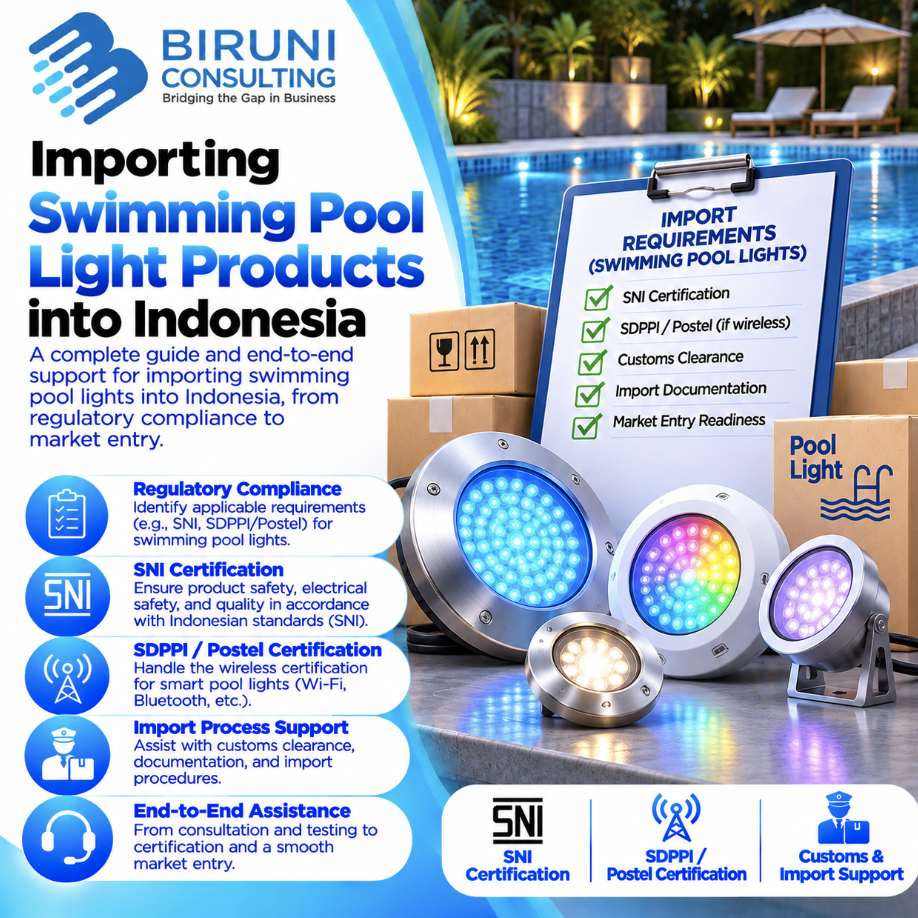
Guide to Import Requirements, SNI, NPB, HS Code, IP Rating, Testing, and Swimming Pool Light Certification
Importing swimming pool light products into Indonesia requires more specific assessment than ordinary indoor luminaires because the products may operate underwater, remain in direct contact with water, be installed within swimming-pool walls, or be used around pools and fountains. Commercial descriptions such as swimming pool light, underwater pool light, fountain light, pond light, niche pool light, surface-mounted pool light, RGB pool light, and underwater spotlight do not necessarily have identical technical classifications or certification routes.
Minister of Energy and Mineral Resources Regulation No. 7 of 2021 makes several luminaire categories subject to mandatory SNI requirements, including general-purpose fixed luminaires, recessed luminaires, road-lighting luminaires, general-purpose portable luminaires, and floodlights. The regulation does not identify “swimming pool luminaire” as a separate mandatory product category within that list. Pool lights should therefore not automatically be considered floodlights or ordinary recessed luminaires solely from their physical appearance. Construction, function, mounting, HS Code, and intended use need to be assessed first.
Internationally, the relevant particular standard is IEC 60598-2-18:2022 – Luminaires – Part 2-18: Particular requirements – Luminaires for swimming pools and similar applications. IEC states that the standard applies to fixed luminaires intended for use in water or in contact with water, including swimming pools, fountains, paddling pools, and garden pools.
Indonesia also has SNI 0225-7-702:2020 – PUIL 2020 Part 7-702: Requirements for special installations or locations – Swimming pools and fountains, which BSN currently lists as active. This is an electrical-installation standard for swimming pools and fountains, rather than automatically being the product-certification standard for every swimming pool light. The distinction between product standards and installation standards is important.
Importers should therefore complete product assessment and standard mapping before mass production and shipment to establish product construction, mounting method, voltage, power supply, IP rating, luminaire classification, HS Code, possible mandatory SNI requirements, NPB, and required technical evidence.
What Is a Swimming Pool Light?
A swimming pool light is a luminaire designed to illuminate swimming pools, decorative pools, fountains, ponds, spas, reflecting pools, or other water-related environments.
Products may be installed underwater, on pool walls, on pool floors, within dedicated niches, on surfaces, or around water features.
Common imported types include:
- Underwater swimming-pool lights.
- Surface-mounted and niche-mounted pool lights.
- Recessed underwater lights and fountain lights.
- RGB, RGBW, and color-changing pool lights.
- Low-voltage 12 V/24 V pool lights using transformers or external power supplies.
These products need to be distinguished from garden spotlights or outdoor floodlights that merely illuminate a pool but are not designed for direct water contact or submerged installation.
Are Imported Pool Lights Subject to Mandatory SNI?
Mandatory status should not be determined solely from the commercial description “pool light”.
Minister of Energy and Mineral Resources Regulation No. 7 of 2021 identifies several mandatory luminaire groups: general-purpose fixed luminaires, recessed luminaires, road-lighting luminaires, general-purpose portable luminaires, and floodlights. It does not separately list a product group called “swimming pool luminaire”.
Companies therefore need to determine whether the actual product falls within one of those defined mandatory groups or is a special-purpose luminaire requiring different assessment.
For example, an underwater spotlight should not automatically be treated as a floodlight under SNI IEC 60598-2-5 merely because it produces a directional beam. Similarly, a niche-mounted pool light should not automatically be equated with an ordinary recessed luminaire under SNI IEC 60598-2-2 merely because its enclosure is installed within a wall.
Intended use in or in contact with water is a critical technical characteristic.
IEC 60598-2-18 for Swimming Pool Lights
The international standard specifically addressing these products is IEC 60598-2-18:2022.
IEC states that it applies to fixed luminaires designed for use in water or in contact with water, including swimming pools, fountains, paddling pools, and garden pools. The 2022 publication is the third edition and was updated to accommodate modern light sources including LEDs.
Where a manufacturer already has a CB Test Report or IEC test report based on IEC 60598-2-18, it can be highly relevant during Indonesian technical assessment.
However, the existence of IEC 60598-2-18 does not by itself mean that a product has an Indonesian SNI 60598-2-18 certificate or automatically satisfies mandatory Indonesian SNI requirements.
Indonesian regulatory mapping still needs to be carried out separately.
SNI IEC 60598-1 and Pool Lights
SNI IEC 60598-1 provides general luminaire safety requirements and forms the basis for various particular luminaire standards.
Minister of Energy and Mineral Resources Regulation No. 7 of 2021 lists SNI IEC 60598-1:2016 together with particular standards for the luminaire groups made mandatory. The regulation also includes relevant luminaires supplied through DC drivers, chargers, adapters, DC plugs, or similar power-conversion devices within its defined luminaire scope, subject to applicable exclusions.
For underwater pool lights, however, the general luminaire standard alone does not address every special application condition.
A luminaire operating underwater has substantially different conditions from a ceiling light, wall light, or ordinary outdoor luminaire.
Manufacturers should therefore provide existing test evidence covering the appropriate pool-luminaire particular standard where available.
SNI 0225-7-702:2020 for Swimming Pool Installations
Indonesia has SNI 0225-7-702:2020 – PUIL 2020 Part 7-702, specifically addressing electrical installations and locations involving swimming pools and fountains. BSN currently lists it as active.
This standard is particularly important because electrical installations around pools involve increased electric-shock risk due to water and direct human contact with the environment.
However, SNI 0225-7-702:2020 is an installation standard, not a substitute for a luminaire product-safety standard.
Pool-light compliance therefore has two separate aspects:
- conformity of the luminaire or product itself; and
- conformity of the electrical installation and protective measures at the pool location.
A suitable product can still create a safety risk when installed within an unsuitable electrical system.
12 V Pool Lights
Pool lights frequently use 12 V supplies because low-voltage systems are common in installations located in or near water.
The marking “12 V”, however, should not be treated as proof that a product is automatically safe or exempt from regulatory assessment.
Companies need to determine whether the supply is AC or DC, the type of transformer or driver, power-supply location, cable configuration, connectors, electrical isolation, and installation method.
The Indonesian PUIL requirements for swimming pools and fountains should be considered by electrical designers when determining appropriate protective measures and equipment for the installation location.
Manufacturers should clearly identify whether a product is rated 12 VAC, 12 VDC, or for another specified input range.
24 V Pool Lights
Many underwater LED lights also operate at 24 VDC.
Such products commonly use an external LED driver or power supply located away from the luminaire body.
Where the driver and luminaire are always marketed together, they should be assessed as a system.
Important information includes driver input, output voltage, output current, maximum load, insulation, driver enclosure rating, cable length, connectors, and intended installation location.
Power supplies should not be substituted after testing without assessing the effect on system compatibility and safety.
220–240 V Pool Lights
Some products marketed as pool lights may operate directly from mains voltage.
These products require particularly careful assessment because of their intended use in a high-risk water environment.
Companies should not rely on an IP68 claim alone to determine whether a mains-voltage product is appropriate for underwater installation.
Electrical protection, insulation, earthing or protection class, cable construction, sealing, and intended installation conditions need to be reviewed together.
Where a manufacturer offers both low-voltage and 220–240 V models using similar housings, they should not automatically be grouped into one certification family.
Transformers for Pool Lights
Low-voltage pool lights frequently depend on transformers or isolated power supplies.
Where a transformer is included in the product package, technical documentation should identify its manufacturer, model, input, output, rated power, insulation characteristics, and available test reports.
Transformer installation location is also important. A transformer designed only for dry indoor use should not be installed in a wet environment merely because the pool luminaire itself has an IP68 enclosure.
Where a luminaire is sold without a transformer, the manual and product information should clearly identify the required power-supply characteristics.
Underwater Pool Lights
An underwater pool light is specifically designed to operate submerged or remain in direct contact with water.
It should be distinguished from an ordinary outdoor spotlight.
Typical construction includes an LED PCB, optical lens or diffuser, sealed housing, gaskets, cable entry, underwater cable, potting compound in some designs, and a mounting system.
IEC 60598-2-18:2022 specifically covers fixed luminaires for use in or in contact with water in swimming pools and similar applications.
An existing IEC 60598-2-18 report is therefore much more relevant to technical assessment than an IP report alone.
Surface-Mounted Pool Lights
Surface-mounted pool lights are installed on the pool wall without most of the enclosure being placed into a deep niche.
They commonly use a bracket or base plate fixed to the pool structure.
Cable exits and rear sealing become critical because these parts may remain permanently exposed to water pressure.
Manufacturers should provide installation drawings showing the mounting base, cable routing, sealing arrangement, and connector position where applicable.
Surface-mounted and niche-mounted versions should not automatically be treated as one product family without comparing their enclosure and mounting structures.
Niche-Mounted Pool Lights
Niche-mounted pool lights use a housing or niche recessed into the pool wall.
The lamp assembly is then fitted into that niche.
Although this is mechanically a recessed installation, companies should not automatically equate it with an ordinary recessed luminaire under SNI IEC 60598-2-2.
Underwater use represents a special environmental condition. Standard mapping needs to consider the intended application rather than only the fact that the housing is recessed.
Niche dimensions, materials, gaskets, fastening systems, cable entries, and service methods should be documented.
Fountain Lights
Fountain lights can be mounted in fountain basins, near water nozzles, underwater, or in wet areas around fountains.
IEC 60598-2-18:2022 covers luminaires used in fountains and similar applications where they operate in or in contact with water.
Indonesia’s SNI 0225-7-702:2020 also expressly addresses swimming pools and fountains as special electrical-installation locations.
A fountain light should therefore not automatically be treated as an ordinary garden light simply because it is used for landscape decoration.
Pond and Garden Pool Lights
Decorative pond lights and garden-pool lights can also operate submerged.
Even where the body of water is not intended for swimming, water-contact construction remains important.
IEC 60598-2-18 expressly identifies garden pools among its example applications.
Installation assessment should nevertheless consider whether the location is used by people, is purely decorative, or is a fountain or pond system without normal human access.
Intended use should be clearly stated in the product documentation.
IP68 for Pool Lights
Many underwater pool lights are marketed with an IP68 rating.
Indonesia has SNI IEC 60529:2014 – Degrees of protection provided by enclosures (IP Code), which BSN currently lists as active.
An IP68 marking in a catalogue alone is not sufficient evidence of compliance.
Manufacturers should ideally provide a test report identifying the relevant model, construction, test conditions, and parameters.
For products continuously submerged in water, construction consistency is especially important. Changes to gaskets, cable glands, potting compounds, glass thickness, screws, connectors, or housings can affect sealing performance.
IP68 Does Not Mean Every Underwater Condition Is Identical
IP68 represents a category of enclosure protection, but suitability for a particular installation also depends on the relevant test conditions and manufacturer specifications.
Products may have different permitted installation depths or operating limitations.
Technical datasheets should therefore state maximum installation depth or other use limitations where specified by the manufacturer.
Importers should not market an IP68 product as suitable for unlimited depth merely from the IP marking.
Commercial swimming pools may also require consideration of depth, temperature, chemical exposure, service conditions, and installation methods.
Cables as Critical Components
For underwater luminaires, the cable is not merely an accessory.
It can form part of both the electrical-insulation and water-sealing systems.
Manufacturers should define cable type, conductor dimensions, insulation material, outer sheath, cable length, and cable-entry construction.
Where the cable enters the luminaire through a gland or molded seal, changing cable diameter can affect watertightness.
Cable manufacturers or dimensions should therefore not be changed after testing without appropriate assessment.
Cable Entries and Glands
The cable entry is one of the most critical points in a swimming pool luminaire.
Water can enter the enclosure where glands, gaskets, seals, or potting systems do not perform as designed.
Assessment should identify whether the cable entry uses a mechanical gland, resin potting, molded cable, compression seal, or another system.
Models using different cable-entry constructions should not automatically be grouped even where their LED PCBs and housings otherwise appear similar.
Stainless-Steel Housings
Premium swimming pool lights frequently use stainless steel.
The description “stainless steel” alone does not establish the product’s resistance to its actual environment.
Manufacturers should provide material specifications where corrosion resistance forms part of the product claim.
Swimming pools contain chlorine or other treatment chemicals, while saltwater pools create different corrosion conditions.
Claims such as corrosion-resistant or suitable for saltwater use should have an appropriate technical basis.
Plastic and Resin Pool Lights
Some underwater lights use engineering plastics, resin-filled bodies, or composite housings.
In these designs, the material can provide electrical insulation as well as water protection.
Changing resin, potting compounds, adhesives, or molding processes can affect sealing and thermal performance.
Critical materials therefore need to be controlled during production.
Tempered Glass and Optical Lenses
Swimming pool lights can use tempered glass, polycarbonate lenses, acrylic, or other optical windows.
These components remain exposed to water and thermal cycling caused by the LEDs.
Thickness, gasket design, mounting pressure, thermal expansion, and mechanical construction can influence safety and durability.
Changes to glass or lens suppliers should be assessed where those components form part of the tested construction.
RGB Pool Lights
RGB swimming pool lights are widely used in hotels, villas, resorts, water features, and residential pools.
They use multiple LED channels and a controller to produce different colors.
RGB versions can use different LED PCBs, drivers, controllers, cable conductors, and power requirements from single-color versions.
An 18 W white product and an 18 W RGB product should therefore not automatically be considered technically identical.
Product-family assessment needs to compare their internal circuits and controller configurations.
RGBW and Tunable Pool Lights
RGBW products add a dedicated white LED channel and use more complex electronic configurations.
Some versions require four or more conductors between the luminaire and controller.
Product lists should clearly identify whether models are single-color, RGB, RGBW, or tunable-white.
The controller should also be specified because one luminaire can be designed for different communication or power architectures.
Pool Lights with External Controllers
Color-changing pool lights frequently use external controllers.
The controller may be installed within an electrical cabinet and operate several luminaires.
Assessment should distinguish the pool luminaire, power supply, controller, receiver, and accessories.
Where they are sold as one kit, the complete configuration should be documented.
Where controllers are sold separately, the required compatibility specifications should still appear in technical documentation.
Smart Pool Lights with WiFi or Bluetooth
Modern pool-light systems may use WiFi, Bluetooth, or another radio technology through controllers or gateways.
Where a product or controller incorporates active telecommunications equipment within the applicable scope, Komdigi certification requirements need separate assessment from electrical product requirements.
Minister of Communication and Informatics Regulation No. 3 of 2024 concerning certification of telecommunications equipment and devices remains in force and provides for technical compliance to be demonstrated through certification for covered devices.
Suppliers should prepare wireless-module manufacturer and model information, frequency bands, transmit power, antenna types, and available RF reports.
Remote-Controlled Pool Lights
Pool lights can be controlled through wired systems, infrared remotes, radio-frequency remotes, or smartphone applications.
Infrared control and RF remote systems do not necessarily have identical regulatory treatment.
Where a radio transmitter is involved, its frequency and module need to be assessed.
Remote-control equipment should not automatically be considered irrelevant to compliance.
Models with and without remote-control circuitry can also have different PCBs and require product-family review.
Pool Lights and Floodlights Are Not Always the Same
Some suppliers market underwater luminaires as “pool spotlights”.
That description does not automatically mean the product should use SNI IEC 60598-2-5 for floodlights.
Minister of Energy and Mineral Resources Regulation No. 7 of 2021 does list floodlight luminaires among mandatory groups, while LAMANSITU lists SNI IEC 60598-1, SNI IEC 60598-2-5, and NPB for the Floodlight Luminaire category.
IEC nevertheless has a dedicated standard for swimming-pool and similar luminaires. Underwater intended use should therefore not be ignored merely because the light distribution is directional.
Standard mapping should be completed before the certification route is selected.
Pool Lights and Recessed Luminaires Are Not Always the Same
The same principle applies to niche-mounted or recessed underwater lights.
LAMANSITU lists Recessed Luminaires with SNI IEC 60598-1:2016, SNI IEC 60598-2-2:2016, and NPB for specified HS Codes.
A luminaire recessed into a swimming-pool wall, however, has a different intended environment from an ordinary recessed luminaire.
The mechanical description “recessed” alone is therefore insufficient for selecting the product standard.
Manufacturer test reports and intended application need to be assessed together.
Pool Lights and Outdoor Garden Lights
A light installed near a swimming pool but not submerged or in direct contact with water has a different application from an underwater pool light.
Such products may instead be garden spotlights, fixed outdoor luminaires, or floodlights depending on construction.
Conversely, pond lights intended for permanent immersion require underwater-application assessment.
Importers should separate dry-location/outdoor models from submersible or water-contact models in their product lists.
Transformers and Drivers Should Not Be Ignored
A common mistake is evaluating only the luminaire housing while treating the transformer or driver as an insignificant accessory.
For low-voltage pool-light systems, the power supply is an important part of electrical safety.
Manufacturer, model, output voltage, output current, rated power, insulation, enclosure rating, installation location, and protection arrangements need to be documented.
Suppliers should establish approved transformer and driver configurations before mass production.
Swimming Pool Light Product Family
One manufacturer may offer pool lights in multiple diameters, wattages, voltages, LED types, mounting systems, and cable lengths.
For example, a single series can contain 6 W, 9 W, 12 W, 18 W, 24 W, and 36 W versions in white, RGB, and RGBW configurations.
Product-family assessment should not rely only on enclosure diameter.
Relevant characteristics include rated voltage, power, AC/DC input, LED PCB, driver, controller, cable, cable entry, enclosure, gaskets, glass, housing materials, IP rating, mounting method, niche design, and declared underwater installation depth.
Representative samples should be selected only after these differences have been mapped.
Cable Length and Product Family
Underwater pool lights frequently have fixed cables in lengths such as 2 m, 5 m, 10 m, or more.
Cable length can be part of the product configuration, particularly where the cable cannot be field-replaced.
Where different cable lengths use identical materials and sealing construction, their grouping can be assessed under the applicable scheme.
Where cable type, conductor dimensions, joints, or cable entries differ, additional assessment may be needed.
Products with Replaceable Light Sources
Older pool lights can use replaceable lamps inside watertight housings.
Modern designs more commonly use integrated LED modules.
These constructions should not automatically be grouped because their light sources, thermal behavior, sealing arrangements, and servicing methods differ.
Product manuals should also explain whether the luminaire can be opened by the user or only serviced under manufacturer-defined procedures.
Sealed and Non-Serviceable Products
Many underwater LED lights use completely sealed construction.
The enclosure can be resin-filled or permanently closed so users cannot open it.
Such products depend heavily on consistent factory processes.
Changes in resin curing, sealing compounds, cable entry, or assembly pressure can alter watertight performance.
Factory quality control is therefore especially important.
Swimming Pool Light Testing
Testing should follow the results of product standard mapping.
Relevant evaluation can include marking, construction, electrical insulation, electric strength, protection against electric shock, cables and cable entries, thermal performance, mechanical construction, ingress protection, and conditions associated with underwater use.
An existing IEC 60598-2-18 report can be important technical evidence for underwater products genuinely falling within that standard’s scope.
An IP test report based on IEC or SNI IEC 60529 can also verify enclosure claims, but IP testing alone does not replace complete luminaire-safety evaluation.
Installation Also Matters
Swimming pool lights differ from most lighting products because safety depends heavily on installation location.
SNI 0225-7-702:2020 specifically addresses electrical installations and locations involving swimming pools and fountains.
Manufacturers should therefore provide clear installation manuals covering power supplies, wiring, cable routing, transformer or controller locations, mounting, and intended use.
Importers should avoid manuals that merely state “connect to 12 V” without explaining the required system configuration.
HS Code for Swimming Pool Lights
Swimming pool lights generally need to be assessed under heading 9405 for lamps and lighting fittings, but the specific subheading depends on light source, material, construction, and the condition of the imported goods.
LAMANSITU currently lists the general Luminaire category under HS Codes 94051191, 94051199, 94051991, 94051992, 94051999, 94054140, 94054220, 94054250, 94054920, and 94054950, together with SNI IEC 60598-1:2016 and NPB.
LAMANSITU also maintains Floodlight Luminaire and Recessed Luminaire categories with their own HS listings. The floodlight category includes codes such as 94054290, 94054920, 94054990, 94051191, 94051199, 94051991, 94054190, and 94054220, while the recessed category includes codes such as 94051199, 94051992, 94054140, 94054190, 94054260, 94054290, 94054960, and 94054990.
These lists do not mean that every swimming pool light automatically uses one of these HS Codes without further classification. The actual product needs to be classified first.
NPB for Swimming Pool Lights
The Goods Registration Number or NPB needs to be reviewed where product classification places the goods within a Ministry of Trade quality-policy category requiring NPB.
LAMANSITU currently lists NPB for the general Luminaire, Floodlight Luminaire, and Recessed Luminaire categories under specified HS Codes.
Companies should not conclude that every pool light universally requires NPB merely because it is a lighting product.
The product category and HS Code should first be established, after which the applicable quality-policy requirement can be confirmed.
Importer Requirements for Swimming Pool Lights
Indonesia’s current general import framework is based on Minister of Trade Regulation No. 16 of 2025 concerning Import Policy and Regulation, as amended by Minister of Trade Regulation No. 37 of 2025 and subsequently by Minister of Trade Regulation No. 18 of 2026 as the second amendment. Regulation No. 18 of 2026 was established on June 3, 2026, promulgated on June 4, 2026, and remains in force.
Minister of Trade Regulation No. 16 of 2025 provides that business importers must hold an NIB functioning as an API.
Companies also need to review product-specific requirements associated with the HS Code, including SNI, NPB, and, where applicable, telecommunications requirements for smart controllers.
Documents from the Manufacturer
Manufacturers should provide comprehensive technical documentation for pool-light assessment.
Typical documentation includes product catalogues, datasheets, model lists, product photographs, internal construction drawings, installation drawings, dimensional drawings, label artwork, user manuals, manufacturer information, and factory information.
Technical data should identify input voltage, AC/DC supply, rated power, LED modules, controllers, transformers or drivers, electrical class, housing materials, glass or lens materials, cable specifications, cable lengths, cable-entry construction, IP ratings, maximum installation depth where specified, and mounting systems.
RGB or smart products should additionally include controller and wireless-module documentation.
Existing IEC and CB Test Reports
Manufacturers supplying pool lights internationally should be asked whether they already hold IEC or CB Test Reports against IEC 60598-2-18.
Such reports can demonstrate that the product has been technically evaluated as a luminaire for swimming pools and similar applications. IEC 60598-2-18:2022 is the current international edition.
Existing IEC 60598-1 reports, IP test reports, transformer reports, and controller reports can also support assessment.
Their acceptance for Indonesian compliance nevertheless depends on the applicable regulatory scope, standard mapping, and conformity-assessment scheme.
Pool Light Marking
Product labels should accurately represent the actual construction.
Relevant information can include brand, model, rated voltage, AC/DC indication, rated power, manufacturer, electrical class, IP rating, and other markings required by the applicable standard.
For low-voltage products, labels should not ambiguously state “12 V” where the product supports only 12 VAC or only 12 VDC.
For underwater products, labels and manuals should also remain consistent regarding intended use and installation limitations.
Component Changes After Testing
Component changes can have particularly significant consequences for pool lights because water sealing is safety-critical.
Changing cables, glands, gaskets, glass, lenses, housings, screws, resin, sealants, drivers, LED PCBs, or connectors can affect both electrical safety and watertightness.
Suppliers should therefore maintain an approved component list and change-control procedure.
Importers or certificate holders should be informed before substitutions are introduced into production.
Factory Changes
Manufacturing processes can directly affect underwater sealing quality.
Two factories using the same drawings may nevertheless have different resin curing, assembly torque, cable sealing, and quality-control processes.
Changing factories should therefore be assessed where certification or test evidence is connected with the manufacturing facility.
Foreign manufacturers should establish which factory will produce the Indonesian-market product before mass production.
Stages of Importing Swimming Pool Lights into Indonesia
The first stage is determining whether the product is genuinely an underwater swimming-pool luminaire, fountain light, dry-area landscape light, floodlight, recessed luminaire, or another lighting product.
Standard mapping, HS Code, mandatory-SNI scope, NPB, IP rating, power-supply configuration, model lists, and product families can then be reviewed.
The manufacturer prepares existing IEC reports, IP reports, transformer or driver documentation, technical drawings, installation manuals, labels, and critical-component lists.
Where assessment establishes that a product falls within one of Indonesia’s mandatory luminaire categories, the applicable certification route needs to be completed. Where the product is a special-purpose underwater luminaire requiring different standard mapping, that issue should be resolved before testing and shipment.
NPB and other HS-linked import requirements can then be confirmed after the product classification is established.
Mistakes to Avoid Before Shipment
One common mistake is assuming that every pool light is automatically an outdoor floodlight.
Another is assuming that every niche-mounted pool light is automatically an ordinary recessed luminaire.
Companies should also avoid relying on an IP68 marking without checking the test report, test conditions, cable sealing, and actual product construction.
Other risks include importing 12 V pool lights without defining the appropriate transformer or power supply and allowing suppliers to substitute drivers, cables, gaskets, or sealing components after testing.
For RGB and smart pool lights, controllers and wireless modules should also be assessed before mass production.
Why Is Assessment Before Import Important?
Swimming pool lights operate in a particularly sensitive environment where electricity and water are present at the same location.
Two products with almost identical external designs may differ substantially in voltage, transformers, cables, gaskets, housings, maximum installation depth, IP construction, controllers, and intended use.
Indonesia also has a specific electrical-installation standard for swimming pools and fountains, while the mandatory luminaire regulation defines particular luminaire categories without separately naming “pool lights” as their own product category.
A product assessment before mass production and shipment is therefore important to determine whether the product falls within a particular mandatory luminaire category, the relevant standard mapping, HS Code, NPB, required test evidence, product-family structure, and installation documentation.
Contact Us
Biruni Consulting assists companies with importing swimming pool light products into Indonesia, including SNI consultation, HS Code identification, luminaire-category assessment, product family assessment, testing, and certification assistance.
Our services include:
- Consultation on swimming-pool-light import requirements and applicable SNI standards.
- HS Code, product specification, IP-rating, installation-drawing, and product-list assessment.
- Identification of underwater pool lights, surface-mounted pool lights, niche-mounted pool lights, fountain lights, RGB pool lights, and smart pool lights.
- Review of drivers, transformers, LED modules, controllers, cables, cable glands, gaskets, housings, wireless modules, and critical components.
- Product family assessment and certification-document preparation.
- Testing, factory-audit or production-evaluation assistance where required, applicable SNI certification, and NPB assistance.
Contact Biruni Consulting for information regarding swimming pool light SNI services, swimming pool light certification, underwater-light certification, fountain-light certification, luminaire NPB, and swimming pool light import requirements in Indonesia according to your product’s brand, model, construction, voltage, IP rating, specifications, HS Code, factory, and country of origin.