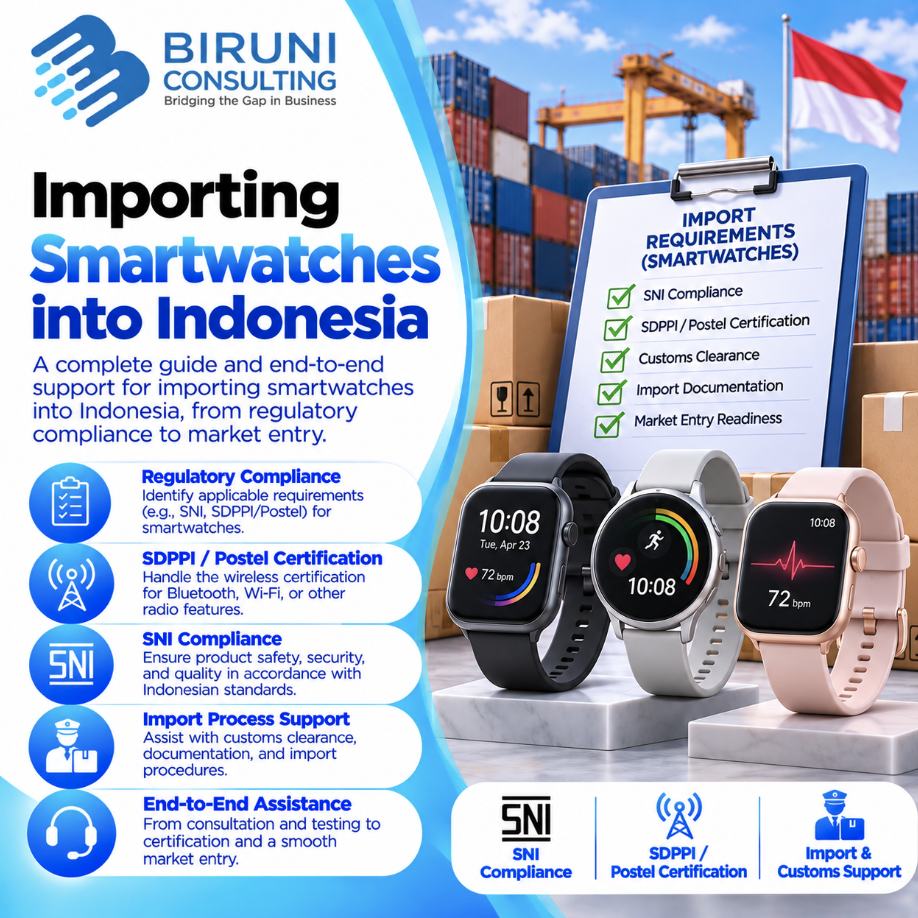
Guide to Indonesian customs classification, DJID/Postel Certification, Bluetooth, WiFi, cellular connectivity, and technical documentation for smartwatches
Importing a smartwatch into Indonesia involves more than normal customs clearance. Unlike a conventional wristwatch, a smartwatch can incorporate Bluetooth, WiFi, NFC, GPS/GNSS, and even direct cellular connectivity using SIM or eSIM.
Importers should therefore identify the exact model, wireless technologies, operating frequencies, transmission power, modules, antennas, supported cellular bands, RF test reports, and customs classification before shipment.
Minister of Communication and Informatics Regulation Number 3 of 2024 applies to telecommunications equipment and other devices containing telecommunications features that are manufactured, assembled, imported, marketed, or used in Indonesia. Compliance with the applicable Technical Standards is demonstrated through certification. JDIH Komdigi
A Smartwatch Is More Than a Conventional Watch
Smartwatches can combine many functions within one compact wearable device.
In addition to displaying time, they can receive notifications, pair with smartphones, connect to WiFi, perform NFC transactions, receive GNSS positioning information, or access mobile networks directly.
The wireless functions therefore need to be considered when planning importation and certification.
Product appearance alone is not an adequate basis for regulatory classification.
Bluetooth Smartwatches
Bluetooth is incorporated into most modern smartwatches.
It may support notifications, health-data synchronization, call audio, music controls, application settings, and firmware updates.
Minister of Communication and Informatics Decision Number 260 of 2024 defines Bluetooth IEEE 802.15.1 within the Short Range Device framework, operating in the 2400–2483.5 MHz band. s3.sertifikasi.postel.go.id
Assessment should review the Bluetooth version, chipset or module, transmission power, antenna, and enabled functions in the exact commercial model.
WiFi-Enabled Smartwatches
Some smartwatches contain WiFi so that they can communicate with networks without depending entirely on a paired smartphone.
WiFi needs to be assessed separately from Bluetooth.
Minister of Communication and Digital Decision Number 12 of 2025 establishes class-licensed spectrum and Technical Standards for RLAN equipment. s3.sertifikasi.postel.go.id
Where both Bluetooth and WiFi are enabled, both interfaces should be included in the technical assessment.
Cellular Smartwatches
Some smartwatch variants contain SIM or eSIM functionality and can connect directly to a mobile operator.
Depending on the model, supported technologies can include GSM, WCDMA, LTE, or 5G.
Current Technical Standards include Decision Number 45 of 2025 for GSM/IMT-2000 equipment and Decision Number 569 of 2025 for LTE and IMT-2020 equipment. JDIH Komdigi
A Bluetooth-only smartwatch and an LTE smartwatch should therefore not automatically be treated as the same certification configuration.
Regional Variants Matter
Smartwatches are frequently produced in different regional versions.
The commercial name and enclosure can be almost identical while cellular bands, WiFi configurations, NFC functions, firmware, or model numbers differ.
Regulation Number 3 of 2024 requires Technical Standard conformity to be demonstrated based on the relevant brand, type, and country of manufacture. JDIH Komdigi
Importers should therefore verify the exact model suffix and region before placing a commercial order.
GPS and GNSS
GPS/GNSS supports fitness tracking, navigation, running, cycling, and location-based functions.
A receive-only GNSS function should be distinguished from active radio transmitters such as Bluetooth, WiFi, NFC, or cellular.
The certification assessment should therefore map each radio function separately.
Simply stating that a smartwatch has “GPS” does not describe the entire telecommunications configuration.
NFC in Smartwatches
NFC may be used for payment, digital keys, pairing, or other contactless functions.
Decision Number 260 of 2024 includes Near Field Communication within the Short Range Device framework. s3.sertifikasi.postel.go.id
Where NFC is combined with Bluetooth, WiFi, or cellular radios, each enabled radio should be identified in the technical assessment.
Does a Smartwatch Require Postel Certification?
Where a smartwatch contains active telecommunications functions such as Bluetooth, WiFi, NFC, or cellular communication, the exact device should be assessed against DJID/SDPPI requirements.
Regulation Number 3 of 2024 requires telecommunications equipment and other devices with telecommunications features imported for trade or use in Indonesia to comply with the applicable Technical Standards. JDIH Komdigi
A wireless smartwatch should therefore not automatically be treated like a conventional non-connected wristwatch.
One Bluetooth Certificate May Not Be Enough
A smartwatch containing Bluetooth, WiFi, NFC, and LTE can be subject to several Technical Standards.
A Bluetooth report alone would not establish compliance for all other enabled radios.
DJID Certificates issued in 2026 demonstrate that multi-radio products can reference several standards simultaneously, including SRD, RLAN, and cellular standards. e-Sertifikasi NextGen
The complete final-product configuration should therefore be assessed.
Using Existing Module Test Reports
Smartwatches may contain integrated wireless modules or chipsets with existing laboratory documentation.
These reports can support certification but do not automatically cover every final product integration.
DJID’s current e-Sertifikasi requirements state that equipment relying on a module test report needs a block diagram, a photograph showing the installed module location, and a declaration linking the module brand/type with the final product brand, type, and variant. e-Sertifikasi NextGen
Antennas, firmware, power settings, and enabled radio functions remain relevant.
Certification Documents
Current e-Sertifikasi requirements for a new Certificate include:
- NIB and OSS access.
- Laboratory test reports.
- Technical specifications.
- Declaration of Conformity.
- Colour photographs showing brand and model/type.
- A declaration that submitted information is correct and complete.
The laboratory report must be issued by an eligible domestic laboratory or a recognised overseas laboratory under the applicable framework. e-Sertifikasi NextGen
Smartwatch importers should also prepare wireless specifications, supported cellular bands, antenna information, module datasheets, and product manuals.
IMEI and Cellular Smartwatches
A cellular smartwatch can contain a mobile-network modem and device identity information.
However, its IMEI requirements should not automatically be treated as identical to those for smartphones.
DJID’s current e-Sertifikasi requirements specifically list an IMEI security declaration and approved IMEI list for cellular phones, handheld computers, and tablets. Smartwatches are not expressly named in that specific requirement. e-Sertifikasi NextGen
An LTE or eSIM smartwatch should therefore be classified first before assuming that all HKT IMEI procedures apply.
SAR Considerations
Smartwatches are worn directly on the body, making RF exposure an understandable compliance consideration.
However, Minister of Communication and Digital Decision Number 197 of 2026 specifically establishes SAR limits for cellular phones and tablet computers. s3.sertifikasi.postel.go.id
The Decision should therefore not automatically be treated as applying to every smartwatch solely because the device is worn on the wrist.
The product’s exact classification and applicable Technical Standards should be confirmed.
Smartwatch HS Code
A smartwatch HS Code should be determined from the actual product characteristics and applicable tariff-classification rules.
Importers should not automatically select the tariff heading used for conventional watches simply because a smartwatch is worn on the wrist.
Indonesia’s BTKI is the official classification reference used for customs classification, import duties, import taxes, and import/export control measures. Beacukai
The Indonesian tariff framework was also most recently amended through Minister of Finance Regulation Number 68 of 2026, effective October 9, 2026. Kementerian Keuangan Republik Indonesia
The final HS code should therefore be confirmed against the exact technical specification before the customs declaration is prepared.
HS Classification and Postel Certification Are Different
HS classification serves customs purposes.
DJID/Postel Certification demonstrates conformity with telecommunications Technical Standards.
A particular HS code is therefore not, by itself, proof that a smartwatch does or does not require telecommunications certification.
Likewise, the presence of Bluetooth or LTE does not by itself establish the final customs classification.
Both assessments should be completed separately.
Commercial Smartwatch Imports
Commercial importers should ideally complete regulatory assessment before placing a major purchase order.
The review should confirm the exact brand and model, country of manufacture, Bluetooth/WiFi/cellular configuration, supported bands, available RF test reports, Certificate strategy, applicant structure, and customs classification.
Regulation Number 3 of 2024 requires covered devices imported for trade or use in Indonesia to meet the applicable Technical Standards and demonstrate compliance through certification. JDIH Komdigi
Certification planning should therefore begin before the shipment arrives in Indonesia.
Smartwatches Imported for Personal Use
Regulation Number 3 of 2024 includes a certification exemption for qualifying personal baggage or postal shipments that are used for personal purposes, are not traded, and are not imported commercially.
For qualifying customer premises equipment, the regulation provides a maximum quantity of two units. JDIH Komdigi
Whether a particular smartwatch qualifies within that category should be checked against its exact configuration and import method.
A personal-use exemption should not be used for commercial shipments.
Regulatory Labeling
After certification, regulatory-marking obligations also apply.
DJID’s current e-Sertifikasi portal states that Certificate holders must apply the required Label, QR Code, and Warning Sign and report implementation within 30 working days after Certificate issuance. e-Sertifikasi NextGen
Because smartwatches have very limited enclosure space, labeling and packaging should be considered during product planning.
Certificate Period
Under Regulation Number 3 of 2024, the Certificate itself is not time-limited.
However, the Certificate holder may manufacture, assemble, or import the equipment for trade and/or use in Indonesia for up to three years from the Certificate issuance date. JDIH Komdigi
Continued commercial importation after that period requires attention to renewed Technical Standard compliance and the applicable new-Certificate requirements.
Pre-Import Checklist
Before commercial shipment, an importer should verify:
- Exact brand and model number.
- Country of manufacture.
- Bluetooth, WiFi, NFC, GNSS, and cellular functionality.
- Supported cellular bands for SIM/eSIM models.
- Operating frequencies and transmission power.
- Wireless modules and antennas.
- RF test reports.
- DJID/SDPPI Certification status.
- HS classification and relevant import requirements.
The model shown on the supplier’s datasheet should match the actual regional variant that will be shipped.
Why Assessment Before the Purchase Order Matters
A supplier may provide technical documents for one regional variant while shipping another.
Even a small difference in a model suffix can indicate different cellular bands, wireless chipsets, antennas, NFC features, or firmware.
Pre-import assessment helps ensure that the laboratory documentation and Certificate strategy match the actual commercial product.
It can also reduce the risk of discovering compliance problems only after the goods have already arrived in Indonesia.
Conclusion
Importing smartwatches into Indonesia requires assessment of both customs classification and telecommunications compliance.
From a DJID/Postel perspective, a smartwatch can incorporate Bluetooth, WiFi, NFC, cellular connectivity, and other wireless technologies that need to be assessed according to the exact configuration and applicable Technical Standards. Regulation Number 3 of 2024 remains the principal certification framework. JDIH Komdigi
Bluetooth may be assessed under Decision Number 260 of 2024, WiFi/RLAN under Decision Number 12 of 2025, and cellular smartwatches against the current GSM/IMT-2000 or LTE/IMT-2020 standards where applicable. s3.sertifikasi.postel.go.id
For customs purposes, the HS code should be determined from the actual product specification using the current Indonesian tariff-classification framework rather than simply treating every smartwatch as a conventional wristwatch. Beacukai
A technical assessment before shipment can help determine the correct HS classification, DJID/SDPPI Certification requirements, suitability of RF reports, cellular bands, applicant documentation, and regulatory labeling.
Contact Us
Biruni Consulting assists with DJID/SDPPI assessment and certification for smartwatches and various wireless products that will be imported or marketed in Indonesia.
Our services include:
- Assessment of DJID/SDPPI certification requirements.
- Bluetooth module assessment.
- RF specification review.
- Frequency and transmission power analysis.
- Technical document review.
- Certification document preparation.
- Testing coordination where required.
- DJID/SDPPI Certification assistance.
If you have a smartwatch, you can prepare product photos, brand, model, datasheet, RF specifications, and wireless module datasheet for an initial assessment of the Postel Certification requirements.