
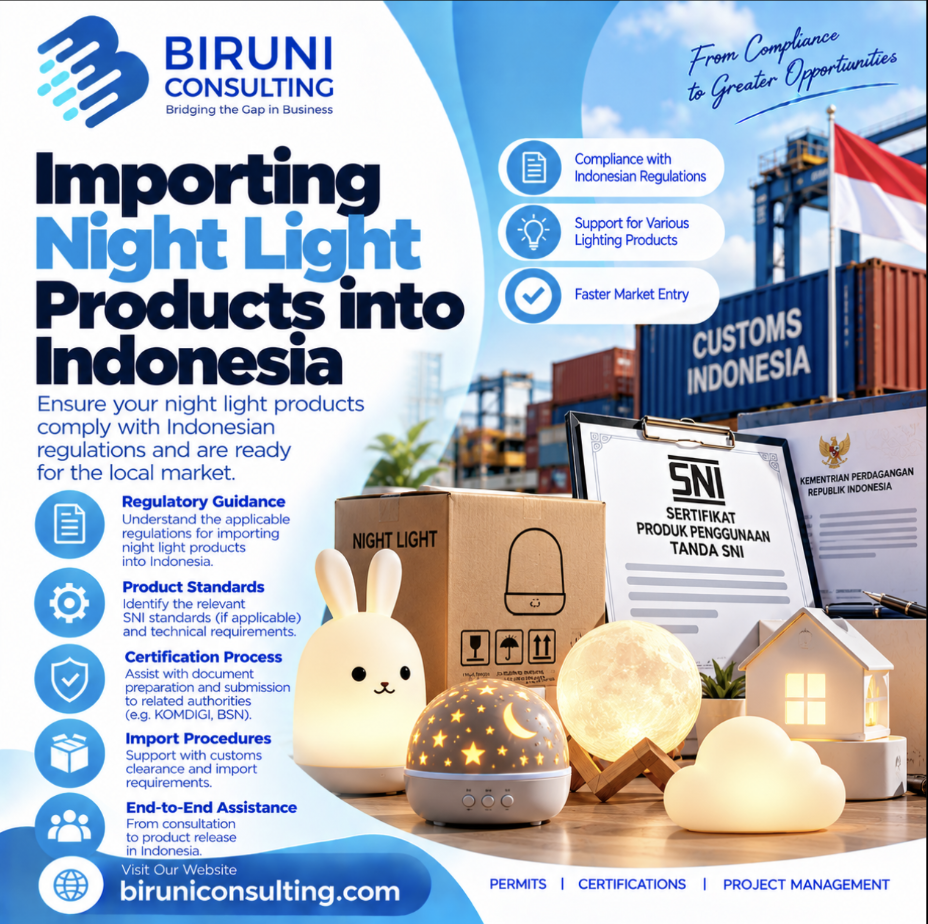
Guide to Import Requirements, SNI, NPB, Testing, and Night Light Certification in Indonesia
Importing night light products into Indonesia requires an assessment of the product type, construction, installation system, power source, technical specifications, HS Code, and applicable standards. The term night light can refer to several technically different products, meaning the applicable certification requirements may also differ.
A night light may be a luminaire directly mounted on an electrical socket outlet, a bedside table lamp using a cord and plug, an LED night light with an external adapter, a rechargeable lamp, or even a smart night light equipped with sensors, WiFi, or Bluetooth.
These differences are important because Indonesia has specific standards for certain product categories. The BSN catalogue currently lists SNI IEC 60598-2-12:2016 – Luminaires – Part 2-12: Particular requirements – Mains socket-outlet mounted nightlights as an active standard. The Ministry of Trade’s LAMANSITU also lists this standard as a quality-policy requirement for the night light luminaire category, together with the Goods Registration Number (NPB). Pesta
However, SNI IEC 60598-2-12:2016 specifically concerns night lights mounted on electrical socket outlets. A bedside or table lamp that is portable may fall under a different classification and needs to be assessed against the appropriate portable luminaire standard. Product assessment should therefore be conducted before products are manufactured or shipped to Indonesia.
What Is a Night Light Product?
A night light is a lighting product generally designed to provide relatively low-level illumination at night. These products are commonly used in bedrooms, children’s rooms, hotels, hospitals, corridors, and other areas requiring supplemental nighttime lighting.
Based on construction, night lights may include:
- Plug-in night lights.
- Bedside or table lamps.
- LED night lights.
- Rechargeable night lights.
- Night lights using adapters.
- USB night lights.
- Night lights with light sensors.
- Night lights with motion sensors.
- Smart WiFi/Bluetooth night lights.
- Decorative night lights.
- Children’s night lights.
- Night lights with dimming functions.
The same marketing name does not necessarily result in the same technical classification. The actual construction of the product is therefore the primary basis for determining the applicable SNI and import requirements.
Are Imported Night Lights Required to Have SNI?
The SNI requirement needs to be determined according to the type of night light being imported.
LAMANSITU has a specific product group for night light luminaires for household electrical installations, fixed electrical installations, low-voltage generating sets, or similar applications. The quality-policy requirements listed for this category are SNI IEC 60598-2-12:2016 and NPB. Laman Situ
BSN states that SNI IEC 60598-2-12:2016 is the particular standard for night lights mounted on electrical socket outlets, and the standard is currently listed as active. Pesta
Therefore, companies should not assume that every product marketed as a “night light” uses SNI IEC 60598-2-12:2016.
A freestanding bedside lamp, for example, may be more appropriately classified as a general-purpose portable luminaire. For this category, LAMANSITU currently lists SNI IEC 60598-1:2016, SNI IEC 60598-2-4:2012, and NPB. Laman Situ
SNI IEC 60598-2-12:2016 for Night Lights
SNI IEC 60598-2-12:2016 is titled Luminaires – Part 2-12: Particular requirements – Mains socket-outlet mounted nightlights.
The standard adopts IEC 60598-2-12:2013 and was established by BSN on December 29, 2016. It remains listed as active in the BSN catalogue. Pesta
This means that the standard is particularly relevant where the night light is designed to be directly mounted or plugged into an electrical socket outlet.
Products of this type generally contain:
- A plug integrated into the product.
- An LED or other light source.
- Housing.
- Internal driver or electronic circuit.
- Switch where provided.
- Light sensor where provided.
- Diffuser.
- Protection components.
- PCB in electronic models.
The actual specifications still need to be assessed before determining the standard used for certification.
Plug-in Night Lights
Plug-in night lights are one of the product forms most closely aligned with SNI IEC 60598-2-12:2016 because the luminaire is mounted directly on an electrical socket outlet.
These products usually do not have a long power cable. The plug forms part of the housing and the device receives mains voltage directly from the socket outlet.
Some models have light sensors that allow them to switch on automatically when the surrounding environment becomes dark.
Other models may include dimming, motion sensors, USB charging, or additional functions.
These features need to be included in the product specification because they may affect the construction and components evaluated during testing.
Bedside or Table Lamps
Not every lamp placed beside a bed is a “night light” within the scope of SNI IEC 60598-2-12.
A table or bedside lamp using an electrical cord and designed to be moved may need to be assessed as a general-purpose portable luminaire.
LAMANSITU currently lists general-purpose portable luminaires under several HS Codes, including 94052190, 94052990, 94054140, 94054190, 94054260, 94054290, 94054960, and 94054990. Listed quality-policy requirements include SNI IEC 60598-2-4:2012, SNI IEC 60598-1:2016, and NPB. Laman Situ
BSN also lists SNI IEC 60598-2-4:2017 for general-purpose portable luminaires as an active standard. However, for mandatory certification purposes, the applicable edition should follow the regulation or certification scheme applied to the product rather than automatically replacing the edition cited in the quality policy. Pesta
The distinction between a plug-in night light and a portable bedside lamp is therefore important during product identification.
Night Lights with Adapters
Some night lights use an AC/DC adapter so that the luminaire itself operates at a low voltage such as 5 V, 12 V, or 24 V DC.
For this configuration, the complete product system needs to be assessed.
Information that should be available includes:
- Adapter input.
- Adapter output.
- Adapter brand.
- Adapter model.
- Rated power.
- Output voltage.
- Output current.
- Connector type.
- Whether the adapter is supplied with the product.
- Existing adapter test reports.
Changing the adapter during production also needs to be controlled because it can alter the product configuration previously tested or evaluated.
USB Night Lights
USB night lights may receive power through USB-A or USB-C. Some products operate at 5 V DC and are not directly connected to AC mains electricity.
However, the term “USB night light” can still cover several different constructions.
Some products consist only of a low-voltage USB luminaire, while others are supplied together with an AC/DC adapter. Certain models also contain integrated rechargeable batteries.
Certification requirements therefore need to be assessed based on the complete configuration of the product being marketed.
Companies should provide information on whether an adapter is included in the packaging, whether a battery is integrated, and how the product connects to its power source.
Rechargeable Night Lights
Rechargeable night lights are increasingly common because they can operate without a power cable once the battery is charged.
These products generally contain a lithium-ion or other type of battery, charging circuit, LED module, PCB, and charging port.
For products of this type, assessment should not consider only the lighting function. Information about the battery, charger, adapter, and charging circuitry may also need to be reviewed.
Where the product has multiple additional functions, the final configuration should ideally be determined before certification so that the tested sample corresponds to the product that will ultimately be marketed.
Children’s Night Lights
Night lights shaped as characters, animals, toys, or other designs specifically intended for children may require additional consideration.
BSN lists SNI IEC 60598-2-10:2016 for portable luminaires for children as an active SNI standard. Pesta
Companies therefore need to determine whether the product falls within the scope of a children’s portable luminaire, a plug-in night light, or another portable luminaire category.
A commercial description such as “kids night light” is not sufficient to determine the standard. Intended use, construction, installation method, target users, and product design need to be assessed together.
Night Lights with Light Sensors
Many modern night lights incorporate photocells or light sensors.
These sensors enable the luminaire to detect surrounding lighting conditions. At night or when the environment becomes dark, the light may switch on automatically.
Adding a sensor does not automatically remove the product from the night light category, but the additional electronic circuitry and components need to be documented.
Sensor datasheets, PCB details, electronic circuits, and major component information may be required during technical assessment.
Night Lights with Motion Sensors
In addition to light sensors, some products use PIR motion sensors or other detection technologies.
The light can switch on when movement is detected and switch off after a specified period.
Such products are commonly used in bedrooms, stairways, corridors, closets, and routes leading to bathrooms.
During certification, the sensor function should be clearly identified because a standard luminaire and a luminaire containing electronic control circuitry may have different constructions.
Smart Night Lights with WiFi or Bluetooth
Some modern night lights incorporate WiFi or Bluetooth and can be controlled using smartphones.
Users may adjust brightness, color, schedules, or lighting modes through an application.
Where the product contains a radio communication module such as WiFi or Bluetooth, telecommunications-device requirements also need to be assessed in addition to electrical requirements.
Companies should prepare information regarding:
- WiFi/Bluetooth module.
- Chipset.
- Operating frequency.
- Transmit power.
- Antenna type.
- Antenna gain.
- Module datasheet.
- RF test reports where available.
- Firmware.
- Application used.
A smart night light can therefore involve more than one regulatory assessment pathway.
Import Requirements for Night Lights in Indonesia
Indonesia’s current import-policy framework is based on Minister of Trade Regulation No. 16 of 2025 concerning Import Policy and Regulation, amended by Minister of Trade Regulation No. 37 of 2025 and subsequently amended again by Minister of Trade Regulation No. 18 of 2026. Regulation No. 18 of 2026 was established on June 3, 2026, promulgated on June 4, 2026, and is currently in force. JDIH Kemendag
Under this import-policy framework, importers use an NIB functioning as an API in accordance with the applicable import provisions. JDIH Kemendag
In addition to importer legality, product requirements need to be reviewed based on the classification of the goods and applicable technical policies.
Before shipment, companies should therefore review:
- Type of night light.
- HS Code.
- Construction.
- Applicable SNI.
- Certification requirements.
- NPB requirements.
- Model or product family.
- Adapter or driver.
- Battery where applicable.
- Radio module where applicable.
HS Code for Night Lights
HS Code classification should not be determined solely from the description “night light.”
Material, light source, function, installation method, and construction may affect the classification.
For general-purpose portable luminaires, LAMANSITU lists several tariff codes under heading 9405, including 94052190 and 94052990, together with other codes depending on the light source and construction. Laman Situ
Meanwhile, LAMANSITU’s specific night light luminaire page currently does not display a particular HS Code, although it lists SNI IEC 60598-2-12:2016 and NPB as quality-policy requirements. Laman Situ
This is another reason HS Code classification should be based on complete product specifications.
NPB for Night Lights
NPB or Goods Registration Number is another aspect that needs to be considered for products falling under the relevant quality policy.
LAMANSITU explicitly lists NPB for the night light luminaire category together with SNI IEC 60598-2-12:2016. Laman Situ
NPB is also listed for the general-purpose portable luminaire category together with SNI IEC 60598-1:2016 and SNI IEC 60598-2-4:2012. Laman Situ
Importers should therefore not focus only on the SNI certificate but should also verify the applicable product-registration requirement before marketing the product.
Do Night Lights Require SKEM?
The applicability of Minimum Energy Performance Standards or SKEM needs to be determined according to the product categories covered by energy-efficiency regulations.
Minister of Energy and Mineral Resources Regulation No. 14 of 2021 regulates SKEM implementation for Energy-Utilizing Equipment within its applicable scope and establishes an Energy Saving Certificate requirement for products subject to SKEM. JDIH ESDM
However, it would not be appropriate to assume that every night light is automatically subject to the same SKEM requirements.
The product needs to be compared with the categories and scope of equipment subject to SKEM. The light source, luminaire construction, power, function, and product configuration should therefore be reviewed first.
Specifications to Prepare Before Importing
Before importing night lights, companies should request that the supplier or manufacturer provide the following information:
- Product name.
- Brand.
- Model.
- Manufacturer.
- Factory address.
- Country of origin.
- Product photographs.
- Datasheet.
- User manual.
- Rated voltage.
- Rated frequency.
- Rated power.
- Rated current.
- Light source.
- LED module specification.
- Driver specification.
- Adapter specification.
- Plug specification.
- Cable specification.
- Battery specification where applicable.
- Charging specification.
- Sensor specification.
- WiFi/Bluetooth specification where applicable.
- Product dimensions.
- Housing material.
- Electrical class.
- Label artwork.
- Existing test reports.
The more complete the information available from the beginning, the easier it is to determine the appropriate certification pathway.
Night Light Testing
LAMANSITU lists a specific testing scope for night light luminaires based on SNI IEC 60598-1:2016 and SNI IEC 60598-2-12:2016 at its testing laboratory. Laman Situ
Luminaire testing can generally cover construction, marking, protection against electric shock, terminals, internal and external wiring, insulation resistance, electric strength, temperature rise, resistance to heat, and other safety parameters specified by the applicable standards.
The actual parameters depend on the standard scope, product construction, and laboratory capability.
The sample submitted for testing should therefore represent the product that will eventually be manufactured and marketed.
Importance of Reviewing the Plug and Cable
For plug-in night lights, the plug is usually an integral part of the product. For table lamps, the product may instead use a flexible cord with a separate plug.
These components should be reviewed from the beginning.
Information concerning plug type, rated current, cable type, conductor cross-sectional area, cable length, earthing, and materials should be included in the technical documentation.
Changes to the cable or plug after testing also need to be controlled because they may affect the construction already evaluated.
Importance of Reviewing the Driver and LED Module
For LED night lights, the driver and LED module are important components.
In certain models, the driver is located inside the housing. Other products may use an external adapter as their power supply.
Companies should prepare information regarding:
- Driver manufacturer.
- Driver model.
- Input voltage.
- Output voltage.
- Output current.
- Rated power.
- LED module.
- LED quantity.
- PCB.
- Existing safety certificates or test reports where available.
Products with the same external appearance may still have different internal constructions.
Night Light Product Family
Suppliers often offer numerous night light models in one catalogue.
Models may differ in shape, color, wattage, diffuser, sensor, LED module, adapter, or additional functions.
Before submitting all models for certification, a product-family assessment should be conducted.
The comparison may include:
- Basic construction.
- Input voltage.
- Power.
- Light source.
- Driver.
- PCB.
- Plug.
- Adapter.
- Sensor.
- Battery.
- Housing.
- Electrical class.
- Model and brand.
Proper family determination helps companies structure their product lists and testing samples more effectively.
Stages of Importing and Certifying Night Lights
Product Identification
The first stage is determining whether the product is a plug-in night light, bedside lamp, portable lamp, rechargeable lamp, or another category.
HS Code Identification
Once the specifications are known, the HS Code is reviewed based on the characteristics of the goods.
SNI Identification
Where the product is a night light mounted on a socket outlet, SNI IEC 60598-2-12:2016 is a particularly relevant standard. For portable bedside lamps, the portable luminaire standards need to be assessed. Pesta
Product Family Assessment
All types are compared to determine appropriate product grouping according to their construction and the applicable certification scheme.
Document Preparation
The company and manufacturer prepare the required legal, technical, model-list, labeling, and production documentation.
Certification Application
The application is submitted through a Product Certification Body with an appropriate scope.
Product Testing
Samples are tested according to the standard that has been determined.
Production Evaluation or Factory Audit
Where required by the certification scheme, the production facility may undergo an audit or evaluation.
Certificate Issuance
Once all requirements have been fulfilled, the certificate can be issued under the applicable certification scheme.
NPB Registration
For product groups where NPB is required, the goods-registration process also needs to be completed in accordance with Ministry of Trade requirements. Laman Situ
Documents for Imported Night Light Certification
Required documents may vary depending on the product and certification scheme, but companies should generally prepare:
- Importer company legal documents.
- Brand information.
- Brand-related authorization documents where required.
- Manufacturer information.
- Factory address.
- Product list.
- Datasheet.
- Technical specification.
- Product photographs.
- Label.
- User manual.
- Circuit diagram.
- Construction drawing.
- Bill of materials where required.
- Critical component list.
- Driver information.
- LED module information.
- Adapter information.
- Battery information where applicable.
- Existing IEC/CB test reports where available.
- Factory quality-system documentation where required.
Documents should be reviewed before the process begins to reduce the need for revisions during certification.
Why Is Assessment Before Shipment Important?
One possible mistake when importing lighting products is shipping the goods first and only then checking the applicable SNI requirements.
This approach creates risk because a product falling under a specific certification scope may require testing, factory audits, registration, or manufacturer documentation.
These processes cannot always be completed using importer documentation alone.
Assessment should therefore ideally take place while the supplier and product models are still being finalized.
This allows companies to correct labels, replace components where necessary, prepare the manufacturer, and ensure that the purchased models correspond to the certification scope.
Contact Us
Biruni Consulting assists companies with the process of importing night light products into Indonesia, including SNI consultation, product-classification review, standard identification, testing, and certification assistance.
Our services include:
- Consultation on night light import requirements.
- Identification of applicable SNI standards and regulations.
- Night light type and product-scope assessment.
- HS Code and product-list review.
- Driver, adapter, LED module, and major-component review.
- Product family assessment.
- Certification document preparation.
- Product testing assistance.
- Factory audit assistance where required.
- Certification and NPB process assistance.
Contact Biruni Consulting for information regarding night light SNI services, night light certification, portable luminaire certification, lighting NPB, and night light import requirements in Indonesia according to your product’s brand, model, construction, specifications, HS Code, and country of origin