
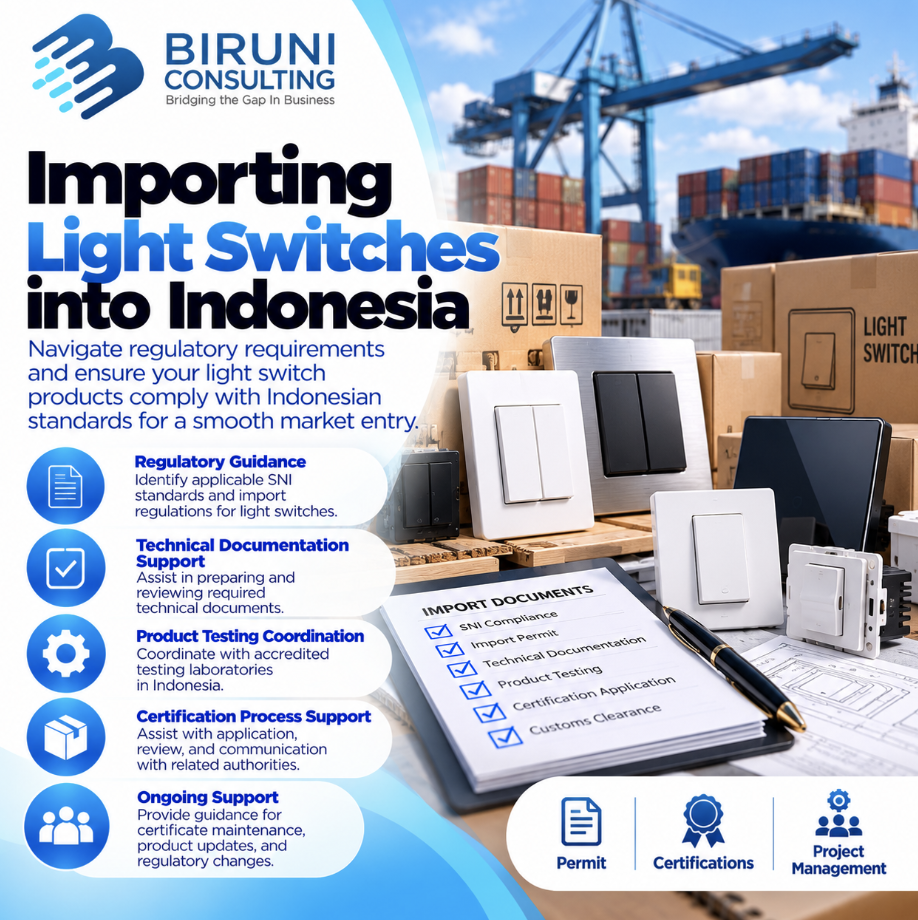
Guide to importing conventional and smart light switches into Indonesia.
A light switch controls the electrical circuit supplying a lamp or lighting system. Products may range from conventional mechanical wall switches to touch switches, WiFi smart switches, Bluetooth switches, Zigbee devices, and RF remote-controlled light switches.
For DJID/SDPPI purposes, the key distinction is whether the product incorporates a wireless telecommunications function.
A conventional electrical switch without a radio has different certification considerations from a smart light switch incorporating WiFi, Bluetooth, Zigbee, or another RF technology.
Minister of Communication and Informatics Regulation Number 3 of 2024 remains Indonesia’s primary certification framework for telecommunications equipment and devices, including other products incorporating telecommunications functions. JDIH Kemkomdigi
Do Light Switches Require DJID Certification?
Not every light switch requires the same DJID assessment.
A conventional wall switch that only opens and closes an electrical circuit does not contain the same telecommunications functions as a wireless smart switch.
Where the product can communicate with a smartphone, remote controller, smart-home hub, or wireless network, the radio function needs to be reviewed.
Examples include WiFi switches, Bluetooth switches, Zigbee smart switches, and RF remote-control switches.
The certification requirement should therefore be determined from the actual technical configuration.
WiFi Smart Light Switches
WiFi is widely used in smart wall switches.
It can allow users to control lighting through a mobile application, create schedules, automate lighting, or connect the switch to a cloud-based smart-home system.
For DJID assessment, the WiFi standard, operating band, transmission power, wireless module, and antenna should be identified.
Indonesia’s current RLAN regulatory framework includes Minister of Communication and Digital Decision Number 12 of 2025, which is listed by DJID as covering class-licensed spectrum and Technical Standards for Radio Local Area Network equipment. Postel
The description “WiFi smart switch” alone is therefore not sufficient to determine compliance.
Bluetooth Light Switches
Bluetooth may be used for direct smartphone control, initial pairing, setup, or local device management.
Minister of Communication and Informatics Decision Number 260 of 2024 defines Bluetooth IEEE 802.15.1 as short-range data communication equipment operating in the 2400–2483.5 MHz frequency band. Postel Certification
A Bluetooth light switch assessment should normally identify the Bluetooth version, operating frequency, RF output power, module, and antenna.
Where the product contains both WiFi and Bluetooth, both radio functions should be included in the assessment.
Zigbee Smart Switches
Zigbee is also commonly used in smart-home lighting systems.
A Zigbee switch typically communicates with a hub or gateway, which then connects the smart-home network to an application or cloud platform.
Even though the switch may not connect directly to the internet, it still contains an active radio communication function.
Its operating frequency, output power, wireless module, and antenna should therefore be assessed against the applicable Indonesian requirements.
RF Remote-Controlled Light Switches
Some light switches use a proprietary RF remote controller rather than WiFi or Bluetooth.
The remote may control on/off functions, dimming, or multiple lighting channels.
In this system, the remote generally contains the transmitter while the wall switch or receiver unit receives the commands.
The operating frequency, transmission power, transmitter, receiver, modulation, and antenna configuration should be identified.
Where the controller is supplied with the switch, both components should be reviewed as part of the complete communication system.
Light Switches and Short Range Devices
Bluetooth, Zigbee, and many low-power proprietary RF systems may fall within technical categories associated with Short Range Devices.
Minister of Communication and Informatics Decision Number 260 of 2024 remains listed as Indonesia’s Technical Standard for Short Range Devices. Postel
Indonesia’s class-license spectrum framework is governed by Regulation Number 2 of 2023 as amended by Minister of Communication and Digital Regulation Number 2 of 2025, which remains in force. JDIH Kemkomdigi
Using short-range or class-licensed spectrum does not automatically exempt a product from DJID Certification.
The radio specifications still need to be assessed against the applicable Technical Standards.
Smart Switches with Multiple Wireless Technologies
Some smart switches contain more than one radio technology.
WiFi may provide cloud connectivity while Bluetooth is used for commissioning or initial setup.
Other products may combine Zigbee with Bluetooth or another proprietary radio system.
Where several wireless functions are incorporated into the same product, each radio should be identified.
The assessment should review its frequency, output power, wireless module, antenna, and intended function.
Is a Certified Wireless Module Sufficient?
Not necessarily.
A certified WiFi, Bluetooth, or Zigbee module may provide useful supporting documentation, but the complete light switch still needs to be assessed.
Integration into the final product may involve different antennas, firmware, output power settings, enclosures, or enabled radio functions.
Module documentation should therefore be compared with the actual final product.
This is particularly important when the same wireless module is used in several different smart-home products.
Does Transmission Power Below 10 mW Mean an Exemption?
Not automatically.
Regulation Number 3 of 2024 contains a specific provision for certain other equipment incorporating telecommunications features below 10 mW and only one identical telecommunications feature.
Where all regulatory conditions are met, one Certificate may cover more than one qualifying variant. JDIH Kemkomdigi
This is not a general exemption from DJID Certification for every low-power smart switch.
The final product configuration still needs to be assessed.
HS Code for Light Switches
For customs purposes, light switches generally fall under heading 8536, covering electrical apparatus for switching or protecting electrical circuits for voltages not exceeding 1,000 V.
Within Indonesia’s tariff nomenclature, 8536.50 covers other switches, with more detailed subheadings depending on the characteristics of the product. INSW API
Certain manually operated switches for household and similar fixed electrical installations are also referenced under Ex. 8536.50.99 in Indonesian trade regulations. jdih.kemendag.go.id
However, a smart electronic wall switch should not automatically be assigned that exact subheading.
Final customs classification should be confirmed from the actual construction, electrical ratings, functions, and imported configuration.
HS Code and DJID Certification Are Different Issues
An HS Code identifies goods for customs purposes.
DJID Certification addresses the telecommunications functions incorporated into the product.
Two light switches with similar electrical functions may therefore have very different telecommunications characteristics.
For example, one may be a conventional wall switch while another contains WiFi and Bluetooth.
The HS classification alone should therefore not be used to determine whether Postel/DJID Certification is required.
Documents to Prepare Before Importation
Importers should obtain sufficient manufacturer documentation before commercial shipment.
Typical information includes:
- Product and label photos.
- Brand and model.
- Product datasheet and user manual.
- Wireless module datasheet.
- Operating frequency and transmission power.
- RF test reports, where available.
- Antenna and country-of-manufacture information.
Electrical specifications such as rated voltage and current are also important for the overall import and compliance assessment.
For products containing several wireless technologies, documentation for each radio function should be prepared.
RF Test Reports
A foreign RF laboratory report may provide important technical information for the assessment.
It normally includes parameters such as operating frequency, RF output power, bandwidth, modulation, and emissions.
However, the report should correspond to the actual wireless module and final product configuration.
Regulation Number 3 of 2024 provides that compliance with applicable Technical Standards is established through testing and demonstrated by certification. JDIH Kemkomdigi
CE, FCC, or other foreign reports therefore do not automatically replace DJID/SDPPI Certification.
Can Several Switch Models Share One Certificate?
Potential model grouping depends on technical similarity.
A smart switch family may include one-gang, two-gang, three-gang, and four-gang models using almost identical enclosures.
However, it should be confirmed that the variants use the same wireless module, operating frequency, RF output power, antenna, and radio configuration.
Regulation Number 3 of 2024 contains a mechanism that may allow one Certificate to cover more than one variant for certain products where the applicable criteria are fulfilled. JDIH Kemkomdigi
Grouping should therefore be assessed before submitting the certification application.
Import Process for Light Switches
A conventional non-wireless light switch primarily requires assessment of its customs classification and applicable electrical-product requirements.
A wireless smart switch adds telecommunications considerations.
Before commercial shipment, the importer should identify the exact model, HS classification, rated voltage and current, wireless technologies, operating frequencies, output power, modules, and antennas.
Available RF reports can then be reviewed to identify the applicable Indonesian Technical Standards and DJID/SDPPI Certification requirements.
DJID also implemented Minister of Communication and Digital Decision Number 469 of 2025 to strengthen supervision over imported telecommunications equipment and other electronic products incorporating communications functions. Postel
Certificate Period for Import Activities
Under Regulation Number 3 of 2024, the Certificate itself is not time-limited.
However, the Certificate holder may manufacture, assemble, or import the relevant equipment for trade and/or use in Indonesia for up to three years from the Certificate issuance date. JDIH Kemkomdigi
If those activities continue beyond the three-year period, the applicable Technical Standard compliance and new-Certificate provisions need to be followed.
Companies importing the same smart-switch models repeatedly should therefore monitor the Certificate issuance date.
DJID Labeling for Smart Light Switches
Certified products are also subject to labeling requirements.
The annex to Regulation Number 3 of 2024 specifies a format containing the Certificate number and PLG ID, QR Code, and warning sign. JDIH Kemkomdigi
Because smart wall switches can have limited external space for regulatory markings, labeling should ideally be considered during the packaging and manufacturing stage rather than after the goods arrive in Indonesia.
DJID Certification and Electrical Product Requirements
DJID/SDPPI Certification focuses on telecommunications and wireless functions.
A light switch is also an electrical product and may be subject to separate electrical safety, SNI, import, or product-compliance requirements depending on its specifications and classification.
Indonesian trade regulations, for example, reference certain household and similar fixed-installation switches under Ex. 8536.50.99 within product-control provisions. jdih.kemendag.go.id
DJID Certification therefore should not be treated as replacing any separate electrical-product requirements.
Both aspects should be assessed independently.
Importance of Pre-Shipment Assessment
Smart light switches are frequently produced in several radio versions under the same external design.
One model family may be offered in WiFi, Zigbee, Bluetooth, or non-wireless versions.
Manufacturers may also change wireless modules between production batches.
A pre-shipment assessment helps identify DJID Certification requirements, Technical Standards, RF reports, HS-code considerations, model-grouping possibilities, and labeling requirements before the products reach Indonesia.
It also reduces the risk of inconsistencies between the actual goods, packaging, datasheets, RF reports, and Certificate information.
Conclusion
Importing light switches into Indonesia requires distinguishing between conventional electrical switches and wireless smart switches.
A switch without radio communication does not have the same Postel considerations as a product containing WiFi, Bluetooth, Zigbee, or proprietary RF.
For smart light switches, the operating frequency, transmission power, wireless module, antenna, test reports, and final configuration should be reviewed.
HS 8536.50 covers the tariff group for other switches, although the final subheading should be determined from the actual product characteristics. INSW API
Conducting an assessment before importation helps businesses prepare DJID/SDPPI Certification, customs classification, testing, technical documentation, labeling, and other product requirements more accurately.
Contact Us
Biruni Consulting assists with DJID/SDPPI assessment and certification for light switches and various wireless products that will be imported or marketed in Indonesia.
Our services include:
- Assessment of DJID/SDPPI certification requirements.
- Bluetooth module assessment.
- RF specification review.
- Frequency and transmission power analysis.
- Technical document review.
- Certification document preparation.
- Testing coordination where required.
- DJID/SDPPI Certification assistance.
If you have a light switch, you can prepare product photos, brand, model, datasheet, RF specifications, and wireless module datasheet for an initial assessment of the Postel Certification requirements.