
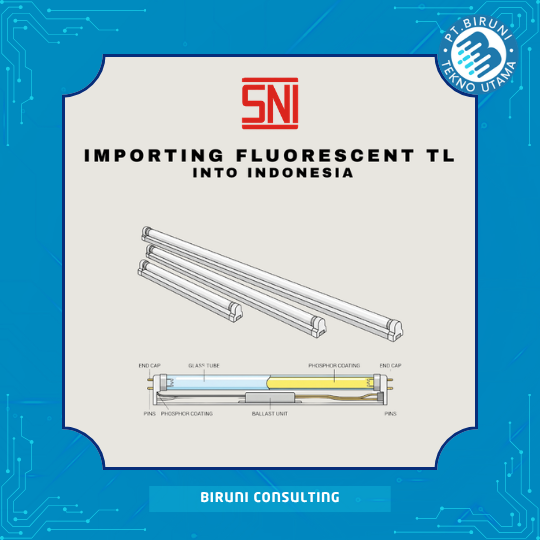
Guide to Import Requirements, SNI, and Fluorescent TL Lamp Certification
Importing fluorescent TL lamps into Indonesia requires comprehensive preparation, particularly when the products will be commercially marketed. In addition to fulfilling general import requirements, companies need to consider product standards, safety requirements, certification, and provisions related to lamp control components such as ballasts and starters.
Fluorescent TL lamps are generally tubular lamps that use gas and a fluorescent coating to produce light. Depending on their construction, these lamps may require a ballast and starter as part of the lighting system. Therefore, when importing the products, companies need to determine whether they are importing only the fluorescent lamp, a lamp and accessory set, or a complete system that also includes ballast and other control components.
The National Standardization Agency of Indonesia lists SNI 04-3559-1999 Fluorescent lamps — Tubular fluorescent lamps for general lighting service as an active standard. In addition, several other standards relate to fluorescent lamps, including safety and performance standards for double-capped and single-capped fluorescent lamps.
Because several standards are associated with fluorescent lamps, importers should conduct product identification before determining the appropriate standard and certification process.
Are Imported Fluorescent TL Lamps Required to Have SNI?
SNI requirements cannot be determined solely based on the term “TL lamp.” Importers need to review the product type, construction, voltage, application, and components included in the product.
For tubular fluorescent lamps intended for general lighting, BSN lists SNI 04-3559-1999 as an active standard. BSN also lists SNI IEC 60081:2015 for double-capped fluorescent lamps covering performance specifications, as well as SNI IEC 61195:2009 covering safety specifications for double-capped fluorescent lamps.
Therefore, importers should not automatically assign one SNI number to every TL lamp product. The lamp type and technical characteristics need to be reviewed first so that the applicable standard is correctly identified.
This becomes even more important when the product uses an electronic ballast, separate ballast, starter, or other control components. Such components may have their own standards and, under certain circumstances, may be subject to separate SNI requirements.
SNI Standards Related to Fluorescent TL Lamps
For fluorescent TL lamps, several standards may apply to the lamp itself or its components. One standard listed in the BSN catalogue is SNI 04-3559-1999 Fluorescent lamps — Tubular fluorescent lamps for general lighting service, which is currently listed as active.
In addition, SNI IEC 60081:2015 covers performance specifications for double-capped fluorescent lamps. Meanwhile, SNI IEC 61195:2009 covers safety specifications for double-capped fluorescent lamps. For single-capped fluorescent lamps, BSN also lists SNI IEC 60901:2009 and SNI IEC 61199:2009 as active standards.
The differences between these standards demonstrate why product identification is an important stage. TL lamps using a particular lamp-cap configuration may have different requirements from other fluorescent lamp types.
What About Fluorescent Lamp Ballasts?
A ballast is an important component in a fluorescent lighting system. For products using ballasts, importers need to determine whether the ballast is integrated into the lamp or imported as a separate product.
BSN lists SNI 04-6509.1-2001 concerning ballasts for fluorescent tubes, covering general and safety requirements. BSN also lists SNI 04-6510-2001 concerning performance requirements for ballasts for fluorescent tubes.
For electronic ballasts, SNI IEC 60929:2009 covers performance requirements for AC-supplied electronic ballasts for tubular fluorescent lamps. BSN also lists SNI IEC 61347-2-3:2010 concerning particular requirements for AC-supplied electronic controlgear for fluorescent lamps.
This means that companies need to assess not only the lamp itself but also the control components used within the TL lighting system.
SNI for Fluorescent Lamp Starters
In addition to ballasts, certain fluorescent lamps use starters as part of their starting system. Starters also have their own standard.
BSN lists SNI 04-0133-2000 Glow starters for fluorescent lamps as an active standard. This standard specifically relates to starters used with fluorescent lamps.
If starters are imported as separate products, importers should review their classification and applicable requirements. If the starter is included as part of an imported lamp system, this information should also be clearly described in the product’s technical documentation.
Import Requirements for Fluorescent TL Lamps into Indonesia
In addition to fulfilling standards and certification requirements, companies conducting imports must comply with general import requirements in Indonesia. Importers need to ensure that company legality, NIB, importer status, HS Code classification, and customs documentation have been properly prepared.
From the product side, companies should also prepare sufficiently detailed technical information. This information will help determine the applicable standards and identify whether additional requirements apply to the lamp or its components.
Documents and information that should generally be prepared include:
- NIB and company legal documents.
- Importer information.
- Overseas manufacturer information.
- Lamp brand and type.
- Product datasheet.
- Product and packaging photographs.
- Voltage and frequency.
- Lamp power.
- Tube length and diameter.
- Lamp-cap or base type.
- Ballast type.
- Starter type, where applicable.
- Lumen and light characteristics where available.
- HS Code.
- Existing test reports or certificates, where available.
Having complete information from the beginning can help prevent discrepancies between the samples, documents, and products that will actually be imported.
Stages of Certification for Imported Fluorescent TL Lamps
Product Identification
The first stage is to identify the fluorescent TL lamp in detail. The importer should provide information regarding the lamp shape, tube length, lamp-cap type, power, voltage, frequency, ballast, starter, and product application.
This information is used to determine the relevant standards and whether the product falls into a category subject to specific certification requirements.
Standard and Regulatory Assessment
Once the product information is available, the applicable SNI standards and regulations are reviewed. This assessment is important because several SNI standards relate to fluorescent lamps, ballasts, starters, and other supporting components.
At this stage, the HS Code should also be reviewed to ensure that the product classification corresponds to the characteristics of the goods being imported.
Document Preparation
After the applicable standards have been determined, the importer and overseas manufacturer prepare the certification documents. Technical documentation must be consistent with the actual product.
If there are several lamp models, the company should prepare a product list containing the brand, model, power, dimensions, base type, ballast, and other relevant specifications. This product list can help determine which models or variants should be included in the certification process.
Product Testing
Samples may then be tested according to the applicable standards. Testing parameters depend on the lamp type and standard used.
Testing may cover safety aspects, electrical characteristics, lamp performance, and other technical parameters according to the applicable standard.
Evaluation and Certification
After testing is completed, the test results and documentation are evaluated according to the applicable certification scheme.
If all requirements are fulfilled, the process may proceed to certificate issuance in accordance with applicable requirements. After certification is obtained, the company must still ensure that product marking and information are applied according to the applicable requirements.
Are TL Lamps and Ballasts Considered the Same Product?
Not necessarily. Fluorescent TL lamps and ballasts may be considered separate products in terms of classification and applicable standards.
If the company imports TL lamps without ballasts, the assessment will primarily focus on the lamps themselves. However, if ballasts are imported as separate products, the ballasts need to be assessed according to the standards and requirements applicable to ballasts.
Conversely, if the lamps are marketed as one system or set together with a ballast, the product structure should be clearly explained to the conformity assessment party. This is necessary to ensure that the certification scope is correctly established.
Therefore, before applying for certification, companies should prepare a detailed product list and explain the relationship between the lamp, ballast, starter, and other components.
What Should Be Considered Before Importing Fluorescent TL Lamps?
Before placing a large-volume order, importers should ensure that the products manufactured by the overseas supplier comply with Indonesian requirements.
Companies should not request only product photographs but also complete datasheets and technical information. This is important because two lamps that appear visually identical may have differences in ballast, power, voltage, lamp base, or other technical characteristics.
Importers should also ensure consistency between the brand and model information appearing on the product, packaging, datasheet, test reports, and certification documents.
If there are several variants such as 18-watt, 36-watt, and 58-watt TL lamps, each variant should be assessed first to determine the appropriate certification scope.
SNI Processing Services for Imported Fluorescent TL Lamps
Importing fluorescent TL lamps requires assessment of several aspects, including product identification, SNI standards, supporting components, technical documents, testing, and certification.
Biruni Consulting can assist companies in conducting an initial assessment of fluorescent TL lamp products intended for import. The assessment can be based on the brand, type, model, specifications, country of origin, and technical information provided by the manufacturer.
Assistance may include identifying the appropriate standards, reviewing certification requirements, preparing documentation, coordinating testing, and supporting the certification process according to applicable requirements.
Contact Us
Biruni Consulting helps companies with the process of importing fluorescent TL lamps into Indonesia, including SNI consultation, standard assessment, testing, and certification assistance.
Our services include:
- Consultation on fluorescent TL lamp import requirements.
- Identification of applicable SNI standards and regulations.
- Product specification and product list assessment.
- Ballast and starter assessment.
- Certification document preparation.
- Product testing assistance.
- Certification process assistance.
Contact Biruni Consulting for information about fluorescent TL lamp SNI processing, TL lamp certification, and fluorescent lamp import requirements in Indonesia according to your product’s brand, model, specifications, and country of origin