
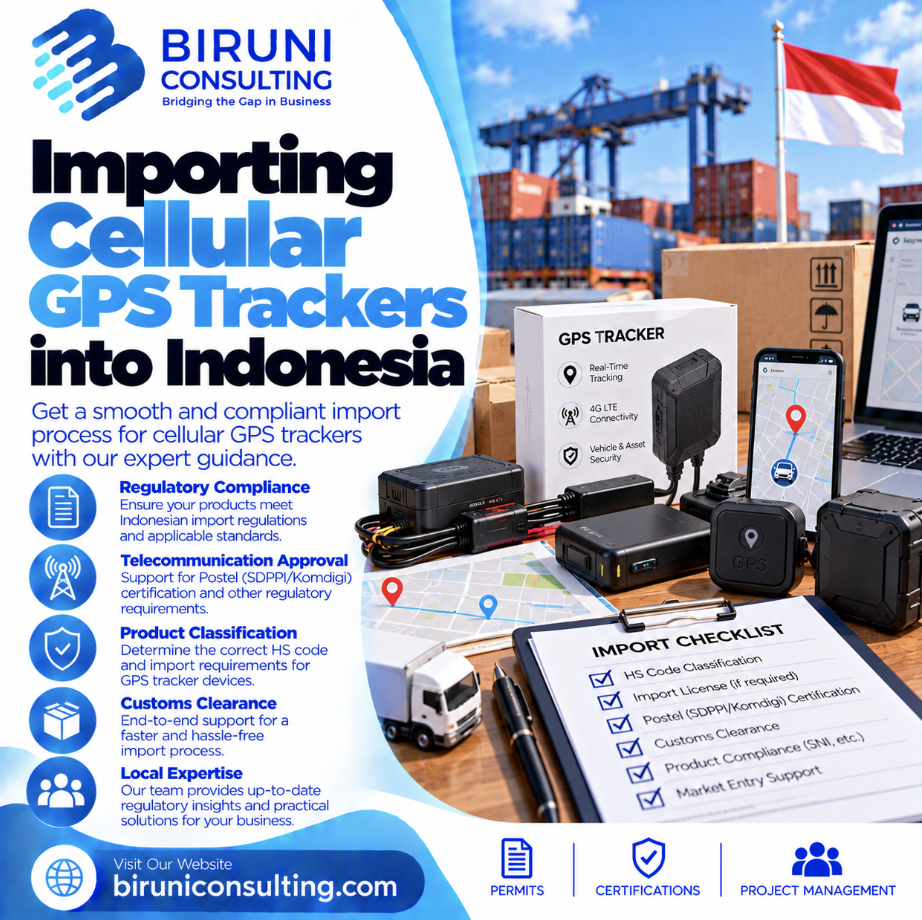
Guide to importing cellular GPS trackers and meeting DJID/SDPPI Certification requirements in Indonesia.
A cellular GPS tracker is a tracking device that uses a satellite navigation system such as GPS/GNSS to determine its location and a cellular network to transmit that information to a server, application, or monitoring platform.
These products are commonly used for vehicle tracking, fleet management, logistics, asset monitoring, heavy equipment, and personal tracking.
Because the device contains cellular telecommunications functions, importation into Indonesia requires assessment of DJID/SDPPI Certification, cellular technology, supported frequency bands, transmission power, SIM connectivity, antennas, and the final product configuration.
Minister of Communication and Informatics Regulation Number 3 of 2024 remains Indonesia’s primary framework for telecommunications equipment and device certification. JDIH Komdigi
Do Cellular GPS Trackers Require DJID Certification?
A cellular GPS tracker should be distinguished from a simple GPS receiver that only receives satellite navigation signals.
A cellular tracker typically performs two main functions.
The GNSS receiver obtains positioning information from navigation satellites, while the cellular module transmits location and other data over a mobile network.
The cellular connection may use GSM, WCDMA, LTE, LTE Cat-1, LTE-M, NB-IoT, or another supported mobile technology.
Because the device actively communicates through a cellular network, its radio configuration needs to be assessed against the applicable Indonesian Technical Standards.
Minister of Communication and Digital Decision Number 469 of 2025 establishes the current list of telecommunications devices subject to Technical Standards. Current implementation lists identify GPS trackers under EX 8526.91.90. hukumonline.com
GPS/GNSS and Cellular Functions
The GPS/GNSS and cellular portions of the product perform different tasks.
The GNSS receiver determines the location of the tracker by receiving navigation signals.
The cellular radio then sends location information and other data to a remote server.
A vehicle tracker, for example, may calculate its position using GNSS and transmit the coordinates, speed, ignition status, or sensor information through an LTE network.
For DJID assessment, it is therefore not sufficient to review only the GPS specification. The cellular transmitter and any additional wireless functions need to be identified.
Importing 4G LTE GPS Trackers
Many new GPS trackers use 4G LTE connectivity.
Depending on the intended application, the device may support LTE Cat-1, Cat-1 bis, Cat-4, LTE-M, or another LTE profile.
The assessment should identify the supported LTE bands, bandwidth, transmission power, cellular module, SIM configuration, and antenna system.
Indonesia’s current Technical Standard for mobile telecommunications equipment based on LTE and IMT-2020 is established under Minister of Communication and Digital Decision Number 569 of 2025, which is currently in force. JDIH Komdigi
The commercial description “4G GPS tracker” is therefore not enough. The actual LTE bands enabled in the product need to be confirmed.
GSM and 3G Tracking Devices
Some industrial and legacy tracking products may still support GSM or IMT-2000 technologies.
Minister of Communication and Digital Decision Number 45 of 2025 establishes the current Technical Standards for cellular telecommunications equipment based on GSM and IMT-2000. JDIH Komdigi
When a tracker supports several generations of cellular technology, such as GSM, WCDMA, and LTE, the complete radio capability should be identified.
This helps ensure that the test reports and module documentation correspond to the actual configuration being imported.
GPS Trackers with NB-IoT or LTE-M
Low-power cellular IoT technologies are increasingly used in tracking devices.
NB-IoT and LTE-M may be suitable for asset trackers and other devices designed for extended battery life and relatively small data transmissions.
The certification assessment should review the cellular module, frequency bands, transmission power, firmware configuration, and antenna specifications.
The exact technology enabled in the final product should be confirmed from manufacturer documentation rather than inferred only from marketing material.
Trackers with Bluetooth or WiFi
Some cellular trackers contain additional radio technologies.
Bluetooth may be used for configuration, smartphone pairing, beacon functions, or external sensors. WiFi may support configuration, connectivity, or positioning-related features.
Where additional radio functions are present, the technical assessment should cover the complete wireless configuration.
This means a GPS tracker may require review of more than just its cellular module.
Cellular Frequency Bands and Transmission Power
Supported cellular bands are a key part of the assessment.
Manufacturers often produce one hardware platform for several international markets, which means the datasheet may contain a long list of frequency bands.
The exact model and firmware configuration being imported into Indonesia should therefore be confirmed.
Transmission power is also important and may appear in documentation as maximum RF output power, conducted power, transmit power, or similar terminology.
The final radio configuration should be matched to the applicable Indonesian Technical Standards.
Is a Certified Cellular Module Sufficient?
Not necessarily.
An existing certification or RF report for the cellular module can be useful supporting documentation, but it does not automatically cover the complete GPS tracker.
Final-product integration may affect the antenna, enabled bands, RF power, firmware, enclosure, and additional wireless functions.
The cellular module documentation should therefore be compared with the final tracker configuration.
This is especially important where one module is used in several different products with different antennas or firmware.
IMEI Considerations
Cellular tracking modules commonly have equipment identities such as IMEI.
However, an IMEI requirement should not automatically be treated in exactly the same way as Indonesia’s IMEI control framework for HKT devices—mobile phones, handheld computers, and tablets.
Minister of Communication and Informatics Regulation Number 1 of 2020 establishes IMEI-based network access controls for HKT devices connected to cellular networks. JDIH Komdigi
A GPS tracker is not automatically an HKT device merely because it contains a SIM card.
The exact device category and applicable IMEI requirements should therefore be reviewed separately.
HS Code for Cellular GPS Trackers
HS classification is also important for the import process.
Heading 8526 includes radar, radio navigational aid, and radio remote-control apparatus, while 8526.91.90 covers other radio navigational aid apparatus. Insw API
The current 2025 telecommunications-device list identifies GPS trackers under EX 8526.91.90. DIMULTI Indonesia
However, Ministerial Decision Number 469 of 2025 states that the HS codes in the telecommunications-device list are used for regulatory supervision and do not themselves determine the final customs classification of an imported product. Scribd
The final HS classification should therefore reflect the actual technical characteristics of the goods.
Documents to Prepare Before Importation
Importers should obtain technical documentation from the manufacturer before commercial shipment.
The main documents generally include product and label photos, product datasheets, user manuals, cellular module information, supported frequency bands, transmission power, GNSS specifications, antenna information, and available RF test reports.
Documentation for Bluetooth or WiFi should also be provided where those technologies are included.
The product model, manufacturer, and country of manufacture should be confirmed at the same stage.
Foreign RF Test Reports
Foreign laboratory reports may support the DJID assessment.
For a cellular GPS tracker, the report should correspond to the actual cellular technology, bands, module, antenna, and product configuration.
A foreign CE, FCC, or similar report does not by itself constitute DJID Certification.
The report still needs to be reviewed against the applicable Indonesian Technical Standards and certification requirements.
Can Several Tracker Models Use One Certificate?
Potential model grouping depends on technical similarity.
Similar housing or software does not automatically mean that several models can be covered under a single Certificate.
The assessment should compare cellular modules, supported bands, transmission power, antennas, GNSS configuration, additional wireless features, brand, and product type.
Regulation Number 3 of 2024 also contains provisions allowing one Certificate to cover more than one variant for certain categories when all applicable technical criteria are fulfilled. JDIH Komdigi
Model grouping should therefore be reviewed before the certification application is submitted.
DJID Certification Process for Cellular GPS Trackers
The process generally begins with a technical assessment of the exact model intended for importation.
The cellular technology, supported bands, module, transmission power, antenna, GNSS function, and any Bluetooth or WiFi features are identified first.
Available RF reports and supporting documents are then reviewed against the applicable Indonesian Technical Standards.
Minister of Communication and Informatics Regulation Number 3 of 2024 provides the main certification framework for telecommunications equipment and devices. JDIH Komdigi
Once the applicable technical and administrative requirements are fulfilled, the certification process can proceed toward DJID/SDPPI Certificate issuance.
Certificate Period for Importation
Under Regulation Number 3 of 2024, the Certificate itself is not time-limited.
However, separate provisions apply to manufacturing, assembly, and importation activities performed under that Certificate. The Certificate holder may conduct those activities for trade and/or use in Indonesia for up to three years from the Certificate issuance date. JDIH Komdigi
Companies planning repeated shipments should therefore monitor the Certificate issuance date.
DJID Labeling
Certified GPS trackers are also subject to labeling requirements.
Regulation Number 3 of 2024 provides a label format including the Certificate number and PLG ID, QR Code, and warning sign. JDIH Komdigi
Because tracking devices are often compact, label placement should be considered before commercial production.
Packaging and regulatory markings should ideally be reviewed before the goods are shipped in large quantities.
Importance of Pre-Shipment Assessment
Pre-shipment assessment is particularly important for cellular trackers because one product family may be available in several radio versions.
For example, the same enclosure may be used for GSM, LTE Cat-1, LTE-M, NB-IoT, or global multi-band variants.
Differences in modules or firmware may change the regulatory configuration of the device.
Completing the assessment before shipment helps identify certification requirements, applicable Technical Standards, RF documentation, HS classification considerations, model grouping, and labeling requirements before the products reach Indonesia.
Conclusion
Importing cellular GPS trackers into Indonesia requires attention to both the positioning function and the cellular telecommunications function.
The cellular technology, supported frequency bands, transmission power, communication module, SIM interface, antenna, and any Bluetooth or WiFi functions are important elements of the DJID/SDPPI assessment.
GPS trackers are also included in the current list of products subject to Technical Standards under the EX 8526.91.90 group, while final customs classification should still be based on the actual imported product. DIMULTI Indonesia
Conducting an assessment before importation helps companies prepare DJID Certification, testing, technical documentation, HS-code information, labeling, and shipment requirements more accurately.
Contact Us
Biruni Consulting assists with DJID/SDPPI assessment and certification for cellular GPS trackers and various IoT and telecommunications products that will be imported or marketed in Indonesia.
Our services include:
- Assessment of DJID/SDPPI certification requirements.
- GSM, LTE, NB-IoT, and other cellular technology assessment.
- RF specification and cellular-band review.
- Frequency and transmission power analysis.
- Technical document review.
- Certification document preparation.
- Testing coordination where required.
- DJID/SDPPI Certification assistance.
If you have a cellular GPS tracker, you can prepare product photos, brand, model, datasheet, cellular band specifications, RF test reports, and module datasheets for an initial assessment of the DJID/Postel Certification requirements.