
Complete Guide to Legal Compliance for Home Food Businesses in Indonesia
Many small-scale food entrepreneurs ask how to register home-based food products with BPOM to ensure legal distribution and market expansion. In Indonesia, food licensing requirements depend on business scale and product risk category. Not all home-based products are immediately required to obtain BPOM MD registration. For low to medium-risk home industries, PIRT certification is usually sufficient.
However, when production capacity increases, distribution expands nationally, or products fall under higher-risk categories, registration with Badan Pengawas Obat dan Makanan Republik Indonesia becomes mandatory. This framework is regulated under Law No. 18 of 2012 on Food and Government Regulation No. 86 of 2019 concerning Food Safety.
Understanding the Difference Between PIRT and BPOM
Before applying, business owners must evaluate their business scale and product category.
1. PIRT for Home Industries
PIRT is issued by local government authorities and applies to low-risk processed food products such as chips, dry cookies, and certain packaged condiments. It requires compliance with Good Food Production Practices for Home Industries (CPPB-IRT).
2. BPOM MD for Larger Scale Businesses
When a home business expands into medium-scale production with nationwide distribution, BPOM MD registration becomes mandatory. This requires compliance with Good Manufacturing Practices (CPPOB).
Requirements for BPOM Registration of Home Products
If the home business qualifies for BPOM MD registration, the following requirements must be prepared:
1. Business Legality
a. Business Identification Number (NIB)
b. Company Tax ID
c. Deed of establishment and legalization
d. Relevant business license
2. Production Facility Readiness
a. Hygienic and compliant facility
b. CPPOB certification
c. Qualified technical person in charge
3. Product Documentation
a. Detailed ingredient composition
b. Production flowchart
c. Raw material specifications
d. Compliant label design
e. Laboratory testing results if required
All documents will undergo administrative and technical evaluation before approval.
Step-by-Step Registration Process
If still under PIRT category:
-
Obtain NIB through OSS
-
Attend food safety training
-
Submit PIRT application
-
Facility inspection
-
Issuance of PIRT number
If required to register under BPOM MD:
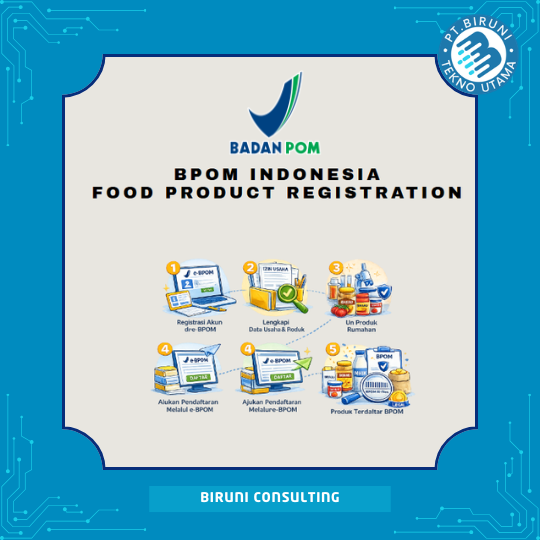
-
Create company account in BPOM e-registration system
-
Obtain CPPOB certification
-
Submit product registration online
-
Undergo evaluation process
-
Receive official MD distribution permit number
Labeling Compliance
Labels must include:
-
Product name
-
Ingredient list
-
Net weight
-
Manufacturer address
-
Distribution permit number
-
Expiry date
-
Production code
-
Nutrition information if applicable
Improper labeling is a frequent cause of application rejection.
Conclusion
Understanding how to register home-based food products with BPOM is essential for legal compliance and business growth. The appropriate license depends on business scale and product risk category. Compliance not only prevents legal issues but also strengthens consumer trust and expands market opportunities.
Biruni Consulting provides professional consultancy services to assist home-based food businesses in obtaining PIRT or BPOM MD registration in full compliance with Indonesian regulations. We support clients from initial assessment, document preparation, label review, CPPOB certification assistance, to final approval. With comprehensive regulatory expertise, Biruni Consulting is your trusted partner in developing a compliant and competitive food business in Indonesia.