
Complete Guide to Obtaining PIRT for Food and Beverage Products in Indonesia
For home-based food and beverage business owners in Indonesia, product legality is an important foundation to ensure safe distribution and consumer trust. One of the most widely used licenses for small food industries is PIRT (Pangan Industri Rumah Tangga) or SPP-IRT (Home Industry Food Production Certificate).
PIRT is a food distribution permit issued for processed food products produced by home industries with a certain risk level. This permit is issued by local government authorities through related agencies as part of food safety supervision in Indonesia.
Products such as chips, cookies, chili sauce, ground coffee, seasoning, powdered drinks, and packaged snacks are generally eligible for PIRT registration. However, certain high-risk food products such as milk-based products, baby food, and canned food usually require BPOM approval instead of PIRT.
Understanding the correct product classification from the beginning is very important to ensure the licensing process runs smoothly and correctly.
Why PIRT Is Important for MSMEs
Obtaining PIRT is not only an administrative requirement but also a form of assurance that food products meet basic safety standards set by the government. This helps increase consumer confidence in the products being sold.
In addition, PIRT also expands business opportunities because many distributors, modern retail stores, and online marketplaces require legal product documentation before allowing food products to be sold.
With PIRT, MSMEs can grow more easily and compete in a more structured and regulated food market.
Requirements for Making PIRT
Before starting the application process, business owners must prepare several important documents as part of the evaluation process. These generally include personal identification such as an ID card, a Business Identification Number (NIB) obtained through OSS, and production location information.
Product-related data must also be prepared carefully, including ingredient composition, production process, shelf life, and packaging label design. Product labeling is a key element because it will be reviewed to ensure compliance with food labeling regulations.
In some regions, business owners may also be required to attend food safety counseling as part of education on hygiene and proper production standards.
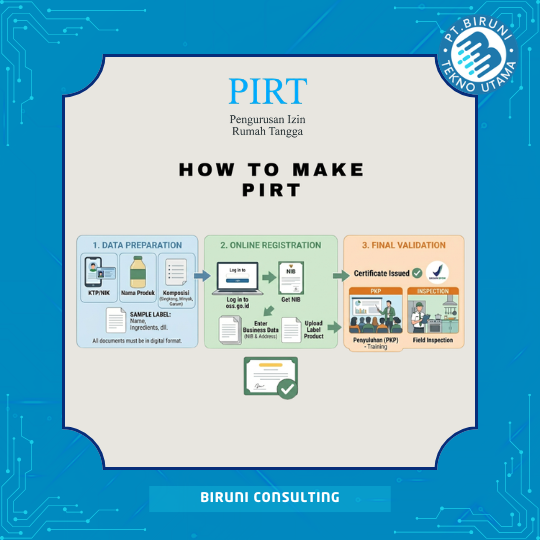
How to Make PIRT
The process of obtaining PIRT involves several structured steps that must be followed in sequence to ensure successful approval.
1. Obtain a Business Identification Number (NIB) through OSS
The first step is to create a Business Identification Number (NIB) through Indonesia’s Online Single Submission (OSS) system. This serves as the main legal identity of the business and is required for most licensing processes.
At this stage, business owners must ensure that their business classification and activity type match their food production activities.
2. Prepare Product Documents
After obtaining NIB, business owners must prepare complete product documentation. This includes ingredient details, net weight, expiration date, manufacturer information, and packaging design.
Complete and accurate documentation helps reduce delays during the verification process.
3. Attend Food Safety Counseling
In certain cases, business owners are required to attend Food Safety Counseling (PKP). This program provides education on good manufacturing practices, hygiene standards, and food safety principles.
4. Submit PIRT Application
Once all requirements are completed, the application can be submitted through local government agencies or the official regional system.
At this stage, authorities will verify business and product data to ensure compliance with applicable regulations.
5. Verification and Inspection
Authorities may conduct document verification and site inspections to ensure that food production is carried out in a clean and hygienic environment according to food safety standards.
6. Issuance of PIRT Number
If all requirements are met, the PIRT or SPP-IRT number will be issued. This number can then be placed on product packaging, allowing the product to be legally distributed in Indonesia.
Regulations Related to PIRT
PIRT issuance follows Indonesian food safety regulations and home industry food supervision policies. These regulations include BPOM provisions for SPP-IRT, OSS business licensing systems, and food labeling requirements.
The main purpose of these regulations is to ensure that food products are safe for consumption, produced hygienically, and clearly labeled for consumer transparency.
Contact Us
Managing PIRT requires proper understanding of food regulations, documentation, and labeling standards. Biruni Consulting is here to assist MSMEs in simplifying the PIRT process in accordance with Indonesian regulations.
- PIRT eligibility consultation to determine correct licensing category.
- Assistance in obtaining NIB (OSS) as basic business legality.
- Food product label review to ensure compliance with regulations.
- PIRT document preparation support to reduce errors and revisions.
- End-to-end consultation until license issuance so products are ready for legal distribution.
We help simplify the licensing process so your products can be legally marketed and professionally managed.