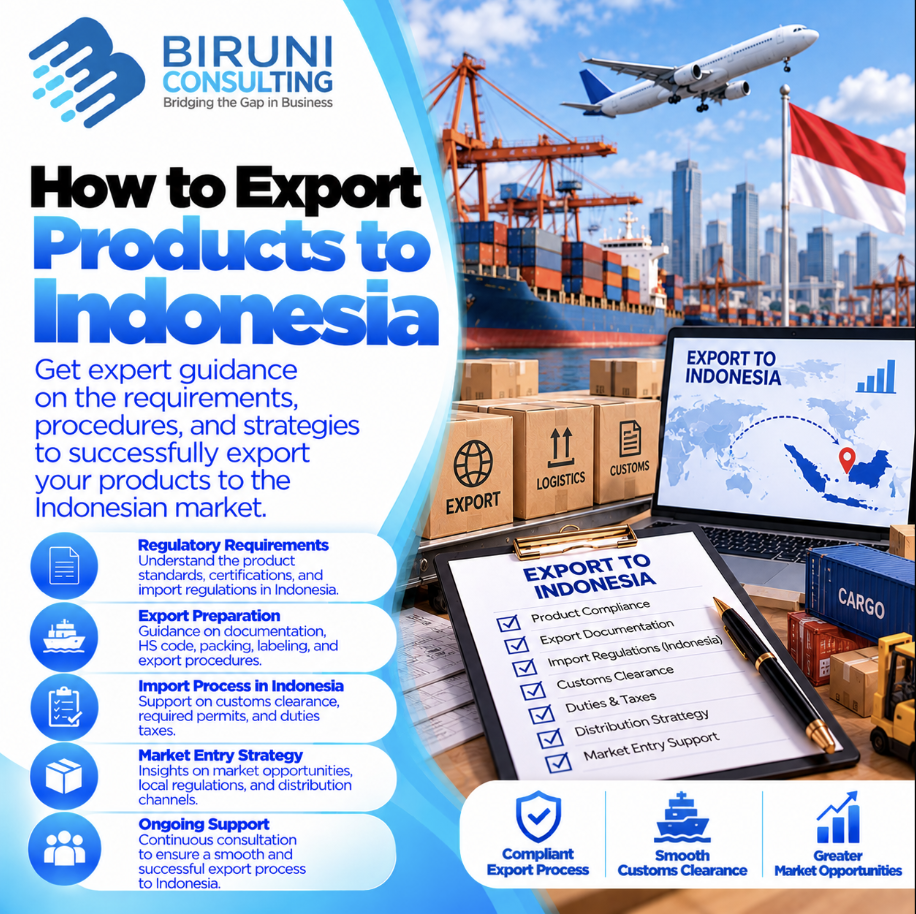
Guide for Overseas Manufacturers and Companies Exporting Products to Indonesia
How to Export Products to Indonesia is an important question for Overseas Manufacturers seeking to sell and ship products to the Indonesian market. Exporting involves more than preparing an invoice, packing list, and international freight. Before goods are shipped, companies need to establish whether the products can legally be imported, whether the Indonesian party holds the appropriate licensing, and whether certification, registration, labeling, and import requirements have been completed.
From the overseas company’s perspective, the transaction is an export. Once the products enter Indonesia, however, the same transaction becomes an import subject to Indonesian customs, trade, and product-specific requirements.
Indonesia’s current general import framework includes Minister of Trade Regulation No. 16 of 2025 concerning Import Policy and Regulation. It was amended by Regulation No. 37 of 2025 and subsequently amended again by Regulation No. 18 of 2026, effective June 4, 2026. The latest amendment covers matters including Import Business Licensing, Import Approvals, Surveyor Reports, Import Customs Declarations, import realization reporting, and administrative sanctions. Database Peraturan | JDIH BPK
Minister of Trade Regulation No. 16 of 2025 also provides that an importer must hold an NIB that functions as its API. An Overseas Manufacturer should therefore establish the appropriate Indonesian import structure before shipping begins. Database Peraturan | JDIH BPK
Start with Product Regulatory Assessment
The first step in How to Export Products to Indonesia is assessing the product to be shipped.
A commercial product name alone is not sufficient to determine import requirements. Companies need to understand technical characteristics, intended use, materials or ingredients, models, capacities, HS codes, country of origin, and manufacturing sites.
Initial information commonly required includes:
- Product catalogues and technical specifications.
- Model or variant lists.
- Material or ingredient information.
- HS code and country of origin.
- Existing certificates or test reports.
The assessment helps establish whether the product requires import approval, SNI, BPOM registration, halal certification, laboratory testing, labeling compliance, or another technical approval.
An HS code is important for customs and trade classification but should not normally serve as the sole basis for interpreting product-specific regulations.
Check Whether the Product Is Prohibited or Restricted
Before shipping, companies need to establish whether the product can legally be imported into Indonesia.
Not every product can enter without restrictions. Certain goods are prohibited, while others can be subject to licensing or technical requirements.
Minister of Trade Regulation No. 47 of 2025 concerning Goods Prohibited for Import is currently in force from January 1, 2026 and replaced the previous prohibited-import framework under Regulation No. 18 of 2021. Database Peraturan | JDIH BPK
In addition to prohibited goods, certain products can require particular Business Licensing, Import Approvals, Surveyor Reports, or other technical requirements.
Commercial shipments should therefore not begin until the product’s prohibition-and-restriction status has been established.
Determine the Correct HS Code
HS classification is an important element of exporting and importing because it identifies the goods for customs and trade purposes.
HS classification can affect:
- import requirements;
- customs duty;
- import taxes;
- prohibitions or restrictions;
- technical documentation; and
- the relevant regulator.
The HS code still needs to be reviewed together with product descriptions and technical specifications.
Products with similar trade names can have different classifications because their functions or characteristics differ. Likewise, goods within similar headings do not necessarily have identical regulatory pathways.
Incorrect classification can delay customs clearance or result in unsuitable import approvals.
Determine the Indonesian Importer
An Overseas Manufacturer generally needs an Indonesian party capable of acting as importer when commercial goods enter Indonesia.
The importer performs a different function from the Overseas Manufacturer and is not automatically the distributor or Official Representative.
Minister of Trade Regulation No. 16 of 2025 provides that importers must hold an NIB functioning as their API or Importer Identification Number. Database Peraturan | JDIH BPK
Before commercial shipment, manufacturers should establish:
- The importer holds an appropriate NIB and eligibility.
- Its business activities correspond with the goods.
- Product-specific import requirements are completed.
- The importer understands customs obligations.
- Its relationship with the distributor or registration holder is clear.
Selecting an importer solely on logistics pricing without reviewing regulatory eligibility can create substantial shipment risk.
Importers and Distributors Are Not Always the Same
A distributor commonly handles sales, commercial distribution, channel management, and customer development.
The importer handles the legal importation of goods according to applicable licensing and import requirements.
One company can perform both functions where the Business Licensing and product regulation permit.
However, Overseas Manufacturers should not automatically assume that a distributor can also act as importer.
The structure should be assessed before distribution and shipping agreements are finalized.
Consider Regulatory Ownership
In addition to selecting an importer, an Overseas Manufacturer needs to decide which party will control product registrations or approvals.
For certain product categories, approvals can be held by an Indonesian party.
Before signing an exclusive agreement, companies should identify:
- The product-registration applicant.
- The approval holder.
- The party controlling the regulator account.
- The party managing renewals.
- What happens if the importer or distributor changes.
Excessive dependence on one commercial partner for regulatory ownership can reduce the manufacturer’s flexibility to change partners later.
Business Licensing and OSS
The Indonesian party performing import activities needs appropriate Business Licensing.
Government Regulation No. 28 of 2025 is currently Indonesia’s Risk-Based Business Licensing framework. It became effective on June 5, 2025 and revoked Government Regulation No. 5 of 2021. Its scope includes Business Licensing, PB UMKU, OSS system services, supervision, evaluation, and other components. Database Peraturan | JDIH BPK
Business Licensing should be reviewed together with KBLI, NIB, actual business activities, and the functions assigned to the Indonesian entity.
Simply having an Indonesian company does not automatically mean that the company can import every category of goods.
NIB as API
An important part of How to Export Products to Indonesia is understanding the relationship between NIB and API.
Minister of Trade Regulation No. 16 of 2025 provides that an importer needs an NIB functioning as its API. The regulation forms part of the current import framework and was most recently amended by Minister of Trade Regulation No. 18 of 2026. Database Peraturan | JDIH BPK
An Overseas Manufacturer should therefore confirm the importer’s structure before goods are shipped.
Additional import approvals can still be necessary depending on the goods.
Check Whether an Import Approval Is Required
Not every product requires an Import Approval or Persetujuan Impor.
The requirement is product-specific and needs to be established under current import regulations.
Minister of Trade Regulation No. 18 of 2026 amended provisions concerning applications for Import Business Licensing, changes to Import Business Licensing, extensions of Import Approvals, Surveyor Reports, Import Customs Declaration documents, and import-realization reporting. Database Peraturan | JDIH BPK
Overseas suppliers should therefore not ship products solely because they have received a purchase order.
The importer needs to confirm that all mandatory approvals have been obtained before shipment.
Check Surveyor or Technical Verification Requirements
Certain product categories can require Verification or Technical Inspection and a Surveyor Report.
These requirements do not apply to every product.
Where required, the process may need to occur before shipment or according to stages established by regulation.
The exporter should ensure that product descriptions, quantities, specifications, shipment information, and supporting documents correspond with the importer’s approvals.
Document inconsistencies can affect customs clearance in Indonesia.
Check SNI Before Export
Many industrial products in Indonesia are covered by Indonesian National Standards.
However, the existence of an SNI does not automatically make certification mandatory.
BBSPJIKKP explains that both Mandatory and Voluntary SNI schemes exist. Applications for products under Ministry of Industry Mandatory SNI schemes are submitted through SIINas. BBSPJIKKP
Before goods are shipped, an SNI assessment should determine:
- The relevant SNI.
- Standard version.
- Mandatory or voluntary status.
- Product scope under the regulation.
- Applicable certification scheme.
Where a product falls under Mandatory SNI, the required certification route should be completed in accordance with the applicable regulation before commercial distribution.
LSPro in SNI Certification
Where SNI certification is required, an Overseas Manufacturer needs to work with an appropriate LSPro or Lembaga Sertifikasi Produk / Product Certification Body.
The LSPro conducts product certification and makes certification decisions. A Testing Laboratory performs testing. A consultant supports regulatory preparation but does not replace the LSPro.
BBSPJIKKP explains that product certification is intended to ensure companies operate an appropriate quality system and can consistently manufacture products meeting applicable standards. BBSPJIKKP
An Overseas Manufacturer can therefore need to prepare documentation, a factory audit, sampling, laboratory testing, and corrective actions according to the certification scheme.
Factory Audits for Overseas Manufacturers
Certain certification schemes can require audits of manufacturing facilities.
Because the production site is outside Indonesia, an audit can require international auditor travel.
Areas reviewed can include:
- Production processes.
- Incoming-material control.
- Quality inspection.
- Internal testing and calibration.
- Traceability and corrective actions.
A pre-audit gap analysis can help manufacturers address avoidable issues before formal assessment.
Laboratory Testing and Sampling
Laboratory testing can be required before products can be commercially distributed.
Exporters should not independently ship samples until applicable sampling rules have been established.
A certification scheme can specify the sample model, quantity, sampling location, sealing, identification, and destination laboratory.
International test reports already held by a manufacturer are also not necessarily automatically acceptable.
Acceptance needs to be assessed according to the applicable regulation and certification scheme.
BPOM for Relevant Products
Products under BPOM supervision can require product registration before commercial shipment or distribution.
For imported processed food, BPOM identifies requirements including an OSS-RBA NIB, Business Licensing corresponding with KBLI, PB UMKU relating to SMKPO, appointment documentation, and GMP/HACCP or comparable documentation for the foreign production facility. Direktorat Registrasi Pangan Olahan
These requirements are examples for processed food.
Cosmetics, medicines, supplements, and other BPOM-regulated categories have separate pathways that need independent review.
Where product approval is required before circulation, Overseas Manufacturers should ensure that registration is completed before commercial shipments begin.
Halal for Products Exported to Indonesia
Halal compliance is also an important consideration for product categories falling within mandatory-halal requirements.
BPJPH confirmed that Mandatory Halal implementation proceeded from October 18, 2026 without postponement. The government was also preparing special provisions for certain circumstances, including some imported products. BPJPH
Because that date has now passed, Overseas Manufacturers should include halal assessment early where their products fall within relevant categories.
Halal requirements should not be generalized across all products. Product category, ingredients, supply chains, and mechanisms applicable to foreign products need specific review.
Foreign Halal Certificates
A company already holding a halal certificate in its country of origin cannot necessarily assume that the certificate completes all Indonesian requirements.
An Overseas Manufacturer needs to review the applicable recognition and registration mechanisms and their relationship with the Indonesian party.
Halal review should be conducted before final labels, packaging, and commercial shipments are finalized.
This allows halal information on packaging to remain consistent with the approvals applicable in Indonesia.
Official Representative for Certain Products
Under certain Mandatory product regulations, an Overseas Manufacturer can be required to maintain an Official Representative in Indonesia.
The Official Representative performs a different role from the importer, distributor, consultant, LSPro, and Testing Laboratory.
Not every imported product requires a Representative.
Where required, the assessment can involve:
- Indonesian legal-entity requirements.
- Manufacturer appointment.
- Trademark relationships.
- Warehouse requirements.
- SIINas or importer relationships.
The requirement needs to be determined from the specific product regulation before an appointment is made.
Prepare Indonesian Labeling
Products already using global packaging cannot necessarily be sold in Indonesia using the same labeling without adjustment.
Label requirements are product-specific.
Review can include:
- Bahasa Indonesia.
- Product identity.
- Ingredients or materials.
- Manufacturer and importer information.
- Warnings, instructions, registration, or halal information.
Labels should ideally be reviewed before mass production.
Where regulatory review occurs after production, the company can face additional relabeling or reprinting costs.
Select Incoterms with Regulatory Responsibility in Mind
Incoterms help divide commercial responsibilities between seller and buyer, but they do not replace Indonesian regulatory obligations.
Exporters need to understand which party bears freight, insurance, customs-clearance, import-duty, and local-delivery responsibilities.
The company still needs to ensure that the party acting as importer is legally eligible under Indonesian requirements.
Commercial terms such as CIF, FOB, FCA, or others do not automatically determine which party can legally serve as importer.
Prepare the Commercial Invoice
The commercial invoice is one of the main international-shipment documents.
Its information should remain consistent with the purchase order, packing list, transport document, customs declaration, and regulatory approvals.
An invoice generally includes:
- seller and buyer;
- product description;
- quantity;
- unit and total value;
- currency;
- Incoterms; and
- country of origin where relevant.
Product descriptions should be sufficiently clear to connect the invoice with the actual goods and supporting import documents.
Prepare the Packing List
A packing list explains how the goods are packed.
It can include carton or pallet quantities, gross weight, net weight, dimensions, product models, quantities, and package identification.
Packing-list information should correspond with the invoice and transport documents.
Where regulated products are involved, model and quantity information should also remain consistent with applicable import approvals or product registrations.
Bill of Lading or Air Waybill
For sea freight, the transport document is normally a Bill of Lading. For air freight, it is normally an Air Waybill.
Exporters need to ensure that consignee, shipper, description, quantity, and shipment information correspond with commercial and customs documents.
Late changes to the consignee or product information can create issues where approvals were issued for a specific party.
Shipping instructions should therefore be finalized after the importer structure is clear.
Certificate of Origin
A Certificate of Origin can be important where the importer seeks preferential tariffs under an applicable trade agreement.
Eligibility depends on the origin criteria and requirements of the relevant agreement.
Country of shipment is not necessarily the same as country of origin.
Exporters should ensure that applicable rules of origin are satisfied before claiming preferential treatment.
Consider Customs Valuation
Customs value is an important basis for the calculation of customs duties and import-related taxes.
The commercial invoice should reflect the transaction correctly, and supporting documents need to be available where necessary.
Exporters and importers should avoid inconsistent pricing or descriptions across commercial and customs documents.
Related-party transactions may also require appropriate consideration under customs-valuation rules.
Import Customs Declaration
When goods arrive in Indonesia, the importer performs the applicable customs obligations.
Indonesia Customs explains that imports for use are generally processed through a Pemberitahuan Impor Barang or PIB. The PIB is prepared using supporting customs documents such as invoices, packing lists, Bills of Lading or Air Waybills, product-identification documents, and documents proving compliance with import requirements. Beacukai
Customs also explains that importers need to complete customs obligations, pay applicable customs duties, excise and/or import taxes, and comply with prohibitions and restrictions. Beacukai
The quality and consistency of documentation supplied by the exporter can therefore directly affect the importer’s customs-clearance process.
Customs Duties and Import Taxes
The importer needs to consider customs duties and applicable import taxes according to classification, customs value, origin, and the relevant regulations.
Rates can vary according to HS code.
Preferential tariff treatment can be available where goods satisfy applicable rules of origin and the required origin documentation is available.
An Overseas Manufacturer should provide accurate product and origin information so the importer can calculate landed costs before confirming purchase orders and shipments.
Customs Clearance
Customs clearance is not simply a matter of presenting documents after the goods arrive.
Indonesia Customs explains that importers need to submit the applicable release documents, settle amounts due, and comply with import prohibitions and restrictions. Customs controls are also applied using risk management. Beacukai
Regulatory preparation should therefore ideally be completed before the goods leave the country of export.
Shipping regulated products and then attempting to obtain certifications or import approvals after arrival can lead to storage costs, demurrage, delays, or an inability to release the goods.
Do Not Ship Before Approvals Are Ready
One of the main mistakes in export projects is assuming that regulatory approvals can be completed after shipment begins.
For regulated goods, that approach can create significant risk.
Before commercial shipment, companies should verify:
- Importer eligibility.
- Import licensing.
- Product registration or certification.
- Label readiness.
- Customs documentation.
Where an important approval remains incomplete, the shipment schedule should be aligned with the regulatory timeline.
Exporting Samples for Testing
Before commercial exports begin, companies may need to ship samples for certification, registration, research, or testing.
Sample shipments do not always follow the same structure as commercial shipments.
A certification scheme can require samples to be selected by a specified party, sealed, or specially identified.
Manufacturers should therefore obtain the applicable sampling instructions before sending samples.
Samples shipped independently may not qualify as formal certification samples.
Multiple Models in One Shipment
An Overseas Manufacturer can export several models within one product family.
The company needs to ensure that every shipped model falls within the approved regulatory scope.
A product registration or SNI Certificate does not necessarily cover every possible variant automatically.
Model mapping before shipment helps maintain consistency among invoices, packing lists, approval documents, and actual goods.
Shipping unapproved models together with approved products can create compliance problems.
Multiple Manufacturing Sites
Multinational manufacturers can manufacture the same product at several factories.
The Overseas Manufacturer needs to verify that the manufacturing site stated in product approvals corresponds with the factory actually supplying the shipment.
Under certain certification schemes, the manufacturing site is an important part of the certification scope.
Production should therefore not be transferred to another factory without assessing the regulatory impact.
Prepare Warehousing and Distribution
After customs clearance, goods typically enter an Indonesian warehouse or distribution network.
Under certain product regulations, warehouses can have regulatory significance.
Companies need to maintain appropriate storage conditions, traceability, inventory identification, and distribution records.
These controls can also become important in the event of a recall or regulatory inspection.
Product Traceability
Traceability allows companies to connect a product batch with the manufacturer, shipment, importer, distributor, and customer channel.
Information can include:
- Batch or lot number.
- Production date.
- Shipment reference.
- Import-declaration reference.
- Distribution records.
Traceability becomes particularly important in the event of complaints, nonconformities, recalls, or regulatory investigations.
Post-Market Compliance
How to Export Products to Indonesia does not end when customs clearance is completed.
Products can remain subject to surveillance, renewals, reporting, post-market monitoring, or periodic certification requirements.
For product certification, BBSPJIKKP maintains procedures covering certification maintenance, suspension, restoration, reduction or extension, and withdrawal. This demonstrates that certification continues through a compliance lifecycle after initial approval. BBSPJIKKP
An Overseas Manufacturer and its Indonesian partner need to establish responsibility for ongoing compliance.
Product Changes After Exports Begin
Once the supply chain is operational, manufacturers can make changes to their products or manufacturing processes.
Changes can include:
- Materials or ingredients.
- Product specifications.
- Models.
- Manufacturing sites.
- Brands, labels, importers, distributors, or Representatives.
Not every change requires new approval.
However, a regulatory impact assessment should be conducted before changes are introduced into products exported to Indonesia.
Regulatory Monitoring
Import rules can change, so exporters should not continue using the same compliance checklist indefinitely without review.
Minister of Trade Regulation No. 16 of 2025 was amended by Regulation No. 37 of 2025 and subsequently Regulation No. 18 of 2026. Regulation No. 47 of 2025 concerning Goods Prohibited for Import also became effective on January 1, 2026. Database Peraturan | JDIH BPK
Regulatory monitoring should cover:
- import regulations;
- prohibited or restricted goods;
- product certification;
- product registration;
- labeling;
- halal; and
- customs procedures.
Monitoring allows companies to update shipping procedures before regulatory changes disrupt the supply chain.
How Long Does It Take to Export Products to Indonesia?
There is no single timeline applicable to every product.
Products with limited regulatory requirements can follow a simpler process than regulated products requiring product registration, factory audits, SNI certification, halal procedures, or laboratory testing.
Timing can depend on:
- Product classification.
- Import licensing.
- Certification or registration.
- Laboratory testing.
- Importer readiness.
Regulatory assessment should be completed before the company promises a first-shipment date to customers.
Cost of Exporting Products to Indonesia
Total cost involves more than international freight.
The cost structure can include:
- product certification;
- product registration;
- laboratory testing;
- factory auditing;
- regulatory consulting;
- sample shipment;
- international freight;
- customs duties and taxes;
- halal procedures; and
- importer, Representative, warehousing, or distribution costs.
An Overseas Manufacturer should calculate the complete landed-cost structure with its Indonesian partner before setting commercial prices.
Common Mistakes When Exporting Products to Indonesia
The first common mistake is shipping before understanding import requirements.
Another is assuming that a buyer or distributor automatically qualifies as importer.
Companies also frequently begin testing too early, rely solely on HS codes without technical assessment, or assume international certification is automatically accepted in Indonesia.
Other mistakes can include:
- inconsistent invoices and packing lists;
- models outside the approved scope;
- non-compliant labeling;
- missing import approvals; or
- unclear regulatory ownership.
Most of these risks can be reduced through regulatory assessment before the first purchase order is shipped.
How to Export Products to Indonesia Roadmap
A general roadmap can include:
- Product classification and regulatory assessment.
- Establishing the importer and commercial structure.
- Completing certification, registration, or import approvals.
- Preparing shipping and customs documents.
- Maintaining post-market compliance after distribution begins.
The detailed roadmap should be adapted to the product category.
For regulated products, certification and import approvals should generally be treated as dependencies before commercial shipment.
Is a Market Entry Consultant Necessary?
An Overseas Manufacturer can use a market-entry or regulatory consultant to connect product requirements with the import process.
A consultant can assist with product assessment, SNI review, BPOM pathway review, halal assessment, importer structures, Official Representative requirements, testing coordination, and documentation preparation.
However, a consultant does not replace regulators, Customs, LSPro, or Testing Laboratories.
A consultant also cannot guarantee customs clearance or certification results without all mandatory requirements being satisfied.
Conclusion
How to Export Products to Indonesia begins long before goods are loaded into a container or handed to a freight forwarder.
An Overseas Manufacturer needs to establish product classification, HS codes, importer structure, NIB/API, import licensing, product certification, BPOM registration, SNI, halal requirements, labeling, customs documentation, and the appropriate local commercial structure.
Minister of Trade Regulation No. 16 of 2025 currently forms an important part of the general import framework and has been amended by Regulation No. 37 of 2025 and Regulation No. 18 of 2026. The current framework provides for the importer’s NIB to function as API, while the 2026 amendment also addresses Import Business Licensing, Import Approvals, Surveyor Reports, Import Customs Declarations, and import-realization reporting. Database Peraturan | JDIH BPK
Companies also need to ensure that the goods are not prohibited from import. Minister of Trade Regulation No. 47 of 2025 concerning Goods Prohibited for Import has been effective since January 1, 2026. Database Peraturan | JDIH BPK
After goods arrive, the importer needs to complete customs obligations through PIB and supporting documents such as invoices, packing lists, Bills of Lading or Air Waybills, and documents demonstrating compliance with import requirements. Beacukai
By establishing a regulatory roadmap before shipment, companies can reduce the risk of cargo delays, duplicated testing, incorrect documentation, import-approval problems, and additional costs when exporting products to Indonesia.
Contact Us
Biruni Consulting assists companies with How to Export Products to Indonesia professionally and in accordance with applicable regulations in Indonesia.
Our services include:
- Regulatory consultation.
- Identification of applicable standards.
- Preparation of certification documents.
- Assistance with laboratory testing.
- Certification processing until certificate issuance.
Biruni Consulting assists Overseas Manufacturers with regulatory assessment, SNI, BPOM, halal compliance, importer selection, Official Representative requirements, product certification, laboratory testing, and compliance preparation before products are exported and marketed in Indonesia.
Contact Us for guidance on How to Export Products to Indonesia, Market Entry Indonesia, Market Access Services Indonesia, Official Representative, and imported-product regulatory compliance assistance.