
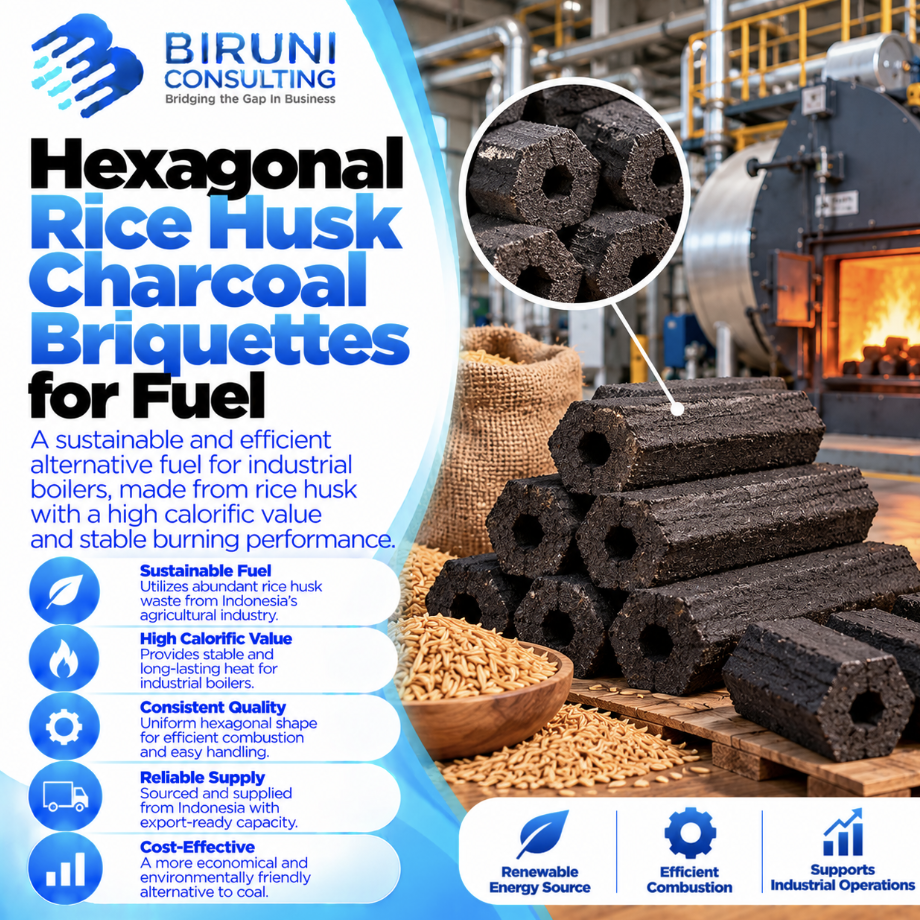
What Are Hexagonal Rice Husk Charcoal Briquettes?
Hexagonal rice husk charcoal briquettes are solid fuels produced from carbonized rice husk that is processed, sized, blended with a binder where required, and compressed into a hexagonal profile.
Many hexagonal briquettes also contain a longitudinal center hole. Technical literature on screw-extruded briquettes describes cylindrical or hexagonal shapes with a concentric hollow core created during extrusion. The opening provides an additional airflow path and increases the amount of fuel surface exposed during combustion. Energypedia
For commercial and industrial users, this geometry may be attractive when a consistent, stackable solid fuel is required.
However, shape alone does not define quality. Calorific value, moisture, ash, fixed carbon, volatile matter, density, mechanical strength, and feedstock composition remain important.
Why Use Rice Husk Charcoal?
Rice husk is an agricultural by-product generated during rice milling.
Carbonization converts the biomass into charcoal with characteristics different from loose rice husk or non-carbonized rice husk briquettes.
After the charcoal is densified into briquettes, the resulting product is generally easier to handle than loose charcoal powder.
The process therefore creates an additional utilization pathway for agricultural residues while producing a solid fuel that can be used in compatible combustion applications.
Why a Hexagonal Shape?
Hexagonal geometry is more than a visual product characteristic.
When a center hole is included, it creates an additional pathway through which air can move during combustion. Technical references on screw presses explain that extrusion can produce round or hexagonal hollow-core briquettes, with the center opening created by the extrusion screw. Energypedia
Potential practical advantages include:
- Additional airflow through the center.
- Increased exposed surface area.
- Convenient stacking and handling.
- Consistent dimensions when production is controlled.
- Compatibility with certain combustion systems.
A center hole does not automatically make every hexagonal briquette superior.
Outer diameter, hole diameter, briquette length, density, porosity, binder, and compression conditions all influence actual burning performance.
Does Briquette Shape Affect Combustion?
Shape can influence combustion characteristics.
A 2026 study evaluating several shapes of rice husk charcoal briquettes found differences in density, combustion rate, moisture, ash, and gross calorific value among the samples. The research evaluated cylinder, sphere, cube, and rectangular forms and reported calorific values of approximately 2,796–3,314 cal/g for the formulations tested. Jurnal UBT
The study did not specifically evaluate a hexagonal profile.
Nevertheless, it demonstrates that briquette geometry can be one of the variables affecting fuel behavior.
This is one reason industrial buyers should evaluate actual samples rather than assuming all briquette shapes perform identically.
Hexagonal Briquettes With and Without a Center Hole
Hexagonal briquettes may be solid or hollow-core.
Hexagonal With a Center Hole
The center opening provides an internal airflow path.
Under suitable combustion conditions, air and flame can interact with more fuel surface.
However, increasing the hole diameter also reduces the amount of fuel contained within a briquette of the same external dimensions and can change its burning rate.
Solid Hexagonal Briquettes
A solid briquette contains more material within the same external dimensions.
Ignition and combustion behavior can differ because direct airflow is concentrated around the external surface.
The preferred design depends on the burner, furnace, grate, or heating application.
Manufacturing Process
Production typically begins by drying rice husk where necessary and carbonizing it under controlled conditions.
The resulting charcoal is crushed and screened to achieve the particle size required for briquetting.
A binder may then be added according to the formulation.
The mixture is compressed through a hexagonal die or extruder and subsequently dried until the desired final moisture and physical strength are achieved.
Carbonization temperature, particle size, binder content, compression, and drying conditions can all affect finished-product quality.
Research on rice-husk-charcoal-based briquettes has shown that changes in carbonization temperature can significantly affect moisture, ash, volatile matter, and calorific value. Jurnal UIN Alauddin
The Role of Carbonization
Carbonization is one of the main differences between a rice husk charcoal briquette and a non-carbonized rice husk briquette.
During carbonization, biomass is heated under limited oxygen conditions to produce charcoal.
This process can change:
- volatile matter,
- fixed carbon,
- moisture,
- material structure,
- and calorific value.
Temperature and residence time influence the characteristics of the resulting charcoal.
Carbonization alone, however, does not guarantee a particular calorific value. Feedstock composition, ash, binder, particle size, and briquetting conditions continue to affect the final product.
Calorific Value of Rice Husk Charcoal Briquettes
Calorific value is one of the most important specifications for a fuel briquette.
There is no single universal value for all rice husk charcoal briquettes.
A 2025 study investigating rice husk and palm kernel shell charcoal briquettes reported a maximum calorific value of approximately 5,242.76 cal/g for the tested 100% rice husk formulation. Other parameters in the same research showed why calorific value alone should not be treated as a complete indicator of fuel quality. eJournals Universitas Mulawarman
A 2026 study using rice husk charcoal blended with sugarcane bagasse charcoal reported mean calorific values of approximately 4,679.59–4,752.72 cal/g, depending on formulation. Scholar Universitas Muhammadiyah Metro
These differences demonstrate the importance of testing the actual commercial product.
Why Can Calorific Value Vary?
Feedstock composition is a major factor.
A 100% rice husk charcoal briquette can produce different results from one blended with coconut shell, palm kernel shell, bagasse, coffee-ground charcoal, or another biomass charcoal.
Binder content also matters.
A 2026 study of briquettes containing 60% rice husk charcoal, 40% coffee-ground charcoal, and 3% molasses reported a calorific value of approximately 5,335.80 cal/g for its best formulation. eJournal UMP
For procurement purposes, suppliers should therefore disclose the actual composition where relevant rather than simply marketing the product as a rice husk briquette.
Moisture Content
Moisture influences useful fuel performance because energy is required to evaporate water during combustion.
Consistent moisture is therefore important when comparing different batches.
Storage conditions also matter.
Briquettes should remain protected against rain and excessive humidity because water absorption can affect both combustion and physical strength.
For recurring purchasing programs, a maximum moisture level can be included in the technical specification.
Ash Content
Ash is an important consideration for rice-husk-based fuels.
Its level can vary substantially according to raw material, contamination, carbonization, binder, and formulation.
Published studies on rice-husk-charcoal-based briquettes report widely differing ash results, demonstrating why a single reference value should not be assumed to represent every commercial product. Jurnal UBT
For fuel users, ash influences:
- Residue volume.
- Cleaning frequency.
- Ash handling and disposal.
- Equipment maintenance.
- Deposit or clinker risk under certain conditions.
Ash should therefore be assessed together with calorific value.
Fixed Carbon and Volatile Matter
Fixed carbon and volatile matter provide additional information about fuel behavior.
Volatile matter represents compounds released as the fuel is heated.
Fixed carbon describes part of the solid carbon fraction remaining after volatile components are accounted for.
These parameters are particularly relevant for charcoal briquettes because carbonization conditions strongly affect them.
Commercial and industrial buyers can request a proximate analysis including moisture, ash, volatile matter, and fixed carbon.
Density and Mechanical Strength
A useful fuel briquette must also survive normal handling.
Products can experience pressure and impact during packaging, transportation, unloading, warehousing, and feeding.
Weak briquettes can generate excessive broken pieces and fines.
Density, compressive strength, shatter resistance, or other durability indicators can therefore be relevant depending on the application.
Long hexagonal briquettes may also require careful packaging because their geometry can make breakage during transport an important quality consideration.
The Role of Binder
Charcoal powder often requires a binding system to maintain its compressed form.
Common formulations can use starch, molasses, or other binders.
Binder concentration needs to be controlled.
Insufficient binding can reduce mechanical strength, while excessive binder may alter moisture, ash, ignition behavior, calorific value, and combustion performance.
Buyers can therefore request the binder type and percentage where this information is relevant to the intended application.
Using SNI 01-6235-2000 as a Reference
Indonesia’s National Standardization Agency currently lists SNI 01-6235-2000 – Wood Charcoal Briquettes as an active standard. Importantly, its stated product scope is wood charcoal briquettes rather than rice husk charcoal briquettes. Pesta
Several rice husk briquette studies use parameters from this SNI as a research benchmark. That does not mean every rice husk charcoal briquette automatically falls within the standard’s formal product scope. Jurnal UBT
Manufacturers or buyers requiring formal compliance should therefore verify the correct product standard and certification requirements before making a compliance claim.
What About ISO 17225?
ISO 17225 contains several standards covering solid biofuel categories.
However, there is an important distinction for charcoal products.
ISO 17225-8:2023 covers graded thermally treated and densified biomass fuels for commercial and industrial use, but ISO explicitly states that products marketed as charcoal or charcoal products are excluded from its scope. ISO
A rice husk charcoal briquette should therefore not automatically be advertised as compliant with ISO 17225-8 simply because the biomass has undergone thermal treatment.
Applicable requirements need to be evaluated according to the actual product and target market.
Hexagonal Briquettes for Industrial Fuel
Hexagonal rice husk charcoal briquettes can potentially be used in furnaces, dryers, burners, and other solid-fuel systems where equipment is compatible.
For boiler applications, important considerations include:
- fuel dimensions and feeding,
- calorific value,
- ash handling,
- combustion-air settings,
- and supply consistency.
Charcoal briquettes behave differently from loose rice husk and non-carbonized briquettes.
An engineering review and controlled trial should therefore be completed before a large-scale fuel change.
Hexagonal Briquettes for Commercial Heating
Hexagonal charcoal briquettes are also used in a variety of commercial heating applications because their dimensions can be controlled and hollow-core designs can be manufactured.
However, products intended for cooking or direct food-heating applications may have different requirements from industrial fuels.
Binder composition, contaminants, smoke, odor, emissions, and raw-material quality can become particularly important.
Suppliers should clearly identify the intended use of the product.
Hexagonal vs. Other Briquette Shapes
No single shape is automatically best for every application.
| Factor | Hexagonal With Hole | Solid Cylinder/Cube |
|---|---|---|
| Airflow | Internal airflow path | Primarily external |
| Surface Area | Increased by center opening | Depends on dimensions |
| Handling | Can stack efficiently | Depends on geometry |
| Breakage | Important for long pieces | Depends on density and strength |
| Feeding | Must match equipment | Must match equipment |
| Combustion | Affected by hole and density | Affected by density and size |
Actual operating tests remain important because geometry is only one of many variables affecting fuel performance.
Rice Husk Charcoal Briquettes vs. Non-Carbonized Rice Husk Briquettes
Both products originate from rice husk but use different production processes.
Non-carbonized briquettes densify biomass without first converting it to charcoal.
Rice husk charcoal briquettes use carbonized feedstock.
The difference can affect fixed carbon, volatile matter, ignition, smoke behavior, density, and calorific value.
Buyers should clearly state which product they require when requesting quotations.
Certificate of Analysis
Commercial buyers can request a Certificate of Analysis or CoA.
A practical CoA may include:
- Calorific value and reporting basis.
- Moisture and ash.
- Volatile matter and fixed carbon.
- Density and dimensions where tested.
- Additional parameters required by the application.
Test methods, sample identification, test date, and batch relevance should also be reviewed.
Trial Before Bulk Purchasing
A physical sample is useful, but actual fuel performance should ideally be tested under representative conditions.
A trial can assess ignition, combustion stability, heat output, fuel consumption, ash generation, breakage, fines, and equipment compatibility.
For industrial boilers or process heating, trial results can also be used to calculate fuel cost relative to steam or useful heat output.
This provides a stronger procurement basis than price per kilogram alone.
Comparing Suppliers
A simple supplier comparison can include:
| Parameter | Supplier A | Supplier B | Supplier C |
|---|---|---|---|
| Raw Material | Data | Data | Data |
| GCV/NCV | CoA | CoA | CoA |
| Moisture | CoA | CoA | CoA |
| Ash | CoA | CoA | CoA |
| Fixed Carbon | CoA | CoA | CoA |
| Dimensions | Data | Data | Data |
| Price | Quote | Quote | Quote |
| Monthly Capacity | Data | Data | Data |
Suppliers meeting the initial technical requirements can then move to sample and trial qualification.
Hexagonal Rice Husk Charcoal Briquette Pricing
Pricing can depend on feedstock quality, carbonization, binder, calorific value, dimensions, packaging, purchase volume, and delivery location.
Custom requirements for external diameter, center-hole dimensions, lower moisture, laboratory testing, or private packaging can also affect cost.
For that reason, quotations should always specify both the technical requirements and commercial terms.
Comparing price without comparing specifications can lead to poor procurement decisions.
Total Cost of Use
Industrial customers should evaluate more than the price per ton.
A useful framework is:
Fuel Price + Transportation + Storage + Actual Consumption + Ash Handling + Cleaning + Maintenance
A more expensive fuel may still provide lower overall operating cost if consumption is reduced or combustion becomes more stable.
Operational trial data provide the best basis for making this comparison.
Packaging and Storage
Rice husk charcoal briquettes can be supplied in bags, woven sacks, cartons, big bags, or other configurations depending on the market.
Packaging should protect the briquettes from moisture and limit physical damage during transportation.
Storage should focus on dry conditions, appropriate ventilation, dust management, inventory control, and fire-safety procedures suitable for combustible solid fuels.
Long exposure to moisture can change both physical and combustion characteristics.
Supplier Capacity
Large buyers should evaluate actual available capacity rather than machine capacity alone.
For example, if a customer requires:
200 metric tons per month,
a supplier producing 300 MT/month may still be unable to support the order if most production is already committed.
Buyers should therefore review actual monthly production, available capacity, feedstock availability, and the supplier’s ability to maintain output throughout the contract period.
Information to Request from a Supplier
Initial supplier screening can focus on:
- Raw-material composition.
- GCV/NCV, moisture, ash, and proximate analysis.
- External dimensions and center-hole size.
- Binder and packaging.
- Available monthly capacity.
- Samples, CoA, MOQ, pricing, and lead time.
This information is generally sufficient for initial technical and commercial evaluation.
How to Select Hexagonal Rice Husk Charcoal Briquettes
Selection should begin by defining the intended application and combustion-equipment requirements.
The buyer can then compare technical specifications and CoAs from several suppliers.
Physical samples should be reviewed for dimensions, center-hole consistency, strength, and fines.
A combustion trial should follow.
Finally, total fuel cost and the supplier’s ability to maintain consistent quality over recurring deliveries should be evaluated.
This process helps determine whether a product works in real operating conditions rather than only meeting specifications on paper.
Are Hexagonal Rice Husk Charcoal Briquettes Suitable as Fuel?
Hexagonal rice husk charcoal briquettes can be a relevant biomass-fuel option where product specifications match the intended application.
A hexagonal hollow-core design provides a different combustion geometry from a solid briquette, including an additional internal airflow path and exposed surface area. Shape alone, however, does not determine overall fuel quality.
For commercial and industrial users, the stronger purchasing decision is based on the combination of calorific value, moisture, ash, fixed carbon, dimensions, mechanical strength, actual combustion performance, price, and supply consistency.
The best product is therefore one that maintains these characteristics consistently and performs successfully during an actual fuel trial.
Contact Us
Biruni Consulting can assist companies that require information and support regarding product requirements, documentation, and compliance processes related to product importation, marketing, or use according to business requirements in Indonesia.
The services that can be supported include:
- Consultation on product requirements for industrial needs.
- Initial assessment of product specifications and applications.
- Technical document review.
- Review of product specifications and information.
- Consultation on applicable regulatory requirements according to the product type and business activities.
- Assistance in preparing required documents.
- Consultation on certification or licensing processes when required based on the product characteristics and intended use.
Contact Biruni Consulting for information regarding product requirements, documentation, certification, and compliance needs to support business activities and product marketing in Indonesia.