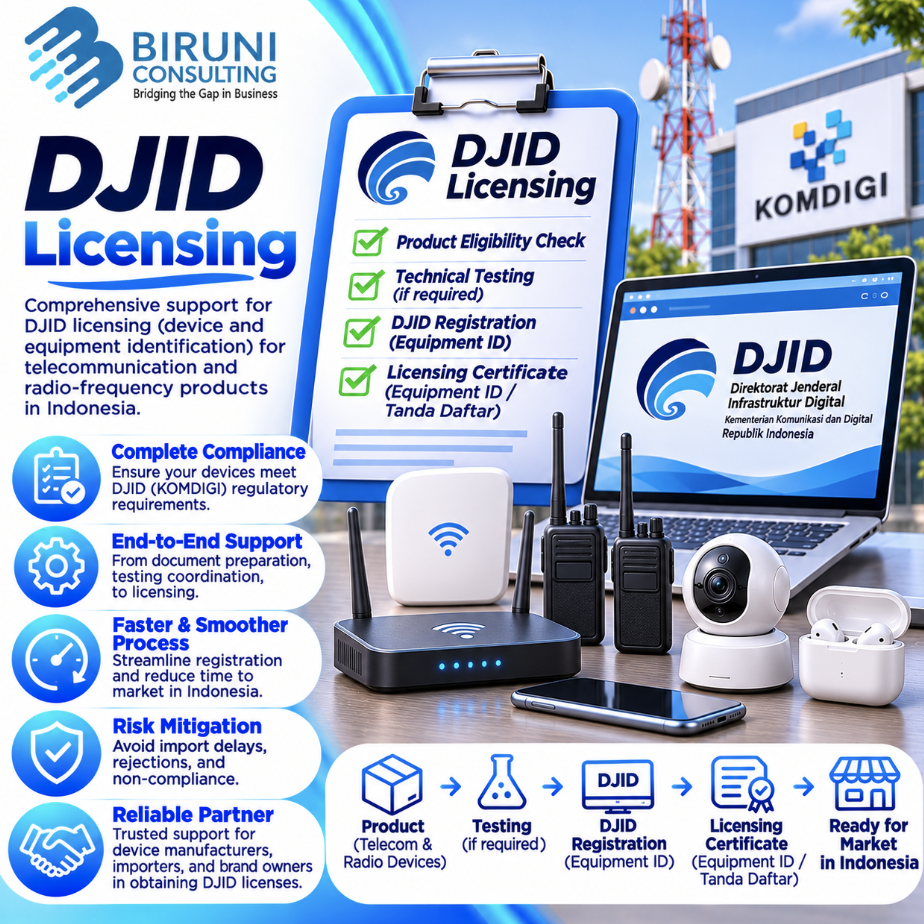
Guide to DJID Certification, spectrum licensing, and regulatory approval for telecommunications and wireless equipment in Indonesia
The term “DJID license” is widely used by importers, manufacturers, distributors, and overseas suppliers, but there is no single universal document called a DJID license that applies to every telecommunications product.
Depending on the equipment and its radio configuration, Indonesian compliance may involve a telecommunications equipment Certificate, spectrum use under a Class License, or specific spectrum authorisation such as a Radio Station License (ISR) or Radio Frequency Band License (IPFR).
Within DJID, the Directorate of Digital Infrastructure Services is responsible for functions covering both spectrum-frequency licensing and certification of telecommunications equipment. Infradigital
The correct approval pathway therefore needs to be established from the actual device, radio technology, frequencies, transmitter power, and intended spectrum use.
What Businesses Mean by a DJID License
Foreign suppliers frequently use terms such as “DJID approval”, “Postel license”, or “SDPPI approval”.
For a commercial wireless product, they are often referring to an Indonesian DJID/SDPPI telecommunications equipment Certificate.
Regulation Number 3 of 2024 establishes that equipment meeting the applicable Technical Standards based on testing is evidenced by a Certificate. Business applications are submitted through OSS integrated with the certification service facility. JDIH Kemkomdigi
For many imported consumer and industrial wireless devices, “DJID Certification” is therefore more technically accurate than referring to a general DJID license.
DJID Equipment Certificates
A DJID Certificate provides evidence that the equipment complies with the applicable Indonesian Technical Standards.
Conformity is assessed with reference to the equipment brand, type, and country of manufacture. The current regulation also requires separate certification evidence where the same brand and type originate from different manufacturing countries. JDIH Kemkomdigi
The current official certification database contains valid Certificates using numbers such as 128618/DJID/2026, demonstrating the use of DJID nomenclature for newly issued Certificates. e-Sertifikasi
Equipment Certification and Spectrum Licensing
Equipment certification and spectrum licensing should be distinguished.
Indonesia’s spectrum framework recognises three principal forms of spectrum authorisation:
- Radio Frequency Band License or IPFR.
- Radio Station License or ISR.
- Class License.
Official Komdigi information defines IPFR as spectrum authorisation in the form of a frequency band, ISR as authorisation for radio-frequency channels, and Class License as authorisation attached to compliant telecommunications equipment subject to specified conditions. JDIH Kemkomdigi
A certified wireless product therefore does not necessarily require a separate ISR.
Class-Licensed Spectrum
A Class License allows spectrum use through equipment that meets applicable Technical Standards and operates according to specified technical requirements.
Regulation Number 2 of 2023 defines a Class License as spectrum authorisation attached to telecommunications equipment that has met the Technical Standards and is used under specified conditions. The Class License framework was subsequently amended by Regulation Number 2 of 2025, which remains in force. JDIH Kemkomdigi
This concept is particularly relevant to WiFi/RLAN, Bluetooth, Short Range Devices, and other technologies using class-licensed spectrum.
A Class License should not be interpreted as an exemption from equipment certification.
WiFi and DJID Approval
WiFi equipment needs to be considered from both equipment-certification and spectrum perspectives.
Minister of Communication and Digital Decision Number 12 of 2025 currently establishes class-licensed spectrum and Technical Standards for Radio Local Area Network equipment. The Decision remains in force. JDIH Kemkomdigi
Products can include routers, access points, smart appliances, IoT gateways, printers, computer equipment, and many other WiFi-enabled devices.
Supported frequency bands, transmitter power, modules, antennas, firmware, and RF test reports should be reviewed before certification.
Bluetooth and Short Range Devices
Bluetooth products also fall within a short-range radio environment and should be assessed against the applicable Indonesian framework.
This can include headsets, keyboards, mice, smart appliances, trackers, MIDI controllers, drawing tablets, sensors, wearables, and other connected products.
Low output power or short communication range should not automatically be treated as a certification exemption.
The actual radio technology, frequency configuration, transmitter power, Technical Standard, and laboratory documentation still need to be identified.
When an ISR May Be Relevant
A Radio Station License, or ISR, is different from a product Certificate.
ISR authorises spectrum use in the form of specified radio-frequency channels. It is one of the recognised spectrum-authorisation types together with IPFR and Class License. JDIH Kemkomdigi
Not every radio product therefore needs an individual ISR.
Equipment operating within a Class License framework follows a different mechanism from radio systems requiring specific spectrum assignments. Regulation Number 2 of 2023 also provides particular situations where operation outside the technical conditions of class-licensed spectrum requires an ISR. JDIH Kemkomdigi
The applicable mechanism depends on the actual use of the spectrum.
DJID Certification Documents
For commercial products requiring certification, current e-Sertifikasi requirements list NIB and OSS access among the general requirements for business applicants.
Technical documentation includes an LHU/test report issued by a designated Indonesian laboratory or recognised overseas laboratory together with technical specifications. e-Sertifikasi
For an initial assessment, companies should normally prepare product photographs, exact brand and model, datasheet, user manual, RF specifications, operating frequencies, transmitter power, module information, antenna specifications, and available test reports.
Exact requirements depend on the product and applicant structure.
DJID Certificate Applicants
Current e-Sertifikasi guidance recognises several categories of business applicants.
These include an Indonesian registered trademark holder, a representative or distributor of a trademark holder, a manufacturer or assembler for the trademark holder, a manufacturer or assembler, and a company using the equipment for its own purposes. e-Sertifikasi
Before certification, the relationship between the applicant, trademark owner, manufacturer, exact model, manufacturing country, and laboratory report should therefore be established.
CE and FCC Are Not DJID Licenses
Manufacturers frequently provide CE, FCC, ETSI, or other international compliance reports.
These documents can be valuable technical evidence, but they are not automatically equivalent to an Indonesian DJID Certificate.
Regulation Number 3 of 2024 requires conformity with Indonesian Technical Standards through testing, while current e-Sertifikasi requirements specify the laboratory-report conditions used for certification applications. JDIH Kemkomdigi
Existing evidence should therefore be reviewed against the exact model, frequency configuration, transmitter power, antennas, applicable Indonesian standards, and laboratory eligibility.
A Class License Does Not Replace Certification
This distinction is particularly important.
The legal definition of a Class License states that the spectrum authorisation is attached to equipment that has met the applicable Technical Standards and is used according to specified requirements. JDIH Kemkomdigi
Regulation Number 3 of 2024 separately establishes that compliance with Technical Standards based on testing is evidenced through a Certificate. JDIH Kemkomdigi
Spectrum authorisation and equipment certification should therefore be considered together rather than treated as substitutes for each other.
Different Wireless Products Can Require Different Approvals
Bluetooth headsets, WiFi routers, cellular modems, professional radios, microwave links, satellite equipment, radar products, smart appliances, and IoT sensors do not necessarily follow the same regulatory pathway.
Some operate under class-licensed spectrum, while other radio applications can involve ISR, IPFR, or additional requirements.
The regulatory route should therefore not be determined from a product’s commercial name or HS Code alone.
The radio transmitter, receiver, frequency use, and final technical configuration need to be assessed.
Assessment Before Importation
Assessment should ideally take place before a purchase order or commercial shipment.
A global product can have different regional variants, radio modules, antennas, firmware configurations, transmitter settings, or manufacturing countries.
An initial review should therefore identify the exact model, radio technology, frequencies, transmitter power, modules, antennas, manufacturer, manufacturing country, and available laboratory evidence.
Only then can the business determine whether the product requires a DJID Certificate, operates under class-licensed spectrum, needs another spectrum authorisation, or has additional regulatory requirements.
Conclusion
“DJID license” is a commonly used commercial expression, but it does not describe one universal permit for every wireless product in Indonesia.
For products placed on the Indonesian market, the document most commonly intended is the DJID/SDPPI telecommunications equipment Certificate, which demonstrates compliance with applicable Technical Standards. Regulation Number 3 of 2024 requires such conformity, based on testing, to be evidenced by a Certificate. JDIH Kemkomdigi
Spectrum use is separately structured through IPFR, ISR, and Class License mechanisms. Technologies such as RLAN/WiFi can operate within a Class License framework, but Class License operation does not automatically remove equipment-certification requirements. JDIH Kemkomdigi
Because DJID is responsible for both spectrum-licensing services and telecommunications-equipment certification, the required approval must ultimately be determined from the actual equipment function and spectrum use. Infradigital
Contact Us
Biruni Consulting assists with DJID/SDPPI assessment and certification for telecommunications equipment and various wireless products that will be imported or marketed in Indonesia.
Our services include:
- Assessment of DJID/SDPPI certification requirements.
- Transmitter and receiver assessment.
- RF specification review.
- Frequency and transmission power analysis.
- Technical document review.
- Certification document preparation.
- Testing coordination where required.
- DJID/SDPPI Certification assistance.
If you have a telecommunications device or wireless product, you can prepare product photos, brand, model, datasheet, RF specifications, and wireless module datasheet for an initial assessment of the Postel Certification requirements.