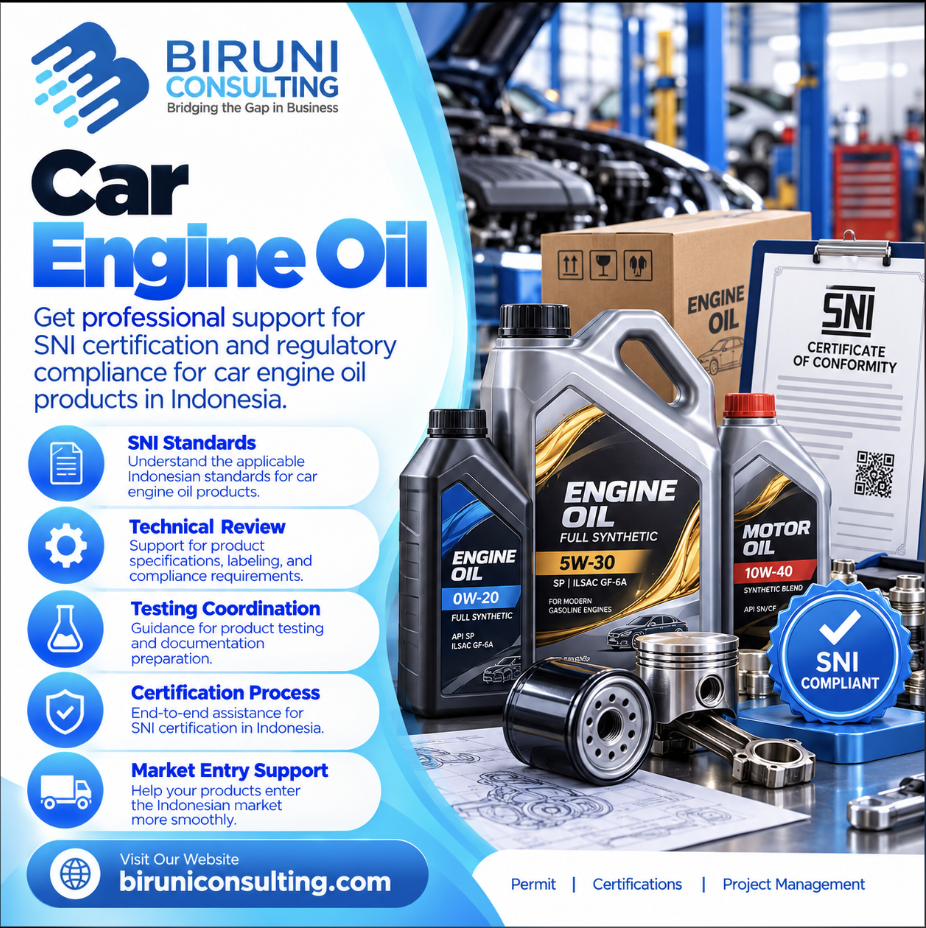
SNI, Certification, Testing, and Regulatory Guide for Car Engine Oil in Indonesia
Car Engine Oil is an essential product used to provide lubrication, reduce friction, assist heat management, maintain internal engine cleanliness, and protect engine components during vehicle operation. From an Indonesian regulatory-compliance perspective, however, car engine oil is not simply an ordinary automotive product. Motor-vehicle lubricating oils fall within a product group subject to Mandatory Indonesian National Standards or SNI.
The principal regulation currently in force is Minister of Industry Regulation No. 8 of 2025 concerning Mandatory Implementation of Indonesian National Standards for Lubricating Oil. The regulation became effective on July 24, 2025, remains in force, and revoked Minister of Industry Regulation No. 25 of 2018. Database Peraturan | JDIH BPK
For four-stroke gasoline car engine oil, the directly relevant standard is SNI 7069-1:2020, Classification and specifications – Lubricants – Part 1: Lubricating oil for four-stroke gasoline motor vehicles. BSN currently lists this standard as valid. Pesta
For diesel-engine vehicles, the relevant standard is SNI 7069-5:2021, Classification and specifications – Lubricants – Part 5: High-speed diesel engine lubricating oil, which BSN also currently lists as valid. Pesta
Manufacturers, trademark owners, importers, distributors, and Overseas Manufacturers therefore need to understand that placing Car Engine Oil on the Indonesian market can involve an SNI Certificate, LSPro, Testing Laboratory, SIINas, SPPT SNI, and an Official Representative for imported products.
What Is Car Engine Oil?
Car Engine Oil is lubricating oil used to protect internal engine components and control contact and friction while an engine operates.
In general, engine oil helps:
- Reduce friction and wear.
- Assist temperature management.
- Maintain internal-engine cleanliness.
- Help protect against corrosion and deposits.
- Protect components under different operating conditions.
Product selection should not be based only on brand or price.
Viscosity specifications, performance level, engine design, vehicle requirements, and recommendations from the vehicle manufacturer remain important.
Gasoline and Diesel Car Engine Oils Are Different
Under Indonesian regulatory classification, engine oils need to be distinguished by application.
Minister of Industry Regulation No. 8 of 2025 identifies SNI 7069-1:2020 for four-stroke gasoline motor vehicles.
For high-speed diesel engines, the same regulation identifies SNI 7069-5:2021.
The regulation also covers other motor-vehicle lubricants, including motorcycle oils, two-stroke oils, manual-transmission and differential oils, and automatic-transmission lubricants. Database Peraturan | JDIH BPK
The term “car oil” should therefore not be used too broadly when determining the applicable SNI.
Engine oil, transmission oil, differential oil, and automatic-transmission fluid can fall within different classifications and standards.
SNI for Gasoline Car Engine Oil
For four-stroke gasoline motor-vehicle oil, the applicable standard is SNI 7069-1:2020.
BSN lists its full title as “Classification and specifications – Lubricants – Part 1: Lubricating oil for four-stroke gasoline motor vehicles” and currently identifies it as valid. Pesta
The standard is one of the SNI requirements made mandatory through Minister of Industry Regulation No. 8 of 2025.
Gasoline-engine oils falling within the regulated scope therefore need to follow the required conformity-assessment pathway before production, importation, and marketing in Indonesia.
SNI for Diesel Car Engine Oil
For high-speed diesel engine oil, the regulatory reference is SNI 7069-5:2021.
BSN currently lists the standard as valid under the title “Classification and specifications – Lubricants – Part 5: High-speed diesel engine lubricating oil.” Pesta
The standard is also expressly included within the Mandatory SNI list under Minister of Industry Regulation No. 8 of 2025. Database Peraturan | JDIH BPK
Manufacturers therefore need to determine whether a product is gasoline engine oil, diesel engine oil, or another lubricant category before beginning certification.
Is SNI Mandatory for Car Engine Oil?
For motor-vehicle lubricating oils falling within the scope of Minister of Industry Regulation No. 8 of 2025, SNI implementation is mandatory.
The regulation applies to products manufactured domestically and imported products marketed within Indonesia. Database Peraturan | JDIH BPK
This is particularly important for foreign lubricant brands because compliance with international specifications in the country of origin does not automatically replace Indonesian mandatory conformity requirements.
The actual product, applicable SNI, HS classification, and regulatory scope need to be reviewed.
Scope of Mandatory Lubricating-Oil SNI
Minister of Industry Regulation No. 8 of 2025 identifies seven principal motor-vehicle lubricant groups:
- SNI 7069-1:2020 for four-stroke gasoline motor vehicles.
- SNI 7069-2:2021 for four-stroke gasoline motorcycles.
- SNI 7069-3:2020 for air-cooled two-stroke gasoline engines.
- SNI 7069-4:2020 for water-cooled two-stroke gasoline engines.
- SNI 7069-5:2021 for high-speed diesel engines.
- SNI 7069-6:2021 for manual-transmission and differential gear oils.
- SNI 7069-7:2021 for automatic-transmission lubricants. Database Peraturan | JDIH BPK
For Car Engine Oil, the principal focus is generally SNI 7069-1:2020 and SNI 7069-5:2021.
SAE, API, and SNI Are Not the Same
Car engine oils are commonly marketed with viscosity grades and performance classifications.
However, those designations should not be confused with Indonesian regulatory certification.
SAE viscosity grades describe viscosity classification, while performance claims can refer to specifications or industry classifications.
SNI is an Indonesian National Standard used within Indonesia’s conformity-assessment framework.
An oil labeled 0W-20, 5W-30, 10W-40, or another viscosity grade can still require assessment against the applicable SNI and Mandatory SNI regulation.
International performance claims do not automatically replace an SNI Certificate.
Product Classification Before Certification
Before submitting an application, companies need to classify the product correctly.
Information normally reviewed can include:
- Intended engine type.
- Gasoline or diesel application.
- Viscosity grade.
- Performance classification.
- Brand, type, and formulation.
- Manufacturing site.
- HS code.
Classification is important because one lubricant manufacturer can have numerous commercially similar products that fall within different SNI or certification scopes.
Type 5 Certification System
Minister of Industry Regulation No. 8 of 2025 requires Mandatory SNI compliance for lubricating oils to use a Type 5 certification system. Database Peraturan | JDIH BPK
Type 5 certification generally involves more than laboratory testing of a finished product.
The process can include manufacturing-process evaluation, quality-management implementation, sampling, laboratory testing, certification decisions, and continuing surveillance.
The annex to Regulation No. 8 of 2025 also expressly states that the lubricating-oil certification procedure uses Type 5 certification. Database Peraturan | JDIH BPK
Manufacturers should therefore not assume that sending one sample to a laboratory is sufficient to obtain SNI certification.
LSPro for Car Engine Oil
An LSPro or Lembaga Sertifikasi Produk / Product Certification Body is the body responsible for product certification and issuing SNI Certificates within its approved scope.
Regulation No. 8 of 2025 defines LSPro as an accredited body performing product certification and issuing SNI Certificates according to applicable Mandatory SNI requirements. Database Peraturan | JDIH BPK
An LSPro performs a different function from a Testing Laboratory.
The LSPro manages conformity assessment and the certification decision, while laboratories perform technical testing.
Companies therefore need to select an LSPro with the appropriate lubricant and SNI scope.
Application Through SIINas
For Mandatory SNI under the Ministry of Industry, certification processes are connected with SIINas, the National Industrial Information System.
BBSPJIKKP explains that applications for products under Ministry of Industry Mandatory SNI schemes are submitted through SIINas. Kemenperin
For lubricating oil, Regulation No. 8 of 2025 also specifically provides for electronic SNI Certificate applications through SIINas.
For an Overseas Manufacturer, the application is submitted through its Official Representative in Indonesia. Database Peraturan | JDIH BPK
Car Engine Oil Certification Documents
Documentation differs between Indonesian manufacturers and Overseas Manufacturers.
Preparation can generally involve:
- company documentation;
- trademark documentation;
- quality-management documentation;
- product information;
- manufacturing-process flows;
- production-facility information;
- testing-equipment information;
- quality-control information; and
- model/type information.
The lubricating-oil regulation also requires manufacturer implementation of ISO 9001:2015 within the applicable certification structure. For an Overseas Manufacturer, this requirement is expressly stated together with blending, filling, and specified testing capabilities. Database Peraturan | JDIH BPK
Requirements for Overseas Manufacturers
An Overseas Manufacturer seeking SNI certification for lubricating oil needs to satisfy several specific requirements.
Regulation No. 8 of 2025 includes requirements that the Overseas Manufacturer:
- Conducts a lubricating-oil manufacturing business.
- Owns its own Class 4 lubricating-oil trademark.
- Maintains blending and filling facilities.
- Maintains specified testing equipment.
- Implements ISO 9001:2015.
- Has an Official Representative in Indonesia. Database Peraturan | JDIH BPK
These requirements demonstrate that certification assesses more than the finished product. Manufacturing capability and the manufacturer’s regulatory structure also matter.
Official Representative for Imported Car Engine Oil
An Official Representative is an important part of the certification structure for an Overseas Manufacturer.
Regulation No. 8 of 2025 requires the Official Representative, among other things, to:
- be appointed by the Overseas Manufacturer;
- obtain a license to use and be responsible for the Class 4 lubricating-oil trademark;
- control a warehouse in the same or nearest regency/city to the Representative’s registered location;
- be permitted to act as importer; and
- maintain a SIINas account. Database Peraturan | JDIH BPK
The Official Representative is therefore not simply a consultant.
It forms part of the regulated Indonesian structure for Overseas Manufacturers supplying lubricating oil.
Must the Official Representative Be the Importer?
Not necessarily.
Regulation No. 8 of 2025 provides that an Official Representative may act as importer.
Where it does not act as importer, the Representative can appoint up to five importers. Changes to importers or importer information during the validity of the SNI Certificate also require an amendment to the issued SNI Certificate. Database Peraturan | JDIH BPK
Manufacturers therefore need to establish the import structure before commercial launch.
The importer, distributor, and Official Representative can perform different functions.
One Manufacturer and One Official Representative
Regulation No. 8 of 2025 provides that an Overseas Manufacturer can appoint only one Official Representative under this structure.
An Official Representative generally represents only one Overseas Manufacturer, although the regulation provides limited exceptions for qualifying corporate-group relationships. Database Peraturan | JDIH BPK
This becomes important where an international lubricant group operates multiple manufacturing companies or brand structures.
Corporate relationships should be mapped before the appointment is finalized.
Changing the Official Representative
The Official Representative should be selected carefully.
Regulation No. 8 of 2025 provides that if an Overseas Manufacturer changes its Official Representative before the SNI Certificate expires, the validity of the SNI Certificate ends. Database Peraturan | JDIH BPK
This can directly affect continuity of supply and commercial distribution.
The Representative should therefore not be selected only on the basis of a short-term distributor relationship.
Certification for Each Production Location
A manufacturer can operate multiple production sites.
Regulation No. 8 of 2025 states that where an Indonesian manufacturer or Overseas Manufacturer has more than one production location, an SNI Certificate application must be submitted for each location. Database Peraturan | JDIH BPK
A manufacturer should therefore not assume that one certificate automatically covers all global production facilities.
Manufacturing-site mapping should be completed before certification.
Factory Audit
Because Type 5 certification applies, production-facility auditing is an important component of conformity assessment.
Preparation can include:
- Incoming raw-material controls.
- Blending processes.
- Filling processes.
- Quality-control systems.
- Internal testing.
- Calibration.
- Traceability and corrective actions.
Manufacturers can benefit from a pre-audit gap analysis so potential nonconformities are identified before formal assessment.
Car Engine Oil Laboratory Testing
Testing determines whether samples satisfy the applicable SNI requirements.
Laboratory testing should not be undertaken randomly before the certification scheme and sampling requirements are understood.
Companies should establish:
- Applicable SNI.
- Product type and viscosity grade.
- Sample selection.
- Laboratory scope.
- Applicable test methods.
- Representation of the types being certified.
Existing overseas test reports can provide supporting information, but acceptance within Mandatory SNI certification remains subject to the applicable certification scheme.
Viscosity in Car Engine Oil
Viscosity is an important engine-oil characteristic.
A viscosity grade helps indicate how a lubricant behaves under specified temperature and operating conditions.
A viscosity grade alone, however, does not demonstrate compliance with every regulatory parameter.
Two products carrying the same grade can use different base oils, additive packages, formulations, performance levels, and technical characteristics.
Regulatory assessment therefore needs to consider the complete product specification, not only the grade printed on the packaging.
SNI Certificate
After the conformity-assessment process is completed successfully and requirements have been satisfied, the LSPro issues the SNI Certificate according to the applicable procedure.
For lubricating oil, Regulation No. 8 of 2025 provides that an SNI Certificate is valid for five years from its date of issuance. Database Peraturan | JDIH BPK
The five-year validity does not remove continuing obligations during the certification period.
Surveillance and certification maintenance remain part of the certification lifecycle.
SPPT SNI
An SNI Certificate and SPPT SNI are different instruments.
After lubricating oil satisfies the applicable SNI and holds an SNI Certificate, the product needs approval to use the SNI Mark.
That approval is issued in the form of SPPT SNI. Database Peraturan | JDIH BPK
Under the principal structure, SPPT SNI is issued to an Indonesian manufacturer or Official Representative.
SPPT SNI is valid for one year and can be renewed for successive one-year periods while the SNI Certificate remains valid. Database Peraturan | JDIH BPK
SPPT SNI applications are submitted electronically through SIINas.
SNI Mark on the Product
Lubricating oil that meets the SNI requirements and holds an SNI Certificate needs to bear the SNI Mark and electronic mark after receiving approval to use the SNI Mark. Database Peraturan | JDIH BPK
Packaging should therefore be planned only after the certification and SPPT SNI structure is understood.
Manufacturers should avoid mass-printing final Indonesian packaging before mark, electronic-information, labeling, and approval requirements have been confirmed.
SNI Surveillance for Car Engine Oil
Certification does not end after the certificate is issued.
The annex to Regulation No. 8 of 2025 provides for surveillance and sample collection once within one year. Database Peraturan | JDIH BPK
Surveillance can result in the SNI Certificate being maintained, suspended, or withdrawn depending on the assessment result. Database Peraturan | JDIH BPK
Manufacturers therefore need to maintain consistency in formulation, manufacturing processes, quality systems, and product conformity throughout the certification period.
Warehouse Requirements for Imported Car Engine Oil
For imported lubricants, warehousing is not only a logistics issue.
Regulation No. 8 of 2025 provides that lubricating oil manufactured by an Overseas Manufacturer must first enter a warehouse controlled by the Official Representative before it is distributed or ownership is transferred.
The entry is also subject to verification or technical inspection to confirm consistency between the shipping address stated in import documentation and the warehouse controlled by the Official Representative. Database Peraturan | JDIH BPK
This requirement needs to be incorporated into import and distribution planning from the beginning.
Importers and Distributors of Car Engine Oil
The importer is responsible for importation, while a distributor generally manages commercial distribution.
The same entity does not necessarily perform both roles.
An Overseas Manufacturer’s structure can therefore involve:
- Overseas Manufacturer.
- Official Representative.
- Importer.
- Distributor.
- LSPro and Testing Laboratory as conformity-assessment parties.
Roles should be established early so regulatory ownership, customs, warehouse, and commercial responsibilities do not overlap unintentionally.
Changes to Engine-Oil Formulation
Lubricant formulations can change as a result of changes in base oil, additive packages, suppliers, or product-development strategy.
A formulation change after certification should be evaluated against the approved certification scope.
Not every change can automatically be introduced without regulatory consequences.
A change can require notification, additional assessment, testing, or another process under the certification scheme.
Manufacturers should therefore maintain an internal change-control procedure for products supplied to Indonesia.
Changes to Trademark or Packaging
Brand and packaging information also form part of regulatory documentation.
For lubricating oil, Class 4 trademark requirements are expressly included within Regulation No. 8 of 2025 for the manufacturer and Official Representative structure. Database Peraturan | JDIH BPK
Changes to brands, trademark ownership, packaging information, or licensing arrangements should be reviewed before commercial implementation.
This is particularly important for imported products because the Official Representative has trademark-related responsibilities under the regulated structure.
Multiple Viscosity Grades
One Car Engine Oil brand can be offered in numerous viscosity grades.
Companies need to map each type and grade against the certification scope.
For example, one product family can include 0W-20, 5W-30, 5W-40, or other grades.
Whether variants can fall within one certificate or require different treatment needs to be established according to the certification scheme, SNI classification, formulation, and LSPro assessment.
Type mapping before application can reduce amendments after certification.
Multiple Brands
A lubricant manufacturer can also produce several brands.
The certification structure needs to consider ownership and licensing for each trademark.
Regulation No. 8 of 2025 contains specific provisions concerning trademarks, Brand Cooperation, and contract manufacturing arrangements.
Manufacturers using private-label or contract-manufacturing structures should therefore conduct a specific review before applying an ordinary certification pathway.
Imported Car Engine Oil
Imported Car Engine Oil is subject to the Mandatory SNI framework where it falls within the scope of Regulation No. 8 of 2025.
An Overseas Manufacturer should therefore establish conformity assessment and the required Indonesian structure before commercial shipment.
The regulatory roadmap can generally consider:
- Product classification.
- Applicable SNI.
- Official Representative.
- LSPro and Testing Laboratory.
- Factory audit and testing.
- SNI Certificate and SPPT SNI.
- Importer, warehouse, and distribution structure.
Starting the assessment only after cargo has been shipped can increase the risk of delay and compliance problems.
Initial Documents for Regulatory Assessment
Before certification begins, manufacturers can prepare initial documentation such as:
- product catalogues;
- Technical Data Sheets;
- Safety Data Sheets where relevant;
- viscosity grades;
- performance claims;
- formulation or composition information where required for assessment;
- ISO 9001 certificates;
- trademark information;
- factory information; and
- existing laboratory reports.
Initial documentation allows regulatory gaps to be identified before formal application.
Car Engine Oil Certification Timeline
There is no single fixed timeline for every application.
Timing can depend on:
- Document readiness.
- Trademark and Official Representative readiness.
- Factory-audit scheduling.
- Sampling.
- Laboratory-testing duration.
- Corrective actions.
- SIINas processing.
Manufacturers should avoid setting a commercial launch date before certification requirements and regulatory gaps have been mapped.
Cost of Car Engine Oil Certification
Certification cost can consist of several separate components.
Costs can include:
- regulatory assessment;
- LSPro certification;
- laboratory testing;
- factory audits;
- international auditor travel;
- sample shipment;
- translation or legalization where required;
- Official Representative services;
- warehousing; and
- post-certification surveillance.
Actual cost depends on product scope, number of products, manufacturing location, LSPro, laboratory, and regulatory structure.
Manufacturers should therefore evaluate total compliance cost rather than laboratory-testing fees alone.
Common Car Engine Oil SNI Mistakes
Common mistakes include assuming that an international specification automatically replaces SNI, beginning testing before the certification pathway is established, or appointing a distributor before understanding the Official Representative structure.
Other mistakes can include:
- identifying the wrong SNI;
- failing to map manufacturing sites;
- unsuitable trademark structures;
- an ineligible Official Representative;
- sampling outside the scheme;
- printing packaging before SPPT SNI is ready; or
- changing formulations without regulatory impact assessment.
Early regulatory assessment can reduce these risks.
How to Select an SNI Consultant for Car Engine Oil
A consultant should understand the relationship among Minister of Industry Regulation No. 8 of 2025, the SNI 7069 series, LSPro, Testing Laboratories, SIINas, Official Representatives, importers, warehouses, and SPPT SNI.
A consultant can assist with:
- Product regulatory assessment.
- SNI identification.
- Documentation gap analysis.
- LSPro and laboratory coordination.
- Factory-audit preparation.
- SIINas and Official Representative coordination.
The consultant is not the regulator, LSPro, or Testing Laboratory and cannot guarantee certificate issuance without the required conformity assessment.
Conclusion
Car Engine Oil marketed in Indonesia needs to be reviewed under the Mandatory SNI framework for motor-vehicle lubricating oils.
For four-stroke gasoline motor-vehicle oil, the principal standard is SNI 7069-1:2020, while high-speed diesel engine oil uses SNI 7069-5:2021. Both standards are currently listed as valid by BSN. Pesta
Minister of Industry Regulation No. 8 of 2025 makes the applicable lubricating-oil SNI mandatory for domestic and imported products and uses a Type 5 certification system. The SNI Certificate is valid for five years, while SPPT SNI is valid for one year and can be renewed while the SNI Certificate remains valid. Database Peraturan | JDIH BPK
For an Overseas Manufacturer, the regulatory structure also involves an Official Representative, Class 4 trademark, ISO 9001:2015, manufacturing capability, SIINas, warehousing, and specified importer arrangements. Imported lubricants also need to enter the warehouse controlled by the Official Representative before distribution or transfer of ownership. Database Peraturan | JDIH BPK
By establishing the regulatory pathway before application and commercial shipment, manufacturers can reduce risks involving incorrect SNI selection, repeated testing, Official Representative issues, import delays, and packaging changes after launch.
Contact Us
Biruni Consulting assists companies with Car Engine Oil professionally and in accordance with applicable regulations in Indonesia.
Our services include:
- Regulatory consultation.
- Identification of applicable standards.
- Preparation of certification documents.
- Assistance with laboratory testing.
- Certification processing until certificate issuance.
Biruni Consulting assists Indonesian manufacturers and Overseas Manufacturers with Car Engine Oil SNI identification, SNI Certificate preparation, LSPro, laboratory testing, factory audits, SIINas, Official Representative requirements, SPPT SNI, and regulatory compliance for motor-vehicle lubricants.
Contact Us for Car Engine Oil SNI, lubricating-oil certification, SNI 7069-1:2020, SNI 7069-5:2021, and motor-vehicle lubricant regulatory compliance assistance.