
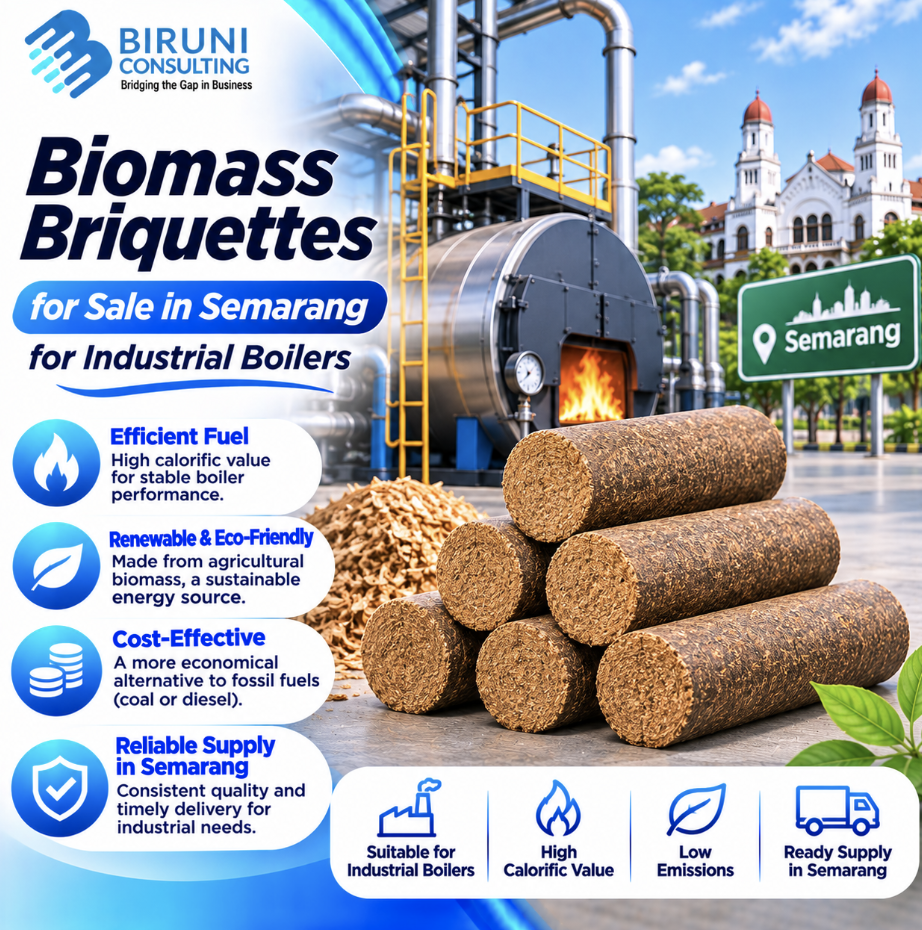
Biomass Briquettes for Industrial Boiler Applications in Semarang
Semarang is one of Central Java’s major industrial, trading, and logistics centers. BPS-Statistics Indonesia reported that the city’s economy grew by 6.49% in 2025, with manufacturing among the major contributors to regional GDP alongside construction and trade. BPS Semarang
The industrial base also includes established estates. Wijayakusuma Industrial Estate, for example, has operated since 1988 and covers more than 315 hectares in Semarang. Kiw
This creates a relevant market for biomass briquettes for sale in Semarang for industrial boilers, particularly for factories requiring steam, process heat, drying, and other thermal-energy applications.
The briquettes do not necessarily need to be produced within Semarang itself.
Manufacturing can take place closer to rice husk, sawdust, wood-processing residue, or other biomass sources, followed by scheduled deliveries to industrial customers.
For buyers, the main considerations should be technical specifications, delivered cost, boiler performance, available monthly capacity, and supply reliability.
What Are Biomass Briquettes?
Biomass briquettes are solid fuels manufactured by densifying organic materials.
Potential feedstocks include rice husks, sawdust, wood-processing residues, and other suitable agricultural residues.
Densification creates a more compact physical form that can improve transportation, warehousing, inventory management, and handling compared with some loose biomass materials.
However, “biomass briquette” is a broad commercial term.
Products made from different feedstocks can have substantially different calorific values, moisture, ash, density, durability, and combustion characteristics.
Types of Biomass Briquettes for Boilers
Industrial buyers can consider several fuel categories.
Rice Husk Briquettes
Rice husk briquettes are produced from husks generated during rice milling.
They are classified as non-woody biomass and can have ash characteristics that differ considerably from woody fuels.
Wood Briquettes
Wood briquettes are generally produced from sawdust or suitable wood-processing residues.
Their calorific value, ash, density, and mechanical characteristics depend on feedstock and manufacturing quality.
Agricultural Biomass Briquettes
Other agricultural residues may also be densified where material properties and production processes are suitable.
Industrial buyers should therefore ask suppliers to identify the actual feedstock composition rather than relying solely on a generic biomass-briquette description.
Technical References for Biomass Briquettes
Woody and non-woody briquettes may require different technical references.
ISO 17225-7:2021 establishes fuel-quality classes and specifications for graded non-woody briquettes. It covers herbaceous biomass, fruit biomass, aquatic biomass, and biomass blends or mixtures. Cereal crops and their processing by-products are included within herbaceous biomass. ISO
Rice-husk briquettes can therefore be considered within the broader non-woody biomass category.
However, buyers should not assume that a product automatically complies with a standard simply because its raw material falls within the standard’s scope.
Actual specifications and test results still need to be verified.
Why Semarang Is Relevant for Biomass Fuel Supply
Semarang combines industrial demand with developed logistics infrastructure.
Wijayakusuma Industrial Estate covers more than 315 hectares, while other industrial areas such as Candi and Terboyo contribute to the city’s broader manufacturing base. Kiw
Manufacturing was also one of the principal contributors to Semarang’s economy in 2025. BPS Semarang
This creates potential demand for boiler fuels used in steam generation, drying, processing, and other industrial heating applications.
Semarang also has Tanjung Emas Port, providing the city with additional logistics infrastructure for regional and commercial distribution. pelindo.co.id
Central Java’s Biomass Feedstock Potential
Semarang City itself is not one of Central Java’s largest rice-producing areas.
However, the wider region provides a substantial agricultural base.
BPS recorded approximately 9.30 million metric tons of paddy production in Central Java in 2025. Nearby or connected production areas included:
Grobogan at approximately 724,004 tons, Demak 634,373 tons, Semarang Regency 159,547 tons, and Kendal 170,759 tons.
Semarang City itself produced about 14,996 tons. BPS Jateng
These figures demonstrate feedstock potential rather than commercially available briquette volume.
Rice husk has competing uses, while collection, drying, storage, and transportation economics determine how much material can realistically enter briquette production.
Production Does Not Need to Be Located in Semarang
Briquetting plants can often operate more efficiently close to biomass sources.
Rice-husk briquettes, for example, can be produced near rice-milling networks in Demak, Grobogan, Kendal, Semarang Regency, or other agricultural regions.
Finished briquettes can then be trucked to industrial users in Semarang.
Buyers should therefore focus on:
delivered pricing + technical quality + available volume + lead time + delivery reliability
rather than supplier address alone.
Industrial Boiler Applications
Biomass briquettes can be considered for compatible:
- Steam boilers.
- Biomass boilers.
- Industrial dryers.
- Process-heating systems.
- Selected furnaces or burners.
Fuel compatibility should always be checked before large-scale substitution.
A boiler currently operating with coal, palm kernel shells, wood chips, or pellets may require different feeding or combustion settings when using briquettes.
Boiler Compatibility
Engineering teams should review the complete fuel-handling and combustion system.
Relevant components include the hopper, conveyor, screw feeder, grate, combustion chamber, air-distribution system, and ash-removal equipment.
Oversized briquettes can cause feeding problems.
Weak products can generate excessive fines during transportation.
Ash behavior can also influence cleaning and maintenance.
Fuel selection should therefore consider both laboratory specifications and physical performance.
Industrial Biomass Briquette Specifications
Buyers should ideally define technical requirements before final price negotiations.
| Parameter | Information to Confirm |
|---|---|
| Raw Material | Rice husk, wood residue or other biomass |
| Product Type | Woody / non-woody / carbonized if relevant |
| Calorific Value | GCV/HHV and/or NCV/LHV |
| Moisture | Maximum percentage |
| Ash | Maximum percentage |
| Proximate Analysis | Volatile matter and fixed carbon |
| Dimensions | Diameter, length and shape |
| Physical Quality | Density, strength and fines |
| Packaging | Bags, big bags or jumbo bags |
| Available Capacity | MT per month |
For recurring contracts, buyers can also establish tolerances and agreed testing methods.
This gives both parties clear shipment-acceptance criteria.
Calorific Value
Calorific value indicates the energy contained in the fuel.
Buyers should confirm whether suppliers report:
Gross Calorific Value / Higher Heating Value
or:
Net Calorific Value / Lower Heating Value.
The reporting basis also matters.
Dry-basis figures should not be compared directly with as-received results without accounting for moisture.
Representative laboratory reports or Certificates of Analysis provide a stronger purchasing basis than a single advertised kcal/kg value.
Moisture Content
Moisture affects useful boiler energy.
Water contained in the fuel must be heated and evaporated during combustion.
High or inconsistent moisture can therefore increase fuel consumption and affect combustion stability.
Recurring contracts can specify maximum moisture.
Covered storage, appropriate drying, and protection during transportation can help maintain fuel condition.
Ash Content
Ash can have a significant impact on industrial boiler operation.
Rice husk, woody biomass, and other agricultural residues can produce different ash quantities and characteristics.
Ash can influence:
- cleaning schedules,
- residue handling,
- grate and furnace conditions,
- maintenance,
- and total operating cost.
The fuel with the highest calorific value is therefore not automatically the most economical option.
Buyers should evaluate energy content, ash, and actual boiler performance together.
Rice Husk Briquettes vs. Wood Briquettes
A preliminary comparison can support supplier screening.
| Factor | Rice Husk Briquette | Wood Briquette |
|---|---|---|
| Feedstock | Rice husk | Wood-processing residue |
| Category | Non-woody biomass | Woody biomass |
| Ash | Rice-husk mineral characteristics require attention | Depends on wood feedstock |
| Calorific Value | Depends on process and moisture | Depends on feedstock and process |
| Feeding | Depends on dimensions and strength | Depends on dimensions and strength |
| Supply Base | Rice-mill network | Wood-processing industry |
Neither category is automatically better.
Boiler compatibility, trial performance, and delivered economics should determine the final choice.
Dimensions, Density and Mechanical Strength
Physical quality directly affects fuel handling.
Briquettes typically pass through:
production → storage → loading → trucking → unloading → warehouse → boiler feeding.
Weak briquettes can break and generate fines during these stages.
Inconsistent dimensions may also create problems for automated feeders.
Industrial buyers should ideally inspect samples after representative transportation rather than only immediately after production.
Certificate of Analysis
A Certificate of Analysis or CoA can support supplier qualification.
Relevant information may include:
- Calorific value and reporting basis.
- Moisture and ash.
- Volatile matter and fixed carbon.
- Application-specific parameters.
- Sample or batch identification.
The testing date should also be reviewed.
An old laboratory report may not represent current production.
Biomass Briquette Prices in Semarang
There is no single market price applicable to every biomass briquette order.
Pricing can depend on:
feedstock + specification + monthly volume + packaging + production location + transportation distance + contract duration.
A question asking only:
“What is the price per kilogram?”
does not provide enough information for an industrial quotation.
Suppliers need specifications, monthly requirements, delivery location, and packaging details.
Ex-Factory vs. Delivered Semarang
An ex-factory price represents the fuel price before transportation from the supplier’s facility.
A delivered Semarang price includes transportation to the agreed receiving location.
For industrial procurement, delivered pricing generally provides a better comparison.
Buyers should confirm whether packaging, loading, trucking, toll charges, and unloading are included where applicable.
Delivered Price Can Matter More Than Factory Price
The supplier with the lowest ex-factory price may not have the lowest delivered cost.
A plant located far from Semarang may offer inexpensive production but face higher transportation expenses.
Another supplier may charge slightly more for the briquettes but operate closer to the customer.
When monthly requirements reach hundreds of metric tons, transportation differences can become commercially significant.
Do Not Compare Price per Kilogram Alone
Consider an illustrative comparison:
Fuel A
Delivered price: IDR 3,000/kg
Consumption: 190 kg/ton of steam
Fuel cost:
IDR 570,000/ton of steam
Fuel B
Delivered price: IDR 3,350/kg
Consumption: 165 kg/ton of steam
Fuel cost:
IDR 552,750/ton of steam
Fuel B is more expensive per kilogram but produces a lower fuel cost per ton of steam in this example.
These figures are illustrative only.
Actual fuel consumption should be determined through boiler testing.
Total Cost of Use
A broader evaluation can include:
Fuel Price + Transportation + Storage + Actual Consumption + Ash Handling + Cleaning + Maintenance + Downtime
This provides a more meaningful Total Cost of Use.
A low-purchase-price fuel may become more expensive if consumption, ash handling, maintenance, or downtime increase.
These differences become increasingly important at high monthly volumes.
Boiler Trial Before Bulk Purchasing
Industrial buyers should avoid committing immediately to large quantities based only on technical data sheets.
Supplier qualification can begin with physical samples and laboratory analysis.
A larger operational trial can then evaluate:
- Fuel-to-steam ratio.
- Steam output.
- Combustion stability.
- Feeding performance.
- Ash and cleaning requirements.
Testing under representative production conditions provides the most useful performance information.
Calculating Monthly Demand
Suppose a factory consumes:
8 MT/day
for:
25 operating days/month.
Basic monthly requirements become:
200 MT/month.
At 12 MT/day over the same operating period, consumption becomes:
300 MT/month.
Suppliers need this information to confirm whether sufficient monthly capacity is actually available.
Production Capacity vs. Available Capacity
Installed production capacity does not necessarily represent available supply.
For example:
Production capacity: 500 MT/month
Existing commitments:
350 MT/month
Available capacity:
150 MT/month
That supplier cannot independently support a new customer requiring 200 MT/month.
Buyers should therefore ask for available capacity allocated to new contracts, not simply maximum machine capacity.
Feedstock Security
Reliable briquette production requires reliable biomass sourcing.
Central Java produced approximately 9.30 million tons of paddy in 2025, with substantial production in areas such as Grobogan, Demak, Kendal, and Semarang Regency. BPS Jateng
This creates a significant potential rice-husk resource base.
However, buyers still need to review the individual supplier’s actual sourcing network.
Regional agricultural production does not automatically mean all residue is commercially available.
Multiple feedstock sources, storage, and backup sourcing can strengthen supply reliability.
Shipment-to-Shipment Consistency
Industrial boilers require repeatable fuel quality.
A good initial sample is not sufficient for a six- or twelve-month supply agreement.
Changes in feedstock, drying, and compression can affect:
calorific value, moisture, ash, density, dimensions, and fines.
Recurring contracts can establish:
minimum calorific value + maximum moisture + maximum ash + dimensional tolerance + agreed testing method.
Clear acceptance criteria reduce quality disputes between buyer and supplier.
Packaging
Briquettes can be supplied in standard bags, big bags, jumbo bags, or other agreed formats.
The correct option depends on receiving equipment.
Factories with forklifts may benefit from larger bags where unloading arrangements support them.
Packaging decisions should consider moisture protection, unloading time, warehouse space, handling cost, and truck payload.
These factors can affect final delivered economics.
Deliveries to Semarang
Supply schedules can be daily, weekly, or divided across several deliveries each month.
Semarang has established industrial and logistics infrastructure, including Wijayakusuma Industrial Estate along the Semarang–Kendal corridor and Tanjung Emas Port within the city. Kiw
A factory requiring 200 MT/month does not necessarily need to receive the entire quantity at once.
Multiple scheduled truckloads can reduce warehouse requirements and help maintain appropriate inventory.
Safety Stock
Industrial users should maintain an appropriate fuel buffer.
If daily consumption is:
8 MT
and the factory wants:
4 days of safety stock,
the basic reserve is:
32 MT.
The appropriate level depends on supplier lead time, warehouse capacity, logistics risk, and production criticality.
Longer or less predictable supply routes may require a larger buffer.
Primary and Backup Suppliers
Complete dependence on one supplier can increase operational risk.
Equipment breakdowns, feedstock shortages, transportation disruptions, or quality problems can interrupt fuel availability.
Factories with critical boiler operations may maintain both a primary supplier and a technically approved backup source.
The backup fuel should ideally be qualified before an emergency occurs.
Manufacturer, Trader or Aggregator?
Biomass suppliers may operate as manufacturers, traders, or aggregators.
Manufacturers control production directly.
Traders can provide sourcing flexibility.
Aggregators may combine output from several plants to meet larger monthly requirements.
No model is automatically superior.
Buyers should focus on traceability, specification consistency, available capacity, quality control, and delivery reliability.
Comparing Biomass Briquette Suppliers
A simple procurement matrix can support evaluation.
| Parameter | Supplier A | Supplier B | Supplier C |
|---|---|---|---|
| Biomass Type | Data | Data | Data |
| GCV/NCV | CoA | CoA | CoA |
| Moisture | CoA | CoA | CoA |
| Ash | CoA | CoA | CoA |
| Delivered Semarang | Quote | Quote | Quote |
| Available Capacity | Data | Data | Data |
| Boiler Trial | Result | Result | Result |
Products that fail technical requirements can be eliminated before detailed commercial negotiations.
The buyer can then compare prices only among technically acceptable fuels.
Information to Include in an RFQ
A useful industrial RFQ should provide:
- Biomass-briquette type.
- Boiler application.
- Target GCV/NCV, moisture, and ash.
- Dimensions or feeding requirements.
- Trial quantity and monthly requirement.
- Semarang delivery location, packaging, CoA, and delivery schedule.
Clear requirements allow suppliers to evaluate both technical suitability and logistics before preparing final pricing.
How to Select a Biomass Briquette Supplier in Semarang
1. Technical Screening
Review feedstock, specifications, CoA, dimensions, and physical quality.
2. Capacity Verification
Confirm actual production, available monthly capacity, and feedstock sourcing.
3. Sample and Boiler Trial
Test the fuel under actual or representative operating conditions.
4. Commercial Evaluation
Compare delivered pricing with actual cost per ton of steam or another useful output measure.
5. Supply Performance
Evaluate quality, communication, and delivery performance over several shipments before increasing contract dependence.
This approach reduces the risk of selecting a low-priced fuel that performs poorly in actual operation.
Supplier Red Flags
Additional verification may be appropriate when suppliers cannot clearly identify feedstock or technical specifications.
Old CoAs, uncertain capacity, unclear manufacturing sources, inconsistent samples, and vague delivery arrangements should also be investigated.
An unusually low quotation should be checked carefully against moisture, ash, packaging, and transportation terms.
The lowest quoted price does not automatically produce the lowest operating cost.
Monthly Supply Contracts
After successful boiler trials, buyer and supplier can establish a recurring supply agreement.
The agreement can define:
monthly quantities + technical specifications + delivered pricing + delivery schedules + payment terms + testing procedures + off-specification handling.
Larger contracts may also include quantity tolerances and price-review mechanisms.
New suppliers should ideally establish a consistent delivery record before becoming the buyer’s sole fuel source.
Are Biomass Briquettes Suitable for Industrial Boilers in Semarang?
Biomass briquettes can be considered as an alternative solid fuel for Semarang industrial users where product specifications match the combustion equipment.
Semarang has a substantial industrial-demand base. Manufacturing was one of the city’s major economic contributors in 2025, and Wijayakusuma Industrial Estate alone covers more than 315 hectares. BPS Semarang
On the feedstock side, Central Java produced approximately 9.30 million metric tons of paddy in 2025, with significant production in areas such as Demak, Grobogan, Kendal, and Semarang Regency. BPS Jateng
This combination creates a relevant regional biomass supply opportunity.
Industrial buyers should nevertheless base purchasing decisions on calorific value, moisture, ash, physical quality, boiler performance, delivered cost, available capacity, and long-term supply reliability.
The strongest supplier is not necessarily the one offering the lowest price per kilogram, but the one capable of consistently delivering the required fuel performance and monthly volume.
Contact Us
Biruni Consulting can assist companies that require information and support regarding product requirements, documentation, and compliance processes related to product importation, marketing, or use according to business requirements in Indonesia.
The services that can be supported include:
- Consultation on product requirements for industrial needs.
- Initial assessment of product specifications and applications.
- Technical document review.
- Review of product specifications and information.
- Consultation on applicable regulatory requirements according to the product type and business activities.
- Assistance in preparing required documents.
- Consultation on certification or licensing processes when required based on the product characteristics and intended use.
Contact Biruni Consulting for information regarding product requirements, documentation, certification, and compliance needs to support business activities and product marketing in Indonesia.