
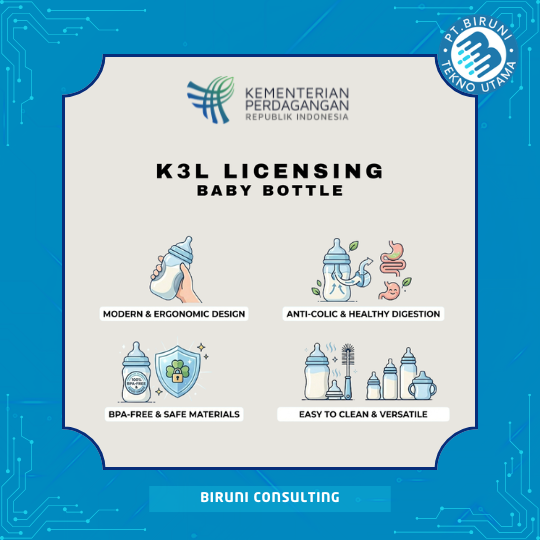
Guide to K3L Licensing for Baby Bottle Products to Support Legal Market Distribution
A baby bottle is a specially designed feeding container used to hold milk, water, formula, or other liquids for infants and toddlers. It is one of the most essential baby care products because it is used frequently and comes into direct contact with food and beverages consumed by young children.
Baby bottles are commonly manufactured using materials such as polypropylene (PP), silicone, glass, and other food-grade materials designed for infant use. In addition to the bottle itself, the product may include nipples, caps, locking rings, anti-colic valves, and other supporting components.
Because baby bottles are intended for infants and come into direct contact with consumable liquids, they should comply with K3L (Safety, Security, Health, and Environmental) requirements before entering the market. K3L licensing helps ensure products use proper materials and controlled production processes.
K3L compliance also helps evaluate plastics, silicone components, printed markings, and other materials to ensure long-term product safety and suitability for infant use.
Regulations Related to Baby Bottle Products
Baby bottles fall under both baby care products and food-contact material categories, requiring careful attention to safety and consumer protection requirements. These regulations are intended to protect infants as the primary users of the product.
Several relevant regulations include:
- Law No. 8 of 1999 concerning Consumer Protection, which protects consumer rights regarding product safety and quality.
- Law No. 3 of 2014 concerning Industry, which regulates industrial quality control and manufacturing standards.
- Food Contact Material (FCM) requirements, covering materials that come into direct contact with food and beverages.
Proper labeling is also important to provide information regarding materials, capacity, usage instructions, sterilization methods, and maintenance recommendations.
Why Do Baby Bottles Require K3L?
Baby bottles are used daily and directly affect the safety of beverages consumed by infants. As a result, material quality and manufacturing controls are especially important.
K3L licensing helps ensure:
- Appropriate food-grade materials are used
- Safety of plastic, silicone, and supporting components
- Controlled manufacturing and hygiene processes
- Compliance for legal product distribution
Products that meet these requirements are generally more trusted by parents because they provide greater assurance of safety and quality for infant care.
K3L Process for Baby Bottle Products
The K3L process begins with identifying product specifications. This includes evaluating bottle materials, nipple materials, capacity, design features, and supporting components.
Manufacturers or importers then prepare supporting documentation such as:
- Product specifications
- Material information (PP, silicone, glass)
- Product labeling details
- Manufacturer or importer information
Depending on applicable requirements, laboratory testing may be conducted to evaluate food-contact safety and material quality. Test results are used as part of the compliance assessment before licensing proceeds.
Benefits of K3L Licensing for Baby Bottles
K3L licensing provides several important benefits for manufacturers and importers seeking to strengthen product quality and market confidence.
Key benefits include:
- Ensuring products comply with applicable requirements
- Supporting distribution through formal and commercial channels
- Increasing consumer confidence and product credibility
- Strengthening competitiveness within the baby care product market
With proper compliance, baby bottle products can achieve broader acceptance among distributors, retailers, and consumers.
Contact Us
Biruni Consulting provides professional assistance for baby bottle product K3L licensing services.
Our services include:
- K3L requirement analysis for baby care products
- Technical documentation assistance
- Food-grade material and product specification consultation
- Laboratory testing assistance
- Certification and licensing support
We are ready to help ensure your baby bottle products meet requirements before market distribution