
Guide to Automotive Part Regulations for Regulatory Compliance in Indonesia
The automotive component industry in Indonesia continues to grow alongside increasing vehicle production, demand for replacement parts, and the expansion of the national automotive market. To manufacture, import, and legally distribute automotive parts, businesses must understand the regulations governing safety, quality, testing, certification, and technical requirements applicable in Indonesia.
Automotive part regulations apply not only to domestic manufacturers but also to importers and distributors. Certain automotive components are subject to mandatory Indonesian National Standards (SNI), while others require technical testing or regulatory approval before entering the market. Understanding these requirements from the beginning helps companies minimize compliance risks and streamline market entry.
What Are Automotive Part Regulations?
Automotive part regulations are a set of legal and technical requirements governing the safety, quality, and conformity assessment of automotive components manufactured, imported, or distributed in Indonesia. These regulations ensure that automotive parts placed on the market meet applicable standards and are safe for public use.
The regulations may apply to components such as vehicle wheels, safety glass, motorcycle helmets, lighting systems, braking components, tires, seat belts, mirrors, and various other automotive parts depending on the applicable requirements.
Why Is It Important to Understand Automotive Part Regulations?
Regulatory compliance ensures products can be legally marketed while improving customer confidence in product quality. Compliance also helps manufacturers maintain consistent product quality and reduce potential safety risks.
The benefits of understanding automotive part regulations include:
- Ensuring compliance with applicable legal requirements.
- Simplifying certification and testing processes.
- Reducing the risk of application rejection.
- Increasing customer confidence in product quality.
- Supporting the legal distribution of automotive parts in Indonesia.
How to Comply with Automotive Part Regulations in Indonesia
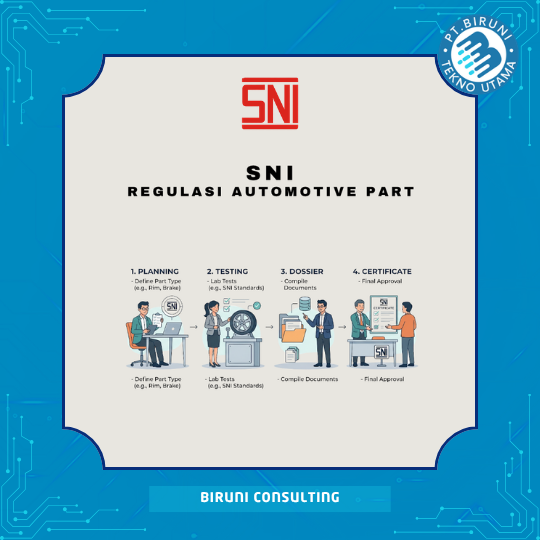
Compliance involves several stages that should be carefully prepared to ensure a smooth certification process.
Product Identification
The first step is identifying the type of automotive part to be manufactured or imported. Different component categories may be subject to different technical requirements and regulatory schemes.
Document Preparation
After product identification, companies should prepare administrative and technical documentation according to applicable requirements.
Documents generally required include:
- Company legal documents.
- Product technical specifications.
- Engineering drawings.
- Material specifications.
- Manufacturing process information.
- Product manuals or technical data.
- Other supporting documents as required.
Certification Application
If the product falls under mandatory compliance requirements, the company may submit a certification or conformity assessment application to the authorized body in accordance with applicable regulations.
Laboratory Testing
The product will undergo laboratory testing according to its characteristics to verify compliance with applicable technical standards.
Testing may include:
- Dimensional testing.
- Material strength testing.
- Durability testing.
- Safety testing.
- Performance testing.
- Quality testing according to product standards.
Factory Audit (if applicable)
For certain certification schemes, the assessment process may include a factory audit to verify that the manufacturing system consistently produces products meeting applicable standards.
Certificate Issuance (if applicable)
Once all requirements have been fulfilled and the evaluation confirms compliance, the certificate or approval document will be issued as evidence that the product complies with applicable regulations.
The Role of Consultants in Automotive Part Regulatory Compliance
Understanding regulations for different automotive components can be challenging because each product category may have different technical standards and certification requirements. Experienced consultants help companies identify applicable regulations, prepare documentation, coordinate testing, and ensure every stage complies with regulatory requirements.
Professional assistance also enables manufacturers and importers to prepare products from the development stage, making certification and testing more efficient before entering the Indonesian market.
Contact Us
Biruni Consulting helps companies in the automotive part regulatory compliance in Indonesia professionally and in accordance with applicable regulations in Indonesia.
Our services include
- Consultation on applicable regulations.
- Identification of applicable standards.
- Certification document preparation.
- Laboratory testing assistance.
- Certification processing until certificate issuance.
With extensive experience in product certification in Indonesia, Biruni Consulting helps ensure products comply with applicable safety, quality, and performance requirements and are ready for legal distribution in Indonesia.
Contact Us for consultation, certification assistance, and certification processing services.