
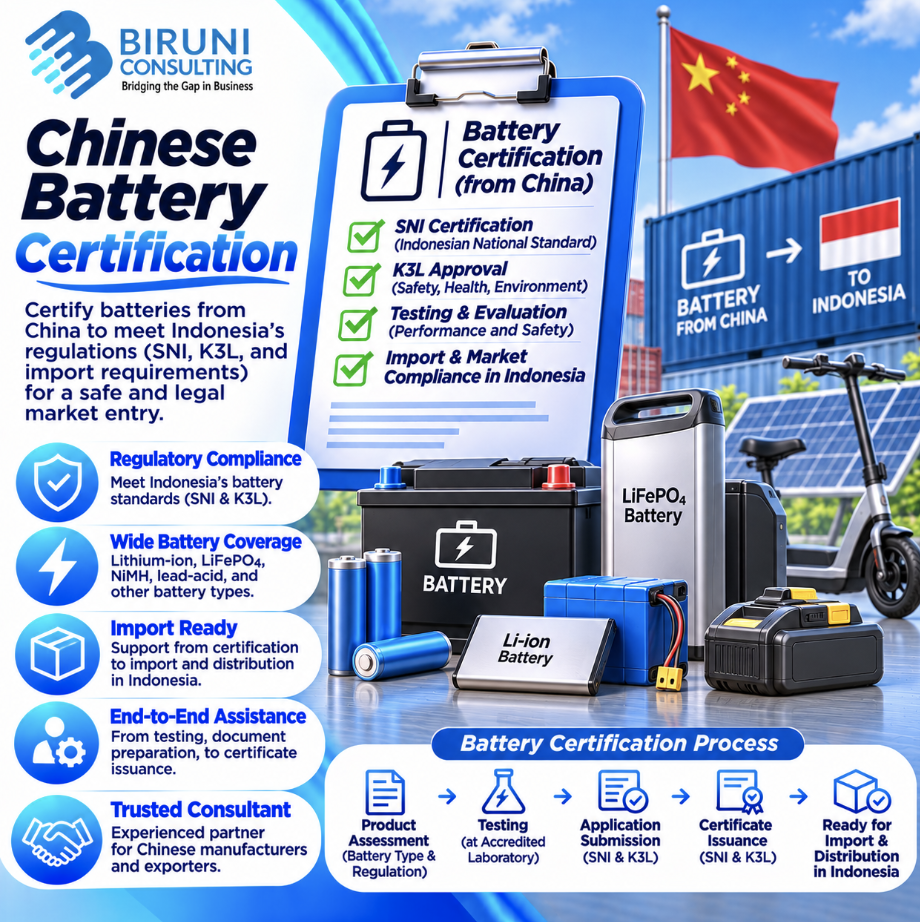
Certification Requirements for Chinese Battery Manufacturers Exporting to Indonesia
Chinese battery certification for the Indonesian market depends first on the exact type of battery being manufactured and exported. Indonesia does not use one universal certificate covering primary batteries, rechargeable lithium-ion batteries, electric-vehicle battery systems, power banks, industrial batteries, and energy-storage batteries.
For Chinese manufacturers, the country of manufacture does not create a separate certification category. Indonesian requirements are determined primarily by the product type, technical characteristics, intended use, manufacturing site, applicable Indonesian National Standard or SNI, and whether a regulation has made that standard mandatory.
One particularly important category is primary batteries. Minister of Industry Regulation No. 69 of 2024 makes SNI compulsory for primary batteries and applies SNI IEC 60086-1:2015 and SNI IEC 60086-2:2015. The regulation covers domestically manufactured and imported primary batteries marketed in Indonesia. Peraturan.go.id
Chinese battery manufacturers should therefore complete product classification before arranging testing, appointing an Indonesian Importer, or shipping commercial inventory.
What Is Chinese battery certification?
In an Indonesian market-entry context, Chinese battery certification means determining and completing the Indonesian regulatory pathway for batteries manufactured in China and intended to be imported, distributed, or incorporated into products sold in Indonesia.
The project can involve:
- Mandatory SNI assessment;
- identification of applicable battery standards;
- SNI Certificate application;
- Official Representative appointment;
- SIINas;
- LSPro certification;
- factory audit;
- laboratory testing;
- SPPT SNI;
- Importer requirements;
- customs readiness; and
- product marking.
The exact pathway depends heavily on the battery chemistry and application.
There Is No Single Indonesia Battery Certificate
The phrase “battery certification” can refer to very different products.
A Chinese manufacturer may produce:
- Primary disposable batteries.
- Portable rechargeable lithium-ion batteries.
- Power banks.
- Lead-acid automotive batteries.
- Electric-motorcycle batteries.
- Electric-car battery packs.
- Rechargeable Electrical Energy Storage Systems or REESS.
- Stationary industrial batteries.
- Energy-storage-system batteries.
- Batteries incorporated into electronic equipment.
Each category needs separate regulatory analysis.
Battery Type Comes First
Before certification begins, a manufacturer should identify:
- battery chemistry;
- primary or rechargeable construction;
- nominal voltage;
- capacity;
- watt-hour rating;
- cell or battery-pack configuration;
- intended application;
- portable, automotive, or stationary use;
- replaceable or permanently installed design;
- model numbers;
- manufacturing site; and
- proposed HS classification.
This information determines which Indonesian standards are potentially relevant.
Primary Batteries Have Mandatory SNI
Primary batteries are currently one of the clearest battery categories subject to Mandatory SNI in Indonesia.
Minister of Industry Regulation No. 69 of 2024 expressly makes SNI mandatory for Primary Batteries. The applicable standards are SNI IEC 60086-1:2015 Primary Batteries — Part 1: General and SNI IEC 60086-2:2015 Primary Batteries — Part 2: Physical and Electrical Specifications. Peraturan.go.id
The regulation applies to specified tariff positions and defines Primary Batteries as batteries intended for single use that cannot be recharged after their energy has been exhausted. Pasal.id
Imported Primary Batteries Are Covered
Mandatory SNI for primary batteries is not limited to Indonesian manufacturers.
The regulation expressly requires business operators producing, importing, and/or distributing Primary Batteries in Indonesia to comply with the Mandatory SNI requirements. Peraturan.go.id
This makes the regulation particularly important for Chinese dry-cell, alkaline, lithium-primary, and other manufacturers whose products fall within the regulated scope.
Batteries Packed with Another Product Can Still Matter
The primary-battery regulation also addresses batteries that are packaged together with another product or form part of another product.
Where the battery falls within the regulated primary-battery scope, packaging it with another product does not necessarily remove the Mandatory SNI requirement. Pasal.id
Chinese electronics manufacturers should therefore assess the battery itself rather than assuming an embedded or bundled battery is automatically outside the rule.
Primary Battery Certification Uses Type 5
Compliance with the mandatory primary-battery regulation uses a Type 5 certification system.
The conformity-assessment process includes an audit of the production process and implementation of an ISO 9001:2015 quality-management system, together with product conformity testing against the applicable SNI. Peraturan.go.id
Certification is therefore not simply a one-time laboratory test.
Factory Audit for Chinese Manufacturers
For a Chinese primary-battery factory, certification can require assessment of the actual manufacturing facility.
Typical readiness areas can include:
- raw-material controls;
- mixing processes where applicable;
- cell assembly;
- packaging;
- process inspection;
- test equipment;
- quality-control records;
- calibration;
- nonconforming-product controls;
- traceability; and
- corrective actions.
Regulation No. 69 of 2024 specifically requires an Overseas Manufacturer within the primary-battery scheme to maintain relevant production facilities, testing capability, and ISO 9001:2015 implementation. Peraturan.go.id
Laboratory Testing
Primary-battery conformity testing must follow the applicable Mandatory SNI scheme.
The regulation allows testing through qualifying domestic or overseas laboratories, but foreign laboratories must satisfy specified accreditation, international-recognition, government-agreement, and Ministerial-designation conditions. Peraturan.go.id
A Chinese manufacturer’s existing laboratory report should therefore not be assumed automatically acceptable merely because the laboratory is accredited in China.
Existing Chinese Test Reports
Existing reports can still be useful.
Before repeating testing, the manufacturer can perform a test-report gap analysis covering:
- applicable SNI;
- IEC edition;
- tested model;
- battery size;
- chemistry;
- laboratory accreditation scope;
- testing date;
- manufacturing site; and
- report owner.
The goal is to establish which existing evidence can support the Indonesian process and which testing needs to be repeated.
Chinese Manufacturer Can Hold the SNI Certificate
Under the primary-battery regulation, the legal SNI Certificate holder does not have to be the Indonesian Importer.
The regulation states that the SNI Certificate may be held by an Industrial Company or Overseas Manufacturer. For a Chinese manufacturer, this means the Overseas Manufacturer itself can be the certificate party when the applicable requirements are satisfied. Peraturan.go.id
This distinction is important for long-term regulatory ownership.
One Manufacturing Site Per Certificate Structure
For primary batteries, the regulation provides that an SNI Certificate is issued to one Industrial Company or one Overseas Manufacturer for one production location.
Where a manufacturer has more than one production location, separate applications are required for each production location. Peraturan.go.id
A Chinese manufacturer operating factories in Guangdong, Zhejiang, Jiangsu, and another province should therefore not assume that certification of one factory automatically covers all Chinese facilities.
Certificate Validity
Under the current primary-battery scheme, the SNI Certificate is valid for five years from the date of issuance. More than one trademark can be included under the Certificate in the circumstances provided by the regulation. Peraturan.go.id
Certification maintenance and surveillance nevertheless remain relevant during the Certificate lifecycle.
Official Representative for Chinese Manufacturers
An Overseas Manufacturer under the mandatory primary-battery scheme must have an Official Representative in Indonesia.
The regulation requires the Overseas Manufacturer to maintain an Official Representative, while the Representative must be appointed by the foreign manufacturer, satisfy the relevant trademark arrangement, control a warehouse within the required geographic framework, be capable of acting as Importer, and maintain a SIINas account. Peraturan.go.id
This is more than an ordinary commercial sales-agent appointment.
One Official Representative
A foreign primary-battery manufacturer generally appoints one Official Representative under the structure established by Regulation No. 69 of 2024.
The regulation also provides that changing the Official Representative before the SNI Certificate expires causes the Certificate to expire. Peraturan.go.id
Representative selection should therefore be treated as a strategic regulatory decision.
Official Representative and Importer Can Be the Same Company
The primary-battery regulation allows the Official Representative to act as the Importer for batteries manufactured by the Overseas Manufacturer.
Where the Representative does not perform the Importer function, it can appoint an importing company. Peraturan.go.id
This allows Chinese manufacturers to consider several local structures rather than assuming the Distributor must always be the Importer.
Importer Is Not Automatically the Certificate Holder
Importer status and SNI Certificate ownership are different.
A company can be responsible for commercial importation while the Chinese manufacturer remains the legal certificate party.
This distinction can help a manufacturer preserve regulatory continuity if it later replaces its Importer or Distributor.
SIINas
Applications for the mandatory primary-battery SNI Certificate are submitted electronically through SIINas.
For an Overseas Manufacturer, the application is submitted through its Official Representative. Where more than one production site exists, the manufacturer through the Representative must apply for each production location. Peraturan.go.id
SIINas control should therefore be addressed before certification begins.
Trademark Documentation
Trademark structure is also relevant to primary-battery certification.
The regulation requires documentation connecting the Overseas Manufacturer, battery trademark, and Indonesian Official Representative, including specified trademark licensing and Indonesian intellectual-property documentation within the applicable structure. Peraturan.go.id
Chinese manufacturers using private labels or customer brands should address trademark ownership early.
Private Label Batteries
Chinese battery factories often manufacture products for multiple international brands.
Private-label structures can become more complicated because:
- the factory may not own the brand;
- the brand owner may be located outside China;
- the Indonesian Importer may be unrelated to either company;
- one factory may produce several labels; and
- different brand arrangements can require different certification documents.
The primary-battery regulation includes provisions for brand cooperation and contract-manufacturing arrangements, so private-label projects should be reviewed before application. Peraturan.go.id
SPPT SNI
The SNI Certificate should be distinguished from SPPT SNI, which is approval concerning the use of the SNI Mark under the Ministry of Industry framework.
Regulation No. 69 of 2024 separately defines the SNI Certificate, SNI Mark, and SPPT SNI, and certification documentation expressly addresses obtaining both the SNI Certificate and SPPT SNI before regulated primary batteries are circulated or marketed. Peraturan.go.id
Chinese manufacturers should therefore not treat successful laboratory testing as the final market-entry step.
Portable Lithium-Ion Batteries
Rechargeable portable lithium-ion batteries are a different category from primary batteries.
BSN currently lists SNI IEC 62133-2:2017 as an in-force standard for sealed portable secondary lithium cells and batteries used in portable applications. pesta.bsn.go.id
The existence of this SNI does not by itself mean every rechargeable lithium battery imported into Indonesia is subject to one universal mandatory SNI certification requirement. Mandatory status needs to be checked against the exact product and any regulation applying to that product.
SNI IEC 62133:2015
BSN also lists SNI IEC 62133:2015 as an in-force standard covering safety requirements for sealed secondary cells and batteries containing alkaline or other non-acid electrolytes for portable applications. pesta.bsn.go.id
Depending on chemistry, product design, and application, a manufacturer may therefore encounter different Indonesian-adopted IEC battery standards.
Power Bank Certification
Power banks have a specific Indonesian standard, SNI 8785:2019 — Lithium-Ion Power Bank, Part 1: General Safety Requirements.
BSN has also established a certification scheme for lithium-ion power banks using that standard. The scheme covers portable power banks using secondary lithium-ion batteries and establishes conformity-assessment requirements for certification. Database Peraturan | JDIH BPK
However, the existence of an SNI and a certification scheme should still be distinguished from a regulation formally making certification compulsory for every power bank placed on the Indonesian market.
Power Bank Testing
Indonesia’s Ministry of Industry B4T laboratory currently lists testing capability for lithium-based power banks against SNI 8785:2019 and identifies test areas such as temperature, insulation resistance, external short circuit, drop testing, overcharging, vibration, mechanical shock, output-port overload, and internal cell resistance. site.b4t.go.id
For Chinese power-bank manufacturers, this illustrates why a technical gap analysis should precede market launch.
EV Battery Standards in Indonesia
Indonesia also maintains several SNI standards relating to electric-vehicle batteries and rechargeable energy-storage systems.
BSN currently lists standards including:
- SNI 8871:2019 for REESS safety for M and N electric vehicles;
- SNI 8872:2019 and SNI 8872:2024 for category L electric vehicles;
- SNI 8927:2020 for removable and swappable category L battery-system safety;
- SNI 8928:2023 for swappable category L battery specifications; and
- SNI 9102:2022 for lithium-ion battery-pack and system performance testing for category L electric vehicles. pesta.bsn.go.id
These standards demonstrate that an EV battery should not be treated in the same way as an ordinary consumer battery.
SNI 8927:2020
SNI 8927:2020 addresses safety requirements for removable and swappable battery systems for category L electric vehicles and remains listed as in force by BSN. pesta.bsn.go.id
This can be relevant to Chinese electric-motorcycle battery manufacturers supplying swappable battery systems into Indonesia.
SNI 8928:2023
SNI 8928:2023 establishes specifications for swappable batteries used in category L electric vehicles, including electric motorcycles, and remains listed as in force. pesta.bsn.go.id
Manufacturers should distinguish between the battery cell, module, pack, swappable system, and complete vehicle when determining the applicable compliance pathway.
Lithium-Ion Cells for EV Propulsion
BSN also lists SNI IEC 62660-1:2017 for performance testing of secondary lithium-ion cells used for electric-vehicle propulsion and SNI IEC 62660-2:2017 for reliability and abuse testing. pesta.bsn.go.id
Existing Chinese IEC 62660 reports can therefore be relevant technical evidence, but their regulatory use needs to be assessed within the actual Indonesian approval pathway.
A Standard Does Not Automatically Mean Mandatory Certification
This distinction is essential for Chinese battery certification.
Indonesia can have an SNI covering a battery technology without having a regulation that makes certification under that SNI mandatory for every commercial product.
Manufacturers should therefore answer two separate questions:
- Which Indonesian standard technically applies?
- Has an Indonesian regulation made that standard mandatory for this exact product?
Confusing those questions can lead either to unnecessary certification or to noncompliant importation.
Electric Vehicle Battery vs Complete Vehicle Approval
A battery pack used inside an electric motorcycle or electric car is only one component of the complete vehicle.
Battery testing or SNI conformity should not automatically be interpreted as complete Indonesian vehicle approval.
Chinese electric-vehicle manufacturers should separate:
- battery-cell compliance;
- battery-pack compliance;
- REESS requirements;
- vehicle technical approval;
- Importer readiness; and
- commercial market-entry requirements.
Stationary Energy-Storage Batteries
Batteries intended for solar storage, industrial backup, telecommunications infrastructure, or Battery Energy Storage Systems should not automatically use the portable-battery or EV-battery pathway.
Indonesia has adopted battery standards for several secondary-battery and renewable-energy applications. For example, government technical requirements for certain renewable-energy power-delivery systems reference SNI IEC 62133, SNI IEC 62133-2, and SNI IEC 61427-1. JDIH ESDM
Actual certification and licensing requirements must still be determined from the particular application.
Automotive Lead-Acid Batteries
Lead-acid starter batteries also require separate technical assessment.
The Ministry of Industry’s B4T electrical laboratory currently lists testing for motor-vehicle batteries for four-wheel-or-more vehicles against SNI 0038:2009, including capacity, high-current discharge, charge acceptance, endurance, vibration, terminal strength, and other parameters. site.b4t.go.id
The existence of laboratory capability or an SNI should not, by itself, be taken as proof that the product is currently subject to a universal mandatory certification regime; the applicable regulatory basis must be checked separately.
Chinese CCC Certification Does Not Replace Indonesian Approval
A Chinese battery manufacturer may already hold Chinese domestic certificates, IEC reports, CB reports, CE-related documentation, or automotive customer approvals.
Those documents can be technically useful, but Indonesian regulatory compliance is assessed under Indonesian rules.
A certificate accepted in China does not automatically function as an Indonesian SNI Certificate.
IEC Reports Do Not Automatically Equal SNI Certification
Many Indonesian battery standards adopt or reference IEC standards.
This similarity can reduce technical gaps, but it does not mean a Chinese IEC test report automatically completes Indonesian certification.
Acceptance can depend on:
- exact standard edition;
- laboratory recognition;
- product model;
- factory;
- sampling method;
- certificate scheme; and
- regulator or LSPro requirements.
A document gap analysis should precede repeat testing.
Manufacturing Site Matters
Chinese manufacturers frequently operate multiple factories.
One group can produce the same battery brand in Shenzhen, Dongguan, Huizhou, Ningbo, or another location.
For the mandatory primary-battery scheme, each production location requires its own application structure. Peraturan.go.id
A sourcing change should therefore trigger a regulatory review before products from the new factory are exported to Indonesia.
Multiple Battery Models
Battery portfolios can include hundreds of SKUs.
A useful regulatory model matrix can identify:
- Product family.
- Cell chemistry.
- Model.
- Size.
- Voltage.
- Capacity.
- Watt-hours.
- Manufacturing site.
- Intended use.
- Applicable SNI.
- Mandatory status.
- Test-report status.
- Certificate status.
- Indonesian Importer.
- Launch status.
This reduces the risk of assuming one certificate covers an entire catalogue.
Chinese OEM Battery Manufacturers
Chinese factories often manufacture batteries for global OEM customers.
OEM status does not automatically create an exemption from Indonesian product requirements.
The regulatory assessment should identify whether the product is:
- sold independently;
- supplied as an industrial component;
- integrated into another regulated product;
- installed in an electric vehicle;
- packaged with consumer electronics; or
- supplied only for manufacturing use.
The answer can materially change the compliance pathway.
Embedded Batteries
An embedded battery requires analysis of both the battery and the final equipment.
For primary batteries, the current mandatory regulation specifically provides that regulated primary batteries can remain subject to the SNI obligation when packaged with or incorporated into another product. Pasal.id
Rechargeable batteries should likewise be assessed together with the regulatory requirements applicable to the finished device.
Importer Requirements
Chinese manufacturers also need to separate battery certification from import licensing.
Under Indonesia’s general import framework, Minister of Trade Regulation No. 16 of 2025 requires an Importer to have an NIB functioning as an API. The regulation remains in force and has been amended, including through Minister of Trade Regulation No. 18 of 2026. Database Peraturan | JDIH BPK
An SNI Certificate does not replace Importer eligibility.
Customs Access
Indonesia Customs states that an Importer is treated as satisfying Customs Registration requirements after having an NIB functioning as TDP, API, and Customs Access. Beacukai
The proposed Indonesian Importer should therefore be checked before the first commercial shipment.
PIB and Customs Documents
For Imports for Use, the Importer generally submits a PIB, pays applicable customs duty, excise and/or import taxes, and satisfies applicable prohibitions and restrictions.
Supporting customs documents can include the Invoice, Packing List, Bill of Lading or Air Waybill, Certificate of Origin, product-identification documentation, and evidence demonstrating compliance with import requirements. Beacukai
Battery certification and customs documentation should therefore use consistent product information.
HS Code Review
Battery classification can affect both customs and certification analysis.
Primary batteries under Regulation No. 69 of 2024 are linked to specified tariff positions, so the manufacturer should not rely only on a generic commercial description such as “battery.” Pasal.id
Chemistry, rechargeable status, intended use, and product construction need to be considered together with the proposed HS code.
Commercial Invoice
For battery shipments, the Commercial Invoice should ideally identify the product more precisely than “battery” or “electronic parts.”
Relevant information can include:
- battery type;
- model;
- chemistry;
- voltage;
- capacity;
- quantity;
- manufacturer;
- factory;
- brand; and
- country of origin.
The information should remain consistent with certification records.
Packing List
The Packing List should also match the actual certified or assessed products.
Mixed shipments require particular care when they contain multiple:
- battery chemistries;
- models;
- capacities;
- production sites; or
- regulatory statuses.
A pre-shipment model matrix can prevent uncertified products from being accidentally included.
Country of Origin and Factory Location
Country of origin is not always the same as country of shipment.
A battery can be manufactured in China, shipped from Hong Kong or another logistics hub, and sold under a European or American trademark.
Indonesian certification and customs documentation should accurately identify the actual manufacturing source where required.
Product Marking
Battery marking can form part of applicable certification requirements.
For regulated primary batteries, the certification process includes SNI marking documentation and SPPT SNI requirements. Peraturan.go.id
Manufacturers should avoid mass-printing packaging or modifying molds until Indonesian marking requirements have been confirmed.
Factory Changes
Changes to production location, process, raw materials, chemistry, or quality systems can affect certification.
A Chinese manufacturer should establish an internal change-control mechanism so the Indonesian regulatory team receives notice before:
- production moves to another factory;
- cell suppliers change;
- chemistry changes;
- product dimensions change;
- capacity changes significantly;
- brand ownership changes; or
- model numbers are revised.
Regulatory impact can then be assessed before export.
Surveillance
Type 5 certification includes continuing conformity rather than only initial approval.
For mandatory primary batteries, certification is based on factory-process assessment and product testing, while the regulation also establishes surveillance and recertification within its certification scheme. Peraturan.go.id
Chinese manufacturers should therefore plan for post-certification cooperation with the LSPro and Indonesian Representative.
Changing the Official Representative
Under the mandatory primary-battery scheme, changing the Official Representative before the Certificate expires causes the SNI Certificate to expire. Peraturan.go.id
This makes Representative due diligence especially important.
The manufacturer should evaluate long-term regulatory capability rather than appointing a Representative solely because the company offers the lowest service fee.
Changing the Importer
Changing the Importer can be different from changing the Official Representative.
The primary-battery regulation expressly allows the Representative to act as Importer or, if it does not import directly, appoint an importing company. Peraturan.go.id
Even so, changes should be assessed against SIINas records, certification documents, customs arrangements, and commercial contracts before the new Importer begins shipping.
Regulatory Ownership
Chinese manufacturers should create a regulatory ownership map that identifies:
- Overseas Manufacturer.
- Production factory.
- Trademark owner.
- SNI Certificate Holder.
- Official Representative.
- SIINas controller.
- SPPT SNI party.
- Importer.
- Distributor.
- LSPro and Testing Laboratory.
This structure can reduce dependency on one Indonesian commercial partner.
Regulatory Gap Analysis
Before formal certification, a Chinese battery manufacturer should perform a gap analysis covering:
- battery type;
- mandatory SNI applicability;
- applicable SNI edition;
- HS classification;
- manufacturing site;
- trademark ownership;
- ISO 9001 status;
- available laboratory reports;
- foreign-laboratory eligibility;
- Official Representative;
- SIINas;
- Importer;
- product marking; and
- shipping documentation.
The resulting gaps can then be converted into a certification plan.
Initial Documents for Chinese battery certification
A manufacturer can initially prepare:
- Business License or Chinese company-registration documents.
- Factory address.
- Product Catalogue.
- Technical Data Sheet.
- Battery chemistry.
- Model list.
- Voltage and capacity.
- Watt-hour ratings where relevant.
- Production-flow diagram.
- ISO 9001 Certificate.
- Existing IEC/SNI/CB reports.
- Trademark Certificate.
- Proposed HS codes.
- Proposed Indonesian Importer.
- Intended application.
- Expected sales channel.
This package usually provides enough information for an initial regulatory classification.
Chinese battery certification Roadmap
A practical project can follow these stages:
- Identify the battery category.
- Determine the intended Indonesian application.
- Review HS classification.
- Identify applicable Indonesian SNI standards.
- Determine whether SNI is mandatory for the exact product.
- Map the Chinese manufacturing site.
- Determine the Certificate Holder.
- Establish an Official Representative where required.
- Review existing Chinese or international test reports.
- Select the appropriate LSPro and laboratory pathway.
- Prepare the factory for audit where required.
- Complete laboratory testing.
- Complete SIINas and certification procedures.
- Obtain SPPT SNI where applicable.
- Complete Importer and customs readiness.
- Verify product marking.
- Conduct pre-shipment compliance review.
- Maintain surveillance and regulatory monitoring.
The exact sequence depends on the battery category.
Timeline
There is no universal Chinese battery certification timeline.
A primary battery subject to Mandatory SNI can require an Official Representative, SIINas application, factory audit, product testing, LSPro review, certification decision, and SPPT SNI.
A rechargeable battery that is not within a product-specific mandatory SNI scheme may follow a substantially different pathway.
Timeline therefore depends on:
- battery category;
- number of models;
- number of Chinese factories;
- existing testing;
- ISO 9001 readiness;
- LSPro availability;
- laboratory route;
- audit findings;
- Representative readiness; and
- Importer readiness.
Cost
Total project cost can include:
- regulatory assessment;
- standard review;
- Official Representative;
- trademark documentation;
- translation and legalization;
- LSPro certification;
- factory audit;
- auditor travel;
- laboratory testing;
- samples;
- sample logistics;
- SIINas administration;
- SPPT SNI;
- product-marking changes;
- Importer services;
- customs brokerage; and
- surveillance.
Reliable costing should therefore follow product classification rather than a generic quotation per “battery certificate.”
Common Chinese battery certification Mistakes
Common mistakes include:
- assuming all batteries use SNI IEC 62133;
- assuming every lithium battery requires the same certification;
- overlooking mandatory primary-battery SNI;
- assuming IEC or Chinese reports automatically replace Indonesian SNI;
- shipping before confirming mandatory status;
- choosing an Importer before determining the Official Representative structure;
- using a certificate from another factory;
- failing to map private-label trademarks;
- testing before selecting the LSPro;
- assuming laboratory testing alone completes certification;
- confusing SNI Certificate and SPPT SNI;
- changing the Representative without checking Certificate consequences; and
- failing to conduct pre-shipment verification.
Why Use a Battery Certification Consultant?
A regulatory consultant can help connect technical battery classification with the Indonesian certification and import structure.
Support can include:
- Mandatory SNI assessment.
- Review of Chinese technical files.
- Test-report gap analysis.
- Factory and model mapping.
- Official Representative planning.
- LSPro coordination.
- Laboratory-testing coordination.
- SIINas documentation.
- Importer readiness review.
- Pre-shipment compliance.
A consultant does not replace the regulator, LSPro, Testing Laboratory, or Customs authority and cannot guarantee approval.
How to Prepare a Chinese Battery Factory for Indonesia
The manufacturer should establish one controlled regulatory data set covering the exact products intended for Indonesia.
Factory, technical, quality, brand, certification, and commercial teams should use the same:
- company name;
- factory address;
- trademark;
- model number;
- chemistry;
- rated voltage;
- rated capacity;
- packaging information; and
- product description.
Inconsistent information across Chinese documents, Indonesian applications, laboratory reports, and customs invoices can create avoidable delays.
Conclusion
Chinese battery certification for Indonesia is product specific. There is no one certificate covering every battery manufactured in China.
Primary batteries are currently subject to a clear Mandatory SNI framework under Minister of Industry Regulation No. 69 of 2024 using SNI IEC 60086-1:2015 and SNI IEC 60086-2:2015. Compliance uses Type 5 certification involving factory and ISO 9001:2015 assessment together with product testing. Peraturan.go.id
For an Overseas Manufacturer, the primary-battery SNI Certificate can be held by the foreign manufacturer, applies on a production-site basis, is valid for five years under the current scheme, and requires an Indonesian Official Representative. Applications are made through the Representative via SIINas. Peraturan.go.id
Rechargeable lithium batteries, portable batteries, power banks, EV battery systems, and REESS products have different standards. BSN currently lists standards including SNI IEC 62133-2:2017, SNI 8785:2019, SNI 8871:2019, SNI 8872:2024, SNI 8927:2020, SNI 8928:2023, and SNI 9102:2022, but the existence of an SNI must always be distinguished from a regulation making that SNI mandatory for the exact product. pesta.bsn.go.id
Chinese manufacturers should therefore complete battery classification, Mandatory SNI assessment, manufacturing-site mapping, test-report review, Official Representative planning, LSPro selection, SIINas, Importer readiness, and pre-shipment verification before commercial products are exported to Indonesia.
Contact Us
Biruni Consulting assists companies with Chinese battery certification professionally and in accordance with applicable regulations in Indonesia.
Our services include:
- Regulatory consultation.
- Identification of applicable standards.
- Preparation of certification documents.
- Assistance with laboratory testing.
- Certification processing until certificate issuance.
Biruni Consulting assists Chinese and other Overseas Manufacturers with battery classification, Mandatory SNI assessment, Official Representative structures, SIINas, LSPro, laboratory testing, factory audits, Importer readiness, and Indonesian market-entry compliance for battery products.
Contact Us for Chinese battery certification, Indonesia battery certification, SNI battery certification, lithium battery compliance, primary battery SNI, and Indonesian product regulatory assistance.