
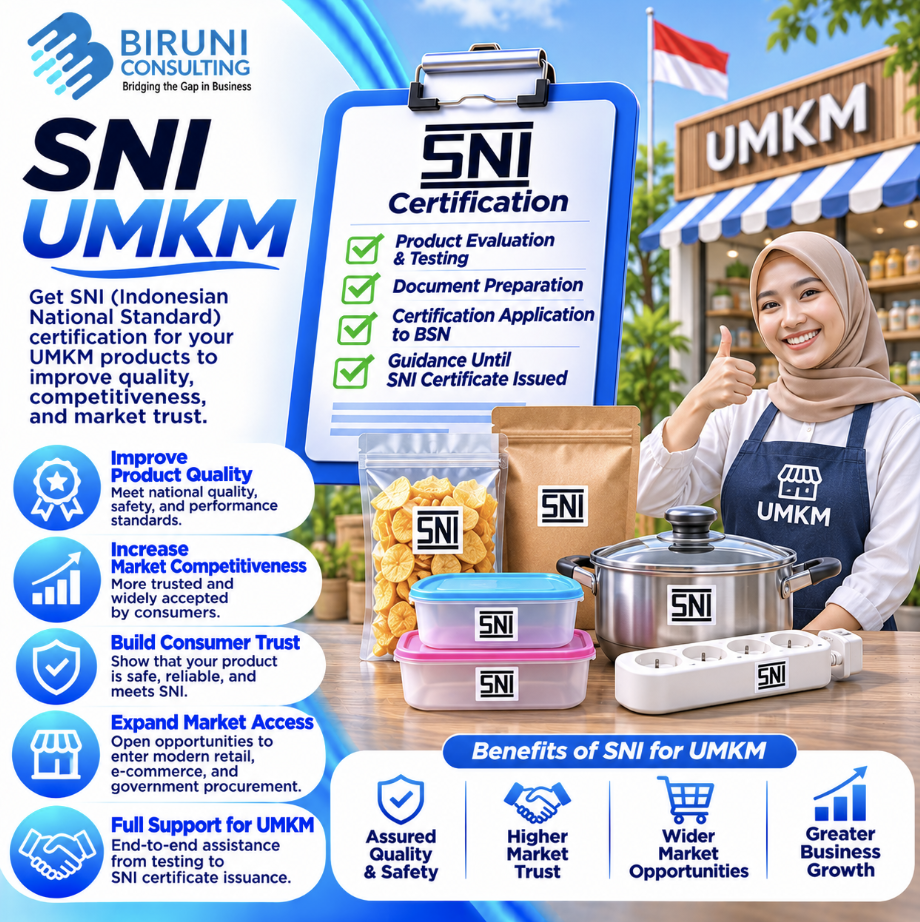
Guide to SNI for Micro, Small, and Medium Enterprises, SNI Bina UMK, Product Certification, Testing, Certification Bodies, and MSME Assistance
SNI for MSMEs generally refers to the application of Indonesian National Standards by micro, small, and medium enterprises. In practice, several routes need to be distinguished, particularly SNI Bina UMK, voluntary SNI certification, and certification required under mandatory technical regulations.
This distinction matters because not every MSME follows the same certification process. For micro and small enterprises, or UMK, conducting low-risk business activities, Government Regulation No. 28 of 2025 provides a special licensing mechanism. The NIB obtained through OSS functions as the business identity and legality and, under the relevant provisions, also applies as SNI and/or a halal assurance statement. These provisions appear in Article 234 of Government Regulation No. 28 of 2025, which is currently in force and replaced Government Regulation No. 5 of 2021. Database Peraturan | JDIH BPK
Formal SNI certification, on the other hand, remains a conformity-assessment process. BSN Regulation No. 9 of 2023 provides that conformity assessment can involve testing, inspection, and/or certification conducted by conformity-assessment bodies accredited by KAN. The regulation also specifically allows implementation arrangements to take the conditions of micro and small businesses into account. Database Peraturan | JDIH BPK
An MSME should therefore not assume that holding an NIB means every product has undergone third-party SNI product certification, while it should likewise not assume that every small business must undergo exactly the same certification process as a large manufacturer. The appropriate route depends on business scale, risk classification, product type, mandatory regulations, and certification objectives.
What Does SNI for MSMEs Mean?
SNI for MSMEs is not a single certificate or a specific standard number.
It broadly refers to the application of Indonesian National Standards by micro, small, and medium businesses.
MSME products can include foods and beverages, agricultural products, handicrafts, textiles, furniture, household goods, machinery, construction materials, chemicals, electrical equipment, consumer products, and many other goods and services.
Each category can use different SNI standards.
The first step should therefore be identifying which standard applies to the product and whether its application is mandatory, voluntary, or potentially eligible for the SNI Bina UMK framework.
MSMEs and UMK Are Not Identical Regulatory Terms
The term MSME includes micro, small, and medium enterprises.
Certain special standardization and licensing arrangements, however, specifically use the term UMK, covering micro and small enterprises.
Government Regulation No. 28 of 2025 separately defines UMK and the broader micro, small, and medium enterprise group. Its Article 234 mechanism concerning low-risk NIB arrangements specifically applies to UMK, rather than automatically applying to medium-sized enterprises. Database Peraturan | JDIH BPK
A medium enterprise should therefore not automatically assume that every SNI Bina UMK facilitation mechanism applies to it.
What Is SNI Bina UMK?
SNI Bina UMK is a program for developing SNI application among micro and small enterprises within the single-business-license framework.
BSN Regulation No. 28 of 2021 defines the SNI Bina UMK Mark as a mark established by BSN for use by UMK within that framework. An eligible UMK applies through OSS, completes an SNI compliance checklist, and makes a self-declaration of commitment to applying the relevant SNI. Under the mechanism, eligible UMK can use the SNI Bina UMK Mark for goods, services, systems, or processes corresponding to the SNI stated in the NIB. Peraturan.go.id
The program functions as a quality-development pathway that helps small businesses progressively understand and implement standards.
SNI Bina UMK Is Different from an SNI Certificate
This distinction is critical.
The SNI Bina UMK Mark operates within the single-license and self-declaration framework for eligible UMK.
Formal SNI certification, in contrast, uses conformity assessment, which may involve testing, inspection, production evaluation, and certification through a conformity-assessment body.
BSN Regulation No. 9 of 2023 provides that a certificate is evidence of conformity issued after the applicable reference requirements have been fulfilled and can become the basis for approval to use the SNI Mark or an SNI-based conformity mark. Database Peraturan | JDIH BPK
An UMK holding the SNI Bina UMK Mark should therefore not represent that its product has undergone formal third-party product certification where that process has not actually occurred.
NIB as SNI for Low-Risk UMK
Government Regulation No. 28 of 2025 provides an important facilitation mechanism for UMK.
Article 234 states that an UMK conducting a low-risk activity obtains an NIB through OSS as its business identity and legality, and that the NIB also applies as SNI and/or a halal assurance statement in accordance with the relevant legislation. Database Peraturan | JDIH BPK
This forms part of Indonesia’s single-business-license framework for micro and small businesses.
It should nevertheless not be interpreted so broadly that product-specific technical regulations are ignored. Particular products can still have separate certification, testing, registration, or sector-specific requirements.
Can Every MSME Obtain SNI Bina UMK?
Not automatically.
SNI Bina UMK is linked specifically to UMK and the low-risk licensing framework.
BSN Regulation No. 28 of 2021 provides for the mark through OSS, NIB, and a self-declaration mechanism. Peraturan.go.id
Eligibility therefore needs to be checked against business status, KBLI, risk classification, and the relevant SNI availability in the OSS mechanism.
Businesses operating under medium or high-risk classifications, or products subject to specific mandatory technical regulations, can have different compliance routes.
Is SNI Bina UMK Free?
The SNI Bina UMK Mark is part of the single-business-license mechanism and differs from formal third-party certification, which can involve testing, audits, certification fees, and surveillance.
BSN, ministries, local governments, universities, and other institutions can also provide facilitation programs for small businesses.
However, MSMEs should not assume that every step toward formal SNI certification is always free.
Laboratory testing, certification-body activities, production assessment, corrective actions, and surveillance can generate costs unless covered by a specific facilitation program.
SNI Assistance Programs for MSMEs
The government uses standardization as one of the instruments for improving small-business competitiveness.
BSN Regulation No. 8 of 2025 on BSN’s strategic planning places standard-application facilitation for micro businesses among its priorities, including SNI Bina UMK, simplified certification implementation for low-risk UMK, and OSS-based NIB facilitation. Peraturan.go.id
Assistance can include awareness, gap analysis, training, technical assistance, documentation preparation, testing, and support toward formal SNI certification.
Availability, quotas, priority sectors, and participating regions can vary between programs and periods.
SNI Bina UMK Bootcamp
BSN has also organized SNI Bina UMK Bootcamp programs to help businesses understand licensing, standard application, and certification preparation.
The program has targeted UMK holding NIBs and provided support concerning SNI implementation, certification, and related business legality. YouTube
Businesses interested in future facilitation should nevertheless develop their legal and technical documentation independently, because public programs can have eligibility requirements and limited quotas.
SNI Bina UMK as a Development Stage
SNI Bina UMK is best understood as an initial stage in developing a quality culture.
Businesses learn to identify standards, control production, document materials, maintain consistency, perform quality checks, and compare their products against SNI requirements.
A later stage can involve more detailed gap assessment and formal third-party certification.
Standardization then becomes a process of strengthening the business rather than merely obtaining a logo.
When Does an MSME Need Formal SNI Certification?
Formal certification can become relevant for several reasons.
First, the applicable SNI may have been made mandatory by a sector regulator.
Second, a retailer, buyer, project owner, tender, marketplace, distributor, or export customer can request a formal certificate even where the standard itself remains voluntary.
Third, a company may voluntarily seek independent evidence of product quality or safety.
In those situations, certification needs to be processed through an appropriately scoped certification body.
Does Mandatory SNI Still Apply to MSMEs?
MSME status should not be used to disregard a product-specific technical regulation.
Where the competent authority has made an SNI mandatory for a defined product scope, the business needs to review that regulation specifically.
SNI Bina UMK and low-risk licensing facilitation exist within their own regulatory framework, while a mandatory product regulation can establish a separate conformity-assessment mechanism.
Product-specific regulations should therefore be checked before compliance claims are made.
Mandatory and Voluntary SNI for MSMEs
SNI can generally be voluntary, while competent regulators can make particular standards mandatory for defined products.
Law No. 20 of 2014 remains Indonesia’s primary legal framework for standardization and conformity assessment. Database Peraturan | JDIH BPK
An MSME should distinguish three situations:
- An SNI exists but remains voluntary.
- The product falls within a mandatory-SNI technical regulation.
- A low-risk UMK qualifies for SNI Bina UMK or the single-license mechanism.
These situations can have different administrative routes and forms of conformity evidence.
Does Every MSME Product Have an SNI?
No.
SNI standards exist for many product categories, but there is not necessarily a dedicated standard for every product or service produced by MSMEs.
Commercial names can also be too broad to identify the correct standard.
Descriptions such as snacks, beverages, furniture, household goods, or small machinery do not by themselves establish the applicable SNI.
Technical product characteristics need to be assessed first.
How to Identify an SNI for an MSME Product
The process should begin with product identification.
For food products, relevant information can include ingredients, processing, composition, packaging, and shelf life.
For non-food products, relevant information can include materials, dimensions, construction, rated specifications, intended use, and manufacturing methods.
Potentially applicable SNI standards are then identified and checked for current status.
The next stage is determining whether the standard remains voluntary or has been made mandatory under a sector regulation.
SNI for MSME Food Products
Food is one of the most common MSME categories for standardization.
Products can include coffee, tea, snacks, spices, sugar products, processed fish products, agricultural products, beverages, and other processed foods.
In addition to SNI, food businesses can face separate requirements involving distribution permits, food safety, hygiene, halal certification, labeling, and other sector-specific controls.
An SNI Certificate does not automatically replace food licensing.
Similarly, PIRT, BPOM registration, or halal certification does not automatically demonstrate compliance with every applicable SNI requirement.
SNI for Non-Food MSMEs
Non-food MSMEs can manufacture textiles, furniture, crafts, household goods, building materials, agricultural equipment, machinery, metal goods, electrical products, cosmetics, and other categories.
Each sector can involve a different regulator.
There is therefore no single MSME certification scheme suitable for every product.
Product assessment needs to occur before a certification body or laboratory is selected.
Electrical Products Manufactured by MSMEs
Small businesses manufacturing electrical products need additional care because some product categories are subject to mandatory SNI.
Product type, voltage, current, power, intended use, construction, and HS Code can affect the applicable regulatory position.
Products incorporating WiFi, Bluetooth, or other radio modules can also have separate telecommunications-device requirements.
MSME status does not remove the need for product-specific regulatory assessment.
What Is a Conformity Assessment Scheme?
A conformity-assessment scheme defines how compliance with SNI is demonstrated.
BSN Regulation No. 9 of 2023 provides that a scheme includes reference requirements, administrative procedures, conformity-assessment activities, evidence of conformity, and supervision by conformity-assessment bodies. Database Peraturan | JDIH BPK
For goods, conformity assessment can include type testing, factory inspection, manufacturing-process assessment, production-management-system audits, representative-sample testing, and verification or validation. Database Peraturan | JDIH BPK
The precise MSME certification process therefore depends on the applicable product scheme.
Simplified Implementation for Micro and Small Enterprises
An important feature of BSN Regulation No. 9 of 2023 is its specific treatment of micro and small enterprises.
Implementation of conformity-assessment schemes for UMK should take business scope and location, number of personnel, nonconformity risk, production complexity, and service complexity into account.
Implementation can include reductions in assessment personnel, assessment time, and/or the number of product samples tested. Database Peraturan | JDIH BPK
This recognizes the scale of UMK while retaining technical conformity requirements.
Simplification Does Not Reduce SNI Requirements
Facilitation for UMK does not mean that safety, quality, or performance limits in an SNI are automatically reduced.
The implementation of conformity assessment can be made more proportionate, for example through fewer personnel, shorter assessment time, or fewer samples according to risk.
The underlying product still needs to satisfy the applicable SNI requirements.
This distinction protects both consumers and the credibility of certification.
What Is an LSPro for MSMEs?
An LSPro or Product Certification Body performs product certification.
An MSME seeking formal certification needs an LSPro whose scope includes the relevant SNI and product category.
Price alone should not determine selection.
The company should review standard scope, accreditation, certification scheme, laboratory arrangements, and the certification body’s ability to handle the relevant product.
Role of KAN
KAN, the National Accreditation Committee, accredits conformity-assessment bodies.
BSN Regulation No. 9 of 2023 provides that conformity assessment is carried out by bodies accredited by KAN. Database Peraturan | JDIH BPK
MSMEs generally do not submit product-certification applications directly to KAN.
Applications are made to the relevant certification body, while laboratories and other bodies perform their respective functions within the conformity-assessment system.
MSME Product Testing
Testing is often one of the more challenging stages for small businesses.
The required parameters depend on the standard.
Food products can require physical, chemical, microbiological, composition, or quality tests.
Materials can require dimensional, tensile, mechanical, or chemical testing.
Electrical products can require substantially more complex safety testing.
The correct standard and representative sample should therefore be established before testing is purchased.
Do Not Test Every Model Immediately
MSMEs can have numerous flavors, sizes, shapes, colors, or models.
Not every variant necessarily requires a completely separate certification process, but they also cannot automatically be grouped.
A product family assessment should be completed.
For foods, formulas or ingredients can influence grouping.
For technical products, materials, ratings, construction, and safety-critical components can be decisive.
Product-family assessment helps identify the correct samples.
Representative Samples
A representative sample is selected to represent a product family during testing.
The physically largest version is not always the most critical sample.
Food formulations, electrical thermal loads, material thicknesses, or mechanical loading can determine the worst-case configuration.
Correct sample selection helps reduce unnecessary retesting.
Existing Test Reports
Some MSMEs already have laboratory reports prepared for PIRT, BPOM, customers, universities, or internal quality control.
These reports should be collected.
However, they do not automatically qualify for use in SNI certification.
The certification body needs to review test parameters, methods, laboratory competence, samples, and standard editions.
Existing evidence should therefore be reviewed before new testing is commissioned.
Factory or Production-Site Evaluation
Certain product-certification schemes include manufacturing-process evaluation.
For MSMEs, assessment implementation can take business conditions into account under BSN Regulation No. 9 of 2023. Database Peraturan | JDIH BPK
The business still needs to demonstrate basic production control.
Records covering materials, suppliers, production dates, batches, inspections, measuring equipment, hygiene, complaints, and nonconforming products can become important evidence.
Does an MSME Need ISO 9001?
There is no universal requirement that every MSME must obtain ISO 9001 before SNI certification.
The requirement depends on the product and certification scheme.
Small businesses should not incur ISO 9001 costs merely because they assume every SNI certificate requires it.
In many cases, demonstrating effective production and quality controls relevant to the product is more important.
Business Legality for MSMEs
Business legality forms an important foundation.
For low-risk UMK, Government Regulation No. 28 of 2025 provides that the NIB functions as business identity and legality and, within the single-license mechanism, can also apply as SNI and/or a halal assurance statement. Database Peraturan | JDIH BPK
For medium- or high-risk activities, the same regulation provides that additional Standard Certificates and/or permits can be required. Database Peraturan | JDIH BPK
Businesses should therefore ensure that KBLI, addresses, products, and activities registered in OSS reflect actual operations.
Product Documentation to Prepare
An MSME does not need a multinational corporation’s documentation system, but product information should still be clear.
Useful information includes:
- NIB and relevant business legality.
- Product lists, brands, photographs, specifications, or formulations.
- Manufacturing-process flows and raw-material or critical-component information.
- Labels and packaging artwork.
- Existing reports and product permits.
- Available quality-control, supplier, production, and complaint records.
Better documentation makes gap assessment and certification preparation more efficient.
MSME Product Labels
Product labeling often requires improvement before certification.
Product name, brand, model or variant, manufacturer, ingredients, ratings, production information, safety statements, or other information needs to correspond to the standard and sector regulations.
Businesses should avoid printing very large volumes of packaging before regulatory review is complete.
Late label changes create unnecessary costs.
Product Trademarks
MSMEs should distinguish trademark ownership from SNI certification.
Registering a trademark does not provide an SNI Certificate.
Conversely, obtaining an SNI Certificate does not automatically provide trademark ownership.
Businesses developing distribution or marketplace channels should establish brand ownership early.
Halal, BPOM, PIRT, and SNI
These instruments perform different regulatory functions.
SNI concerns technical standards and conformity.
Halal certification addresses halal assurance.
PIRT and BPOM relate to food licensing and supervision according to the relevant product category.
One instrument does not automatically replace another.
Food MSMEs should therefore prepare a regulatory map identifying all applicable requirements.
Can SNI Help with Marketplaces?
Certification can provide additional value where marketplaces, modern retailers, customers, or buyers request quality evidence.
Marketing claims nevertheless need to correspond to the certificate scope.
A certificate covering one product should not be used to suggest that an entire catalogue is certified.
The SNI Bina UMK Mark likewise needs to be used according to its applicable rules.
SNI and Government Procurement
Standards can play an important role in procurement.
Tenders and electronic catalogues can establish technical requirements and conformity evidence.
However, each procurement requirement needs to be read carefully.
There can be an important distinction between a requirement that a product meets an SNI, that it holds an SNI Certificate, or that it satisfies particular technical specifications.
SNI for MSME Exports
Applying SNI can help MSMEs develop consistent quality before entering export markets.
SNI does not, however, automatically provide market access to every foreign country.
Destination countries can impose their own standards, technical regulations, labels, safety rules, food registrations, or conformity-assessment requirements.
SNI can strengthen export readiness, but destination-market compliance still needs separate review.
SNI Bina UMK as a Step toward Formal Certification
A major value of SNI Bina UMK is helping businesses develop standardization habits while still small.
UMK can learn documentation, raw-material control, process monitoring, product consistency, and quality evaluation.
This can reduce the gap when the business later seeks third-party certification.
BSN Regulation No. 8 of 2025 also positions SNI Bina UMK as part of the government’s standard-application facilitation for micro businesses. Peraturan.go.id
Control of the SNI Bina UMK Mark
Holding the SNI Bina UMK Mark does not eliminate ongoing responsibilities.
BSN Regulation No. 28 of 2021 requires participating UMK to maintain conformity of their goods, services, processes, or systems with the self-declaration made through the mechanism.
It also provides for control through supervision, monitoring, and/or sampling. CRPG Law Database
Self-declaration therefore still carries a responsibility to maintain consistency.
When Should an UMK Move from SNI Bina UMK to Formal Certification?
There is no universal point suitable for every business.
Formal certification becomes particularly relevant when customers request certificates, the company enters modern retail, participates in tenders, expands distribution, targets exports, seeks stronger brand positioning, or becomes subject to a mandatory regulation.
Businesses can also pursue certification voluntarily to obtain independent evidence of quality or safety.
The decision should be driven by both commercial objectives and regulatory requirements.
Can MSMEs Receive Free Certification Assistance?
Facilitation can be available through BSN, ministries, local governments, universities, state-owned enterprises, and other business-development programs.
Programs generally have eligibility requirements, application periods, quotas, and priority sectors.
Businesses should therefore continue improving their documentation rather than simply waiting for a free program.
An MSME with NIB, relevant product legality, basic production records, appropriate labels, and quality controls will generally be better prepared when facilitation opportunities arise.
Cost of SNI Certification for MSMEs
There is no single certification price applicable to all MSMEs.
Costs can depend on the SNI, product category, product families, laboratory testing, number of samples, production evaluation, business location, corrective actions, and surveillance.
BSN Regulation No. 9 of 2023 permits simplified implementation for UMK, including reductions in assessment personnel, time, or samples where appropriate. Database Peraturan | JDIH BPK
Actual project costs nevertheless depend on the applicable certification scheme and product.
How Long Does MSME SNI Certification Take?
Certification time also varies by product.
A small business with one straightforward product and complete documentation has a different project from a company with dozens of variants or several manufacturing locations.
Laboratory capacity, test duration, corrective actions, production readiness, and certification review all affect timing.
A realistic schedule should therefore follow standard mapping and gap assessment.
Product Families Can Improve Efficiency
MSMEs with several related products should not automatically submit every model separately.
Where the certification scheme permits product families, technically similar models can potentially be handled together.
Overly aggressive grouping can nevertheless cause problems.
Family structure needs to follow technical similarity and scheme requirements rather than merely sharing one brand.
Food Formula Changes
Food MSMEs frequently develop new flavors and formulations.
Ingredient changes can affect SNI parameters, nutritional characteristics, shelf life, allergen considerations, and regulatory labeling.
Certified formulations should therefore be controlled.
Formula and supplier changes need assessment before they are routinely introduced.
Material Changes for Non-Food Products
The same principle applies to non-food products.
Suppliers can change plastics, metal grades, cables, motors, adhesives, coatings, resins, and other components for cost reasons.
Such changes can influence test results.
Even small certified businesses should therefore maintain a basic change-control procedure.
Changing the Production Location
Moving production can affect certification.
A new workshop or facility can have different equipment, layouts, storage, processes, hygiene, or quality controls.
Where the certification scheme connects conformity with a manufacturing site, such changes need to be communicated to the certification body.
Businesses should not relocate production and wait until surveillance to disclose the change.
Surveillance
Formal SNI certification can include surveillance according to the certification scheme.
BSN Regulation No. 9 of 2023 includes conformity monitoring by the certification body as part of a scheme and identifies surveillance as the applicable monitoring mechanism. Database Peraturan | JDIH BPK
MSMEs therefore need to maintain production records and product consistency after certification.
An SNI Certificate is not merely a one-time document.
Common MSME SNI Mistakes
One common mistake is treating the SNI Bina UMK Mark as identical to third-party product certification.
Another is assuming that every MSME automatically receives SNI simply by holding an NIB.
Businesses can also order testing before establishing the correct standard or sample.
Some print SNI logos on packaging before they have the appropriate marking rights.
Another mistake is assuming that every MSME product is voluntary even though some products can fall under mandatory technical regulations.
Do Not Buy a Certification Package before Assessment
Small businesses can receive fixed-price “SNI package” offers before the product has even been reviewed.
That approach carries significant risk because one commercial product description can correspond to several different technical standards.
Before committing expenditure, the business should establish:
product → SNI → mandatory/voluntary status → scheme → certification body → sample → testing.
This sequence reduces unnecessary costs.
SNI Process for MSMEs
The process should begin by identifying the business scale, KBLI, NIB, and risk classification. The product is then mapped against the relevant SNI and technical regulation to determine whether the correct route is SNI Bina UMK, voluntary SNI, or mandatory SNI.
Where formal certification is pursued, product-family assessment should take place before representative samples are selected.
The business then prepares legal documentation, labels, material or ingredient information, manufacturing processes, existing reports, and basic quality records.
Application proceeds through an appropriately scoped certification body. Depending on the scheme, the project may include documentation review, testing, audits or production assessment, corrective actions, certification review, and surveillance.
Preparing for Certification
An MSME does not need to wait until it has a perfect quality-management system.
Basic controls should nevertheless exist: clear product identification, controlled suppliers, defined production flows, fixed formulations or specifications, consistent labels, and basic quality records.
These foundations reduce nonconformities during assessment.
Food businesses should focus on hygiene and production controls, while technical manufacturers should also address measurement, inspection, drawings, materials, and component control.
Why Is SNI Important for MSMEs?
Standardization helps transform production knowledge that may previously exist only in the owner’s experience into a more consistent and documented process.
This becomes especially important as the business hires employees, works with distributors, adds production locations, or receives larger orders.
SNI also provides a technical benchmark for improvement rather than relying only on trial and error.
The greatest value of SNI is therefore not simply a logo, but the ability to consistently produce goods meeting defined requirements.
Why Is Pre-Assessment Important?
MSMEs generally have fewer resources than large corporations, so an incorrect certification route can create a disproportionate financial burden.
Choosing the wrong standard, laboratory, sample, or testing every model without product-family assessment can increase costs unnecessarily.
Pre-assessment helps determine whether the business qualifies for SNI Bina UMK, whether formal certification is mandatory, which standard applies, which certification body has the correct scope, what testing is required, and whether facilitation opportunities may be relevant.
This allows certification budgets to be directed toward the correct requirements.
Contact Us
Biruni Consulting assists businesses with SNI for MSMEs and UMK, including SNI Bina UMK consultation, mandatory or voluntary SNI assessment, product family assessment, testing, and certification assistance.
Our services include:
- Consultation on MSME SNI, SNI Bina UMK, and mandatory or voluntary SNI status.
- Review of NIB, KBLI, product specifications, applicable SNI standards, and product lists.
- Gap assessment of MSME readiness for formal SNI certification.
- Review of labels, raw materials, critical components, production processes, and existing test reports.
- Product family assessment, representative-sample selection, and preparation for production-site evaluation.
- Testing, corrective-action, certification-body, SNI certification, surveillance, and SNI Mark assistance according to applicable requirements.
Contact Biruni Consulting for information regarding MSME SNI certification services, SNI Bina UMK consultation, SNI certification for small businesses, MSME product SNI, MSME SNI testing, product-family assessment, and SNI certification assistance according to your product type, brand, models or variants, manufacturing process, business location, and target market.