
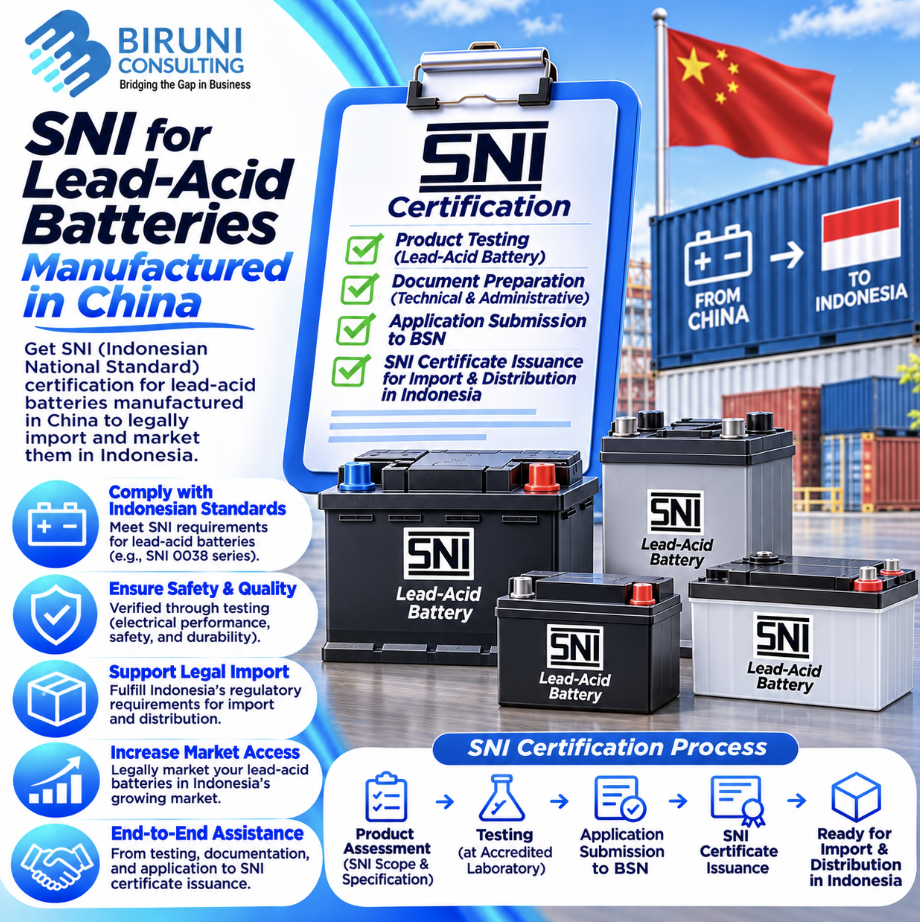
Guide to Indonesian SNI Certification for Chinese Automotive Battery Manufacturers, Lead-Acid Accumulators, Authorized Representatives, Importers, Factory Audits, Testing, and SIINas
SNI for lead-acid batteries manufactured in China is an important regulatory consideration for automotive battery manufacturers, OEM factories, brand owners, exporters, importers, and distributors intending to enter the Indonesian market.
China is a major global manufacturing center for automotive batteries, producing motorcycle batteries, passenger vehicle batteries, commercial vehicle batteries, maintenance-free batteries, AGM batteries, EFB batteries, and lead-acid batteries for industrial applications.
Each battery category can have different technical standards and certification requirements depending on its technology, construction, capacity, voltage, and intended application.
Chinese battery manufacturers should understand the differences between Indonesian National Standards, mandatory SNI regulations, and product certification mechanisms before establishing their Indonesian importation and distribution arrangements.
Is SNI Mandatory for Lead-Acid Batteries Manufactured in China?
As of November 2026, Indonesia’s Ministry of Industry has been preparing a regulation concerning the mandatory implementation of Indonesian National Standards for lead-acid batteries or accumulators used in motor vehicles of categories M, N, O, and L.
The proposed regulation covers relevant batteries intended for passenger vehicles, commercial vehicles, trailers, and motor vehicles with fewer than four wheels.
However, a draft regulation should not be treated as an enacted mandatory technical regulation. A final mandatory regulation had not been identified in the official sources reviewed at the time of this assessment.
Chinese battery manufacturers should begin preparing their corporate documents, manufacturing facilities, quality management systems, trademark arrangements, and Indonesian representative structures in anticipation of the forthcoming regulatory requirements.
Reference: Ministry of Industry Preparations for Mandatory SNI for Automotive Accumulators.
Latest Indonesian SNI Standards for Automotive Batteries
The standards identified in the development of Indonesia’s proposed mandatory automotive battery regulation include:
| SNI Standard | General scope |
|---|---|
| SNI 38:2025 | Lead-acid batteries for motor vehicles of categories M, N, and O |
| SNI 4326:2025 | Lead-acid batteries for motor vehicles of category L |
These standards are identified in the available 2026 technical regulatory planning information.
Previous Indonesian automotive battery standards include SNI 0038:2009 and SNI 4326:2013.
Manufacturers should pay particular attention to standard revisions because certification based on previous editions may not automatically satisfy future mandatory requirements.
What Is a Lead-Acid Battery or Accumulator?
An accumulator is an electrical energy storage device capable of being recharged through an electrochemical process.
A lead-acid battery uses lead and lead compounds as electrode materials and sulfuric acid-based electrolyte.
Lead-acid batteries are widely used for vehicle starting systems, lighting, ignition, and other automotive electrical applications.
They can also be used in industrial equipment, energy storage systems, uninterruptible power supplies, and telecommunications infrastructure.
However, not every lead-acid battery application falls within the same Indonesian National Standard.
Differences Between SNI for Lead-Acid Batteries and Primary Batteries
Lead-acid batteries are classified as secondary or rechargeable batteries.
Primary batteries, in contrast, are generally designed for use without recharging.
Ministry of Industry Regulation No. 69 of 2024 establishes mandatory SNI requirements for primary batteries under SNI IEC 60086-1 and SNI IEC 60086-2.
This regulation is not the mandatory regulatory basis for automotive lead-acid batteries.
Chinese automotive battery manufacturers must therefore identify the specific standards and regulations applicable to accumulators.
Reference: Ministry of Industry Regulation No. 69 of 2024.
SNI 38:2025 for Automotive Lead-Acid Batteries
SNI 38:2025 concerns lead-acid batteries for motor vehicles of categories M, N, and O.
This standard is particularly relevant to manufacturers of batteries for passenger vehicles, commercial vehicles, goods transport vehicles, and other applicable automotive products.
The general vehicle classifications include:
-
Category M: motor vehicles intended for passenger transportation.
-
Category N: motor vehicles intended for goods transportation.
-
Category O: trailers and semi-trailers.
Manufacturers should evaluate the intended use, technical characteristics, and product classification to establish whether their batteries fall within the applicable standard.
SNI 4326:2025 for Motorcycle Batteries
SNI 4326:2025 concerns lead-acid batteries for motor vehicles of category L.
Category L generally includes motorcycles and other applicable motor vehicles with fewer than four wheels.
Chinese motorcycle battery manufacturers should evaluate product voltage, capacity, dimensions, terminal configurations, internal construction, battery technology, and performance characteristics before preparing certification applications.
The previous edition, SNI 4326:2013, is available through the Indonesian National Standardization Agency catalogue.
Reference: BSN Catalogue – SNI 4326:2013.
HS Codes for Lead-Acid Batteries Manufactured in China
Lead-acid batteries generally fall within HS heading 8507, which covers electrical accumulators.
Relevant HS classifications include:
| HS Code | General description |
|---|---|
| 8507.10 | Lead-acid accumulators used for starting piston engines |
| 8507.20 | Other lead-acid accumulators |
| 8507.30 | Nickel-cadmium accumulators |
| 8507.50 | Nickel-metal hydride accumulators |
| 8507.60 | Lithium-ion accumulators |
| 8507.80 | Other electrical accumulators |
| 8507.90 | Parts of electrical accumulators |
For automotive starter batteries, HS Code 8507.10 is one of the principal classifications requiring assessment.
However, not every product under HS heading 8507 automatically falls within the scope of the proposed mandatory automotive lead-acid battery regulation.
The complete Indonesian tariff classification must be determined according to the applicable Indonesian Customs Tariff Book, product characteristics, and final technical regulations.
SNI Certification for Flooded Lead-Acid Batteries Manufactured in China
Flooded lead-acid batteries use liquid electrolyte and are widely used in automotive and electrical applications.
Manufacturers should maintain appropriate controls over plate materials, electrolytes, separators, casing construction, terminals, capacity, and production consistency.
Product maintenance requirements should also be communicated through appropriate instructions and product information.
The applicable technical standard and testing requirements must be established before certification.
SNI Certification for Maintenance-Free Automotive Batteries
Maintenance-free batteries are designed to reduce maintenance requirements during normal operation.
Commercial descriptions such as dry batteries or maintenance-free batteries do not necessarily establish that a product contains no electrolyte.
Chinese manufacturers should provide detailed information concerning the actual battery technology and internal construction.
Differences in construction and electrolyte systems may influence laboratory testing and product family classification.
SNI Certification for AGM Batteries Manufactured in China
Absorbent Glass Mat, commonly known as AGM Battery, is a lead-acid battery technology that uses glass mat material to absorb the electrolyte.
AGM batteries are widely used in vehicles with higher electrical requirements, including certain vehicles equipped with start-stop systems.
Manufacturers should evaluate charging characteristics, battery capacity, starting performance, vibration resistance, internal construction, and other applicable technical requirements.
AGM batteries should not automatically be grouped with conventional flooded batteries without assessing technical similarities and certification scheme requirements.
SNI Certification for EFB Batteries Manufactured in China
Enhanced Flooded Battery, commonly known as EFB, is an improved flooded lead-acid battery technology.
EFB batteries are frequently used in vehicles requiring improved charging and discharging cycle performance compared with conventional automotive batteries.
Manufacturers should prepare technical datasheets, construction information, capacity specifications, performance characteristics, and available test reports.
Product family classification should consider the technology and technical differences between EFB and conventional batteries.
SNI Certification for VRLA Batteries
Valve-Regulated Lead-Acid Batteries, or VRLA batteries, use valve-regulated pressure control systems.
VRLA technology can be found in AGM batteries, gel batteries, UPS batteries, and various industrial battery applications.
Not every VRLA battery is intended for starting automotive engines.
The applicable SNI must therefore be determined according to whether the battery is intended for automotive applications, telecommunications equipment, energy storage, UPS systems, or other industrial uses.
SNI Certification for Car Batteries Manufactured in China
Chinese car battery manufacturers commonly offer numerous battery models with different capacities, physical dimensions, terminal configurations, and starting performance characteristics.
Examples of commercial battery model designations include NS40, NS60, N50, N70, DIN, JIS, and other formats.
Identical commercial model names do not necessarily establish identical technical characteristics.
Manufacturers should prepare comprehensive product lists identifying trademarks, model numbers, rated voltages, capacities, dimensions, battery technologies, and performance specifications.
SNI Certification for Motorcycle Batteries Manufactured in China
Motorcycle batteries are available in various capacities and constructions to support starting systems, lighting, and vehicle electronics.
Common commercial model designations include YTX, YTZ, and YB series batteries.
Manufacturers should assess their products against the applicable standard for category L motor vehicles.
Differences in battery capacity, terminal configurations, physical dimensions, internal construction, and electrolyte systems should be considered during product family assessment.
SNI Certification for Truck and Commercial Vehicle Batteries
Commercial vehicle batteries generally have different capacity and starting performance requirements compared with passenger vehicle batteries.
These batteries can be used in trucks, buses, goods transport vehicles, and other commercial transportation equipment.
Manufacturers should consider operating conditions, vibration exposure, usage cycles, and vehicle electrical system requirements.
The applicable standard must be established based on the vehicle category and battery specifications.
SNI for UPS Batteries and Industrial Lead-Acid Batteries
UPS batteries and industrial lead-acid batteries do not necessarily perform the same functions as automotive starter batteries.
Stationary batteries can be designed to provide backup energy for telecommunications infrastructure, data centers, security systems, industrial facilities, and electrical infrastructure.
Standards within the IEC 60896 and IEC 61427 series may provide relevant technical references for certain applications, subject to confirmation of Indonesian adoption and applicable standard editions.
Automotive battery certification should not automatically be applied to all stationary battery products.
Can Chinese Battery Manufacturers Apply for Indonesian SNI Certification?
Chinese battery manufacturers can pursue SNI certification through the conformity-assessment mechanisms available for their products.
For voluntary certification, manufacturers should identify a Product Certification Body with an appropriate accreditation scope.
When mandatory automotive battery regulations are formally enacted, overseas manufacturers will need to comply with the specific requirements established under the final regulation.
Preparation should begin with manufacturer identification, factory addresses, corporate legality, trademarks, manufacturing facilities, production capacity, and quality management systems.
Battery Manufacturers and Trading Companies in China
Manufacturing companies and trading companies perform different functions within SNI certification projects.
A trading company may act as an exporter or international sales organization.
However, a trading company does not automatically qualify as the manufacturer entitled to hold a product certification.
The actual manufacturing company responsible for producing the batteries must be identified and appropriately documented.
Indonesian companies purchasing batteries through Chinese trading companies should obtain complete manufacturer information before initiating certification.
Manufacturing Facility Requirements for Chinese Battery Factories
Battery manufacturers should demonstrate appropriate manufacturing capabilities and production quality controls.
Manufacturing processes that may form part of factory evaluation include plate manufacturing or processing, pasting, curing, assembly, electrolyte filling, formation, sealing, final inspection, and packaging.
The legally required minimum manufacturing facilities must be determined according to the applicable certification scheme and final regulation.
Factories performing only relabeling, repackaging, or product distribution should complete an eligibility assessment before applying for certification.
ISO 9001:2015 for Chinese Lead-Acid Battery Manufacturers
ISO 9001:2015 is a quality management system standard that can support manufacturing readiness for SNI certification.
Chinese battery manufacturers should establish a quality management system covering the relevant accumulator manufacturing activities.
Important information includes the company’s legal name, manufacturing address, certification scope, certificate validity, and consistency between documentation and actual manufacturing activities.
An ISO 9001 Certificate covering only trading or distribution activities may not adequately demonstrate manufacturing quality management capabilities.
IATF 16949 for Automotive Battery Manufacturers
Battery manufacturers supplying international automotive companies may hold IATF 16949 certification.
IATF 16949 addresses automotive quality management systems and supply chain requirements.
Existing IATF 16949 Certificates can provide useful supporting evidence during factory readiness assessment.
However, acceptance of IATF 16949 as an alternative quality management system requirement must follow the applicable Indonesian regulation and certification scheme.
Authorized Representative in Indonesia for Chinese Battery Manufacturers
An Authorized Representative is an Indonesian company appointed by an overseas manufacturer to perform regulatory representation functions under the applicable product regulation.
Chinese battery manufacturers preparing for mandatory automotive battery certification should consider their Authorized Representative arrangements at an early stage.
The Authorized Representative may perform functions involving certification applications, regulatory documentation, trademark management, coordination with government authorities, and ongoing product compliance.
The specific eligibility requirements and limitations for automotive battery representatives must follow the final Indonesian regulation.
Must the Authorized Representative Also Be the Importer?
An Authorized Representative and an importer generally perform different regulatory and commercial functions.
Under certain Indonesian mandatory SNI regulations for industrial products, an Authorized Representative may act as an importer or appoint another importing company subject to applicable requirements.
However, this mechanism should not automatically be assumed to apply to automotive batteries before the final regulation is established.
Chinese manufacturers should map their business arrangements, including the manufacturer, trademark owner, Authorized Representative, importer, distributor, and Indonesian sales network.
Indonesian Battery Importer Requirements
Indonesian battery importers must maintain business legality appropriate to their importation and trading activities.
Relevant documents may include the Business Identification Number or NIB, tax registration, corporate establishment documents, applicable KBLI business classifications, business licenses, customs access, and other supporting documentation.
Additional import approvals or trade requirements should be assessed according to the product’s HS Code and the regulations applicable when importation takes place.
Battery Trademark Ownership in Indonesia
Trademark ownership is an important aspect of imported product certification preparation.
Chinese battery manufacturers should review their trademark registration status in Indonesia through the Directorate General of Intellectual Property, commonly known as DJKI.
Electrical accumulators and batteries generally relate to trademark Class 9.
Manufacturers should establish whether the trademark is owned by the manufacturer, parent company, Indonesian importer, distributor, or another legal entity.
An unsuitable trademark ownership structure can create difficulties during regulatory verification.
Trademark License Agreements for Imported Batteries
Manufacturers granting trademark usage rights to Indonesian companies may need to prepare an appropriate Trademark License Agreement.
A trademark licensing agreement differs from a conventional sales or distribution agreement.
License recordation with the Directorate General of Intellectual Property should be prepared where required by the applicable certification mechanism and regulations.
Trademark ownership and corporate relationships should be reviewed before submitting a certification application.
SNI Certification for OEM Batteries Manufactured in China
Many Indonesian companies cooperate with Chinese OEM battery factories to manufacture products under their own trademarks.
Under OEM arrangements, the trademark owner is not necessarily the company performing the actual manufacturing activities.
The relationship between the manufacturer, trademark owner, Authorized Representative, and importer should be clearly established.
Manufacturers should not automatically assume that OEM or contract manufacturing mechanisms established under unrelated SNI regulations will apply to automotive batteries.
Eligibility must be assessed against the applicable certification scheme and final regulatory provisions.
SNI Certification for Private-Label Automotive Batteries
Private-label automotive batteries are manufactured by one company and marketed under another company’s trademark.
This commercial model is common in the international automotive aftermarket.
Certification preparation should establish trademark ownership, manufacturing responsibility, product traceability, regulatory representation, and importer arrangements.
An unsuitable private-label structure may create administrative complications even when the products satisfy technical testing requirements.
One Chinese Battery Factory Producing Multiple Brands
Chinese battery factories can manufacture products under numerous trademarks for customers in different countries.
However, an SNI Certificate covering one trademark does not automatically establish certification coverage for every trademark manufactured at the same facility.
Certification scope may be influenced by trademarks, battery models, technical standards, manufacturing locations, and corporate relationships.
Product mapping should therefore be completed before finalizing the application structure.
One Battery Brand with Multiple Manufacturing Locations in China
Large battery manufacturers may operate several production facilities throughout China.
Even where the same company name and trademark are used, individual factories may have different manufacturing facilities, suppliers, personnel, and quality control systems.
Manufacturers should assess whether each manufacturing location requires separate certification under the applicable certification scheme.
Factory location mapping helps prevent inconsistencies between certification documentation and actual production arrangements.
SNI Battery Certification Applications Through SIINas
SIINas stands for Indonesia’s National Industrial Information System.
The Ministry of Industry uses SIINas to manage industrial information and various regulatory services.
Under numerous mandatory industrial product certification mechanisms, SIINas is used for certification applications, documentation verification, and approval to use the SNI Mark.
Chinese battery manufacturers and Indonesian companies should prepare corporate documentation, trademark information, factory details, and technical product data in anticipation of potential SIINas application requirements.
The specific application procedure for automotive batteries will depend on the final regulation and official technical instructions.
Product Certification Bodies for SNI Automotive Batteries
An LSPro, or Product Certification Body, performs product conformity assessment and certification within its accredited scope.
One Indonesian institution listing automotive battery certification services under previous standard editions is the Center for Standardization and Industrial Services for Materials and Technical Products, commonly known as B4T.
Manufacturers should verify whether the selected certification body holds accreditation covering the latest applicable SNI editions.
If mandatory automotive battery certification is introduced, the certification body’s official appointment by the Ministry of Industry should also be verified.
Reference: B4T Product Certification Services.
Role of KAN in SNI Battery Certification
Indonesia’s National Accreditation Committee, commonly known as KAN, accredits conformity-assessment bodies.
Battery manufacturers do not normally apply for product certification directly to KAN.
Certification applications are submitted to an appropriately accredited Product Certification Body.
Testing laboratories must also demonstrate competence for the relevant testing methods, parameters, and applicable standards.
SNI Automotive Battery Certification Scheme
Automotive battery certification can involve document review, quality management system evaluation, factory assessment, product sampling, laboratory testing, and certification decision-making.
Where a Type 5 certification scheme is applied, conformity assessment considers both product testing results and the manufacturer’s ability to maintain consistent production quality.
The certification scheme for mandatory automotive batteries must follow the officially established regulation and its technical annexes.
Factory Audits for Battery Manufacturers in China
Factory audits may form part of automotive battery certification.
Chinese manufacturers should prepare for evaluation of areas such as:
-
Lead and raw material control.
-
Incoming quality inspections.
-
Battery plate manufacturing processes.
-
Assembly process controls.
-
Electrolyte controls.
-
Formation and charging processes.
-
In-process quality inspections.
-
Final product testing.
-
Testing equipment and calibration.
-
Batch identification and traceability.
-
Nonconforming product control.
-
Storage and packaging controls.
-
Customer complaint management.
-
Corrective and preventive actions.
Manufacturers should ensure that relevant production facilities, manufacturing records, and operating processes are available during factory assessment.
Automotive Battery Sampling in China
Product sampling is an important component of certification.
Sample selection and collection must follow the applicable certification scheme and instructions issued by the Product Certification Body.
Samples should appropriately represent the battery models being submitted and remain traceable to the relevant manufacturing processes.
Manufacturers should avoid independently selecting and shipping certification samples before receiving appropriate instructions.
Incorrect sample selection can result in additional testing and unnecessary certification costs.
Battery Product Family Assessment
Chinese battery manufacturers frequently offer dozens or hundreds of products with different capacities, physical dimensions, and construction characteristics.
Product family assessment helps identify whether technically related models can be grouped under the applicable certification scheme.
Relevant assessment factors may include battery technology, nominal voltage, capacity, plate materials, internal construction, electrolyte type, dimensions, terminal configuration, and intended application.
Products should not automatically be grouped together merely because they share the same trademark.
Laboratory Testing for SNI Lead-Acid Batteries
Laboratory testing evaluates product conformity against the requirements established by the applicable standard.
Testing parameters may differ according to battery technology, intended application, and standard edition.
Typical automotive battery performance considerations include capacity, voltage, starting performance, cycle endurance, vibration resistance, water consumption, charging characteristics, and storage performance.
The mandatory test parameters, acceptance criteria, and testing methods must follow the applicable Indonesian National Standard.
Automotive Battery Capacity Testing
Battery capacity is generally expressed in ampere-hours, commonly abbreviated as Ah.
Capacity testing evaluates the battery’s ability to deliver electrical energy under specified testing conditions.
The capacity stated on the product label should be supported by appropriate technical evidence.
Differences in testing methods, temperature, discharge rates, and operating conditions can influence laboratory results.
Manufacturers should ensure that declared performance values correspond to the applicable testing methods.
Cold Cranking Amps Testing for Automotive Batteries
Cold Cranking Amps, commonly known as CCA, is an important automotive starter battery performance characteristic.
CCA relates to the battery’s ability to deliver high electrical current under specified low-temperature testing conditions.
Manufacturers should recognize that testing methods under JIS, EN, SAE, IEC, and other standards are not necessarily identical.
CCA values stated in technical datasheets should therefore be reviewed together with their corresponding testing methods.
Vibration Resistance Testing for Automotive Batteries
Automotive batteries can experience vibration during normal vehicle operation.
Vibration resistance testing can evaluate the battery construction’s ability to maintain functionality and structural integrity under specified testing conditions.
Terminal quality, internal connections, casing construction, plate arrangements, and component assembly may influence battery performance.
Manufacturers should maintain appropriate design and production controls for these characteristics.
Can SNI Battery Testing Be Conducted in China?
Chinese battery manufacturers often operate internal testing laboratories or cooperate with independent third-party testing laboratories.
Existing laboratory reports can provide useful technical information during preliminary regulatory assessment.
However, ISO/IEC 17025 accreditation does not automatically establish acceptance of an overseas laboratory under every Indonesian SNI certification mechanism.
Laboratory recognition, accreditation scope, standard editions, testing methods, and acceptance by the relevant authorities and Product Certification Body should be evaluated before commissioning certification tests.
Can JIS, DIN, EN, and IEC Battery Test Reports Be Used?
Chinese automotive battery manufacturers may possess test reports based on various national and international standards.
Common technical references within the automotive battery industry include JIS D 5301, IEC 60095, EN 50342, SAE J537, and other applicable standards.
Existing reports should be evaluated according to standard editions, testing methods, sample identification, laboratory competence, and conformity with Indonesian SNI requirements.
International laboratory reports and certificates do not automatically replace Indonesian SNI product certification.
Manufacturers should conduct an existing test report review before investing in additional laboratory testing.
Documents Required from Chinese Battery Manufacturers
Initial documentation that Chinese battery manufacturers should prepare includes:
-
Manufacturer business license.
-
Corporate registration documents.
-
Manufacturing facility profile and address.
-
ISO 9001:2015 or IATF 16949 Certificate, where available.
-
Battery product list.
-
Trademark and model information.
-
Technical datasheets.
-
Battery technology information.
-
Voltage, capacity, and starting performance specifications.
-
Trademark registration certificates.
-
Trademark License Agreement, where applicable.
-
Manufacturing process flowchart.
-
Production equipment list.
-
Laboratory testing equipment list.
-
Quality control procedures.
-
Existing laboratory test reports.
-
Product labels and packaging artwork.
-
Manufacturing capacity information.
-
Safety Data Sheet.
-
Authorized Representative appointment documents, where required.
Additional documentation may be necessary according to regulatory verification results and the applicable certification scheme.
Documents Required from Indonesian Companies
Indonesian Authorized Representatives and importers may need to prepare corporate legality, NIB, tax registration, establishment documents, business activity classifications, warehouse information, trademark documentation, cooperation agreements, appointment letters, and importation plans.
Information submitted by the Indonesian company should be consistent with the actual manufacturer’s corporate and technical documentation.
Early documentation review can reduce unnecessary administrative complications.
Labeling and Packaging for Batteries Manufactured in China
Automotive battery labels may contain information concerning the trademark, model, nominal voltage, capacity, starting performance, manufacturer identity, production codes, country of origin, and safety instructions.
Mandatory labeling information must follow the applicable Indonesian National Standard and product regulations.
Manufacturers should avoid printing packaging containing the SNI Mark before obtaining the applicable authorization to use it.
SNI Certificate and Approval to Use the SNI Mark
An SNI Certificate provides evidence of conformity based on the applicable assessment process.
Several mandatory industrial product regulations administered by the Indonesian Ministry of Industry also establish an Approval Letter for the Use of the SNI Mark, commonly known as SPPT SNI.
If this mechanism is implemented for automotive batteries, manufacturers and Authorized Representatives must satisfy the relevant issuance and marking requirements established by the final regulation.
Surveillance for SNI-Certified Lead-Acid Batteries
Product certification does not necessarily end when the certificate has been issued.
Surveillance may be required to ensure that manufacturers continue maintaining product conformity and consistent manufacturing quality.
Surveillance activities can include factory assessments, documentation reviews, product sampling, laboratory testing, and evaluation of changes to certified products.
Manufacturers should establish appropriate ongoing compliance and quality control procedures.
Changes to Battery Materials and Components
Changes in battery plate materials, separators, electrolytes, casings, terminals, and other critical components may influence technical product performance.
Certified manufacturers should control these changes through appropriate change-control procedures.
Certain modifications may require additional evaluation by the Product Certification Body according to the certification scheme.
Manufacturers should assess certification implications before implementing significant product changes.
Shipping Lead-Acid Battery Samples from China to Indonesia
Battery sample shipments must comply with applicable transportation requirements according to product characteristics.
Certain lead-acid batteries may be classified as dangerous goods depending on electrolyte conditions, battery construction, and transportation methods.
Manufacturers should prepare relevant Safety Data Sheets, transportation classification information, and shipping documentation.
Certification sample shipments must also comply with applicable customs procedures and sample importation requirements.
SNI Automotive Batteries and Environmental Requirements
Lead-acid batteries contain materials requiring appropriate environmental management.
Environmental considerations may include manufacturing waste control, hazardous material storage, used battery management, and recycling activities.
An SNI product certificate does not automatically replace environmental permits or obligations relating to waste management.
Manufacturers, importers, and distributors should evaluate product compliance and environmental responsibilities separately.
Cost of SNI Certification for Lead-Acid Batteries Manufactured in China
There is no single certification cost applicable to every Chinese battery manufacturer.
Certification costs may depend on:
-
Applicable standards and certification schemes.
-
Number of trademarks.
-
Number of battery models and product families.
-
Number of manufacturing locations.
-
Corporate documentation readiness.
-
Quality management system readiness.
-
Factory audit requirements.
-
Laboratory testing requirements.
-
Product sampling and transportation.
-
Trademark registration and licensing.
-
Authorized Representative arrangements.
-
Surveillance and ongoing certification maintenance.
A project-specific estimate should be prepared after regulatory assessment and preliminary documentation review.
How Long Does SNI Automotive Battery Certification Take?
Certification duration may depend on manufacturer readiness, trademark ownership, Authorized Representative arrangements, regulatory verification, factory audit scheduling, laboratory availability, and testing duration.
For products covered by forthcoming mandatory regulations, the readiness of certification bodies and testing laboratories should also be considered.
Because certification involves regulatory authorities and conformity-assessment bodies, neither the final completion date nor successful certificate issuance can be guaranteed in advance.
Indonesian Import Policies and Domestic Battery Manufacturing
Indonesia uses industrial standardization as one of its instruments for consumer protection, product quality improvement, and national industrial development.
Chinese lead-acid battery manufacturers should consider developments in Indonesian import policies and government initiatives supporting domestic battery manufacturing.
Technical manufacturing readiness and existing international certifications do not automatically guarantee approval of an Indonesian certification or importation application.
Regulatory feasibility assessment should therefore be completed before making substantial commercial commitments.
SNI Automotive Battery Certification Preparation Process
The general preparation process may involve the following stages:
-
Identification of battery types and intended applications.
-
HS Code assessment.
-
Applicable SNI standard identification.
-
Mandatory or voluntary certification assessment.
-
Chinese manufacturer eligibility review.
-
Trademark ownership assessment.
-
Authorized Representative and importer arrangement.
-
Quality management system readiness assessment.
-
Battery product family assessment.
-
Corporate and technical documentation preparation.
-
Product Certification Body and laboratory selection.
-
Certification application through the applicable mechanism.
-
Factory audit in China, where required.
-
Product sampling and laboratory testing.
-
Corrective actions, where required.
-
Certification evaluation and certificate issuance when requirements are fulfilled.
-
Approval to use the SNI Mark, where required.
-
Surveillance and ongoing certification maintenance.
The final certification procedure must be adjusted to the applicable regulatory framework and officially established certification scheme.
Common SNI Certification Mistakes Made by Chinese Battery Manufacturers
Common mistakes include assuming that every lead-acid battery follows the same SNI standard, selecting importers before reviewing Authorized Representative requirements, using unsuitable trademark arrangements, and commissioning laboratory tests before determining the correct certification scheme.
Manufacturers may also incorrectly assume that existing JIS, IEC, EN, or IATF 16949 certification automatically replaces Indonesian SNI product certification.
Another mistake is printing the SNI Mark on battery labels or packaging before receiving the appropriate authorization.
Early assessment helps reduce unnecessary costs, repeated testing, and administrative difficulties.
Why Is SNI Pre-Assessment Important for Chinese Battery Manufacturers?
Pre-assessment helps manufacturers identify their technical and administrative readiness before investing in factory audits, laboratory testing, trademark registration, and Indonesian corporate arrangements.
This process becomes particularly important when new mandatory technical regulations are being developed.
A comprehensive preliminary assessment can help establish the applicable SNI standard, regulatory status, manufacturer eligibility, product family structure, trademark arrangements, Authorized Representative requirements, and potential certification obstacles.
Chinese manufacturers can therefore develop an Indonesian market-entry strategy based on actual regulatory requirements rather than assumptions.
Preparing for Future Mandatory SNI Automotive Battery Regulations
Chinese battery manufacturers should not necessarily wait until a mandatory regulation becomes effective before preparing their documentation.
Early preparation can include reviewing the latest SNI standards, evaluating manufacturing facilities, maintaining quality management systems, organizing product specifications, reviewing trademark ownership, and identifying suitable Indonesian business partners.
Manufacturers should also monitor official regulatory developments to ensure their certification strategies remain consistent with the final requirements.
Preparing early can help reduce potential administrative and technical difficulties once mandatory certification requirements are formally implemented.
Contact Us
Biruni Consulting supports Chinese automotive battery manufacturers, OEM factories, trademark owners, exporters, Indonesian importers, and distributors with SNI certification preparation for lead-acid batteries and automotive accumulators entering the Indonesian market.
Our services include:
-
Regulatory consultation for automotive lead-acid batteries.
-
SNI 38:2025 and SNI 4326:2025 assessment.
-
Review of forthcoming mandatory SNI automotive battery regulations.
-
Battery HS Code and technical specification assessment.
-
Regulatory feasibility assessment for Chinese manufacturers.
-
Authorized Representative and Indonesian importer arrangement support.
-
Trademark ownership and licensing document review.
-
Manufacturing facility and quality management system gap assessment.
-
Battery product family assessment.
-
Existing laboratory test report review.
-
SIINas application support, where required.
-
Product Certification Body and laboratory coordination.
-
Factory audit and product sampling coordination in China.
-
SNI certification and ongoing product compliance support.
Contact Biruni Consulting for professional assistance with SNI for lead-acid batteries manufactured in China, Indonesia automotive battery certification, SNI car batteries, SNI motorcycle batteries, SNI 38:2025, SNI 4326:2025, Authorized Representative services in Indonesia, battery laboratory testing, and Chinese battery factory audits according to your product specifications, trademarks, battery models, manufacturing locations, and Indonesian market-entry plans.