
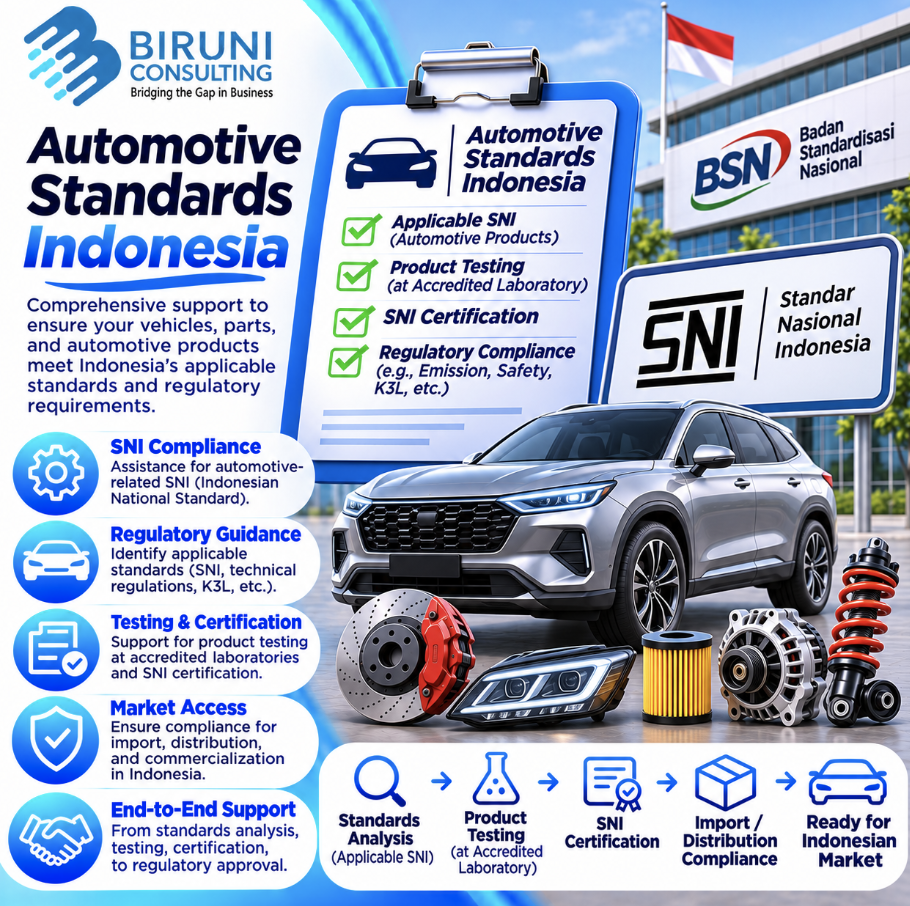
Automotive Standards in Indonesia
Automotive Standards Indonesia covers technical requirements, Indonesian National Standards or SNI, conformity assessment, product certification, vehicle approvals, and other regulatory requirements applicable to vehicles, components, spare parts, consumables, and aftermarket products marketed in Indonesia.
For Overseas Manufacturers, one of the most important principles is that not every automotive standard is automatically mandatory. An SNI can exist and remain in force in the National Standardization Agency catalogue without necessarily requiring compulsory certification. Mandatory certification generally arises when an applicable regulation makes that standard compulsory for a defined product scope. Ministry of Industry Mandatory SNI applications are processed through SIINas. BBSPJIKKP
Current automotive-related Mandatory SNI frameworks include tires under Minister of Industry Regulation No. 9 of 2025, motor-vehicle safety glass under Regulation No. 15 of 2025, lubricating oil under Regulation No. 8 of 2025, motor-vehicle wheels under Regulation No. 71 of 2024, and motorcycle helmets under Regulation No. 59 of 2024. Database Peraturan | JDIH BPK
An Automotive Standards Indonesia assessment should therefore begin with the exact product rather than the general description “automotive part.”
What Are Automotive Standards Indonesia?
Automotive Standards Indonesia refers to technical standards and regulatory requirements that can apply to vehicles and vehicle-related products manufactured, imported, traded, or used in Indonesia.
The regulatory landscape can involve several layers:
- Indonesian National Standards or SNI.
- Mandatory SNI regulations.
- Conformity assessment.
- LSPro certification.
- Laboratory testing.
- Factory audits.
- SPPT SNI and product marking.
- Vehicle type approval.
- Import requirements.
- Other sector-specific approvals.
Not every layer applies to every product.
SNI and Automotive Standards Are Not Exactly the Same
SNI is Indonesia’s national-standard framework.
However, Automotive Standards Indonesia is broader than SNI alone.
Automotive compliance can involve:
- product or component SNI;
- technical requirements for complete vehicles;
- vehicle type testing;
- SUT;
- SRUT;
- product labeling;
- import restrictions;
- telecommunications or electronic requirements for connected products; and
- customer-specific OEM requirements.
Complete-vehicle manufacturers and spare-parts manufacturers can therefore have very different regulatory roadmaps.
Mandatory and Voluntary SNI
The distinction between Mandatory and Voluntary SNI is fundamental.
BSN maintains numerous standards in the field of road-vehicle engineering. Its current catalogue includes standards relating to wheels, power-steering hoses, radiator components, suspension-related products, and other automotive components. The existence of those standards does not by itself make every related product subject to compulsory certification. Pesta
Mandatory status needs to be confirmed from the regulation making the particular SNI compulsory.
Why Does the Distinction Matter?
Assuming every SNI is mandatory can result in unnecessary testing and certification expenses.
Assuming automotive parts are automatically outside Mandatory SNI can create the opposite risk: commercial shipments can begin before product compliance is complete.
Regulatory assessment should therefore classify each product as:
- Mandatory SNI.
- Voluntary SNI.
- Standard available but not applicable.
- Outside current SNI scope.
- Subject to another approval.
- Requiring further technical assessment.
Role of the National Standardization Agency
BSN maintains Indonesia’s national-standard framework and SNI catalogue.
The catalogue can be used to review standard numbers, titles, current status, technical committees, and general scopes.
For example, SNI 8210:2018 for motor-vehicle safety glass is currently listed as in force. Its scope includes laminated and tempered safety glass for specified motor-vehicle applications. Pesta
However, current-standard status still needs to be distinguished from mandatory regulatory status.
Role of the Ministry of Industry
The Ministry of Industry plays a major role in making SNI compulsory for industrial products, including several automotive-related categories.
Applications for products under Ministry of Industry Mandatory SNI schemes are submitted through SIINas. Certification can also involve LSPro conformity assessment, testing, audits, surveillance, and certification-maintenance mechanisms. BBSPJIKKP
Manufacturers should therefore review the technical standard and applicable Mandatory SNI regulation together.
Role of the Ministry of Transportation
Complete vehicles have regulatory requirements extending beyond component SNI.
The Directorate General of Land Transportation’s 2026 public-information listing continues to identify procedures for motor-vehicle type testing, Type Test Certificates or SUT, and Type Test Registration Certificates or SRUT for relevant applicants. PPID Kementerian Perhubungan
Accordingly:
component SNI certification ≠ complete-vehicle approval.
Vehicle manufacturers need separate but coordinated workstreams.
Motor-Vehicle Tire Standards
Tires are one of the clearest automotive categories subject to a current Mandatory SNI framework.
Minister of Industry Regulation No. 9 of 2025 makes SNI mandatory for tires and became effective on July 24, 2025. The regulation remains in force. Database Peraturan | JDIH BPK
BSN currently lists several relevant tire standards as in force, including:
- SNI 98:2019 for passenger-car tires.
- SNI 99:2019 for truck and bus tires.
- SNI 100:2019 for light-truck tires.
- SNI 101:2019 for motorcycle tires.
- SNI 6700:2012 for motor-vehicle inner tubes. Pesta
The actual tire category should be established before the certification pathway is determined.
Passenger-Car Tires
SNI 98:2019 covers passenger-car tires and is currently listed by BSN as in force. The BSN catalogue also identifies a 2025 confirmation entry for the standard. Pesta
Manufacturers need to ensure that model, size, construction, factory, and actual product correspond with the certification scope.
One global trademark does not automatically mean one Certificate covers the complete tire portfolio.
Truck and Bus Tires
Truck and bus tires use a different standard from passenger-car tires.
BSN currently lists SNI 99:2019 for truck and bus tires as in force. Pesta
Manufacturers with mixed portfolios should separate models by technical category before sampling and testing.
Light-Truck Tires
SNI 100:2019 applies to light-truck tires and remains listed as in force by BSN. Pesta
A commercial description such as “commercial tire” is not necessarily sufficient for determining the applicable Indonesian standard.
Motorcycle Tires
SNI 101:2019 is currently listed as an in-force standard for motorcycle tires. Pesta
Motorcycle tire manufacturers should evaluate model grouping, dimensions, construction, production sites, and the applicable certification scheme before market launch.
Motor-Vehicle Wheels
Motor-vehicle wheels are also subject to Mandatory SNI.
Minister of Industry Regulation No. 71 of 2024 makes SNI mandatory for motor-vehicle wheels in categories M, N, O, and L and specifies a Type 5 certification system. Peraturan
Relevant current standards include:
- SNI 1896:2008 for M, N, and O motor-vehicle wheels; and
- SNI 4658:2015 for category L motor-vehicle wheels. Pesta
Vehicle Categories for Wheel Standards
Wheel certification should not be determined merely from descriptions such as “alloy wheel,” “steel wheel,” or “motorcycle rim.”
The applicable standard depends on the vehicle category and defined product scope.
Manufacturers should establish the relevant M, N, O, or L category before final testing scope is selected.
SNI 1896:2008
BSN currently lists SNI 1896:2008 Motor-Vehicle Wheels Categories M, N and O as in force. Pesta
This can be relevant to passenger-vehicle, commercial-vehicle, and trailer-wheel manufacturers entering Indonesia.
Model and production-site mapping should precede certification.
SNI 4658:2015
BSN also lists SNI 4658:2015 Motor-Vehicle Wheels Category L as in force. Pesta
Manufacturers should confirm the applicable standard edition under the current regulatory scheme rather than relying on historical technical documentation.
Motor-Vehicle Safety Glass
Motor-vehicle safety glass is another major Automotive Standards Indonesia category.
Minister of Industry Regulation No. 15 of 2025 makes SNI mandatory for motor-vehicle safety glass. It became effective on October 25, 2025, remains in force, and revoked Regulation No. 80 of 2015. Database Peraturan | JDIH BPK
The current technical standard is SNI 8210:2018 Motor-Vehicle Safety Glass, which BSN continues to list as in force. Pesta
Scope of SNI 8210:2018
BSN explains that SNI 8210:2018 covers laminated and tempered safety glass for relevant motor-vehicle applications.
Its scope includes glass used for windshields, vehicle glass panels, or partitions within the specified vehicle categories. Pesta
Manufacturers therefore need to provide the actual glass construction rather than relying only on the description “automotive glass.”
Windshields and Side Glass
Windshields, rear glass, side windows, and other glazing products can have different technical constructions and applications.
Testing can depend on whether the product is laminated or tempered and where it is installed on the vehicle.
Product catalogues should therefore be connected with a regulatory model matrix before formal testing.
Lubricating-Oil Standards
Automotive standards also cover consumables such as lubricating oils.
Minister of Industry Regulation No. 8 of 2025 makes SNI mandatory for lubricating oil, became effective on July 24, 2025, and remains in force. Database Peraturan | JDIH BPK
BSN currently lists a broad SNI 7069 series covering various vehicle and industrial lubricant classifications. Pesta
SNI 7069 for Automotive Lubricants
Current examples include:
- SNI 7069-1:2020 for four-stroke gasoline motor-vehicle engine oil;
- SNI 7069-2:2021 for four-stroke gasoline motorcycle oil;
- SNI 7069-5:2021 for high-speed diesel engine oil;
- SNI 7069-6:2021 for manual-transmission and differential gear oil; and
- SNI 7069-7:2021 for automatic-transmission oil. Pesta
Lubricants should therefore be classified by actual application and formulation.
Brake Fluid
The BSN catalogue also currently lists SNI 2769:2020 Motor-Vehicle Brake Fluid as in force. Pesta
However, the existence of an in-force SNI should not be automatically equated with mandatory certification unless an applicable regulation makes the standard compulsory.
This distinction applies throughout Automotive Standards Indonesia.
Motorcycle Helmets
Motorcycle helmets are automotive-related safety products with their own Mandatory SNI framework.
Minister of Industry Regulation No. 59 of 2024 makes SNI mandatory for motorcycle helmets and replaced the earlier mandatory framework. It remains listed as in force. Database Peraturan | JDIH BPK
BSN also currently lists SNI 1811-2007/Amd1:2010 relating to motorcycle helmets as in force. Pesta
Automotive Standards Beyond the Main Mandatory Categories
The BSN catalogue contains many more automotive-related standards than the principal Mandatory SNI product categories discussed above.
Examples include standards relating to power-steering hoses, radiators, rubber glass trim, suspension-related products, and other automotive components. Pesta
Manufacturers should nevertheless avoid assuming that every technical standard listed by BSN is compulsory for Indonesian market entry.
An In-Force Standard Does Not Automatically Mean Mandatory
This is one of the central principles of Automotive Standards Indonesia.
A standard can be listed by BSN as in force without compulsory certification applying to every related product.
Two separate questions should therefore be answered:
- Is the SNI currently valid?
- Has that SNI been made mandatory for the exact product?
Both questions matter.
OEM Components
Components supplied to vehicle assembly plants still require product-specific regulatory assessment.
OEM supply status is a commercial or supply-chain classification rather than a universal regulatory exemption.
The applicable regulation should be checked for industrial-input mechanisms, exemptions, or specific conditions.
OEM customer requirements should also remain separate from government regulatory requirements.
Aftermarket Components
Aftermarket products can be supplied through dealers, workshops, Distributors, retailers, or marketplaces.
The sales channel does not determine Mandatory SNI status.
Where the exact product falls within a mandatory scope, the requirement remains applicable even when the product is sold only as a replacement part.
Complete-Vehicle Standards
Complete-vehicle manufacturers face a wider regulatory landscape than component suppliers.
In addition to component-level SNI requirements, vehicles can enter type-testing and registration pathways.
The Ministry of Transportation continues to list procedures for motor-vehicle type testing, SUT, and SRUT in its 2026 public information. PPID Kementerian Perhubungan
Complete-vehicle market entry should therefore use an integrated compliance map.
Vehicle Identification Numbers
Indonesia’s industrial automotive framework also includes Vehicle Identification Numbers or NIK/VIN.
Ministry of Industry information describes the NIK as a combination of characters placed or printed on a motor vehicle by its manufacturer or assembler for identification and describes requirements for automotive manufacturers to implement NIK or NIK Tambahan within the applicable framework. ILMATE
Automotive standards therefore extend beyond product-performance testing.
Automotive Electronics
Modern automotive components increasingly contain wireless, radio, telecommunications, and electronic functionality.
Connected head units, telematics modules, trackers, wireless cameras, TPMS devices, and other smart vehicle products can require assessment outside traditional automotive SNI.
Manufacturers should therefore use cross-regulatory assessment based on actual technical functionality.
Batteries and Electrical Components
Batteries, chargers, converters, lighting systems, power electronics, and other electrical products can also involve separate regulatory pathways.
Assessment can depend on:
- voltage;
- capacity;
- chemistry;
- technical function;
- wireless connectivity; and
- intended use.
Automotive use alone does not necessarily determine the complete regulatory pathway.
International Automotive Standards
Global manufacturers commonly use UNECE regulations, ISO, SAE, JIS, E-mark approvals, and other international standards.
Such evidence can be highly useful for technical review.
However, international conformity does not automatically replace Indonesian Mandatory SNI or Indonesian vehicle approval.
A gap analysis should compare technical requirements, testing methods, laboratory acceptability, models, and manufacturing sites.
CE Marking and Automotive Products
CE Marking should likewise not be treated as a universal substitute for SNI.
It can demonstrate conformity with requirements applicable in other jurisdictions, but Indonesian market entry remains subject to Indonesian regulations.
International documentation is best used as technical evidence within a regulatory gap assessment.
LSPro
An LSPro or Product Certification Body performs product certification within its applicable scope.
The Ministry of Industry describes product certification as an assessment of a company’s ability to apply an appropriate quality system and consistently manufacture products meeting the relevant standard. Qualifying companies receive a Product Certificate issued by the LSPro. BBSPJIKKP
Consultants, Importers, Distributors, and Official Representatives are not LSPro.
Selecting an LSPro
The LSPro should be selected according to the actual product and standard.
Manufacturers should assess:
- Accreditation scope.
- Product scope.
- Applicable SNI.
- Government designation where required.
- Laboratory arrangements.
- Factory-audit capability.
- Experience with Overseas Manufacturers.
Selecting the LSPro before formal testing can reduce the risk of unusable test evidence.
Laboratory Testing
Testing requirements are highly product specific.
Tires require performance testing, wheels require structural testing, safety glass has optical and safety-related tests, lubricants require physical and chemical assessment, and helmets require protective-performance testing.
A single generic automotive test pathway therefore does not exist.
Existing Foreign Test Reports
Manufacturers with overseas test reports should conduct a test-report gap analysis.
The assessment can compare:
- standard edition;
- test method;
- parameters;
- laboratory status;
- model;
- manufacturing site;
- product configuration; and
- report date.
This helps reduce unnecessary repeat testing while confirming whether existing evidence can support Indonesian conformity assessment.
Type 5 Certification
Several automotive Mandatory SNI schemes use Type 5 certification.
Minister of Industry Regulation No. 71 of 2024 for motor-vehicle wheels expressly specifies Type 5 certification. Peraturan
Type 5 makes manufacturing consistency and continuing conformity important in addition to initial product testing.
Factory Audits
Factory audits can evaluate production and quality-management controls.
Preparation can cover:
- incoming inspection;
- process controls;
- calibration;
- testing equipment;
- final inspection;
- nonconforming-product management;
- traceability;
- corrective actions; and
- quality records.
An internal readiness review should ideally precede the formal audit.
ISO 9001 and IATF 16949
ISO 9001 and IATF 16949 are important quality-management certifications throughout the automotive industry.
They do not automatically replace product-specific Mandatory SNI certification.
Where an Indonesian regulation makes an SNI compulsory, the applicable Indonesian conformity-assessment process still needs to be completed.
Overseas Manufacturers
Overseas automotive manufacturers have additional local-structure considerations.
A Mandatory SNI regulation can use the concepts of Overseas Manufacturer and Official Representative.
The appropriate Indonesian structure should therefore be established before certification, importation, and distribution agreements are finalized.
Official Representative
An Official Representative can be required under product-specific schemes for Overseas Manufacturers.
Its role can involve:
- SIINas;
- certification administration;
- communication with the LSPro;
- trademark documentation;
- warehousing;
- Importer coordination;
- surveillance; and
- regulatory records.
The precise function remains product specific.
SIINas
SIINas is a central platform for Ministry of Industry Mandatory SNI schemes.
The Ministry of Industry states that applications for Mandatory SNI products under its schemes are submitted through SIINas. BBSPJIKKP
Overseas Manufacturers should therefore establish who will control the account, submissions, amendments, and continuing administration.
SNI Certificate Holder
The Certificate Holder is not automatically the Importer or Official Representative.
Product-specific regulations determine which party can legally hold the Certificate.
The mandatory wheel regulation, for example, defines the SNI Certificate as one issued by the LSPro for an Industrial Company or Overseas Manufacturer capable of manufacturing wheels in conformity with the mandatory requirements. Peraturan
Regulatory ownership and commercial distribution should therefore be mapped separately.
SPPT SNI
The SNI Certificate and SPPT SNI are separate concepts.
Under applicable industrial Mandatory SNI frameworks, SPPT SNI concerns approval to use the SNI Mark. The motor-vehicle wheel regulation, for example, separately defines the SNI Certificate, SNI Mark, and SPPT SNI. Peraturan
Manufacturers should identify both the Certificate Holder and the party responsible for SNI Mark administration.
Manufacturing Sites
Automotive certification often has a strong relationship with the actual production facility.
A global manufacturer can produce the same commercial model at several factories.
A Certificate associated with one manufacturing site should not automatically be assumed to cover another factory.
Production-site mapping should therefore occur before application.
Multiple Manufacturing Sites
A global manufacturer can maintain a factory matrix showing:
- Factory legal name.
- Address.
- Country.
- Product family.
- Models.
- Quality Certificates.
- Indonesian certification status.
- Test-report status.
Supply-chain changes can then undergo regulatory impact assessment before the sourcing location changes.
Multiple Models
Automotive products can have extensive model complexity.
One tire family can include dozens of sizes. Wheel manufacturers can maintain hundreds of diameter and width combinations. Safety-glass manufacturers can have different products for every vehicle model.
Model grouping is therefore a certification strategy issue.
Grouping should follow the certification scheme and actual technical similarity rather than only marketing categories.
HS Codes and Automotive Standards
HS classification is important for importation but should not be treated as the sole basis for SNI assessment.
Mandatory regulations can combine tariff codes with technical product definitions.
Manufacturers should therefore provide full technical specifications rather than relying only on the customs classification.
Importers and Automotive Standards
The Importer performs a different role from the LSPro, Certificate Holder, and Official Representative.
The Importer manages importation and customs compliance.
Where Mandatory SNI applies, the Importer should ensure that the actual imported goods correspond with the approved product, manufacturing site, model, and certification scope.
Importer readiness and certification readiness need to proceed in parallel.
Product Marking
Products under Mandatory SNI schemes can have specific marking requirements.
Product artwork, embossing, molding, labels, packaging, and electronic marking should not be finalized before the applicable requirements are confirmed.
This is particularly important where permanent markings need to be incorporated during manufacturing.
Pre-Shipment Standards Review
Before commercial cargo departs, manufacturers can verify:
- Product classification.
- Applicable standard.
- Mandatory status.
- SNI Certificate.
- SPPT SNI where applicable.
- Manufacturing site.
- Model or part number.
- Official Representative.
- Importer.
- Product marking.
- Invoice and Packing List.
Pre-shipment review reduces the risk of discovering a regulatory mismatch only after arrival.
Product Changes
Automotive products undergo frequent engineering changes.
Changes can include:
- materials;
- formulations;
- dimensions;
- suppliers;
- designs;
- tooling;
- software;
- hardware;
- production processes;
- factories;
- trademarks; or
- model numbers.
Each change should undergo regulatory impact assessment before revised products enter the Indonesian market.
Surveillance
Certification can continue after the initial Certificate is issued.
The Ministry of Industry certification framework includes procedures relating to maintenance, scope changes, suspension, restoration, and withdrawal of certification. BBSPJIKKP
Manufacturers should therefore include surveillance in annual regulatory planning and compliance budgets.
Regulatory Monitoring
Automotive Standards Indonesia can change through revised standards, confirmation of existing standards, amended Mandatory SNI regulations, or updated certification schemes.
The BSN catalogue, for example, shows confirmation entries for several tire standards in 2025, while current Mandatory SNI regulations for tires, safety glass, and lubricating oil became effective during 2025. Pesta
Regulatory assessment should therefore continue after initial market launch.
Regulatory Gap Analysis
An automotive standards gap analysis can identify:
- incorrect standards;
- outdated standard editions;
- unclear Mandatory SNI status;
- models outside Certificate scope;
- unapproved manufacturing sites;
- unsuitable LSPro;
- unusable foreign reports;
- factory-audit gaps;
- missing Official Representative;
- incomplete SIINas arrangements;
- incorrect marking; or
- incomplete Importer readiness.
Those gaps can then become a compliance implementation plan.
Initial Documents for Automotive Standards Indonesia
Manufacturers can prepare:
- Product Catalogue.
- Technical Data Sheet.
- Model or part-number matrix.
- Proposed HS codes.
- Manufacturing-site list.
- ISO 9001 or IATF Certificates.
- Existing test reports.
- International approvals.
- Trademark documents.
- Proposed Importer.
- Proposed Official Representative.
- Intended sales channels.
These documents provide the basis for regulatory mapping.
Automotive Standards Indonesia Roadmap
A typical roadmap can include:
- Product classification.
- Identify applicable automotive standards.
- Confirm current standard status.
- Confirm Mandatory or Voluntary status.
- Identify the applicable regulation.
- Map models and production sites.
- Determine the Certificate Holder.
- Determine the Official Representative where applicable.
- Select the LSPro and laboratory pathway.
- Complete factory audits and testing.
- Complete certification and SIINas.
- Obtain SPPT SNI and marking approval where applicable.
- Complete Importer readiness.
- Conduct pre-shipment verification.
- Maintain surveillance and regulatory monitoring.
The exact pathway remains product specific.
Automotive Standards Indonesia Timeline
There is no universal timeline for every automotive product.
A product requiring only voluntary technical assessment can have a very different timeline from a Mandatory SNI product requiring:
- Overseas Manufacturer documentation;
- an Official Representative;
- LSPro review;
- factory audits;
- laboratory testing;
- corrective actions;
- SIINas; and
- certification decisions.
Timing should therefore be developed after the product scope and regulatory gaps are understood.
Automotive Standards Indonesia Cost
Compliance costs can include:
- regulatory assessment;
- purchase of standards;
- LSPro;
- laboratory testing;
- factory audits;
- auditor travel;
- sample preparation;
- sample logistics;
- translations;
- Official Representative services;
- SIINas administration;
- SPPT SNI;
- marking changes;
- surveillance; and
- Importer-related compliance.
Total cost depends heavily on the number of products, models, standards, and factories.
Common Automotive Standards Indonesia Mistakes
Common mistakes include:
- assuming every SNI is mandatory;
- assuming all automotive parts are outside Mandatory SNI;
- relying only on HS codes;
- using outdated standard editions;
- testing before selecting the LSPro;
- assuming E-mark, SAE, JIS, CE, or international reports automatically replace SNI;
- ignoring manufacturing sites;
- assuming ISO 9001 or IATF 16949 replaces product certification;
- confusing complete-vehicle approval with component certification;
- assuming the Importer automatically holds the Certificate;
- ignoring surveillance; and
- failing to monitor regulatory changes.
Conclusion
Automotive Standards Indonesia is not a single standard or Certificate covering every vehicle and automotive component. The applicable regulatory requirements need to be determined from the exact product, technical specifications, intended use, manufacturing site, applicable SNI, and Mandatory SNI regulation.
Current automotive-related Mandatory SNI frameworks include tires under Minister of Industry Regulation No. 9 of 2025, motor-vehicle wheels under Regulation No. 71 of 2024, motor-vehicle safety glass under Regulation No. 15 of 2025, lubricating oil under Regulation No. 8 of 2025, and motorcycle helmets under Regulation No. 59 of 2024. Database Peraturan | JDIH BPK
BSN currently lists relevant automotive standards such as SNI 98:2019 for passenger-car tires, SNI 1896:2008 for M, N, and O wheels, SNI 4658:2015 for category L wheels, and SNI 8210:2018 for motor-vehicle safety glass as in force. Pesta
However, an in-force SNI does not automatically mean that the standard is mandatory for every related product. Mandatory status still needs to be verified against the applicable regulation. Ministry of Industry Mandatory SNI applications are submitted through SIINas, while conformity assessment can involve the LSPro, testing, factory assessment, and continuing certification controls. BBSPJIKKP
For complete vehicles, component SNI also does not replace vehicle type approval. The Ministry of Transportation continues to maintain procedures for motor-vehicle type testing, SUT, and SRUT. PPID Kementerian Perhubungan
By completing product classification, standard identification, Mandatory SNI assessment, LSPro selection, factory and model mapping, Official Representative planning, SIINas, Importer readiness, and pre-shipment verification, an Overseas Manufacturer can build a more efficient Indonesian automotive compliance strategy and avoid unnecessary testing or shipment before regulatory readiness.
Contact Us
Biruni Consulting assists companies with Automotive Standards Indonesia professionally and in accordance with applicable regulations in Indonesia.
Our services include:
- Regulatory consultation.
- Identification of applicable standards.
- Preparation of certification documents.
- Assistance with laboratory testing.
- Certification processing until certificate issuance.
Biruni Consulting assists Overseas Manufacturers with Automotive Standards Indonesia identification, Mandatory SNI assessment, Automotive SNI Certification, Official Representative structures, SIINas, LSPro, laboratory testing, factory audits, manufacturing-site assessment, and automotive-product regulatory compliance.
Contact Us for guidance on Automotive Standards Indonesia, SNI Automotive Parts Indonesia, Automotive SNI Certification Indonesia, Automotive Representative Indonesia, and automotive-product regulatory compliance assistance.