
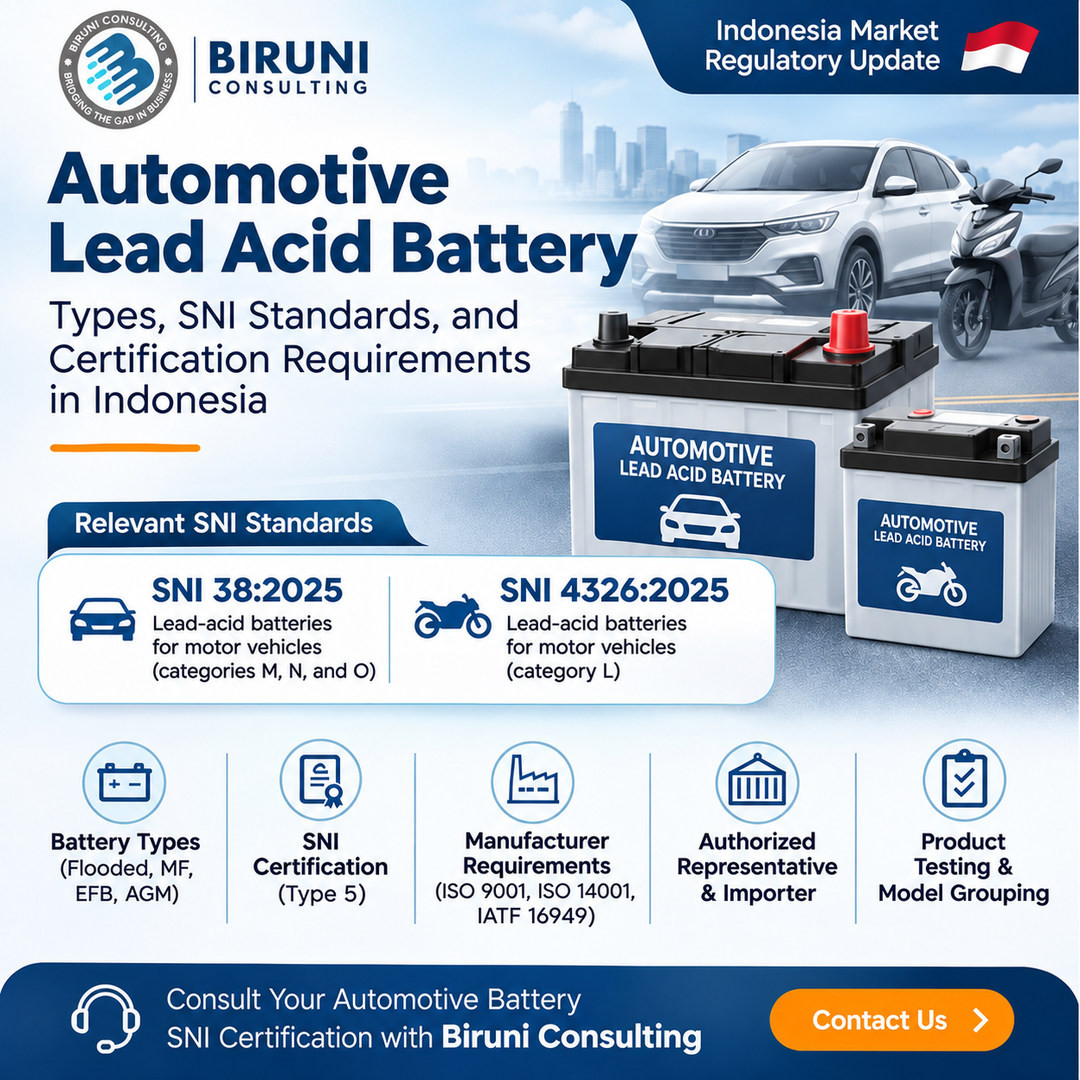
The subject of SNI automotive battery sampling age 45 60 days needs careful assessment before manufacturers, brand owners or importers proceed with an Indonesian SNI application. This guide explains the documentation, practical risks and regulatory distinctions relevant to the automotive battery sector.
Business context and practical meaning
Certification samples cannot always be drawn from months-old warehouse stock. Electrolyte state and manufacturing date are relevant to sample eligibility.
Sampling and laboratory testing must be planned around correct technical classification. Representative grouping considers the standard, type, battery technology, capacity, brand and design. Sample collection follows an approved certification scheme by authorized personnel rather than allowing the supplier to select arbitrary units without sampling records.
Relevant draft or technical provisions
The draft appendix limits electrolyte-filled samples to 45 days from manufacture and dry-charged samples to 60 days. Sample collection is documented by the sampling officer with a sampling report and labels.
The draft scheme uses four testing units and four archive units per representative group. Sample age, electrolyte condition, existing test reports and laboratory eligibility should be checked. Nonconformities and retesting may add sample units, costs and time.
Risks to avoid
Do not confuse the marketing term “maintenance-free” with dry-charged storage. Confirm actual electrolyte condition and production date before scheduling sampling.
Treat these proposed administrative requirements as planning guidance, not proof that a final mandatory regulation is already effective. Technical conformity must be assessed against the full standard and competent authorities.
Initial document checklist
For an efficient initial review, prepare the following evidence groups:
- Vehicle category, battery type and technology.
- Models, C20/C10 Ah, brand and construction details.
- Manufacture date, electrolyte status and sampling site.
- Existing IEC/SNI reports and laboratory identity.
Recommended next steps
For SNI automotive battery sampling age 45 60 days, map the product, manufacturing site and documents already held. Send a model list and identify every involved entity so document gaps, cost drivers and the appropriate route can be considered without promising certification results.
Biruni Consulting can support an initial readiness review, identify document gaps and coordinate the relevant certification process where applicable. Final decisions remain with the appointed bodies, laboratories and competent authorities.
Frequently Asked Questions
What matters most for SNI automotive battery sampling age 45 60 days?
The draft appendix limits electrolyte-filled samples to 45 days from manufacture and dry-charged samples to 60 days. Sample collection is documented by the sampling officer with a sampling report and labels.
Can sample units be calculated from SKU count alone?
No. Representative groups must first be determined by type, technology, brand and capacity under the applicable plan.
Related Reading
- SNI Certification Services for Car and Motorcycle Batteries in Indonesia
- SNI 38:2025 Car Battery Requirements in Indonesia
- SNI 4326:2025 Motorcycle Battery Requirements in Indonesia
Automotive Battery SNI Consultation
For an initial assessment, prepare a model list and specifications, manufacturer identity, management-system certificates, trademark documents and your proposed Authorized Representative/importer arrangement. Biruni Consulting can review the documentation and identify the next regulatory steps.
Regulatory status: SNI 38:2025 and SNI 4326:2025 are BSN technical standards. Draft mandatory-SNI provisions must be verified against the enacted regulation, if any. Certification outcomes and timelines are not guaranteed.