
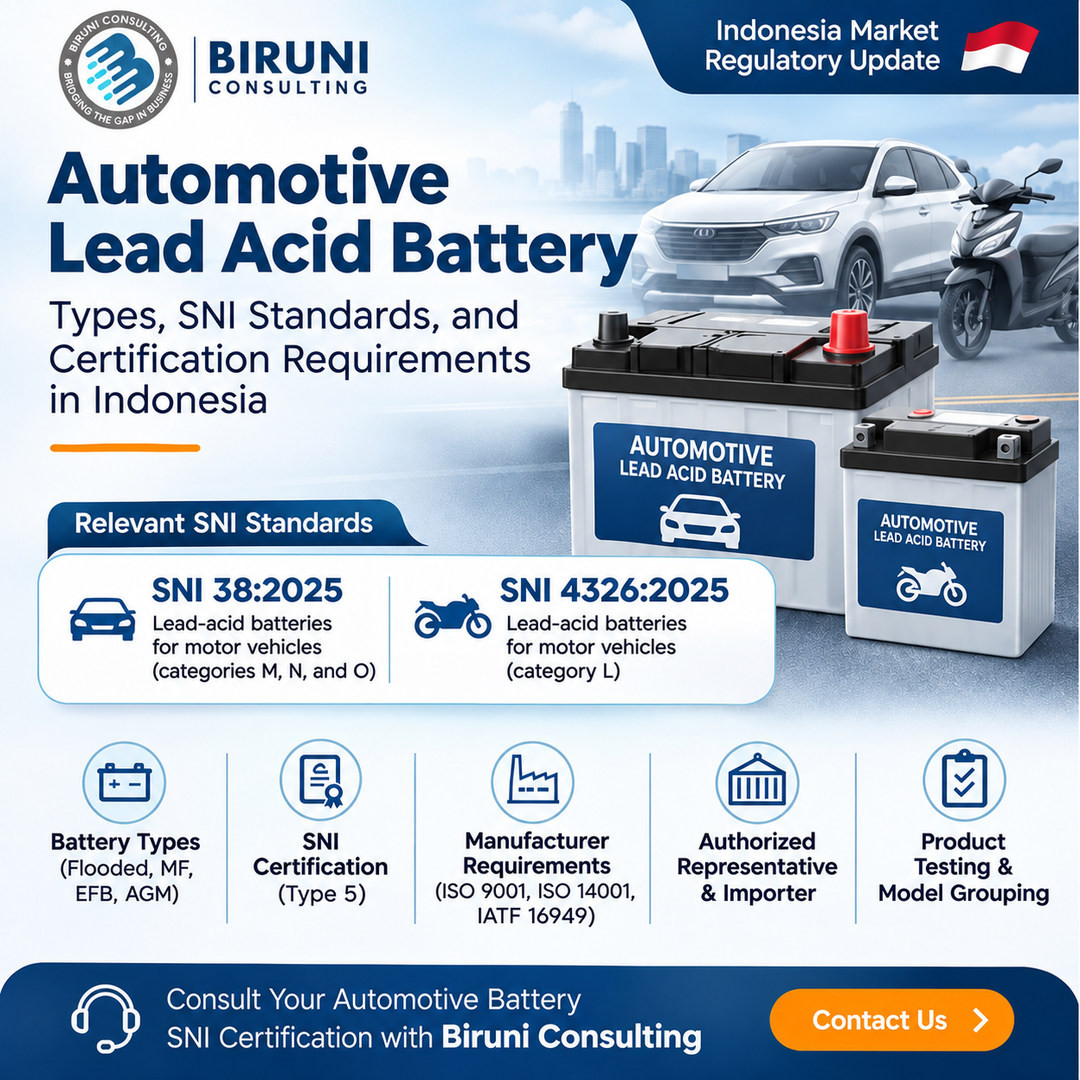
Automotive battery manufacturers and exporters planning to enter Indonesia should review the relevant national standards and the proposed regulatory pathway. A useful certification assessment begins with product scope, factory documentation and the importer structure, rather than pricing based only on the number of models. This guide explains the preparation steps for car and motorcycle batteries.
Applicable SNI standards
SNI 38:2025 covers lead-acid starter batteries within categories M, N and O, while SNI 4326:2025 covers category L applications. Voltage and capacity alone cannot establish scope; battery chemistry, starting function, vehicle category and technology must be reviewed together.
An established technical standard does not, by itself, prove that mandatory certification is already legally effective. The draft ministerial regulation must be distinguished from a promulgated final regulation.
Certification preparation workflow
An initial review checks the product list, factory address, trademark holder, management-system documents and the Authorized Representative (AR) or importer structure. The proposed Type 5 scheme includes manufacturing assessment and conformity testing, followed by the prescribed administrative steps.
LSPro and laboratory coordination, SIINas submission and governmental validation are separate activities. A consultant cannot guarantee certification approval or an exact completion date.
Documents for an initial assessment
Prepare company registration, manufacturing authorization, ISO 9001 or IATF 16949 documentation, ISO 14001, trademark evidence, models and capacities, product labels, technical catalogues and available laboratory reports. Overseas factories should also clarify their planned Indonesian AR and importer arrangements.
The final checklist varies according to brand ownership, production location, contract manufacturing and the commercial structure.
Why product grouping matters
The number of SKUs does not necessarily equal the number of test groups. The proposed scheme evaluates battery classification, technology, capacity ranges and brands when establishing representative groups.
Laboratories and the appointed certification body must validate the final sampling plan; preliminary estimates should not be presented as official requirements.
What to send before requesting a quotation
Before discussing a price, prepare one complete list of battery models, trademarks, type codes, intended vehicle applications, rated capacities and battery technologies. Include the manufacturing address and the legal trademark holder. A consistent product matrix is more useful than isolated catalogue photographs.
For overseas manufacturers, state whether an Indonesian AR already exists, who will act as importer, and whether products are intended for vehicle assembly or the replacement market. These points help establish the legal structure before costly administrative or factory work begins.
Frequently Asked Questions
Can a foreign factory apply?
The draft framework provides a route through an Indonesian Authorized Representative, subject to factory documentation and the final regulation.
Must every model be tested separately?
Not necessarily. Grouping depends on technical specifications and the representative sampling provisions.
Automotive Battery SNI Consultation
For an initial assessment, prepare a model list and specifications, manufacturer identity, management-system certificates, trademark documents and your proposed Authorized Representative/importer arrangement. Biruni Consulting can review the documentation and identify the next regulatory steps.
Regulatory status: SNI 38:2025 and SNI 4326:2025 are BSN technical standards. Draft mandatory-SNI provisions must be verified against the enacted regulation, if any. Certification outcomes and timelines are not guaranteed.