
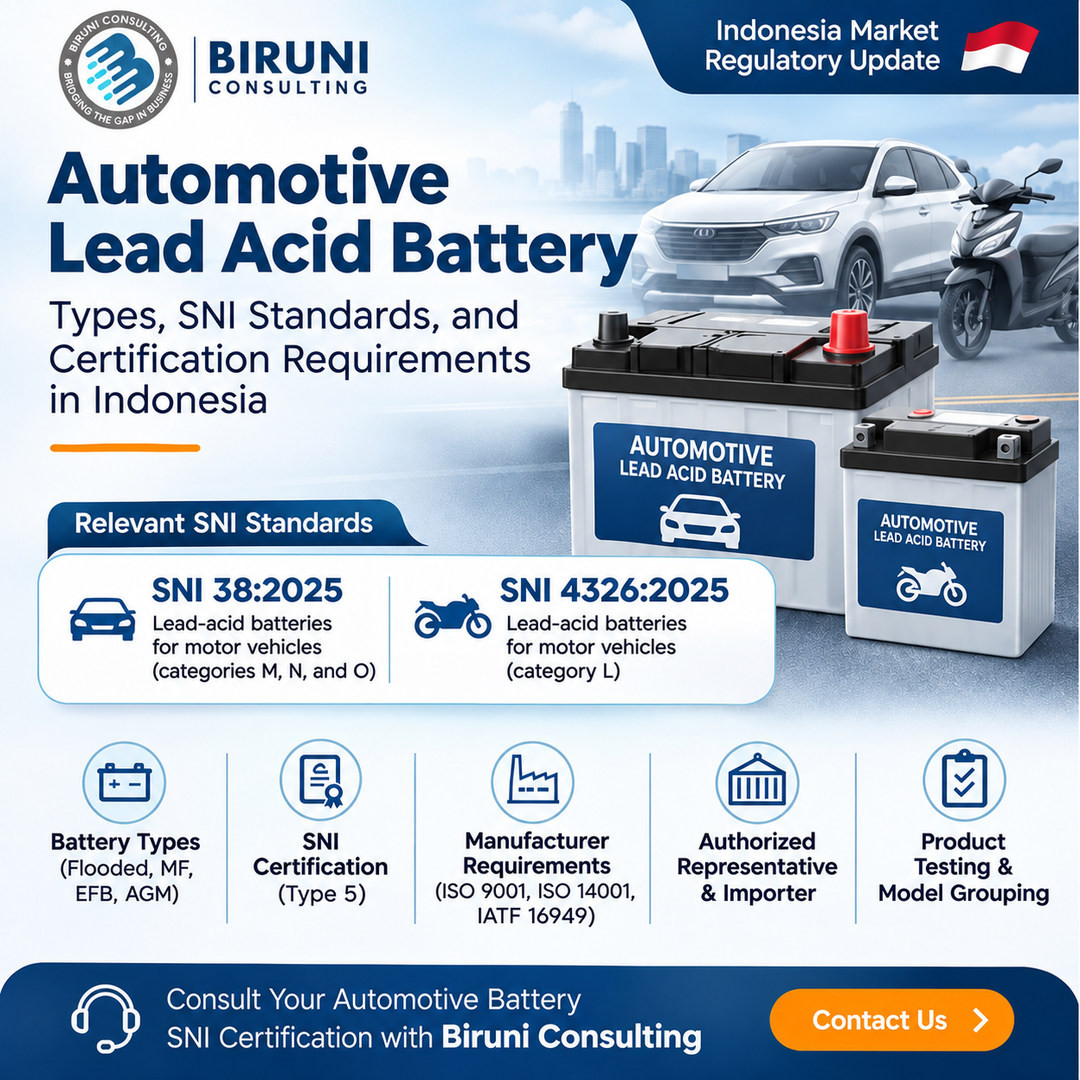
The subject of automotive battery SNI ISO 14001 requirement needs careful assessment before manufacturers, brand owners or importers proceed with an Indonesian SNI application. This guide explains the documentation, practical risks and regulatory distinctions relevant to the automotive battery sector.
Business context and practical meaning
Manufacturers sometimes send one ISO certificate and assume all factory requirements are fulfilled. The three management standards address related but distinct management disciplines.
The proposed Type 5 certification combines manufacturing-process and quality-system audits with product conformity testing. An ISO certificate therefore does not replace evidence of facilities, process control, traceability and testing equipment. Real operating readiness should be mapped before the certification body visits.
Relevant draft or technical provisions
Articles 10 and 11 of the draft require ISO 9001:2015 and/or IATF 16949:2016 for quality, together with ISO 14001:2015 for environmental management. Review certificate scopes, legal entities, factory addresses and validity.
Manufacturers should assemble organization charts, process diagrams, quality plans, facility and test-equipment registers, calibration records, internal audits, management reviews and the list of models available for sampling. Overseas manufacturers also need local establishment evidence and an Indonesian Authorized Representative.
Risks to avoid
A parent-company certificate may not cover the audited facility. Holding ISO 9001 alone does not establish that all proposed certification conditions have been met.
Treat these proposed administrative requirements as planning guidance, not proof that a final mandatory regulation is already effective. Technical conformity must be assessed against the full standard and competent authorities.
Initial document checklist
For an efficient initial review, prepare the following evidence groups:
- Each physical manufacturing site.
- Manufacturer permits and ISO 9001/IATF/ISO 14001.
- Process flow, six core facilities and in-house testing.
- Quality records, calibration and internal audits.
Recommended next steps
For automotive battery SNI ISO 14001 requirement, map the product, manufacturing site and documents already held. Send a model list and identify every involved entity so document gaps, cost drivers and the appropriate route can be considered without promising certification results.
Biruni Consulting can support an initial readiness review, identify document gaps and coordinate the relevant certification process where applicable. Final decisions remain with the appointed bodies, laboratories and competent authorities.
Frequently Asked Questions
What matters most for automotive battery SNI ISO 14001 requirement?
Articles 10 and 11 of the draft require ISO 9001:2015 and/or IATF 16949:2016 for quality, together with ISO 14001:2015 for environmental management. Review certificate scopes, legal entities, factory addresses and validity.
Does ISO certification replace a factory audit?
No. Under the draft Type 5 scheme, actual manufacturing and product testing remain part of conformity assessment.
Related Reading
- SNI Certification Services for Car and Motorcycle Batteries in Indonesia
- SNI 38:2025 Car Battery Requirements in Indonesia
- SNI 4326:2025 Motorcycle Battery Requirements in Indonesia
Automotive Battery SNI Consultation
For an initial assessment, prepare a model list and specifications, manufacturer identity, management-system certificates, trademark documents and your proposed Authorized Representative/importer arrangement. Biruni Consulting can review the documentation and identify the next regulatory steps.
Regulatory status: SNI 38:2025 and SNI 4326:2025 are BSN technical standards. Draft mandatory-SNI provisions must be verified against the enacted regulation, if any. Certification outcomes and timelines are not guaranteed.