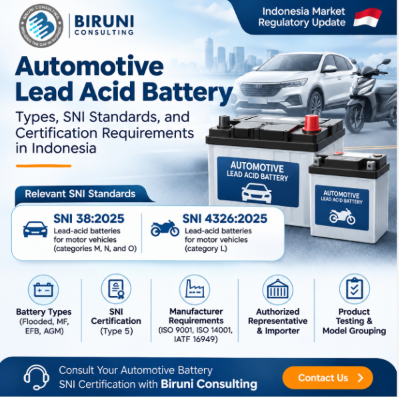
Automotive Lead Acid Battery: Types, SNI Standards, and Certification Requirements in Indonesia
An essential guide for automotive battery manufacturers, overseas exporters, brand owners, and importers entering the Indonesian market.
What Is an Automotive Lead Acid Battery?
An automotive lead acid battery is a rechargeable battery commonly used in motor vehicles to deliver electrical power for engine starting, lighting, ignition, and other automotive electrical systems.
Also known as an automotive lead-acid battery, car battery, motorcycle battery, or starter battery, it uses lead-based electrodes and sulfuric acid electrolyte to store and release electrical energy.
Lead-acid technology remains widely used in vehicles powered by internal combustion engines due to its ability to deliver high starting currents, established manufacturing processes, and reliable performance.
For international manufacturers planning to export automotive batteries to Indonesia, understanding the relevant Indonesian National Standards (SNI) and regulatory requirements is an essential part of market entry preparation.
How Does an Automotive Lead Acid Battery Work?
Automotive starter batteries are primarily designed for three functions, commonly referred to as SLI (Starting, Lighting, and Ignition).
Starting
The battery delivers a high electrical current for a short period to operate the vehicle’s starter motor.
Lighting
The battery supports lighting systems and other electrical components, particularly when the engine is not operating.
Ignition
The battery supplies electrical energy to ignition systems and other equipment required for engine operation.
Unlike deep-cycle batteries designed for repeated deep discharges, conventional automotive starter batteries are optimized for delivering high starting current.
Types of Automotive Lead Acid Batteries
Different lead-acid technologies are available for modern automotive applications.
1. Conventional Flooded Lead Acid Battery
Conventional flooded batteries contain liquid electrolyte and are widely used in passenger cars, commercial vehicles, and motorcycles.
They are commonly suitable for vehicles with conventional starting systems and standard electrical requirements.
2. Maintenance-Free Lead Acid Battery
Maintenance-free batteries are designed to minimize routine electrolyte maintenance. The term describes maintenance characteristics rather than a separate battery chemistry.
3. Enhanced Flooded Battery (EFB)
Enhanced Flooded Batteries are designed with improved durability and charge acceptance compared with conventional flooded batteries.
EFB batteries are commonly used in vehicles equipped with certain automatic start-stop systems.
4. Absorbent Glass Mat (AGM) Battery
AGM batteries use glass-fiber separators that absorb the electrolyte. They belong to the valve-regulated lead-acid (VRLA) battery family.
AGM technology is frequently used in vehicles with higher electrical demands and advanced start-stop systems.
Manufacturers should note that commercial battery descriptions do not automatically determine SNI product classification. Classification must be evaluated against the applicable standard.
Automotive Lead Acid Battery SNI Standards in Indonesia
Indonesia has established national technical standards for automotive lead-acid batteries through the National Standardization Agency of Indonesia (BSN).
The relevant standards include:
| Standard | Product scope |
|---|---|
| SNI 38:2025 | Lead-acid batteries for motor vehicles in categories M, N, and O |
| SNI 4326:2025 | Lead-acid batteries for motor vehicles in category L |
SNI 38:2025 — Car and Commercial Vehicle Batteries
SNI 38:2025 covers lead-acid batteries used for starting, lighting, and ignition in the specified M, N, and O vehicle categories, with a nominal terminal voltage of 12 V.
These categories include passenger vehicles and commercial vehicle applications within the standard’s scope.
SNI 4326:2025 — Motorcycle Batteries
SNI 4326:2025 covers lead-acid starter batteries for category L vehicles, including motorcycles and relevant three-wheeled vehicle applications.
The applicable nominal voltages include 6 V and 12 V.
The correct standard must be determined from the battery’s chemistry, intended application, vehicle category, nominal voltage, and technical specifications.
Not every lead-acid battery used in a vehicle automatically falls within these particular automotive starter-battery standards.
Is SNI Certification Mandatory for Automotive Lead Acid Batteries in Indonesia?
The Indonesian Ministry of Industry has developed a draft regulation concerning mandatory SNI requirements for lead-acid batteries used in motor vehicle categories M, N, O, and L.
The proposed framework addresses product certification, manufacturers, foreign representatives, importers, factory audits, product testing, and market surveillance.
An important distinction must be made between an established technical SNI standard and a legally effective mandatory certification requirement.
SNI 38:2025 and SNI 4326:2025 are established technical standards. Whether certification is mandatory for a particular product and transaction must be confirmed against the final applicable regulation and its effective date.
Manufacturers and importers should monitor regulatory developments and evaluate their readiness before the proposed requirements take effect.
Proposed SNI Certification Requirements for Battery Manufacturers
Under the draft regulatory framework, conformity assessment would follow a Type 5 product certification scheme, involving assessment of the manufacturing process and quality management system together with product testing.
Manufacturers should prepare to review the following documentation and capabilities:
- Manufacturer registration and legal establishment documents.
- Manufacturing business license or equivalent authorization.
- ISO 9001:2015 and/or IATF 16949:2016 quality management documentation.
- ISO 14001:2015 environmental management certification.
- Trademark ownership and relevant licensing documents.
- Manufacturing process flowchart and facility information.
- List of manufacturing and testing equipment.
- Product quality control documentation.
- Battery model list, technical specifications, and product identification.
- Available laboratory test reports and supporting technical documentation.
These requirements reflect the draft framework and should be rechecked against the final regulation before a formal application.
SNI Certification for Overseas Automotive Battery Manufacturers
International automotive battery manufacturers may need to establish an appropriate legal and certification structure before supplying products to Indonesia.
Under the proposed regulation, an overseas manufacturer would apply through an Indonesian Authorized Representative (AR).
The foreign manufacturer would be the SNI Certificate holder under the ordinary manufacturer-brand scheme, while the Authorized Representative would have responsibilities in the Indonesian certification and regulatory process.
The proposed Authorized Representative framework includes:
- Official appointment by the overseas manufacturer.
- Relevant trademark licensing and registration arrangements.
- Legal establishment in Indonesia.
- Warehouse arrangements that meet the regulatory requirements.
- Registration and administration through the SIINas system.
- Responsibility for imported product quality in accordance with the applicable provisions.
The draft also allows an Authorized Representative to act as an importer or appoint another qualified importer for specified import purposes.
Importer Requirements for Automotive Batteries
The proposed importer arrangements distinguish between batteries imported for vehicle assembly and batteries imported for the automotive aftersales market.
Different business classifications and supporting documents apply to these two purposes.
For aftermarket imports, the draft contains specific requirements relating to distribution agreements with vehicle trademark owners or their authorized parties.
Therefore, exporters should not assume that appointing any general trading company in Indonesia is sufficient for SNI compliance.
The manufacturer’s legal structure, brand ownership, Authorized Representative, and importer arrangement should be reviewed together.
OEM and Private Label Automotive Lead Acid Batteries
Many automotive battery manufacturers supply products under OEM, ODM, or private-label commercial arrangements.
In Indonesia, the proposed SNI framework distinguishes between trademark cooperation and contract manufacturing arrangements.
The appropriate certification structure depends on whether the brand owner is also an automotive battery manufacturer, which company operates the production facility, and the relevant existing certification and trademark documentation.
A manufacturer supplying several brands should evaluate these arrangements before submitting an SNI application.
Product Testing and Battery Model Grouping
Product testing is an important part of automotive lead-acid battery conformity assessment.
Depending on the applicable standard and battery classification, technical assessment may address characteristics such as:
- Nominal voltage and capacity.
- Cold-cranking performance.
- Reserve capacity.
- Battery endurance.
- Charge acceptance.
- Battery dimensions and identification.
- Product marking and safety information.
The number of battery models is not necessarily the same as the number of testing groups.
Grouping may depend on battery type, capacity range, technology, brand, design, and other requirements established in the certification scheme.
Manufacturers should prepare a complete product list for an initial technical review before estimating testing requirements and certification costs.
How Biruni Consulting Supports Automotive Battery Certification
Biruni Consulting provides regulatory consulting and certification assistance for manufacturers, exporters, brand owners, and importers seeking access to the Indonesian market.
Our support may include:
- Initial assessment of applicable SNI standards and regulatory scope.
- Review of automotive battery product specifications and model lists.
- Evaluation of manufacturer documentation and certification readiness.
- Guidance on Authorized Representative and importer structures.
- Review of trademark and supporting legal requirements.
- Coordination of the applicable product certification process.
- Administrative and regulatory documentation assistance.
Each application is subject to the applicable regulatory framework, product specifications, manufacturer circumstances, and the assessment and decisions of the relevant authorities and conformity assessment bodies.
Frequently Asked Questions
What is an automotive lead acid battery?
It is a rechargeable lead-acid battery designed for automotive applications, particularly starting, lighting, and ignition functions.
Which SNI standards apply to automotive lead-acid batteries in Indonesia?
SNI 38:2025 relates to the specified M, N, and O vehicle categories, while SNI 4326:2025 relates to category L vehicles. Product classification must be verified individually.
Can a Chinese automotive battery manufacturer apply for SNI certification?
The proposed regulatory framework provides a route for overseas manufacturers through an Indonesian Authorized Representative, subject to the applicable requirements.
Is an Authorized Representative required to be the importer?
Under the draft framework, the Authorized Representative