
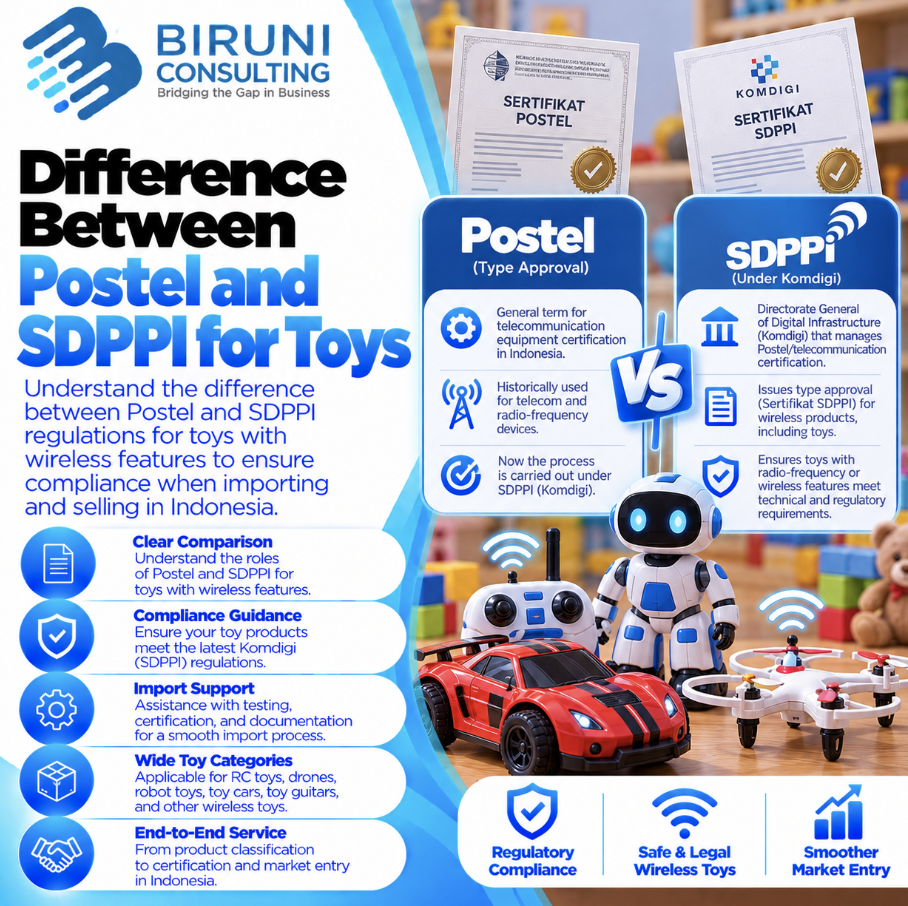
Guide to understanding Postel, SDPPI, and DJID terminology for wireless-toy certification in Indonesia
The terms Postel, SDPPI, and DJID are often used interchangeably when businesses discuss certification for toys containing RF remote controls, Bluetooth, WiFi, NFC, RFID, or other wireless functions.
However, they do not mean exactly the same thing.
In simple terms, Postel is an older industry term that remains widely used, while SDPPI was the name of the Directorate General previously responsible for spectrum and telecommunications-device matters. Following the restructuring of Indonesia’s Ministry of Communication and Digital Affairs, SDPPI became the Directorate General of Digital Infrastructure, or DJID. The institutional restructuring was implemented under Minister of Communication and Digital Regulation Number 1 of 2025. Infradigital
For wireless toys, the important issue is not choosing between two separate “Postel” and “SDPPI” certifications. The product needs to comply with the applicable telecommunications-equipment certification framework and Technical Standards.
What Does Postel Mean?
Postel is an older term originating from Indonesia’s historical postal and telecommunications regulatory structure.
The expression remains widely used commercially in phrases such as Postel Certification, Postel testing, Postel labeling, and Postel services.
In business discussions, “Postel Certification” normally refers to Indonesian telecommunications-equipment certification.
However, Postel is not the current name of the Directorate General administering certification services.
The official e-Sertifikasi system in 2026 identifies itself as a service of the Directorate of Digital Infrastructure Services under DJID, Ministry of Communication and Digital Affairs. e-Sertifikasi
What Does SDPPI Mean?
SDPPI stands for Sumber Daya dan Perangkat Pos dan Informatika, historically translated in the context of postal and informatics resources and equipment.
The former Directorate General of SDPPI handled functions associated with radio spectrum, technical standards, testing, and telecommunications equipment.
As a result, the expression SDPPI Certification became extremely common among manufacturers, importers, laboratories, and certification consultants.
Official Certificates issued before the organisational restructuring also used /SDPPI/ in their Certificate numbers. One official 2024 Certificate, for example, carries the number 102784/SDPPI/2024. e-Sertifikasi
What Does DJID Mean?
DJID stands for Direktorat Jenderal Infrastruktur Digital, or Directorate General of Digital Infrastructure.
Following the restructuring of the Ministry of Communication and Digital Affairs, the former SDPPI Directorate General became DJID under the organisational framework established in 2025. Infradigital
Within the current structure, the Directorate of Digital Infrastructure Services has responsibilities that include telecommunications-equipment certification services. Postel
DJID is therefore the more accurate institutional reference for the current organisational structure.
Are Postel and SDPPI Two Different Certifications?
No.
In the telecommunications-equipment context, Postel and SDPPI are commonly used names associated with the Indonesian certification system rather than two independent certificates that must both be obtained.
The formal terminology under Regulation Number 3 of 2024 is the Certificate for Telecommunications Equipment and/or Telecommunications Devices, which confirms that an equipment type complies with the applicable Technical Standards. JDIH Kemkomdigi
A business therefore does not normally obtain one Postel Certificate and then another SDPPI Certificate for the same radio configuration.
Why Does SDPPI Still Appear on Documents?
Institutional restructuring does not immediately remove old terminology from every document.
Existing Certificates, test reports, historical regulations, databases, and technical references may still contain the SDPPI name.
The current e-Sertifikasi portal itself describes its public database as containing valid SDPPI/DJID Komdigi telecommunications-device certificates, while its footer identifies the present organisation as DJID. e-Sertifikasi
The presence of “SDPPI” on an older Certificate therefore does not by itself make that Certificate invalid.
Its actual status and regulatory applicability should be checked.
Why Do New Certificates Use DJID?
The organisational transition is also visible in Certificate numbering.
An official Certificate issued on 12 June 2025, for example, carries the number 111217/DJID/2025, while older Certificates issued during 2024 used /SDPPI/2024. e-Sertifikasi
For toy importers, the more important issue is whether the Certificate matches the exact brand, model/type, radio configuration, and product being imported.
Current Certification Regulation
The principal certification regulation remains Minister of Communication and Informatics Regulation Number 3 of 2024 on Certification of Telecommunications Equipment and/or Devices.
The regulation remains in force and repealed Regulation Number 16 of 2018. JDIH Kemkomdigi
It covers applicant categories, documentation, application procedures, Certificates, commercial activities, and regulatory marking.
Businesses may continue using the familiar term “Postel,” but the actual process needs to follow the current regulatory framework.
Which Toys Need Assessment?
Not every toy automatically has telecommunications-certification requirements.
A conventional electronic toy should be distinguished from one incorporating:
- RF remote controls.
- Bluetooth.
- WiFi.
- NFC or RFID.
- UWB.
- Wireless microphones.
- Other active radio modules.
Wireless-toy assessment should identify transmitters, receivers, operating frequencies, transmission power, antennas, radio modules, firmware, and RF test reports.
RF Remote-Controlled Toys
RC cars, tanks, excavators, trucks, robots, boats, and racing toys frequently use proprietary RF links.
In a simple system, the remote controller contains a transmitter while the toy contains a receiver.
More sophisticated products may use bidirectional communication, meaning that the toy itself also transmits data.
The remote controller and toy should therefore be considered as a complete communications system during technical assessment.
Bluetooth and Short Range Devices
Bluetooth is commonly used for smartphone control, pairing, interactive applications, and other smart-toy functions.
Minister of Communication and Informatics Decision Number 260 of 2024 establishes the Short Range Device Technical Standards and includes Bluetooth IEEE 802.15.1 operating at 2400–2483.5 MHz. Postel Sertifikasi
However, identifying a toy as “Bluetooth” is not enough.
The module, Bluetooth version, operating frequency, output power, antenna, firmware, and final-product configuration still need to be reviewed.
Postel, SDPPI, and DJID Are Not Radio Technologies
Postel, SDPPI, and DJID do not describe the radio technology contained in a toy.
They relate to historical terminology and the institutions involved in Indonesian telecommunications regulation.
The applicable Technical Standard is determined by the actual radio function and technical characteristics of the product.
Two products both described commercially as requiring “Postel Certification” may therefore have very different certification scopes if one uses Bluetooth and another uses WiFi or proprietary RF.
Current Documentation Requirements
Regardless of the commercial terminology used, a new Certificate application needs to comply with current official requirements.
DJID’s e-Sertifikasi NextGen portal currently lists requirements including NIB and OSS access for business applicants, a laboratory test report, technical specifications, and other supporting documentation according to the product and applicant. e-Sertifikasi
Calling the process “Postel Certification” therefore does not mean that older certification procedures can still be followed.
Do Old SDPPI Certificates Need to Be Replaced?
A change in institutional name does not by itself mean that every Certificate containing /SDPPI/ needs to be replaced simply because the authority is now called DJID.
The official portal in 2026 still displays older /SDPPI/2024 Certificates with valid status, while newer Certificates use /DJID/2025. e-Sertifikasi
Businesses should nevertheless consider the commercial-activity provisions of Regulation Number 3 of 2024.
The Certificate itself is not time-limited, but a Certificate holder may manufacture, assemble, or import covered equipment for trade and/or use in Indonesia for up to three years from the Certificate issuance date. Continued activity after that period requires renewed Technical Standard compliance and a new Certificate. JDIH Kemkomdigi
SDPPI and DJID Labels on Toys
Regulation Number 3 of 2024 provides regulatory-marking formats involving the Certificate number and PLG ID, QR Code, and Warning Sign. JDIH Kemkomdigi
An older valid Certificate may therefore contain an SDPPI-formatted Certificate number, while a newer Certificate may use DJID.
Manufacturers should use the information associated with the actual Certificate for the exact product rather than manually changing SDPPI to DJID on existing certification information.
Is Postel Certification the Same as Toy SNI?
No.
Telecommunications-equipment certification and toy-safety compliance address different regulatory areas.
DJID/Postel Certification concerns active telecommunications functions such as RF remote controls, Bluetooth, WiFi, and other radio interfaces.
Toy SNI requirements concern product-safety compliance under a different regulatory framework.
A wireless toy can therefore require assessment under both regulatory areas.
Which Term Should Businesses Use?
The term Postel Certification remains useful commercially because it is still widely recognised by importers and manufacturers.
SDPPI Certification also remains common because older Certificates and technical documents frequently contain that terminology.
For the current institutional structure, however, DJID is the correct Directorate General nomenclature. The official 2026 e-Sertifikasi service is operated under the Directorate General of Digital Infrastructure. e-Sertifikasi
Using the expression Postel/DJID Certification can therefore be practical for commercial communication while reflecting the current institutional structure.
Why Pre-Import Assessment Matters
The more important risk is usually not whether a company calls the process Postel or SDPPI, but whether it correctly identifies the radio configuration.
One toy may use proprietary RF, another Bluetooth, and a premium version may add WiFi.
Manufacturers may also change modules, antennas, PCBs, firmware, or controllers without significantly changing the external design.
Pre-import assessment helps verify the exact model, wireless technologies, transmitters, receivers, frequencies, transmission power, antennas, modules, and test reports before certification and shipment.
Conclusion
The difference between Postel and SDPPI for toys primarily relates to terminology and institutional evolution, rather than two separate certifications that businesses must obtain.
Postel is an older term that remains widely used commercially. SDPPI was the previous Directorate General responsible for spectrum and telecommunications-device matters. Following the 2025 restructuring, SDPPI became the Directorate General of Digital Infrastructure or DJID. Infradigital
Today, toys incorporating RF remote controls, Bluetooth, WiFi, or other active radio technologies need to be assessed under Indonesia’s Telecommunications Equipment and/or Device Certification framework and the applicable Technical Standards. JDIH Kemkomdigi
For an importer, the more important questions are therefore: Which radio technologies are installed? What frequencies and transmission power are used? Which modules and antennas are installed? Does the test report match the final product?
Contact Us
Biruni Consulting assists with DJID/SDPPI assessment and certification for wireless toys and various wireless products that will be imported or marketed in Indonesia.
Our services include:
- Assessment of DJID/SDPPI certification requirements.
- Transmitter and receiver assessment.
- RF specification review.
- Frequency and transmission power analysis.
- Technical document review.
- Certification document preparation.
- Testing coordination where required.
- DJID/SDPPI Certification assistance.
If you have a wireless toy, you can prepare product photos, brand, model, datasheet, RF specifications, and wireless module datasheet for an initial assessment of the Postel Certification requirements.