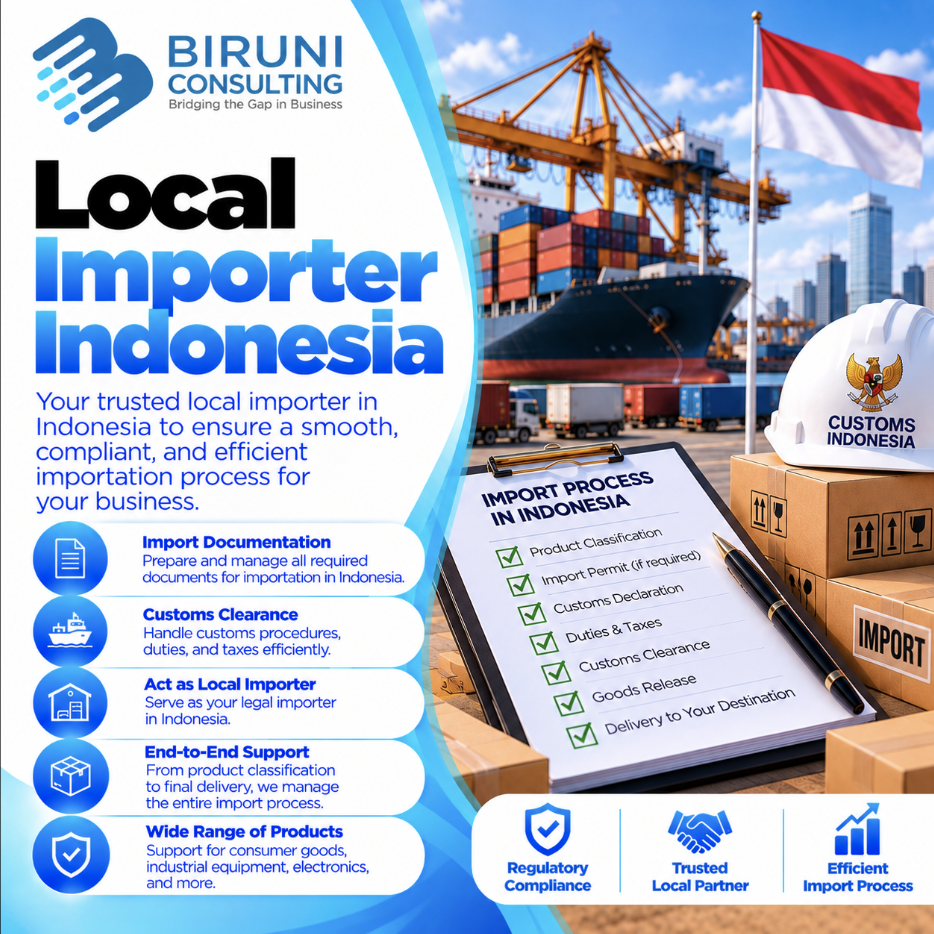
Local Importer Services for Overseas Manufacturers and Companies
Local Importer Indonesia provides an import structure for Overseas Manufacturers requiring an Indonesian company to legally bring products into the country. The local importer’s role can extend beyond receiving goods or arranging customs clearance and can involve NIB/API, Business Licensing, Customs Access, Import Approvals, Import Customs Declarations, prohibitions and restrictions, and coordination of product-specific compliance before commercial shipment.
Indonesian regulations formally use the term Importer. Minister of Trade Regulation No. 16 of 2025 concerning Import Policy and Regulation requires Importers to hold an NIB functioning as an API or Importer Identification Number. The regulation became effective on August 29, 2025. The framework was subsequently amended, including through the second amendment under Minister of Trade Regulation No. 18 of 2026, effective June 4, 2026. Database Peraturan | JDIH BPK
Local Importer Indonesia should therefore be understood as a commercial term for an Indonesian company maintaining the legal structure, Business Licensing, and customs readiness needed to perform the Importer function.
For an Overseas Manufacturer, selecting the right local importer also affects long-term market strategy. The importer, distributor, product-registration holder, Official Representative, and customs broker do not necessarily need to be the same company.
What Is Local Importer Indonesia?
Local Importer Indonesia is an Indonesian party performing the Importer function when foreign goods enter Indonesia.
The company can be responsible for areas including:
- Importer eligibility and NIB/API.
- Customs documentation and PIB.
- Import Approvals where required.
- Payment of import obligations.
- Compliance with prohibitions and restrictions.
Indonesia Customs explains that for Imports for Use, the Importer uses a PIB based on Supporting Customs Documents and is responsible for calculating applicable Customs Duty, Excise, and/or Import Taxes. Beacukai
A local importer is therefore more than a company appearing as consignee.
Local Importer Is Not a Separate Type of License
“Local Importer” is commercial terminology rather than the name of a specific Indonesian permit.
The relevant question is whether the company genuinely satisfies the requirements for acting as Importer and maintains appropriate Business Licensing.
Minister of Trade Regulation No. 16 of 2025 establishes the import framework involving an NIB functioning as API and applicable Import Business Licensing. Database Peraturan | JDIH BPK
An Overseas Manufacturer should therefore assess legal eligibility and product-specific capability rather than relying only on a provider’s “local importer” service description.
Why Does an Overseas Manufacturer Need a Local Importer?
An Overseas Manufacturer does not necessarily have its own Indonesian subsidiary when entering the market.
A local importer can be relevant where the company:
- Is entering Indonesia for the first time.
- Has not established an Indonesian entity.
- Uses a distributor that does not perform the Importer function.
- Wants importer and distributor roles separated.
- Requires a structure for recurring commercial shipments.
This approach can support market entry without immediately building complete local infrastructure.
However, a local importer does not replace mandatory product approvals.
Local Importer and Importer of Record Indonesia
The term Importer of Record Indonesia or IOR Indonesia is commonly used in international trade to describe the party responsible for the importer role in a shipment.
Local Importer Indonesia and IOR Indonesia can perform very similar commercial functions.
Indonesian regulations nevertheless use the formal term Importer. The critical issue is therefore whether the entity holds an appropriate NIB/API, Business Licensing, Customs Access, and product-category eligibility.
Using the IOR or local-importer terminology does not correct an unsuitable regulatory structure.
Start with Product Regulatory Assessment
Selection of a local importer should begin after the product’s regulatory profile is established.
Information commonly reviewed includes:
- product name;
- intended use;
- technical specifications;
- materials or ingredients;
- models or variants;
- HS code;
- manufacturing site; and
- country of origin.
Existing certificates, laboratory reports, Product Catalogues, Technical Data Sheets, and packaging can support the assessment.
The objective is to establish the required import structure and product approvals.
Product Classification
A commercial product name alone may not determine the appropriate regulatory pathway.
Products that appear similar can have different intended uses, compositions, performance characteristics, or technical features.
Correct classification supports identification of:
- HS code.
- Relevant regulator.
- Import restrictions.
- Product certification or registration.
- Local importer requirements.
An importer should therefore not be appointed solely because it has experience importing products with a similar commercial description.
HS Code and Local Importer Indonesia
HS classification is important because it can affect tariffs, customs classification, prohibitions and restrictions, and import requirements.
The HS code should nevertheless be supported by the product’s actual technical characteristics.
The classification needs to remain consistent with:
- Commercial Invoice.
- Packing List.
- Product specifications.
- Product approvals.
- PIB.
Incorrect classification can create inconsistencies between the actual goods, customs declaration, and applicable approvals.
NIB as API
One of the principal Importer requirements is an NIB functioning as an API.
Minister of Trade Regulation No. 16 of 2025 states that Importers need an NIB functioning as API. The regulation also explains that the NIB represents business registration and identity, while API is the Importer’s identification mechanism. Database Peraturan | JDIH BPK
Local Importer Indonesia due diligence should therefore verify NIB/API from the beginning.
NIB/API does not, however, automatically satisfy all product-specific licensing requirements.
Customs Access
The importer also needs customs readiness.
Indonesia Customs explains that Importers and/or Exporters are treated as satisfying Customs Registration requirements after holding an NIB functioning as TDP, API, and Customs Access. Customs Registration information is also integrated with NIB data in OSS and taxpayer information. Beacukai
This makes accurate and current company information important.
Changes to company data need to be managed so they do not interfere with customs operations.
Business Licensing and OSS
The local importer also needs to be assessed against Business Licensing requirements.
Government Regulation No. 28 of 2025 currently governs Risk-Based Business Licensing. It became effective on June 5, 2025, revoked Government Regulation No. 5 of 2021, and covers Business Licensing, PB UMKU, OSS services, supervision, evaluation, and sanctions. Database Peraturan | JDIH BPK
Having an Indonesian legal entity and NIB therefore does not necessarily make a company suitable for every project.
Its actual business activities and licensing should correspond with the Importer functions being performed.
KBLI and the Local Importer
KBLI describes the economic activities conducted by a company.
Where a local importer also performs wholesale trading, distribution, warehousing, or other activities, its Business Licensing should support those functions.
In certain regulated sectors, product-specific rules can also impose additional importer or applicant qualifications.
Due diligence should therefore consider:
- Legal entity.
- NIB.
- KBLI.
- Business Licensing.
- Product-specific eligibility.
Can Every Local Importer Import Every Product?
No.
A company capable of importing one category of goods may not be suitable for another.
Food, cosmetics, supplements, chemicals, electronics, industrial products, automotive goods, and other consumer products can follow substantially different regulatory pathways.
An Overseas Manufacturer should therefore ask not merely whether a company has an API but whether it is eligible for the specific product and regulatory pathway involved.
Goods Prohibited from Import
Companies should first establish that the goods can legally be imported.
Minister of Trade Regulation No. 47 of 2025 concerning Goods Prohibited for Import became effective on January 1, 2026 and remains in force. It revoked the previous prohibited-import framework under Minister of Trade Regulation No. 18 of 2021. Database Peraturan | JDIH BPK
A Local Importer Indonesia structure cannot be used to bypass import prohibitions.
A prohibited-goods assessment should therefore precede commercial shipment.
Prohibitions and Restrictions
In addition to goods that are completely prohibited, some products can be imported only after applicable prohibitions and restrictions are satisfied.
Indonesia Customs explains that for Imports for Use, the Importer needs to satisfy applicable prohibitions and restrictions. Beacukai
Requirements can originate from different authorities and can include:
- product registration;
- certification;
- Import Approvals;
- technical requirements; or
- other supporting documentation.
The applicable restrictions should be established before cargo departs.
Import Approval
Not every product requires an Import Approval.
The requirement needs to be assessed according to product category and current import regulations.
Minister of Trade Regulation No. 18 of 2026 amended provisions within the import framework involving applications for Import Business Licensing, changes to licensing, extensions of Import Approvals, Surveyor Reports, Import Customs Declaration documents, and import-realization reporting. Database Peraturan | JDIH BPK
Where an Import Approval is mandatory, the local importer should ensure that it is available and valid before commercial shipment.
Surveyor Reports
Certain product categories can require Verification or Technical Inspection and a Surveyor Report.
The requirement does not apply universally.
Where it applies, product descriptions, HS codes, models, quantities, origin, and shipment information need to correspond with the actual cargo and applicable approvals.
Minister of Trade Regulation No. 18 of 2026 also amended several provisions concerning Surveyor Reports within the import framework. Database Peraturan | JDIH BPK
Coordination between the local importer and exporter may therefore need to begin before shipment.
Importer Readiness Is Different from Product Readiness
A local importer can be ready legally and operationally while the product itself remains unapproved.
The product can still require:
- SNI certification;
- BPOM registration;
- laboratory testing;
- labeling compliance;
- technical approval; or
- product-specific import permission.
Importer and product-compliance assessments should therefore proceed in parallel.
Commercial shipment should generally follow completion of both.
SNI and Local Importer Indonesia
Certain industrial products can fall under Mandatory SNI requirements.
The existence of an SNI alone does not make certification mandatory. Mandatory status arises where the government imposes the standard through the applicable regulation.
BBSPJIKKP explains that product certification includes both Mandatory and Voluntary SNI schemes. Applications for Ministry of Industry Mandatory SNI products are submitted through SIINas. Kemenperin
The local importer does not replace the LSPro, Testing Laboratory, SNI Certificate, or other approvals required by the product-specific scheme.
LSPro and Product Certification
Where SNI certification is required, conformity assessment is conducted by an LSPro or Lembaga Sertifikasi Produk / Product Certification Body with the appropriate scope.
BBSPJIKKP explains that product certification is a conformity-assessment process used to determine whether companies maintain an appropriate quality system and can consistently manufacture products satisfying applicable standards. Kemenperin
The Importer and LSPro therefore perform different functions.
The local importer supports the import structure, while the LSPro conducts certification according to the applicable scheme.
Laboratory Testing
Testing can form part of product approval.
An Overseas Manufacturer needs to identify:
- Applicable test parameters.
- Test methods.
- Accepted laboratories.
- Sampling procedures.
- Representation of models or variants.
Existing international reports are not necessarily automatic substitutes for Indonesian conformity assessment.
Testing should therefore be planned after the applicable regulatory pathway is established.
BPOM and Local Importer Indonesia
Products supervised by BPOM can have specific applicant and importer requirements.
BPOM maintains separate pathways for medicines, traditional medicines and health supplements, cosmetic notification, processed-food registration, and other licensing. Badan Pengawas Obat dan Makanan
For imported processed food, BPOM identifies company requirements including an OSS-RBA NIB, appropriate Business Licensing according to KBLI, PB UMKU relating to SMKPO, a Letter of Appointment or LOA, and GMP/HACCP or comparable documentation from the overseas manufacturing facility. Direktorat Registrasi Pangan Olahan
A general importer capable of completing customs clearance is therefore not necessarily eligible to act as applicant for every BPOM category.
Local Importer and Product Registration Holder
The Importer does not automatically need to be the product-registration holder.
An Overseas Manufacturer should distinguish:
- Importer.
- Registration applicant.
- Registration holder.
- Distributor.
- Regulatory-account controller.
Separating these functions where permitted can preserve flexibility when commercial relationships change.
Where the Importer also holds all approvals, the manufacturer should understand the exit mechanism from the beginning.
Regulatory Ownership
Regulatory ownership is a strategic issue in selecting Local Importer Indonesia.
Before appointment, companies should establish:
- who holds product approvals;
- who controls regulatory accounts;
- who manages renewals;
- whether approvals can be transferred;
- whether changing Importers requires amendments; and
- what occurs when the agreement ends.
A low-cost local importer can become expensive in the long term where the structure leaves the manufacturer without regulatory control.
Local Importer and Distributor
The importer and distributor do not necessarily perform the same function.
The Importer focuses on legal importation and customs responsibilities.
The distributor normally manages:
- sales;
- dealer or channel management;
- domestic distribution;
- customer development; and
- commercial marketing.
One company can perform both roles where regulations and Business Licensing permit.
Separating importer and distributor functions can also preserve flexibility when an Overseas Manufacturer changes its sales partner.
Local Importer and Official Representative
An Official Representative performs a different function from an Importer.
Certain Mandatory product regulations require an Overseas Manufacturer to maintain an Official Representative in Indonesia.
Under some regulations, the Official Representative can also act as Importer. Under others, a separate Importer can be used where permitted.
Appointing Local Importer Indonesia therefore does not automatically satisfy an Official Representative requirement.
The specific product regulation needs to be reviewed.
Local Importer and IOR Indonesia
Local Importer Indonesia, Indonesia Importer Service, and IOR Indonesia are closely related commercial concepts.
The regulatory question nevertheless remains the same: which entity is the legal Importer and does it have the appropriate eligibility?
An IOR also cannot be used to bypass:
- product registration;
- Mandatory SNI;
- Import Approvals;
- BPOM requirements;
- labeling; or
- other product-specific obligations.
The compliance pathway remains determined by the actual product.
Local Importer and Freight Forwarder
A freight forwarder generally manages transportation, booking, consolidation, international freight, and logistics coordination.
Those functions are different from the legal Importer role.
An Overseas Manufacturer should clearly establish:
- The Importer.
- The freight forwarder.
- The PPJK.
- The distributor.
A logistics provider capable of arranging transportation is not necessarily eligible to act as Importer.
Local Importer and PPJK
A PPJK or customs broker can support customs procedures under authorization.
The PPJK does not automatically become the Importer.
Indonesia Customs identifies Importers and PPJK separately within PIB and Supporting Customs Document procedures. Beacukai
The structure should therefore distinguish the party carrying substantive Importer responsibilities from the customs broker assisting with processing.
PIB in Local Importer Indonesia
The Pemberitahuan Impor Barang or PIB is a principal document for Imports for Use.
Indonesia Customs explains that goods imported for use are released using a PIB for each transport-contract document and that the Importer prepares the PIB from Supporting Customs Documents. Beacukai
The PIB needs to correspond with the actual shipment.
Product descriptions, HS classification, quantities, customs values, Importer information, origin, and supporting documents should remain consistent.
Supporting Customs Documents
Indonesia Customs identifies invoices, Packing Lists, Bills of Lading or Air Waybills, product-identification documentation, documentation demonstrating compliance with import requirements, and other required records as Supporting Customs Documents. Beacukai
Local Importer Indonesia should therefore conduct pre-shipment document review.
Problems discovered before shipment are generally easier to correct than problems discovered after cargo arrival.
Commercial Invoice
The Commercial Invoice should accurately reflect the actual transaction.
Information normally includes:
- seller;
- buyer;
- product description;
- quantity;
- unit price;
- total value;
- currency; and
- commercial terms.
The Importer should ensure that descriptions correspond with the actual goods, HS code, product approvals, and supporting documents.
Overly generic descriptions can also make product identification more difficult.
Packing List
The Packing List contains information concerning packaging and actual shipment quantities.
Information can include cartons, pallets, gross weight, net weight, dimensions, models, and quantities.
For regulated products, listed models should correspond with approved products.
Variants outside the registration or certification scope should not be included without regulatory assessment.
Bill of Lading or Air Waybill
Sea freight generally uses a Bill of Lading, while air freight uses an Air Waybill.
Consignee, Importer, shipper, descriptions, and shipment references need to correspond with the import structure.
Changing the local importer after transport documents have been issued can be more complicated.
Where product approvals are also linked to a specified Importer, the change can have additional regulatory consequences.
Certificate of Origin
A Certificate of Origin can demonstrate the origin of goods and support preferential tariffs where the applicable trade agreement and rules of origin are satisfied.
Country of shipment is not necessarily the country of origin.
The local importer should ensure that the Certificate of Origin corresponds with the Invoice, manufacturer, HS code, and shipment.
Origin documentation should follow the applicable trade-agreement requirements rather than commercial assumptions.
Customs Duty, Excise, and Import Taxes
Indonesia Customs applies a self-assessment approach to Imports for Use.
The Importer is responsible for calculating, paying, and depositing applicable Customs Duty, Excise, and/or Import Taxes based on the PIB. Beacukai
The importer agreement should therefore establish the commercial allocation of those costs between the Importer and overseas supplier.
Landed-cost calculations should ideally be completed before the Purchase Order is finalized.
Customs Clearance
When goods arrive, the Importer performs or coordinates customs clearance.
Indonesia Customs applies selective, risk-based examination, including Red and Green channels. The Red channel involves document review and physical inspection before release. Beacukai
Customs clearance therefore requires operational capability.
The local importer should be capable of responding to customs queries, documentation requests, physical inspections, and payment requirements where applicable.
Importer’s Obligations for Imports for Use
Indonesia Customs explains that an Importer conducting Imports for Use generally needs to submit the release document, usually a PIB, pay applicable Customs Duty, Excise and Import Taxes, and comply with applicable prohibitions and restrictions. Beacukai
These obligations are important when evaluating a local importer.
Logistics capability alone is insufficient where the company cannot perform its regulatory and customs responsibilities.
Pre-Shipment Compliance Review
Before commercial shipment, companies should conduct a final compliance review.
The checklist can include:
- Importer eligibility has been confirmed.
- NIB/API and Customs Access are ready.
- Import Approvals are available where required.
- Product approvals are available where required.
- Shipping documents are consistent.
- Prohibitions and restrictions have been satisfied.
This approach moves problem solving away from port arrival and into the pre-shipment stage.
Do Not Ship Before Approvals Are Ready
One common mistake is shipping because an Importer is available while product approval is still incomplete.
For regulated goods, this can result in:
- customs delays;
- storage charges;
- demurrage;
- relabeling;
- re-export; or
- inability to release the goods.
Importer readiness and product readiness should therefore reach the required stage before commercial shipment.
Sample Importation
An Overseas Manufacturer can require samples for testing, certification, registration, research, exhibitions, or market evaluation.
Sample shipments should not automatically be treated in the same manner as commercial shipments.
Product regulations can contain particular exemptions or procedures.
Under certain certification schemes, formal samples can also need to be selected or witnessed by a conformity-assessment party.
Sampling requirements should therefore be established before samples are sent.
Labeling and the Local Importer
Certain product categories can require packaging to identify the local Importer, distributor, product-registration holder, or responsible party.
Selecting the local importer only after artwork has been printed can result in relabeling.
Label review should therefore be coordinated with importer-structure review.
Areas to assess can include:
- Local-party name.
- Address information.
- Bahasa Indonesia.
- Registration or certification markings.
- Mandatory warnings or instructions.
Warehousing and Local Delivery
Following customs clearance, goods can move to warehouses, distributors, customers, or another location according to the commercial structure.
Specific product regulations can nevertheless impose warehouse requirements.
The local importer needs to establish whether products:
- can be delivered directly to the distributor;
- must first enter a specified warehouse;
- require controlled storage conditions; or
- require specific distribution records.
Warehousing can therefore have regulatory significance.
Product Traceability
A local importer should maintain a system connecting the shipment with the actual product.
Traceability records can include:
- Invoice reference.
- PIB reference.
- Batch or lot number.
- Serial number.
- Manufacturing site.
- Distribution destination.
Traceability becomes important during customs investigations, regulatory inspections, complaints, nonconformities, or recalls.
Post-Import Compliance
Regulatory obligations do not necessarily end after goods receive customs release.
Certain products can remain subject to:
- surveillance;
- certificate renewals;
- registration renewals;
- reporting;
- post-market monitoring;
- storage requirements; or
- product-change controls.
The importer agreement should establish which party handles each continuing obligation.
Local Importer for Recurring Imports
Where an Overseas Manufacturer intends to import regularly, the structure should support recurring shipments.
Companies need to monitor:
- NIB/API and Business Licensing.
- Product-approval validity.
- Import-approval validity.
- Origin documentation.
- Customs classification.
- Reporting requirements.
Minister of Trade Regulation No. 18 of 2026 amended provisions including import-realization reporting and administrative sanctions under the current framework. Database Peraturan | JDIH BPK
Importer compliance therefore requires ongoing monitoring.
Temporary Local Importer Indonesia
An Overseas Manufacturer can sometimes use a third-party local importer before its own Indonesian subsidiary becomes operational.
This can form part of a market-entry transition where permitted.
The company should nevertheless establish from the beginning:
- Who holds product approvals.
- Who owns regulatory data.
- How inventory will transfer.
- How the Importer will change.
- Whether packaging needs modification.
Transition planning reduces duplicated regulatory work.
Local Importer for Multiple Products
Companies managing multiple product categories should prepare a regulatory map.
The map can include:
- Product.
- HS code.
- Regulator.
- Import requirements.
- Product approvals.
- Proposed local importer.
- Distributor.
One local importer can be suitable for most of a portfolio while certain categories require a different structure.
Local Importer for Multiple Models
A product family can contain several models or variants.
Where an approval is model-specific, the Importer needs to ensure all imported models fall within the approved scope.
Model numbers should remain consistent among:
- Invoices;
- Packing Lists;
- certificates;
- registrations;
- labels; and
- actual goods.
Model mapping before shipment reduces regulatory mismatches.
Local Importer for Multiple Manufacturing Sites
A multinational manufacturer can produce the same goods at multiple factories.
Certain product approvals can be linked to specified manufacturing facilities.
The Importer therefore needs to know which factory actually supplies each shipment.
A production-site change should be assessed before the next shipment to establish whether existing registrations or certifications remain applicable.
Product Changes After the Import Structure Is Operational
Manufacturers can change:
- Materials.
- Formulations.
- Technical specifications.
- Models.
- Manufacturing sites.
- Trademarks or packaging.
These changes can affect HS classifications, Import Approvals, SNI, BPOM registrations, labeling, or other approvals.
The local importer should receive advance notice before changed products are shipped.
Changing the Local Importer
Changing the Importer can also have regulatory consequences.
Importer information can appear in product registrations, labels, Import Approvals, or regulator accounts.
Before changing the local importer, companies should determine whether the change requires:
- an amendment;
- notification;
- labeling changes;
- a new application; or
- regulator-account updates.
Importer selection should therefore consider long-term continuity.
Regulatory Monitoring
Import rules can change over time.
Minister of Trade Regulation No. 16 of 2025 remains a key part of the general import framework and has been amended, including through Minister of Trade Regulation No. 18 of 2026. Database Peraturan | JDIH BPK
Regulatory monitoring should cover:
- import policy;
- product-specific restrictions;
- customs;
- product registration;
- certification;
- reporting obligations; and
- local-party requirements.
An Importer supporting recurring shipments needs to remain compliant with current rules rather than only those applying when the initial contract was signed.
Regulatory Gap Analysis
Before the first shipment, companies should conduct a gap analysis.
Potential gaps can include:
- Importer not yet eligible;
- unsuitable NIB/API;
- Customs Access not ready;
- KBLI or Business Licensing requiring adjustment;
- missing Import Approvals;
- incomplete product registration;
- incomplete SNI certification;
- non-compliant labels; or
- inconsistent shipping documents.
The identified gaps can then be converted into shipment dependencies.
Initial Documents for Local Importer Assessment
An Overseas Manufacturer can prepare initial documentation including:
- Product Catalogue;
- Technical Data Sheet;
- current HS code;
- product composition where relevant;
- country of origin;
- manufacturing-site information;
- draft Commercial Invoice;
- existing certificates;
- existing Indonesian registrations; and
- proposed distributor structure.
These documents support assessment of whether the proposed local importer is suitable.
Local Importer Indonesia Due Diligence
Due diligence should extend beyond reviewing the company deed or NIB.
Operational and regulatory capabilities also need to be considered.
Five key areas include:
- NIB/API.
- Customs Access.
- KBLI and Business Licensing.
- Experience with the relevant product category.
- Regulatory ownership and exit mechanisms.
A company can hold valid corporate documentation while lacking the operational capability required for a particular import project.
Local Importer Indonesia Roadmap
A project can generally follow five stages:
- Product classification and regulatory assessment.
- Local importer eligibility and Business Licensing review.
- Product and import-approval preparation.
- Pre-shipment documentation and customs preparation.
- Customs clearance and post-import compliance.
For regulated products, mandatory approvals should generally become dependencies before shipment.
The roadmap also allocates responsibilities among the Overseas Manufacturer, Importer, distributor, PPJK, consultant, LSPro, and regulator.
Local Importer Indonesia Timeline
There is no single timeline applicable to all import projects.
Products with relatively simple regulatory requirements can follow a shorter preparation pathway.
Regulated products can require additional stages involving:
- SNI certification;
- BPOM registration;
- laboratory testing;
- Import Approvals;
- Surveyor processes;
- Official Representative setup; or
- labeling.
The availability of a local importer therefore does not automatically mean that goods can be shipped immediately.
Local Importer Indonesia Cost
Costs can consist of several components.
They can include:
- importer service fees;
- regulatory assessment;
- customs brokerage;
- product registration;
- certification;
- laboratory testing;
- Import Approvals;
- freight;
- customs duties and import taxes;
- warehousing; and
- local delivery.
Companies should separate importer-service fees from government duties, taxes, freight, and third-party expenses to provide a clearer landed-cost calculation.
Risks of Selecting the Wrong Local Importer
An unsuitable importer can result in:
- cargo delays;
- missing import approvals;
- unsuitable NIB/API;
- customs discrepancies;
- additional storage costs;
- regulatory-ownership problems;
- difficulty changing distributors; or
- dependency on a local partner.
Due diligence should therefore be completed before appointment.
Common Local Importer Indonesia Mistakes
One common mistake is assuming that every company holding an NIB/API can import every product.
Other mistakes include:
- selecting an Importer before product classification;
- assuming the Importer automatically acts as distributor;
- assuming the Importer automatically satisfies Official Representative requirements;
- shipping before product approvals are ready;
- failing to assess prohibitions and restrictions;
- having no exit strategy; or
- printing labels before finalizing the local-party structure.
Early regulatory planning can prevent many of these problems.
Benefits of Local Importer Indonesia Services
Local Importer Indonesia services can support Overseas Manufacturers that do not yet maintain their own import structure.
Benefits can include:
- Establishing a compliant importer structure.
- Reviewing importer eligibility.
- Integrating product approvals with import planning.
- Supporting pre-shipment review.
- Supporting recurring commercial shipments.
Importer services do not replace regulators, LSPro, Testing Laboratories, BPOM, or other mandatory product approvals.
How to Select a Local Importer Indonesia
A local importer should be selected based on regulatory fit and operational capability rather than service fees alone.
Important factors include:
- NIB/API and Customs Access.
- KBLI and Business Licensing.
- Experience with the relevant product category.
- Customs-document capability.
- Regulatory ownership and exit arrangements.
Companies should also have transparency regarding the PPJK, distributor, warehousing, payment of duties, and responsibility following customs clearance.
Conclusion
Local Importer Indonesia helps Overseas Manufacturers establish an import structure through an Indonesian company meeting applicable import and customs requirements.
Minister of Trade Regulation No. 16 of 2025 requires Importers to maintain an NIB functioning as API. The regulation remains an important part of Indonesia’s import framework and has subsequently been amended, including by Minister of Trade Regulation No. 18 of 2026 effective June 4, 2026. Database Peraturan | JDIH BPK
From the customs perspective, Indonesia Customs explains that Importers and/or Exporters are treated as satisfying Customs Registration requirements once they hold an NIB functioning as TDP, API, and Customs Access. Beacukai
For Imports for Use, Importers use PIB based on Supporting Customs Documents, are responsible for applicable Customs Duty, Excise and/or Import Taxes, and need to comply with prohibitions and restrictions. Beacukai
For regulated products, the local importer still needs to be combined with product-specific compliance. Ministry of Industry Mandatory SNI products use the applicable certification route through SIINas, while BPOM maintains separate applicant and registration requirements for products under its supervision. Kemenperin
By completing product assessment, importer due diligence, regulatory-ownership planning, and pre-shipment compliance review from the beginning, companies can reduce cargo delays, missing approvals, unsuitable importer structures, customs problems, and excessive dependency on local commercial partners.
Contact Us
Biruni Consulting assists companies with Local Importer Indonesia professionally and in accordance with applicable regulations in Indonesia.
Our services include:
- Regulatory consultation.
- Identification of applicable standards.
- Preparation of certification documents.
- Assistance with laboratory testing.
- Certification processing until certificate issuance.
Biruni Consulting assists Overseas Manufacturers with regulatory assessment, local importer structures, NIB/API review, product compliance, SNI, BPOM, Official Representative requirements, customs preparation, and market-entry planning before products are imported and marketed in Indonesia.
Contact Us for Local Importer Indonesia, Indonesia Importer Service, Importer of Record Indonesia, IOR Indonesia, and imported-product regulatory compliance assistance.