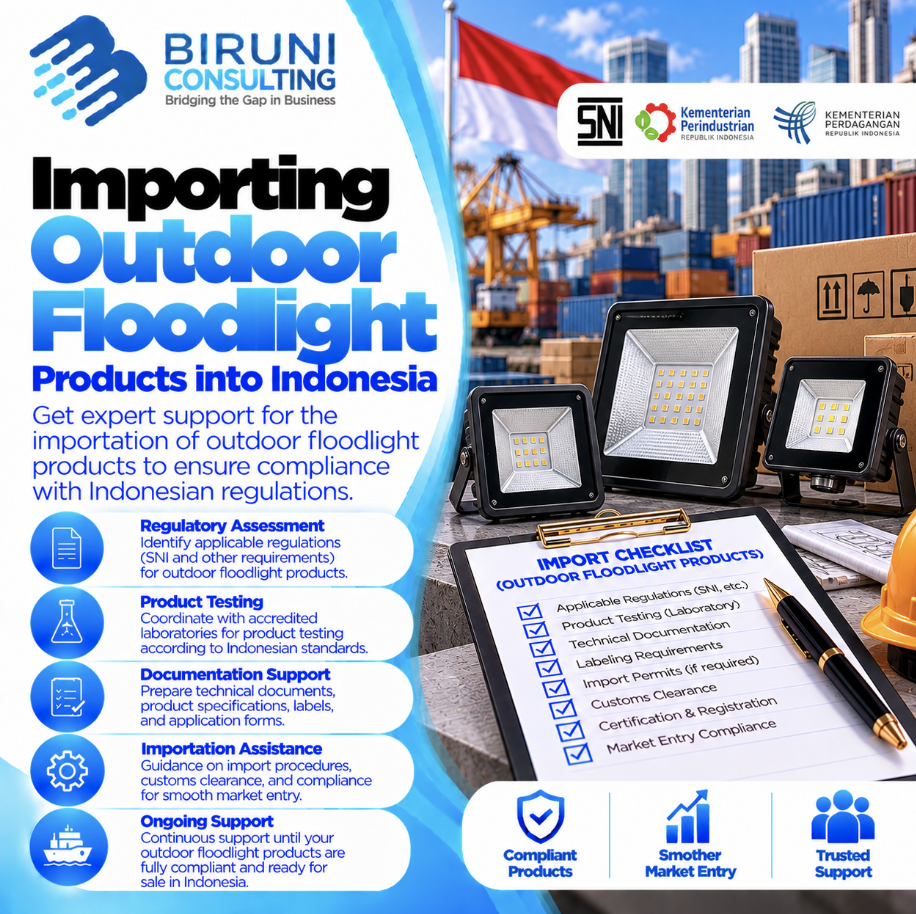
Guide to Import Requirements, SNI, NPB, HS Code, IP Rating, Testing, and Outdoor Floodlight Certification
Importing outdoor floodlight products into Indonesia requires assessment of luminaire type, lighting function, voltage, wattage, light source, LED driver, installation method, housing materials, IP rating, HS Code, and applicable SNI standards. The term outdoor floodlight can cover LED floodlights, outdoor spotlights, garden spotlights, landscape spotlights, facade floodlights, security floodlights, and smart outdoor floodlights.
From a regulatory perspective, floodlights are a specific luminaire category. Minister of Energy and Mineral Resources Regulation No. 7 of 2021 includes floodlight luminaires within the mandatory electricity-standardization scope. The applicable framework uses SNI IEC 60598-1 as the general luminaire requirement and SNI IEC 60598-2-5 as the particular requirement for floodlights. JDIH ESDM
The Ministry of Trade’s LAMANSITU also currently lists the Floodlight Luminaire category with SNI IEC 60598-1:2016, SNI IEC 60598-2-5:2016, and NPB for several HS Codes under heading 9405. Laman Situ
Importers should therefore conduct a product assessment before mass production and shipment to determine the luminaire category, applicable standards, HS Code, IP rating, product family, critical components, NPB requirements, and documentation.
What Is an Outdoor Floodlight?
An outdoor floodlight is a luminaire designed to provide directional or defined-area illumination in an exterior environment. These products are widely used for building facades, yards, gardens, parking areas, billboards, sports fields, warehouses, industrial areas, hotels, resorts, and landscapes.
Common product types include:
- LED floodlights and outdoor spotlights.
- Garden and landscape spotlights.
- Facade and architectural floodlights.
- Floodlights with motion sensors or photocells.
- RGB, smart, and solar outdoor floodlights.
Although these products can all be marketed as outdoor lighting, their technical classification should be based on construction and intended use. Garden spotlights, street lights, outdoor wall lights, and in-ground luminaires do not automatically belong to the same certification category.
Are Outdoor Floodlights Subject to Mandatory SNI?
Floodlights falling within the scope of Minister of Energy and Mineral Resources Regulation No. 7 of 2021 are included among luminaires subject to mandatory SNI requirements. The regulation covers floodlight luminaires used in household electrical installations, fixed electrical installations, low-voltage generating sets, and similar applications according to the defined technical and HS scope. JDIH ESDM
The electricity product-registration framework requires floodlight luminaires to comply with SNI IEC 60598-1:2016 or its latest edition and SNI IEC 60598-2-5:2016 or its latest edition. JDIH ESDM
The commercial description “outdoor lamp” is therefore not sufficient. Datasheets, product construction, beam distribution, mounting method, rated voltage, and intended use should be reviewed before selecting the standard.
SNI IEC 60598-1 for Floodlights
SNI IEC 60598-1 provides the general safety requirements for luminaires and is used together with an appropriate particular standard. Minister of Energy and Mineral Resources Regulation No. 7 of 2021 lists SNI IEC 60598-1:2016 for luminaire groups falling within its mandatory scope. JDIH ESDM
General luminaire requirements address areas such as construction, marking, protection against electric shock, terminals, internal and external wiring, earthing, insulation, temperature, and mechanical and material characteristics.
For outdoor floodlights, these general requirements need to be combined with the particular floodlight standard.
SNI IEC 60598-2-5:2016 for Floodlights
The relevant particular standard is SNI IEC 60598-2-5:2016 – Luminaires – Part 2-5: Particular requirements – Floodlights. BSN currently lists this standard as active, adopting IEC 60598-2-5:2015. Pesta
LAMANSITU also lists SNI IEC 60598-2-5:2016 together with SNI IEC 60598-1:2016 and NPB for the Floodlight Luminaire category. Laman Situ
An outdoor LED floodlight falling within this technical category therefore needs assessment against both the general and particular luminaire requirements under the applicable certification scheme.
Outdoor LED Floodlights
LED floodlights generally consist of an LED PCB or module, LED driver, aluminium housing, tempered glass or diffuser, optical lens, gasket, cable gland, supply cable, earthing arrangement, and mounting bracket.
Although their external construction may appear simple, product safety depends significantly on internal components. A different driver can change temperature and output current, while a different gasket or cable gland may affect the claimed IP rating.
Suppliers should therefore finalize drivers, LED PCBs, housings, glass, gaskets, cable glands, and other critical components before samples are submitted for testing.
Outdoor Spotlights and Floodlights
The terms spotlight and floodlight are often used interchangeably in the market, although their light distributions can differ.
A spotlight usually produces a more concentrated beam, whereas a floodlight generally covers a wider area.
The applicable standard, however, should not be selected solely from beam angle or marketing terminology. Intended use, luminaire construction, mounting arrangement, and regulatory scope need to be considered together.
A product described as an “architectural spotlight” or “landscape projector” may therefore still require assessment against the floodlight category.
Garden and Landscape Spotlights
Garden spotlights are commonly used to illuminate trees, plants, sculptures, building facades, signage, and landscape features.
Products may use ground spikes or surface-mounted brackets. Some connect directly to 220–240 V AC, while others operate at 12 V or 24 V DC through an external driver or transformer.
Low-voltage operation does not automatically eliminate the need for product assessment. The power supply, driver, cable, connector, rated power, and installation method need to be reviewed.
Where a driver is supplied with the luminaire, its specification should also be included in the technical documentation and product-family assessment.
Facade Floodlights
Facade floodlights are used on hotels, shopping centers, monuments, commercial buildings, places of worship, and other architectural structures.
They may use fixed or adjustable brackets and provide narrow, medium, wide, or asymmetric beams.
In addition to lighting performance, safety assessment should consider mounting strength, earthing, drivers, wiring, thermal management, IP protection, and mechanical construction.
Larger and heavier products also require suitable mounting arrangements for their intended installation.
Sports and Large-Area Floodlights
Sports-field, industrial-area, and large parking-area floodlights may have substantially higher power ratings than residential products.
Models may be rated at 100 W, 200 W, 400 W, 600 W, or more depending on their design.
Different wattages should not automatically be treated as one product family. Higher-power products frequently use different housings, LED PCBs, driver quantities, thermal systems, connectors, and mounting brackets.
Product-family assessment should therefore take place before representative samples are selected.
IP Rating for Outdoor Floodlights
IP rating is an important characteristic of outdoor luminaires. Indonesia has SNI IEC 60529:2014 – Degrees of protection provided by enclosures (IP Code), which BSN currently lists as active. Pesta
Outdoor floodlights are commonly marketed with IP54, IP65, IP66, or IP67 ratings.
IP protection should not be treated simply as a catalogue claim. Manufacturers should have test evidence corresponding to the actual product construction.
Gaskets, glass seals, cable glands, connectors, screw openings, covers, driver compartments, and sealing interfaces should remain consistent with the tested configuration.
Does Every Outdoor Floodlight Need IP65?
Not every outdoor luminaire automatically requires IP65. The necessary degree of protection depends on its installation environment.
A product installed beneath a protected canopy faces different exposure conditions from a floodlight installed directly in rain.
Where IP65 or IP66 is claimed, however, the construction and test evidence should support that rating.
Changes to gaskets, cable glands, glass, connectors, and housings after testing should be controlled because they may affect ingress protection.
Floodlights with Internal Drivers
Many LED floodlights incorporate their driver inside the luminaire housing.
The driver converts the incoming supply into the electrical conditions required by the LED module.
Driver manufacturer, model, input voltage, output voltage, output current, rated power, and available certificates or test reports should be documented.
Driver substitutions after testing should be assessed because they can affect temperature, insulation, power, and electrical safety.
Floodlights with External Drivers
Some landscape and architectural luminaires use external drivers.
Importers should identify whether the driver is supplied with the product, where it is intended to be installed, cable length, connector type, and driver protection rating.
An IP65 luminaire housing does not make the entire system IP65 if an accompanying external driver is only suitable for indoor use.
The complete marketed configuration should therefore be assessed.
Earthing and Electrical Class
Outdoor floodlights commonly use aluminium or metal housings for thermal management.
Where accessible metal parts rely on Class I protection, protective earthing becomes an important part of the construction.
Earthing wires, terminals, screws, washers, and protective-conductor continuity should remain consistent with the tested design.
Products using another protection method should clearly identify their electrical class in technical documentation and marking.
Floodlights with Motion Sensors
Security floodlights may incorporate PIR or other motion sensors.
These functions allow the light to operate automatically when movement is detected.
Models with sensors contain additional control circuitry and should not automatically be treated as identical to basic models without sensors.
Relevant data includes sensor type, detection range, detection angle, time delay, day/night mode, and wiring configuration.
Floodlights with Photocells
Photocells or daylight sensors allow outdoor lights to respond automatically to ambient lighting conditions.
The sensor may be integrated into the luminaire or supplied as a separate module.
Models using photocells should be included in the product list because their electronic control configuration may differ from basic models.
Smart Outdoor Floodlights
Smart floodlights may use WiFi, Bluetooth, Zigbee, or other wireless technologies.
Functions can include application-based switching, dimming, RGB control, tunable white, timers, scheduling, scenes, and automation.
The product still needs electrical assessment as a luminaire. Where a radio transmitter is incorporated, separate assessment of applicable telecommunications-device requirements may also be necessary.
Wireless-module manufacturer, model, frequency, transmit power, antenna information, and available RF reports should be prepared.
RGB and Color-Changing Floodlights
RGB, RGBW, and other color-changing floodlights are commonly used for facade and decorative outdoor lighting.
They may incorporate an integrated controller or use an external control system such as DMX.
RGB models should not automatically be grouped with single-color variants where LED PCBs, drivers, controllers, wiring, or electrical loading differ.
Solar Outdoor Floodlights
Solar floodlights typically combine a luminaire, solar panel, rechargeable battery, charge controller, LED module, sensor, and mounting system.
The panel may be integrated or supplied separately.
Solar operation does not automatically mean that all luminaire-related requirements are irrelevant, and the regulatory treatment should not automatically be assumed to be identical to a 220–240 V AC floodlight.
Rated voltage, battery configuration, charging circuit, panel specification, intended use, and HS classification need individual assessment.
Surge Protection
Outdoor floodlights may incorporate surge protection within the driver or through a separate SPD.
Where a manufacturer claims a particular surge level, supporting test evidence should ideally be reviewed.
Versions with and without additional surge-protection modules should also be identified in the product list because their constructions differ.
Housing Materials
Die-cast aluminium is widely used in outdoor floodlights because it provides mechanical strength and supports thermal dissipation.
Other materials may include stainless steel, polycarbonate, and tempered glass.
Changes to housing materials, glass thickness, gaskets, coatings, or sealing systems can influence thermal performance, mechanical strength, earthing, corrosion resistance, and IP protection.
These materials should therefore form part of the controlled production specification.
Outdoor Floodlight Product Family
A manufacturer may offer a single floodlight series in 20 W, 30 W, 50 W, 100 W, 150 W, and 200 W versions.
Similar external appearances do not necessarily mean identical internal construction.
Product-family assessment may consider rated voltage, rated power, electrical class, LED PCB, driver, housing, glass, gaskets, cable glands, mounting brackets, earthing, sensors, control systems, and IP rating.
Higher-wattage models may use multiple drivers or substantially different thermal designs, so representative testing needs to follow the applicable certification scheme.
HS Code for Outdoor Floodlights
Outdoor floodlights generally fall under heading 9405, although the exact subheading depends on the imported goods.
LAMANSITU currently lists the Floodlight Luminaire category under HS Codes 94054290, 94054920, 94054990, 94051191, 94051199, 94051991, 94054190, and 94054220. Laman Situ
These codes should not be applied automatically without classification. Light source, materials, construction, function, and the condition of the goods at importation need to be considered.
LAMANSITU also retains an older floodlight page containing tariff codes from a previous nomenclature, so importers should not simply copy HS Codes from older certificates without checking the current tariff classification. Laman Situ
NPB for Outdoor Floodlights
In addition to SNI certification, the Goods Registration Number or NPB needs to be considered for products falling within the applicable Ministry of Trade quality-policy scope.
LAMANSITU currently lists SNI IEC 60598-2-5:2016, SNI IEC 60598-1:2016, and NPB for the Floodlight Luminaire category. Laman Situ
Where assessment confirms that the product and HS Code fall within this scope, NPB should also be addressed in accordance with the applicable registration requirements.
Product category, brand, models, HS Code, and certification information should remain consistent.
Importer Requirements for Outdoor Floodlights
Indonesia’s current general import framework is based on Minister of Trade Regulation No. 16 of 2025 concerning Import Policy and Regulation, as amended, including the second amendment through Minister of Trade Regulation No. 18 of 2026. Regulation No. 18 of 2026 was established on June 3, 2026, promulgated on June 4, 2026, and is currently in force. JDIH Kemendag
Under Minister of Trade Regulation No. 16 of 2025, business importers are required to hold an NIB functioning as an API, consisting of API-U or API-P. Certain goods may also be subject to import business licensing and/or technical verification depending on their classification. JDIH Kemendag
Importers should therefore review both their general importer status and product-specific requirements before shipment.
Documents Required from the Manufacturer
Manufacturers should prepare technical documentation before certification begins.
Basic documentation may include product catalogues, datasheets, model lists, product photographs, technical drawings, installation instructions, label artwork, user manuals, and manufacturer and factory information.
Technical data should identify rated voltage, frequency, power, electrical class, LED module, driver, cables, earthing, housing material, glass or diffuser, mounting brackets, IP rating, and control functions.
For smart floodlights, wireless-module documentation should also be prepared. For solar products, battery, solar-panel, charging-circuit, and controller specifications should be available.
Outdoor Floodlight Testing
Testing follows the applicable general and particular luminaire standards. SNI IEC 60598-2-5:2016 remains active according to BSN. Pesta
Evaluation may cover marking, construction, protection against electric shock, terminals, earthing, internal and external wiring, insulation, electric strength, temperature, resistance to heat, and mechanical construction.
For outdoor products, claimed IP protection is also important. SNI IEC 60529:2014 remains active as Indonesia’s national IP Code standard. Pesta
Test samples should represent mass-production units, including drivers, LED modules, gaskets, cable glands, glass, housings, and other critical components.
Component Changes After Certification
Suppliers may have multiple options for drivers, LED PCBs, cable glands, connectors, gaskets, or other components.
Changing these items after testing without assessment can alter product characteristics.
Driver substitutions may change temperatures or electrical safety, while gasket and cable-gland substitutions may affect IP performance.
Importers or certificate holders should therefore maintain approved component lists and factory change-control procedures.
Stages of Importing Outdoor Floodlights into Indonesia
The first stage is to establish whether the product is genuinely a floodlight rather than another luminaire type. HS Code, SNI, IP rating, model list, drivers, and product family can then be assessed.
The manufacturer prepares datasheets, technical drawings, label artwork, critical-component lists, existing test reports, and factory information. Representative models are selected after product-family grouping.
Where mandatory SNI applies, certification and testing proceed according to the applicable scheme. The electricity product-registration framework specifically refers to SNI IEC 60598-1:2016 and SNI IEC 60598-2-5:2016 or their latest editions for floodlight luminaires. JDIH ESDM
NPB and other applicable import requirements should then be completed before the products are marketed.
Mistakes to Avoid Before Shipment
One common mistake is assuming that every outdoor lighting product can use floodlight certification. Outdoor wall lights, street lights, recessed ground lights, garden bollards, and floodlights may belong to different technical categories.
Another mistake is relying on a supplier’s IP65 claim without reviewing test reports and actual construction.
Companies should also avoid mass production before drivers, LED PCBs, gaskets, cable glands, labels, and model lists are finalized.
HS Code, SNI, product-family grouping, NPB, and any smart or radio-related requirements should ideally be reviewed before shipment.
Why Is Pre-Shipment Assessment Important?
Outdoor floodlights combine electrical-safety, thermal, mechanical, and environmental-protection considerations.
Two products with almost identical external designs may use different drivers, LED PCBs, gaskets, glass, cable glands, sensors, or wireless modules.
These differences can affect product-family grouping, representative samples, testing, IP rating, HS classification, certification, and NPB.
Assessment using product lists, datasheets, technical drawings, and test reports before mass production and shipment helps importers identify Indonesian requirements early and reduces the risk of changes after production.
Contact Us
Biruni Consulting assists companies with importing outdoor floodlight products into Indonesia, including SNI consultation, HS Code identification, luminaire-category assessment, product family assessment, testing, and certification assistance.
Our services include:
- Consultation on outdoor floodlight import requirements and applicable SNI standards.
- HS Code, product specification, IP-rating, and product-list assessment.
- Identification of LED floodlights, garden spotlights, landscape spotlights, facade floodlights, sensor floodlights, and smart outdoor floodlights.
- Review of drivers, LED modules, cable glands, gaskets, earthing, housings, sensors, and critical components.
- Product family assessment and certification-document preparation.
- Testing, factory-audit or production-evaluation assistance where required, SNI certification, and NPB assistance.
Contact Biruni Consulting for information regarding outdoor floodlight SNI services, LED floodlight certification, outdoor spotlight certification, SNI IEC 60598-2-5, floodlight NPB, and outdoor floodlight import requirements in Indonesia according to your product’s brand, model, construction, wattage, IP rating, specifications, HS Code, and country of origin.