
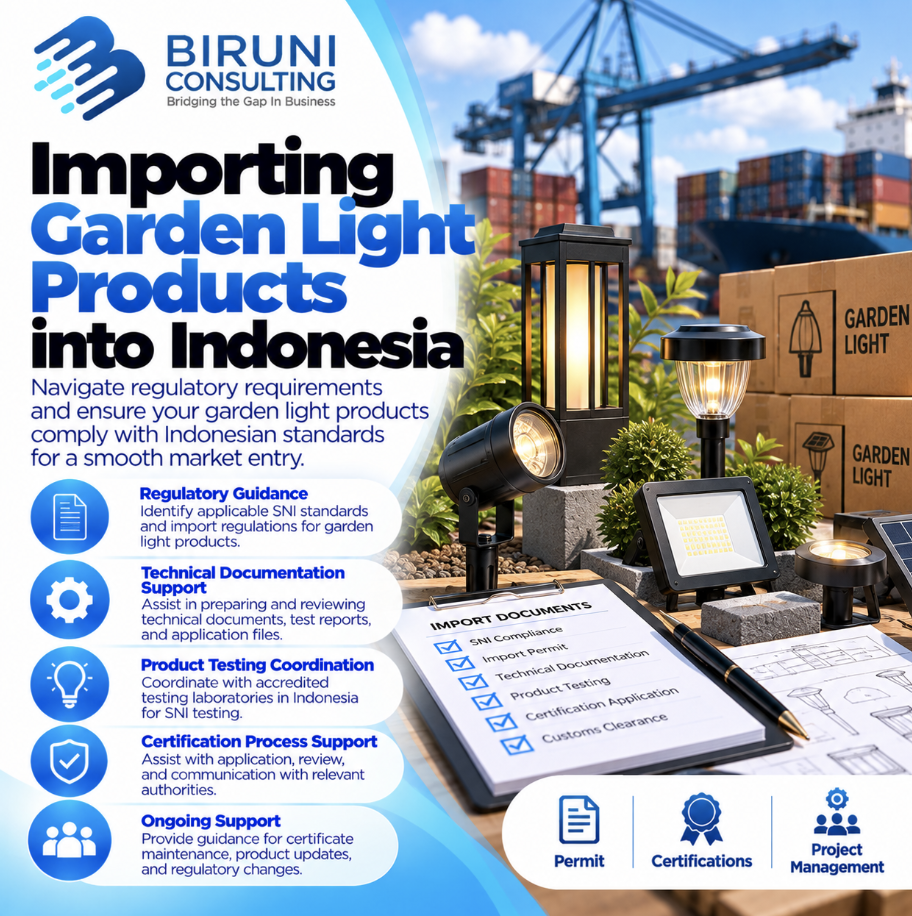
Guide to Import Requirements, SNI, NPB, HS Code, Testing, and Garden Light Certification
Importing garden light products into Indonesia requires an assessment of luminaire type, construction, power supply, installation method, protection against water and dust, drivers, light sources, HS Code, and applicable standards. The term garden light can cover many technically different products, meaning they may not all follow the same certification pathway.
Products may include bollard lights, spike lights, garden spotlights, wall-mounted outdoor lights, recessed garden lights, portable garden lamps, solar garden lights, and smart garden lights equipped with WiFi or Bluetooth.
For products technically classified as luminaires, SNI IEC 60598-1:2016 – Luminaires – Part 1: General requirements and tests is one of the main standards that needs to be reviewed. BSN lists the standard as active. The Ministry of Trade’s LAMANSITU also lists SNI IEC 60598-1:2016 and the Goods Registration Number or NPB as quality-policy requirements for several luminaire HS Codes. Pesta
However, the exact certification requirement and applicable standard still need to be determined from the actual product construction. A garden spotlight, for example, may be assessed differently from a portable garden lamp or solar garden light.
What Is a Garden Light?
A garden light is a luminaire used to illuminate outdoor areas such as gardens, yards, pedestrian paths, landscapes, terraces, entrances, ponds, planting areas, and other exterior facilities.
Garden lighting can provide general illumination, decorative lighting, accent lighting, security lighting, or focused illumination for specific objects.
Common types include:
- Garden bollard lights.
- Spike lights.
- Garden spotlights.
- Landscape lights.
- Outdoor wall lights.
- Pathway lights.
- In-ground lights.
- Recessed garden lights.
- Portable garden lamps.
- Solar garden lights.
- Decorative garden lights.
- Smart garden lights.
- Garden lights with motion sensors.
- Garden lights with photocells.
- RGB garden lights.
Although all these products may be described commercially as garden lights, their applicable standards and certification requirements may differ.
Are Imported Garden Lights Required to Have SNI?
Companies should not automatically assume that every garden light is subject to identical SNI requirements solely because of its product name.
The first stage is to determine whether the product falls within a luminaire category covered by an applicable quality policy and HS Code.
LAMANSITU currently lists a Luminaire category with HS Codes including 94051191, 94051199, 94051991, 94051992, 94051999, 94054140, 94054220, 94054250, 94054920, and 94054950. SNI IEC 60598-1:2016 and NPB are listed as quality-policy requirements for this category. Laman Situ
Classification should not, however, be based only on product appearance. Installation method, light source, voltage, function, and construction need to be assessed.
A spike light functioning as a spotlight may follow a different assessment from a bollard light. Likewise, a solar product using a photovoltaic panel and battery has a different system configuration from a 220–240 V AC garden luminaire connected directly to an electrical installation.
SNI IEC 60598-1 for Garden Lights
One of the principal luminaire standards is SNI IEC 60598-1:2016.
The standard covers general luminaire requirements and testing and is currently listed as active by BSN. BSN also lists SNI IEC 60598-1:2017 as active, meaning the edition applied during certification needs to follow the requirements and certification scheme applicable to the relevant product category. Pesta
For the quality-policy requirements currently displayed by LAMANSITU, the general luminaire category continues to list SNI IEC 60598-1:2016. Laman Situ
Importers should therefore not independently substitute a newer SNI edition simply because one exists in the BSN catalogue. The applicable certification edition should be confirmed according to the relevant scheme and scope.
Garden Spotlights
Spike lights and landscape spotlights are commonly used to illuminate trees, plants, statues, walls, and other landscape elements.
Where the product construction and function correspond to a floodlight or spotlight, SNI IEC 60598-2-5:2016 – Luminaires – Part 2-5: Particular requirements – Floodlights is one relevant standard and is currently listed as active. Pesta
LAMANSITU also lists a floodlight luminaire category with:
- SNI IEC 60598-1:2016.
- SNI IEC 60598-2-5:2016.
- NPB. Laman Situ
A product marketed as a garden spike light but technically functioning as a spotlight therefore needs to be assessed against this product category.
Garden Bollard Lights
A bollard light is typically mounted on a short post and used to illuminate pathways, gardens, yards, and landscape areas.
Products may use:
- Integrated LED modules.
- Replaceable lamps and lamp holders.
- Internal LED drivers.
- External drivers.
- AC mains supply.
- Solar panels and batteries.
For bollard lights, the assessment should consider luminaire design, installation method, power source, enclosure protection, and HS Code.
The commercial description “bollard lamp” alone should not be used to determine the applicable SNI.
In-Ground Garden Lights
In-ground lights are installed at or below ground level and generally direct light upward.
They are commonly used to illuminate trees, facades, pedestrian routes, landscapes, and decorative areas.
Because the product is installed close to or directly in the ground and may be exposed to water, moisture, mud, and mechanical loads, its technical characteristics differ from ordinary indoor luminaires.
LAMANSITU currently has a Recessed Luminaire category listing SNI IEC 60598-1:2016, SNI IEC 60598-2-2:2016, NPB, and several HS Codes. However, products specifically installed in the ground still require technical scope confirmation based on their actual construction and should not automatically be treated in exactly the same way as ordinary recessed luminaires. Laman Situ
Installation drawings, installation depth, drainage requirements, IP rating, housing materials, and applicable surface-load information should therefore be prepared.
Portable Garden Lamps
Some garden lamps are portable and can be moved without permanent installation.
LAMANSITU lists a General-Purpose Portable Luminaire category with:
- SNI IEC 60598-1:2016.
- SNI IEC 60598-2-4:2012.
- NPB. Laman Situ
BSN also lists SNI IEC 60598-2-4:2017 as an active standard for general-purpose portable luminaires. Pesta
As with other luminaire categories, the edition used for mandatory certification should follow the applicable scheme or quality policy rather than simply the newest standard available in the BSN catalogue.
Solar Garden Lights
Solar garden lights are increasingly imported because they can operate without a direct grid connection during use.
The system generally consists of:
- Solar panel.
- LED module.
- Rechargeable battery.
- Charge controller.
- PCB.
- Light sensor.
- Housing.
- Diffuser or optical lens.
- Mounting pole or spike.
Some models use Ni-MH batteries, while others use lithium-ion or LiFePO4 batteries.
Because a solar garden light has a different system configuration from a conventional AC luminaire, product assessment needs to consider all major components.
The presence of a solar panel does not automatically exempt the product from all luminaire requirements. Conversely, the existence of an SNI luminaire standard does not mean every solar garden light automatically follows the same certification scheme. HS Code, construction, electrical ratings, and product scope need to be assessed together.
Garden Lights with External Adapters or Drivers
Certain garden lights operate at low voltages such as:
- 12 V DC.
- 24 V DC.
- 48 V DC.
Power may come from an adapter or LED driver installed either inside or outside the luminaire.
For assessment, importers should provide:
- Driver manufacturer.
- Driver model.
- Input voltage.
- Output voltage.
- Output current.
- Rated power.
- Driver IP rating.
- Cable type.
- Connector type.
- Whether the driver is supplied with the product.
This is important because a garden luminaire may have an IP65 enclosure while using an indoor driver with inadequate environmental protection.
The product should therefore be assessed based on its actual installation configuration rather than only the lamp housing.
Importance of IP Ratings for Garden Lights
Because garden lighting is intended for outdoor use, protection against dust and water is an important parameter.
Indonesia has SNI IEC 60529:2014 – Degrees of protection provided by enclosures (IP Code), which is currently listed as active. Pesta
Outdoor products commonly claim ratings such as:
- IP44.
- IP54.
- IP55.
- IP65.
- IP66.
- IP67.
- IP68.
An IP rating should not be based solely on a supplier’s commercial claim. Where the rating forms part of the product specification, supporting test evidence should be reviewed.
Attention also needs to be given to cable glands, connectors, junction boxes, drivers, and cable joints because these can provide entry points for water.
Is IP65 Always Sufficient for Garden Lighting?
There is no single IP rating automatically suitable for every garden-light application.
Required protection depends on installation conditions.
A bollard installed in an open garden has different exposure conditions from an in-ground luminaire. Products installed near sprinklers, pools, or areas subject to temporary flooding may face different risks.
Importers therefore need to match the IP rating to the intended installation.
Mechanical-impact or IK protection may also be relevant for certain products, particularly those installed in pedestrian areas or locations exposed to accidental impact.
Garden Lights with Light Sensors
Many garden lights incorporate photocells or light sensors, enabling them to switch on automatically when the environment becomes dark.
These sensors are common in solar garden lights as well as AC-powered products.
Sensor functions should be included in the product list because they may distinguish one model from another.
Information should include:
- Sensor type.
- Switching threshold where available.
- Control circuit.
- Power consumption.
- Operating mode.
- Manual override where available.
Additional functions can affect internal construction and product-family grouping.
Garden Lights with Motion Sensors
Motion sensors are also widely used in outdoor wall lights and garden security lighting.
Products may use PIR sensors or other detection technology to switch lighting on when movement is detected.
Relevant information includes:
- Detection distance.
- Detection angle.
- Delay time.
- Sensor type.
- Operating mode.
- Adjustable sensitivity.
- Day/night sensor function.
Where the sensor is integrated into the luminaire, the tested configuration needs to remain consistent with the marketed product.
Smart Garden Lights with WiFi or Bluetooth
Garden lighting may also incorporate WiFi, Bluetooth, Zigbee, or other wireless communication technologies.
Users may control:
- ON/OFF.
- Dimming.
- RGB colors.
- Color temperature.
- Timers.
- Scenes.
- Automation.
Where the product contains an active radio transmitter, telecommunications-device certification requirements need to be assessed separately from luminaire SNI requirements.
Information such as operating frequency, maximum transmit power, module manufacturer, module model, antenna type, antenna gain, and RF test reports should be prepared.
A smart garden light may therefore be subject to more than one regulatory assessment.
RGB and Decorative Garden Lighting
Decorative garden lights may use RGB, RGBW, tunable-white, or dynamic-lighting technology.
These products normally include an additional controller and may use remote controls or smartphone applications.
Importers should identify whether the controller is:
- Built-in.
- External.
- Infrared.
- RF.
- Bluetooth.
- WiFi.
Differences in controllers may affect product configuration and family grouping.
Are Garden Lights the Same as Street Lights?
Garden lighting is not automatically equivalent to public-road lighting.
BSN lists SNI IEC 60598-2-3:2016 – Luminaires – Part 2-3: Particular requirements – Luminaires for road and street lighting as an active standard. Pesta
This standard is relevant to public-road lighting luminaires and does not automatically apply to every outdoor light.
A pathway light installed in a hotel garden should therefore not automatically be classified as a street-light luminaire merely because it is used outdoors.
Conversely, where the product is genuinely designed for road lighting, the relevant public-road lighting requirements need to be reviewed.
Determining the HS Code for Garden Lights
HS Code classification is important because technical and import requirements may depend on the customs classification of the goods.
LAMANSITU lists several codes under heading 9405 for luminaires. The general luminaire category includes codes such as 94051191, 94051199, 94051991, 94051992, 94051999, 94054140, 94054220, 94054250, 94054920, and 94054950. Laman Situ
However, an HS Code should not be selected simply because the product is commercially described as a “garden lamp.”
Classification needs to consider:
- Light source.
- Materials.
- Luminaire type.
- Function.
- Portable or fixed construction.
- Power source.
- Complete product or component.
- Configuration at the time of import.
For solar products, packages containing a luminaire, panel, battery, and additional components also need to be assessed based on the condition of the goods when imported.
NPB for Garden Lights
Where a garden light falls within a luminaire category listed in LAMANSITU’s quality policy, the Goods Registration Number or NPB also needs to be considered.
LAMANSITU lists NPB together with SNI IEC 60598-1:2016 for general luminaires. Floodlight, recessed, and portable luminaire categories also list NPB together with their respective standards. Laman Situ
Companies should therefore not focus solely on obtaining an SNI certificate. Once the product classification has been confirmed, the applicable NPB registration requirement also needs to be reviewed.
Importer Requirements for Garden Lights
Indonesia’s current import-policy framework is based on Minister of Trade Regulation No. 16 of 2025 concerning Import Policy and Regulation, which has subsequently been amended. The second amendment was issued through Minister of Trade Regulation No. 18 of 2026, established on June 3, 2026, promulgated on June 4, 2026, and currently in force. JDIH Kemendag
Under Minister of Trade Regulation No. 16 of 2025, importers are required to have an NIB functioning as an API, with API-U and API-P provided for under the import framework. Certain goods may also be subject to additional licensing or verification requirements. JDIH Kemendag
Companies therefore need to review product-specific requirements in addition to importer legality before shipment.
Product Information to Prepare
For garden-light import assessment, companies should prepare:
- Product name.
- Brand.
- Model.
- Manufacturer.
- Factory address.
- Country of origin.
- Product photographs.
- Datasheet.
- User manual.
- Installation manual.
- Rated voltage.
- Rated current.
- Rated frequency.
- Rated power.
- Light source.
- LED module specification.
- Driver specification.
- Adapter specification.
- Power factor where available.
- IP rating.
- IK rating where available.
- Housing material.
- Diffuser material.
- Mounting method.
- Cable specification.
- Connector specification.
- Sensor specification.
- Battery specification for solar products.
- Solar-panel specification.
- Existing IEC/CB test reports where available.
More complete information makes it easier to determine the correct product category and certification route.
Garden Light Testing
Testing requirements depend on the standard and product construction.
Luminaire testing may include:
- Marking.
- Construction.
- Protection against electric shock.
- Terminals.
- Internal wiring.
- External wiring.
- Insulation resistance.
- Electric strength.
- Creepage and clearance.
- Temperature rise.
- Resistance to heat.
- Mechanical strength.
LAMANSITU lists laboratories with full-test scopes for several luminaire groups, including general luminaires, recessed luminaires, portable luminaires, floodlights, and road-lighting luminaires. Laman Situ
For outdoor products, IP testing is also important where the product claims a specific degree of protection.
IP and Outdoor-Durability Testing
Garden lighting may be exposed to rain, dust, humidity, heat, and changing environmental conditions.
The enclosure therefore needs to be appropriate for its intended application.
SNI IEC 60529:2014 is the national reference for IP codes and is currently active. Pesta
Manufacturers may also have test reports covering:
- Corrosion resistance.
- Salt spray.
- Material UV resistance.
- Mechanical impact.
- Temperature cycling.
These tests do not necessarily create identical requirements for every garden light, but they may provide important information for products intended for demanding outdoor environments.
Drivers as Critical Components
The driver is one of the important components in an LED garden luminaire.
Companies need to ensure that driver information remains consistent across the test sample, bill of materials, datasheets, and mass-production units.
Changing a driver can affect:
- Input current.
- Output current.
- Power.
- Temperature.
- Insulation.
- EMC characteristics.
- IP protection.
- Lifetime.
Suppliers should therefore avoid changing drivers after the tested sample has been finalized without appropriate evaluation.
Garden Light Product Family
One supplier may offer dozens of garden-light models with different physical designs while using similar electronic platforms.
Models may differ in:
- Wattage.
- Housing.
- Dimensions.
- LED modules.
- Drivers.
- CCT.
- Optical lenses.
- IP rating.
- Mounting.
- Sensors.
- Solar panels.
- Batteries.
Before certification, all models should be organized in a product list.
A product-family assessment can then determine whether models can be grouped within one process or need to be separated according to their construction and certification scheme.
Solar Garden Light Product Families
Product-family grouping for solar garden lights requires additional attention because differences extend beyond the LED source.
Two visually identical models may use:
- Different solar panels.
- Different battery chemistry.
- Different battery capacities.
- Different controllers.
- Different LED PCBs.
- Different sensors.
These changes may affect performance and product safety.
Major components should therefore be included in the technical product list.
Documents from Overseas Manufacturers
Before placing a purchase order or arranging shipment, importers should request:
- Product catalogue.
- Product datasheet.
- Model list.
- Technical drawing.
- Product photographs.
- Label artwork.
- User manual.
- Installation instructions.
- Circuit diagram where available.
- Bill of materials where required.
- LED-module information.
- Driver information.
- Cable information.
- IP test report.
- Existing IEC/CB reports.
- Battery datasheet for solar products.
- Solar-panel datasheet.
- Manufacturer information.
- Factory address.
- Quality-management certificate where available.
Complete documentation helps reduce specification changes once certification is underway.
Stages of Importing Garden Lights into Indonesia
Product Identification
Determine whether the product is a bollard light, spike light, spotlight, in-ground light, portable light, solar light, or another type.
HS Code Identification
Review the HS Code according to the product form, construction, function, and light source.
SNI Assessment
Compare the product with applicable luminaire categories and relevant particular standards.
IP Rating Review
For outdoor products, verify claims regarding protection against dust and water.
Product Family Assessment
Compare models based on construction, wattage, drivers, LEDs, housings, sensors, and other important components.
Document Preparation
Prepare importer, manufacturer, product, label, test-report, and model-list documentation.
Certification Application
Where the product falls within a certification category, submit the process through a Product Certification Body with an appropriate scope.
Product Testing
Samples are tested according to the determined standards and certification scheme.
Factory Audit or Production Evaluation
Where required by the certification scheme, the production facility may undergo an audit or evaluation.
Certificate Issuance
Once all applicable requirements have been fulfilled, the certificate can be issued according to the scheme.
NPB Registration
Where NPB applies to the relevant product category, goods registration also needs to be completed in accordance with Ministry of Trade requirements.
What Should Be Checked Before Shipment?
Before garden lights are shipped to Indonesia, companies should ensure that:
- The product category is correctly identified.
- The HS Code has been reviewed.
- Relevant SNI standards have been identified.
- NPB requirements have been reviewed.
- The product family has been determined.
- Samples correspond to mass-production units.
- Drivers have not been changed.
- IP-rating claims have supporting evidence.
- Labels are consistent.
- The manufacturer is prepared to provide certification documentation.
Checking these matters early is generally easier than making changes after production has been completed.
Why Is Pre-Import Assessment Important?
Garden lights have a wide range of constructions.
One product may use 220–240 V AC with an internal driver, while another may use 24 V DC with an external driver. Another model may operate entirely through solar power and an internal battery.
All may be commercially described as “garden lights,” but their regulatory assessment pathways may not be identical.
Pre-shipment product assessment helps importers identify applicable SNI standards, HS Code, NPB, testing requirements, and documentation from the beginning.
It also reduces the risk of beginning certification under an incorrect product category.
Contact Us
Biruni Consulting assists companies with importing garden light products into Indonesia, including SNI consultation, HS Code identification, luminaire classification, product-family assessment, testing, and certification assistance.
Our services include:
- Consultation on garden-light import requirements.
- Identification of applicable SNI standards and regulations.
- HS Code and product-scope review.
- Product specification and product-list review.
- Identification of bollard lights, spike lights, spotlights, in-ground lights, and solar garden lights.
- Driver, LED-module, sensor, battery, and solar-panel review.
- IP-rating and supporting-document review.
- Product-family assessment.
- Certification testing and documentation assistance.
- SNI certification and NPB process assistance.
Contact Biruni Consulting for information regarding garden-light SNI services, garden-light certification, solar garden-light certification, outdoor luminaire certification, lighting NPB, and garden-light import requirements in Indonesia according to your product’s brand, model, construction, specifications, HS Code, and country of origin.