
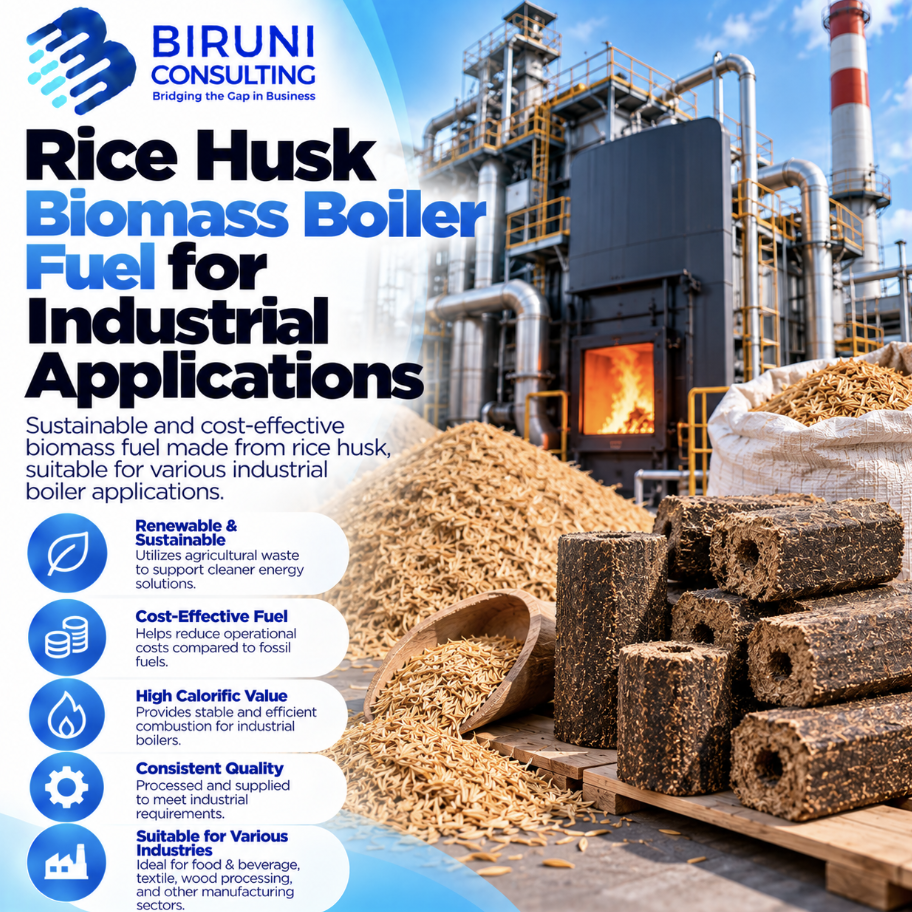
Rice Husk as Biomass Boiler Fuel
Rice husk is an agricultural by-product generated during rice milling that can be utilized as a biomass energy source.
For industrial applications, rice husk can be used as loose biomass in appropriately designed combustion systems or processed into denser products such as briquettes and pellets.
Indonesia’s BRMP post-harvest agency describes the densification of rice residues into briquettes and pellets as a process that improves physical characteristics and calorific value per unit volume while making the material easier to transport and store. The agency also identifies densified rice biomass as suitable for industrial energy applications. Pascapanen BRMP
Industrial facilities operating steam boilers, furnaces, dryers, thermal-oil systems, or other thermal equipment may therefore consider rice husk as one biomass-fuel option.
However, fuel selection should also account for boiler design, feeding equipment, calorific value, moisture, ash, ash characteristics, storage capacity, logistics, and supply continuity.
Why Consider Rice Husk for Industrial Energy?
Rice milling generates rice husk as a by-product.
When an appropriate supply chain and combustion system are available, this material can be converted from an agricultural residue into useful thermal energy.
Indonesia’s agricultural agencies continued to highlight the conversion of rice residues into biomass briquettes as an alternative-energy pathway in publications from 2025 and 2026. Pascapanen BRMP
Potential advantages for industrial users include:
- Agricultural-biomass feedstock.
- Compatibility with suitable solid-fuel combustion systems.
- Availability in loose, briquetted, or pelletized forms.
- Potential use for heat and steam generation.
- Local sourcing opportunities in rice-producing regions.
- Potential development of biomass supply chains based on agricultural by-products.
Availability alone, however, does not determine whether rice husk is economically or technically suitable for a particular factory.
Forms of Rice Husk Boiler Fuel
Rice husk can be supplied and processed in several forms.
1. Loose Rice Husk
Loose rice husk can be used directly in boilers specifically designed to handle its low bulk density and flow characteristics.
The principal logistical disadvantage is the relatively large volume required for storage and transportation.
Fuel-feeding equipment must also be designed to maintain consistent flow of the lightweight material.
2. Rice Husk Briquettes
Rice husk can be compressed into briquettes.
Densification produces a more compact fuel and can improve storage, transportation, and dimensional uniformity. Pascapanen BRMP
Briquettes are generally larger than pellets, so their dimensions need to be compatible with conveyors, hoppers, grates, and fuel-feeding systems.
3. Rice Husk Pellets
Rice husk can also be processed into smaller pellets.
Uniform pellet dimensions may be advantageous for automated feeding equipment specifically designed to handle pelletized biomass.
4. Rice Husk Charcoal Briquettes
Rice husk may be carbonized before being manufactured into briquettes.
Carbonized and non-carbonized products differ in volatile matter, fixed carbon, moisture, ash, and combustion behavior.
Industrial buyers should therefore confirm the exact fuel type before comparing specifications.
Calorific Value of Rice Husk Boiler Fuel
Calorific value indicates how much thermal energy a fuel can provide.
It is important because it affects the amount of fuel required to achieve a specified heat or steam output.
A 2026 study comparing biomass fuels measured rice husk with a Lower Heating Value of approximately 15.8 ± 0.3 MJ/kg, moisture of approximately 9.6%, and ash of approximately 13.9% for the material tested. Sawdust in the same study had a higher LHV and substantially lower ash. ScienceDirect
These values should not be treated as universal rice husk specifications.
Feedstock source, moisture, contamination, densification, carbonization, and manufacturing conditions can all change analytical results.
Industrial procurement should therefore rely on data from the actual fuel being offered.
Gross and Net Calorific Value
Fuel specifications may refer to either:
Gross Calorific Value (GCV) or Higher Heating Value
and:
Net Calorific Value (NCV) or Lower Heating Value.
The two are not directly interchangeable.
GCV includes heat associated with condensation of water produced during combustion, while NCV reflects conditions in which this water remains as vapor in the exhaust.
Laboratory results can also be expressed on:
- an as-received basis,
- an air-dried basis,
- or a dry basis.
Industrial buyers should make sure supplier values are presented on comparable test and reporting bases.
Moisture Content
Moisture is one of the key operating parameters for biomass boiler fuel.
Water contained in the fuel must be heated and evaporated during combustion.
Higher moisture can therefore reduce the amount of useful heat available to the industrial process and may affect furnace temperature and fuel consumption.
Moisture can also increase during storage and transportation if rice husk or briquettes are exposed to rain or excessive humidity.
For recurring industrial purchases, buyers can establish an agreed maximum moisture specification.
Rice Husk Ash Content
Ash content deserves particular attention when considering rice husk.
The 2026 biomass study noted earlier measured approximately 13.9% ash in the rice husk sample, considerably more than in the sawdust tested under the same study conditions. ScienceDirect
Actual commercial products may produce different values.
Higher ash levels can affect:
- Ash-removal capacity.
- Boiler cleaning frequency.
- Residue-storage requirements.
- Waste handling.
- Operator workload.
- Maintenance schedules.
Purchasing teams should therefore evaluate ash alongside calorific value and price.
Silica-Rich Rice Husk Ash
Rice husk ash is widely known for its silica content.
The ash has been studied not only as a combustion residue but also as a potential source of biogenic silica. Research also shows that combustion conditions can influence the structure and quality of the silica produced. MDPI
For boiler operators, mineral composition can influence ash behavior, deposition, slagging, fouling, and cleaning requirements.
However, silica percentage alone does not determine operational risk.
Furnace temperature, complete ash chemistry, boiler design, fuel residence time, and combustion conditions should also be evaluated.
Can Rice Husk Be Used in Any Biomass Boiler?
No.
Biomass boilers are not all designed for the same type of fuel.
Rice husk differs from wood chips, wood pellets, palm kernel shells, coal, and other solid fuels in terms of particle geometry, bulk density, ash content, and flow behavior.
Before changing fuel, engineering teams should evaluate:
- Grate type.
- Feeding system.
- Acceptable fuel dimensions.
- Combustion chamber.
- Air distribution.
- Furnace temperature.
- Ash-removal system.
- Dust collection.
- Steam capacity.
- Emission-control equipment.
Equipment modifications may be necessary where the boiler was not originally designed for rice husk.
Rice Husk Fuel-Feeding Systems
Fuel feeding can be one of the most important technical considerations.
Loose rice husk is lightweight and requires equipment capable of maintaining consistent material flow.
Rice husk briquettes require feeders that can accommodate larger fuel dimensions and the mechanical characteristics of the briquettes.
Pelletized rice husk may be suitable for screw feeders and automated systems when dimensions are compatible.
The best fuel form therefore depends partly on the plant’s existing material-handling equipment.
A cheaper fuel may not remain economical if extensive feeder modifications are required.
Boiler Efficiency and Fuel Consumption
Calorific value indicates potential fuel energy, but actual steam generation also depends on boiler efficiency.
A simplified relationship is:
Useful Energy = Fuel Energy × System Efficiency
Energy losses can arise from:
- hot flue gases,
- moisture,
- incomplete combustion,
- unburned carbon,
- radiation,
- blowdown,
- and equipment condition.
Studies involving rice husk gasification and producer-gas-fired boilers for rice-processing applications demonstrate that system performance depends heavily on equipment design and operating conditions, not merely the raw fuel properties. ScienceDirect
Actual fuel performance should therefore be evaluated under plant operating conditions.
Fuel-to-Steam Ratio
A practical boiler-performance indicator is the fuel-to-steam ratio.
Suppose a boiler consumes:
200 kg of fuel to produce one metric ton of steam.
Its fuel-to-steam ratio is:
200 kg fuel/ton steam.
If another fuel requires only 170 kg per ton of steam, the economic comparison must consider the price of both fuels.
The fuel with the lowest price per kilogram is not necessarily the fuel with the lowest steam-generation cost.
Example Fuel-Cost Calculation
Consider the following simplified example.
Fuel A
Price: IDR 2,500/kg
Consumption: 200 kg/ton steam
Fuel cost:
IDR 2,500 × 200 = IDR 500,000 per ton of steam
Fuel B
Price: IDR 3,000/kg
Consumption: 160 kg/ton steam
Fuel cost:
IDR 3,000 × 160 = IDR 480,000 per ton of steam
Fuel B is more expensive per kilogram but cheaper per ton of steam in this example.
These numbers are purely illustrative. Actual figures should be derived from controlled trials and plant operating records.
Do Not Compare Fuel Price per Ton Alone
Industrial biomass procurement should consider Total Cost of Use.
This may include:
Fuel price + transportation + handling + storage + actual consumption + ash handling + maintenance + downtime.
Low-cost rice husk can be economically attractive where the boiler burns it efficiently and supply is close to the facility.
However, the advantage may disappear if consumption, ash handling, cleaning frequency, or operational downtime increases substantially.
Advantages of Briquettes over Loose Rice Husk
For some facilities, densification can offer significant logistical benefits.
BRMP states that densifying rice biomass can increase calorific value per unit volume, improve storage and transportation, and create more consistent fuel dimensions. Pascapanen BRMP
Potential industrial advantages of rice husk briquettes include:
- More efficient storage volume.
- Easier material handling.
- More uniform fuel dimensions.
- More practical transportation.
- Easier weight-based inventory management.
- Potentially more consistent feeding on compatible equipment.
Briquetting adds processing cost, however, so briquettes may carry a higher purchase price than loose rice husk.
Loose Rice Husk or Briquettes?
Loose rice husk can be attractive where:
- a source is close to the factory,
- the boiler is specifically designed for loose husk,
- adequate storage is available,
- the feeding system handles lightweight material,
- and logistics remain economical.
Briquettes can be attractive where:
- greater fuel density is required,
- transportation distances are longer,
- storage space is limited,
- consistent fuel dimensions are important,
- and the boiler accepts the briquette size.
Neither format is automatically the best option for every plant.
Importance of Boiler Trials
A controlled trial should be considered before entering into a large-volume fuel contract.
Useful data include:
- Hourly fuel consumption.
- Fuel-to-steam ratio.
- Steam output.
- Steam pressure.
- Furnace temperature.
- Combustion stability.
- Feeding performance.
- Ash quantity.
- Ash characteristics.
- Deposit or clinker formation.
- Cleaning frequency.
- Operator intervention.
- Measured emissions where applicable.
- Actual fuel cost per ton of steam.
Trials should represent normal operating conditions as closely as possible.
Certificate of Analysis
For processed rice-husk fuels such as briquettes or pellets, industrial buyers can request a Certificate of Analysis when available.
Parameters may include:
- Gross Calorific Value.
- Net Calorific Value.
- Moisture content.
- Ash content.
- Volatile matter.
- Fixed carbon.
- Bulk density or briquette density.
- Dimensions.
- Sulfur where required.
- Chlorine where required.
For loose rice husk, periodic sampling and laboratory analysis can also support quality control.
Batch-to-Batch Consistency
Biomass can vary between production batches.
Rice husk sourced from different mills may differ in:
- moisture,
- contamination,
- particle condition,
- and storage history.
Briquette characteristics can also vary when feedstock or production conditions change.
Long-term fuel contracts can therefore define acceptable specification ranges and incoming inspection procedures.
Rice Husk Storage
Storage planning depends on fuel form and daily consumption.
Loose rice husk requires considerably more storage volume than densified briquettes or pellets.
Processed fuels should also remain protected from water so that moisture and mechanical strength do not deteriorate.
Storage planning can consider:
- Weather protection.
- Dry flooring.
- Ventilation.
- FIFO inventory control.
- Material-handling access.
- Dust management.
- Fire-safety procedures.
- Safety-stock requirements.
Facility-specific safety procedures should always be applied.
Boiler-Fuel Safety Stock
Boilers may be critical to continuous industrial production.
A fuel shortage can therefore interrupt factory operations.
Safety stock can be determined according to:
- daily consumption,
- supplier lead time,
- delivery distance,
- seasonal supply fluctuations,
- warehouse capacity,
- and availability of alternative suppliers.
For example, a plant consuming 4 tons per day and maintaining five days of inventory would require approximately:
4 tons × 5 days = 20 tons of safety stock.
Actual inventory levels should reflect the facility’s supply-chain risk.
Supplier Capacity
Industrial users should evaluate supplier capacity in addition to pricing.
If a plant requires:
5 tons/day × 25 operating days = 125 tons/month,
the supplier needs to consistently support approximately 125 tons of monthly demand if it is expected to supply the full requirement.
Buyers may request information about:
- Production capacity.
- Actual available monthly supply.
- Feedstock sources.
- Supporting rice mills.
- Warehouse capacity.
- Average stock levels.
- Lead time.
- Transportation capacity.
- Long-term contract capability.
Nominal production capacity is not necessarily the same as uncommitted capacity available to a new customer.
Transportation and Delivery
Logistics can represent a significant portion of total biomass-fuel cost.
Companies should evaluate:
- Supplier location.
- Factory location.
- Transportation distance.
- Truck capacity.
- Shipment volume.
- Packaging.
- Loading and unloading.
- Factory access.
- Delivery frequency.
A low ex-factory fuel price may not translate into the lowest delivered cost when the supplier is located far from the factory.
Ex-Factory and Delivered Price
Industrial buyers should confirm the basis of supplier quotations.
Ex-Factory Price
The fuel is priced at the supplier’s production site or warehouse.
Transportation is arranged or calculated separately.
Delivered Price
Transportation to the customer’s agreed destination is included according to the commercial terms.
Delivered quotations can be easier to compare when suppliers are located in different regions.
Buyers should still verify whether loading, unloading, tolls, packaging, taxes where applicable, and other logistics charges are included.
Industrial Applications for Biomass Boilers
Biomass boilers can supply process steam or thermal energy for a variety of industries, depending on equipment design.
Potential applications include:
- Food and beverage processing.
- Agricultural processing.
- Rice milling and parboiling.
- Wood processing.
- Industrial drying.
- Certain textile operations.
- Heating processes.
- Other steam-dependent manufacturing activities.
Research in rice-processing facilities has specifically evaluated rice husk as an energy source for generating process heat and steam. ScienceDirect
Technical suitability must still be assessed for each individual facility.
Is Rice Husk Better than Wood Pellets?
Not necessarily.
Wood pellets generally offer highly uniform dimensions and can provide lower ash levels for certain grades.
Rice husk may offer an economic advantage where it is locally available and the boiler has been designed to handle its characteristics.
In the 2026 biomass comparison discussed earlier, sawdust had an LHV of approximately 18.2 MJ/kg and ash content of 1.7%, compared with approximately 15.8 MJ/kg LHV and 13.9% ash for the rice husk tested. ScienceDirect
Industrial selection should nevertheless consider delivered price, combustion efficiency, feeding performance, and actual fuel-to-steam ratio.
Rice Husk Co-Firing
Rice husk may also be used as part of biomass blending or co-firing strategies where combustion equipment supports the approach.
A 2025 study evaluating coal co-firing with rice husk, sawdust, and other biomass materials found that fuel composition and ash behavior required careful management when optimizing boiler performance and slagging control. ScienceDirect
Fuel blending should therefore be based on technical analysis rather than cost percentage alone.
How to Evaluate Rice Husk Boiler Fuel
Industrial facilities can use a structured evaluation process.
Stage 1 – Fuel Specification Screening
Review:
- calorific value,
- moisture,
- ash,
- volatile matter,
- fixed carbon,
- density,
- dimensions.
Stage 2 – Boiler Compatibility
Review:
- grate,
- feeder,
- combustion chamber,
- air supply,
- ash handling,
- emission controls.
Stage 3 – Supplier Evaluation
Review:
- supply capacity,
- consistency,
- lead time,
- supplier location,
- backup supply.
Stage 4 – Operational Trial
Test the fuel in the actual boiler.
Stage 5 – Economic Evaluation
Calculate:
- delivered fuel price,
- hourly consumption,
- fuel-to-steam ratio,
- ash-handling cost,
- maintenance,
- and cost per ton of steam.
This approach provides a more useful decision framework than fuel price alone.
Information to Request from a Supplier
Before establishing recurring supply, industrial buyers should request:
- Fuel form: loose husk, briquette, or pellet.
- Calorific value.
- Calorific-value reporting basis.
- Moisture content.
- Ash content.
- Volatile matter.
- Fixed carbon.
- Bulk density or product density.
- Product dimensions.
- Packaging.
- Monthly supply capacity.
- Minimum order quantity.
- Lead time.
- Ex-factory price.
- Delivered price.
- Sample availability.
- Trial availability.
- Certificate of Analysis where available.
This information allows purchasing and engineering teams to evaluate both technical and commercial suitability.
Selecting Rice Husk Fuel for Industrial Boilers
Rice husk can be a relevant biomass-fuel option when three main conditions are satisfied.
First, technical compatibility. The boiler and fuel-feeding equipment must be able to use the fuel safely and consistently.
Second, economic feasibility. Fuel should be compared based on delivered cost and cost per unit of steam output rather than price per ton alone.
Third, supply continuity. The supplier must be capable of maintaining both volume and quality throughout the production period.
Where these conditions can be achieved, rice husk in an appropriate fuel form can form part of an industrial biomass-energy strategy.
Contact Us
Biruni Consulting can assist companies that require information and support regarding product requirements, documentation, and compliance processes related to product importation, marketing, or use according to business requirements in Indonesia.
The services that can be supported include:
- Consultation on product requirements for industrial needs.
- Initial assessment of product specifications and applications.
- Technical document review.
- Review of product specifications and information.
- Consultation on applicable regulatory requirements according to the product type and business activities.
- Assistance in preparing required documents.
- Consultation on certification or licensing processes when required based on the product characteristics and intended use.
Contact Biruni Consulting for information regarding product requirements, documentation, certification, and compliance needs to support business activities and product marketing in Indonesia.