
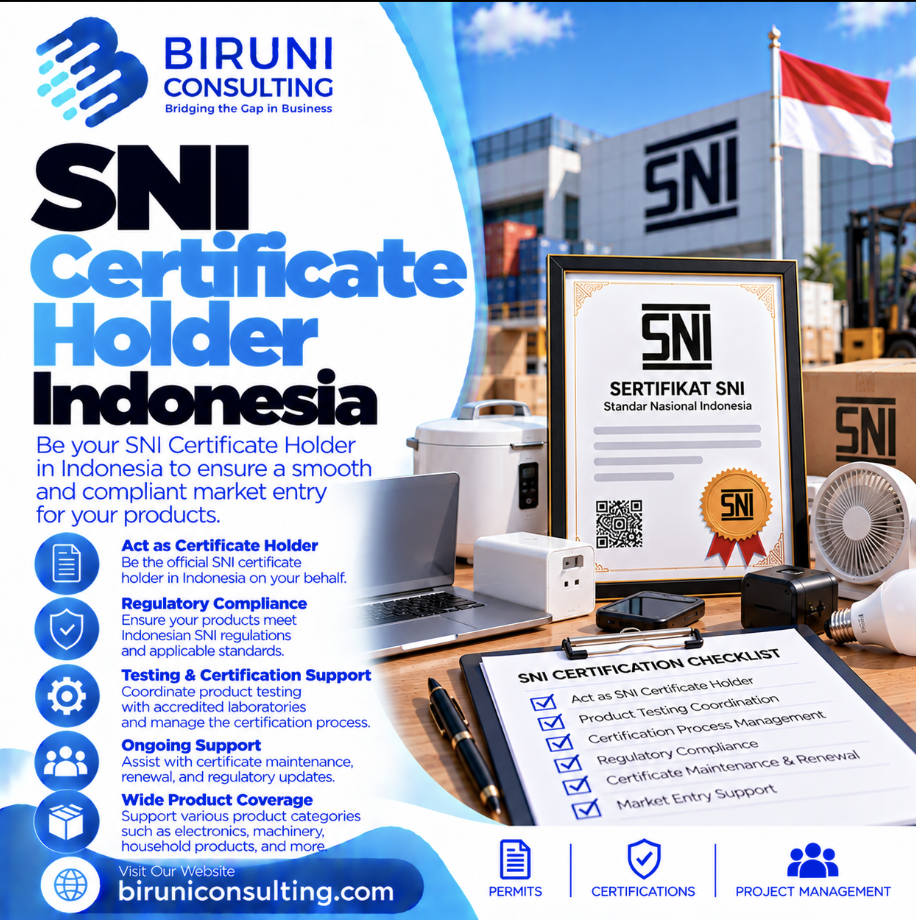
Certificate Holder and SNI Representation Services for Overseas Manufacturers
SNI Certificate Holder Indonesia is a term frequently used by overseas manufacturers looking for a local company that can hold, manage, or maintain SNI certification for products intended for the Indonesian market. However, the term Certificate Holder needs to be used carefully because the legal structure of SNI certification does not always make the Indonesian company the owner of the SNI Certificate.
Under several recent mandatory SNI regulations, the SNI Certificate for an imported product is essentially issued to the Overseas Manufacturer, while the local application and compliance functions are performed through an Official Representative in Indonesia. Under Minister of Industry Regulation No. 8 of 2025 concerning lubricating oils, for example, an SNI Certificate is defined as a certificate issued by an LSPro for an Industrial Company or Overseas Manufacturer capable of manufacturing products in compliance with mandatory SNI requirements. BPK Regulation
A similar structure appears under Minister of Industry Regulation No. 15 of 2025 concerning motor vehicle safety glass. The SNI Certificate is issued for an Industrial Company or Overseas Manufacturer. For imported products, the certificate additionally states the name and address of the Official Representative and the address of the Representative’s warehouse. The presence of the Indonesian company on the certificate therefore does not automatically make it the primary owner of the SNI Certificate. BPK Regulation
An SNI Certificate Holder Indonesia service should therefore begin by identifying the correct regulatory structure: whether the Indonesian entity will act as Official Representative, administrative applicant, SPPT SNI holder, importer, distributor, or, under a particular scheme, the actual owner of the SNI Certificate.
What Is an SNI Certificate Holder Indonesia?
Commercially, the term SNI Certificate Holder Indonesia is generally used to describe a party with local responsibility for a product certification in Indonesia.
From a regulatory perspective, however, the term should not automatically be treated as equivalent to an Official Representative.
Under various recent mandatory SNI schemes, the party owning the SNI Certificate may be:
- An Industrial Company in Indonesia.
- An Overseas Manufacturer.
- A specified party under Trademark Cooperation or Contract Manufacturing arrangements.
- Another entity expressly determined under the applicable product regulation.
The Official Representative, meanwhile, performs the function of representing the Overseas Manufacturer in Indonesia.
Under the lubricating-oil regulation, the Official Representative is formally defined as an Indonesian legal entity functioning as the representative of the Overseas Manufacturer. The SNI Certificate is separately defined as a certificate issued for the Industrial Company or Overseas Manufacturer. BPK Regulation
This distinction is fundamental when a foreign manufacturer searches for Certificate Holder services in Indonesia.
Who Actually Holds the SNI Certificate for Imported Products?
The answer depends on the applicable product regulation.
Under several recent Ministry of Industry regulations, the Overseas Manufacturer owns the SNI Certificate while the Official Representative acts as the local party submitting, administering, and maintaining specified obligations in Indonesia.
For motor vehicle safety glass, an SNI Certificate application may be submitted by an Industrial Company or by an Overseas Manufacturer through its Official Representative electronically through SIINas. The regulation also states that an SNI Certificate belonging to an Industrial Company or Overseas Manufacturer applies to one production location. BPK Regulation
The same structure appears for lubricating oils. The certification scheme states that an SNI Certificate belonging to an Industrial Company or Overseas Manufacturer applies to one production location. For an Overseas Manufacturer, the certificate also contains the Official Representative’s name and address and its warehouse address. BPK Regulation
An Indonesian company should therefore not automatically be described or promised as the “certificate holder” before the applicable product regulation has been reviewed.
Are the SNI Certificate Holder and Official Representative the Same?
Not always.
SNI Certificate Holder is a commercial term describing the party associated with certificate ownership or management.
Official Representative or Perwakilan Resmi is a specific regulatory function established under various regulations for representing an Overseas Manufacturer.
For motor vehicle safety glass, for example, the SNI Certificate continues to state the name of the Overseas Manufacturer and the factory address. Because the product is imported, the certificate additionally states the Official Representative’s name and address and its warehouse address. BPK Regulation
The Representative therefore forms part of the certification structure without automatically replacing the foreign manufacturer as the certificate owner.
For foreign companies, this distinction is important for certificate ownership, trademark control, replacement of the Representative, and continuity of business in Indonesia.
Why Does an Overseas Manufacturer Need a Local Structure?
An Overseas Manufacturer may require a local structure where the applicable product regulation requires an Official Representative.
The Representative serves as the connection between the overseas producer and Indonesian administrative processes. Its responsibilities may include SIINas, certification documentation, trademarks, warehouses, importers, SPPT SNI, and certification amendments.
For lubricating oils, the Official Representative must, among other things, be appointed by the Overseas Manufacturer, hold the relevant trademark license and responsibility, control a warehouse in the prescribed area, be able to act as importer, and maintain an SIINas account. The Overseas Manufacturer may also appoint only one Official Representative under that regulation. BPK Regulation
Local certificate management is therefore more than simply using the address of an Indonesian company. The Representative performs genuine regulatory-compliance functions.
SNI Certificate Holder Indonesia Process
Product and Regulatory Identification
The first stage is accurate product identification.
Information generally reviewed includes the product name, function, model, trademark, HS code, country of origin, factory address, and technical specifications.
After the product has been identified, the company needs to determine whether an SNI exists and whether that SNI has been made mandatory.
The existence of an SNI standard does not automatically mean that the product requires mandatory SNI certification.
This stage also determines who legally owns the SNI Certificate and whether an Official Representative is required in Indonesia.
Determining the Certificate Holder Structure
Once the applicable regulation has been identified, the certification structure can be established.
For domestic manufacturers, an SNI Certificate can generally be issued to the Industrial Company according to the applicable product regulation.
For foreign manufacturers, several recent regulations use a structure under which the SNI Certificate belongs to the Overseas Manufacturer while the application is submitted through the Official Representative.
This distinction determines the name appearing on the certificate, trademark relationship, production location, Representative, warehouse, and SIINas administration.
Appointing the Official Representative
Where required, the foreign manufacturer needs to appoint an Indonesian legal entity as its Official Representative.
The Representative needs to satisfy all applicable product requirements. A company should not assume that its existing distributor or importer automatically qualifies.
Company legality, appointment relationship, trademarks, warehouse, SIINas, and ability to act as importer need to be reviewed first.
For lubricating oils, the Representative requirements specifically include Overseas Manufacturer appointment, trademark licensing, warehouse control, importer capability, and SIINas. BPK Regulation
Documentation and Trademark Preparation
Manufacturer, Representative, and trademark documentation then needs to be aligned.
The Overseas Manufacturer generally needs to provide company legal documents, production-facility information, product information, manufacturing processes, quality-management-system documentation, and other technical records according to the scheme.
Where trademark licensing is required, the relationship between the trademark owner, Overseas Manufacturer, and Official Representative also needs to be clearly established.
An incorrect trademark structure can delay certification even where the product technically complies with the SNI.
Application Through SIINas
For various mandatory SNI schemes administered by the Ministry of Industry, applications are submitted electronically through SIINas.
For motor vehicle safety glass, an Overseas Manufacturer applies for the SNI Certificate through its Official Representative. Where there is more than one production location, a separate SNI Certificate application needs to be submitted for each production location. BPK Regulation
This demonstrates that an SNI Certificate may be linked not only to a trademark but also directly to the manufacturing site.
Assessment by the LSPro
Once the administrative application satisfies the requirements, the process continues with the LSPro.
An LSPro, or Lembaga Sertifikasi Produk, is the Product Certification Body that conducts conformity assessment and issues the SNI Certificate when requirements are fulfilled.
The process may involve a production-facility audit, quality-management-system assessment, sampling, laboratory testing, corrective action, and a certification decision.
The local Representative manages local administrative matters, while the technical assessment remains focused on the manufacturer and product.
Whose Name Appears on the SNI Certificate?
This depends on the applicable product scheme.
For imported motor vehicle safety glass, the SNI Certificate includes the name and address of the Overseas Manufacturer, factory address, trademark, product details, SNI number, date of issuance, and validity period. Because the product is imported, the certificate also needs to include the Official Representative’s name and address and its warehouse address. BPK Regulation
The lubricating-oil certification structure similarly distinguishes between information for an Industrial Company and information for an Overseas Manufacturer. For a foreign manufacturer, the Overseas Manufacturer’s name appears together with the factory address, Official Representative, warehouse, trademark, and other certification information. BPK Regulation
The appearance of an Indonesian company’s name on the SNI Certificate therefore does not necessarily mean that the Indonesian company owns the certificate.
SNI Certificate Holder and SPPT SNI
One of the most important distinctions is between the SNI Certificate and SPPT SNI.
The SNI Certificate results from the certification process and is issued by the LSPro.
SPPT SNI represents approval to use the SNI Mark through the Ministry of Industry mechanism.
For motor vehicle safety glass, SPPT SNI may expressly be issued to an Industrial Company or an Official Representative. The Industrial Company or Official Representative applies for SPPT SNI electronically through SIINas. BPK Regulation
A similar structure applies to lubricating oils. SPPT SNI may be issued to an Industrial Company or Official Representative and is applied for through SIINas. BPK Regulation
This is one reason why the phrase “certificate holder” can cause confusion. Under certain imported-product schemes, the Overseas Manufacturer may own the SNI Certificate while the Official Representative receives and administers SPPT SNI.
SNI Certificate Holder and Importer
The Certificate Holder, Official Representative, and importer are also not necessarily the same entity.
An importer is responsible for bringing goods into Indonesia according to applicable trade licensing and import requirements.
The Official Representative represents the foreign manufacturer under the SNI regulatory structure.
The party legally owning the SNI Certificate is determined by the applicable product regulation.
For lubricating oils, the Official Representative may act as importer. If it does not act as importer, the regulation provides for another importer arrangement. A change of importer or importer data may even require the Official Representative to apply for an amendment to the issued SNI Certificate. BPK Regulation
The importer structure should therefore be established at the beginning of the certification project.
SNI Certificate Holder and Distributor
A distributor is also not automatically the Certificate Holder or Official Representative.
The distributor’s primary function is the sale and distribution of goods.
One company may potentially act as Representative, importer, and distributor where regulations and licensing permit. However, those functions need to remain legally and administratively distinguishable.
An Overseas Manufacturer with an existing Indonesian distributor should conduct an assessment before incorporating that distributor into the SNI structure.
Relevant considerations include company legality, trademark arrangements, warehouse capability, SIINas, import licensing, document-control capability, and long-term relationship stability.
Can the Certificate Holder Be Changed?
Changes to the local party need to be handled carefully.
Where an Indonesian company acts only as distributor or importer, the impact of a change may be different from a change involving the Official Representative.
Under several regulations, replacing the Official Representative before the SNI Certificate expires can cause the SNI Certificate to lose its validity.
The concept of “transferring the certificate holder” should therefore not be treated like an ordinary change of commercial agent.
The company first needs to identify whether the party being changed is the certificate owner, Official Representative, importer, distributor, warehouse provider, or a combination of these roles.
Certificate Holder for Multiple Factories
SNI certification can also be tied to the production location.
For motor vehicle safety glass, an SNI Certificate belonging to an Industrial Company or Overseas Manufacturer applies to one production location. Where the manufacturer operates more than one production location, a separate SNI Certificate application needs to be made for each site. BPK Regulation
The lubricating-oil scheme contains a similar provision stating that the SNI Certificate belonging to an Industrial Company or Overseas Manufacturer applies to one production location. BPK Regulation
A foreign manufacturer operating multiple factories should therefore not assume that one Certificate Holder structure automatically covers every manufacturing site.
Regulatory mapping needs to be performed for each production location.
Certificate Holder for Multiple Trademarks
Trademarks also form an important part of the certification scope.
Whether one or several trademarks can be covered depends on the relevant regulation and product scheme.
In addition to manufacturer-owned trademarks, certain regulations provide mechanisms for Trademark Cooperation or Contract Manufacturing. Under such arrangements, the regulation may specifically determine who owns the SNI Certificate.
For lubricating oils, for example, an SNI Certificate for a trademark under Trademark Cooperation or Contract Manufacturing belongs to the Industrial Company or Overseas Manufacturer receiving that Trademark Cooperation or Contract Manufacturing arrangement. BPK Regulation
Trademark ownership and SNI Certificate ownership are therefore not necessarily the same.
SNI Certificate Holder for Automotive Products
The term SNI Certificate Holder Indonesia is particularly relevant to foreign manufacturers in the automotive sector because several product categories are subject to mandatory SNI and use an Official Representative structure.
Motor vehicle lubricating oils are currently governed by Minister of Industry Regulation No. 8 of 2025, which has been in force since July 24, 2025. BPK Regulation
Motor vehicle safety glass is governed by Minister of Industry Regulation No. 15 of 2025, which has been in force since October 25, 2025. BPK Regulation
Under both regulations, the distinction between the foreign manufacturer as the SNI Certificate owner and the Official Representative as the Indonesian regulatory structure is clear.
Automotive companies should therefore not simply search for a “certificate holder company.” They should first confirm the structure permitted under the applicable product regulation.
Responsibilities After Certificate Issuance
Compliance obligations do not end when the SNI Certificate is issued.
Products using a type 5 certification system may be subject to surveillance throughout the certificate validity period.
Manufacturers need to maintain product quality, manufacturing processes, quality-management systems, internal testing, calibration, and document control.
The Official Representative may continue to have responsibilities involving SIINas, SPPT SNI, warehouses, importers, information amendments, and certification coordination.
The SNI Certificate Holder Indonesia structure should therefore be designed for long-term compliance rather than only to complete the first certification process.
SNI Certificate Holder Indonesia Documents
Documentation needs to be adjusted according to the product. However, preparation may generally include:
- Overseas Manufacturer and Indonesian legal-entity documents.
- Official Representative appointment documentation.
- Relevant trademark and licensing documentation.
- Evidence of warehouse control and SIINas information.
- Product, factory, LSPro, and importer documentation.
Foreign Manufacturer documents may also require translation or additional formalities under the applicable product regulation.
A document review should be completed before submission to ensure consistency between legal-entity names, production-facility addresses, trademarks, Representatives, warehouses, and importer information.
SNI Certificate Holder Indonesia Cost
There is no single fee applicable to every SNI Certificate Holder Indonesia service.
Costs depend on the product and legal structure required. Where the Indonesian entity needs to function as Official Representative, the service scope may include Representative management, SIINas, trademark licensing, warehouse arrangements, importer coordination, and SPPT SNI administration.
These costs need to be separated from LSPro fees, laboratory testing, factory audits, auditor travel, sample shipment, legalization, translation, and importation activities.
A quotation should therefore be prepared after regulatory assessment has been completed.
The key issue is not simply finding the lowest “certificate holder fee,” but ensuring that the proposed structure is legally permitted under the applicable product regulation.
How Long Does It Take to Prepare the Certificate Holder Structure?
There is no single timeline applicable to all products.
Preparation time can depend on the readiness of the Indonesian legal entity, appointment documentation, trademark licensing, warehouse arrangements, SIINas, importer structure, and Overseas Manufacturer documentation.
Where the Representative structure is only prepared after the SNI Certificate application has started, certification may be delayed.
Certificate ownership and local representation should therefore be assessed before factory audits, sampling, and laboratory testing are scheduled.
Selecting an SNI Certificate Holder Indonesia
An Overseas Manufacturer should not simply ask whether an Indonesian company is willing to “hold the certificate.”
The more important question is whether the proposed structure complies with the product regulation.
The company needs to identify:
- who legally owns the SNI Certificate;
- who acts as Official Representative;
- who receives SPPT SNI;
- who acts as importer; and
- who is responsible for the warehouse and SIINas.
Where the regulation states that the SNI Certificate belongs to the Overseas Manufacturer, the Representative service should be structured accordingly rather than artificially transferring certificate ownership to an Indonesian company.
This approach creates a clearer compliance structure and reduces risks when Representatives, importers, warehouses, or commercial relationships change.
Conclusion
SNI Certificate Holder Indonesia is a useful keyword describing a foreign manufacturer’s need for a local party assisting with SNI certification. However, the term does not always reflect the legal ownership structure of the SNI Certificate.
Under recent mandatory SNI regulations such as those governing lubricating oils and motor vehicle safety glass, the SNI Certificate may belong to the Overseas Manufacturer while the application is submitted through an Official Representative in Indonesia. An imported-product certificate may include the Official Representative and warehouse details without changing the foreign manufacturer’s position as the certificate owner. BPK Regulation
At the same time, SPPT SNI may be issued to the Official Representative. Certificate Holder, Official Representative, SPPT SNI holder, importer, and distributor should therefore not be treated as the same function. BPK Regulation
Foreign manufacturers should conduct a regulatory assessment to establish the correct SNI Certificate Holder Indonesia structure before certification, auditing, testing, and commercial importation begin.
Contact Us
Biruni Consulting assists companies with SNI Certificate Holder Indonesia professionally and in accordance with applicable regulations in Indonesia.
Our services include:
- Regulatory consultation.
- Identification of applicable standards.
- Preparation of certification documents.
- Assistance with laboratory testing.
- Certification processing until certificate issuance.
Biruni Consulting assists Overseas Manufacturers in determining the correct structure between the SNI Certificate owner, Official Representative, SPPT SNI, SIINas, warehouse, and importer according to the applicable product regulation.
Contact Us for SNI Certificate Holder Indonesia, Official Representative, Local Representative, Overseas Manufacturer Representative, and imported-product certification assistance in Indonesia.