
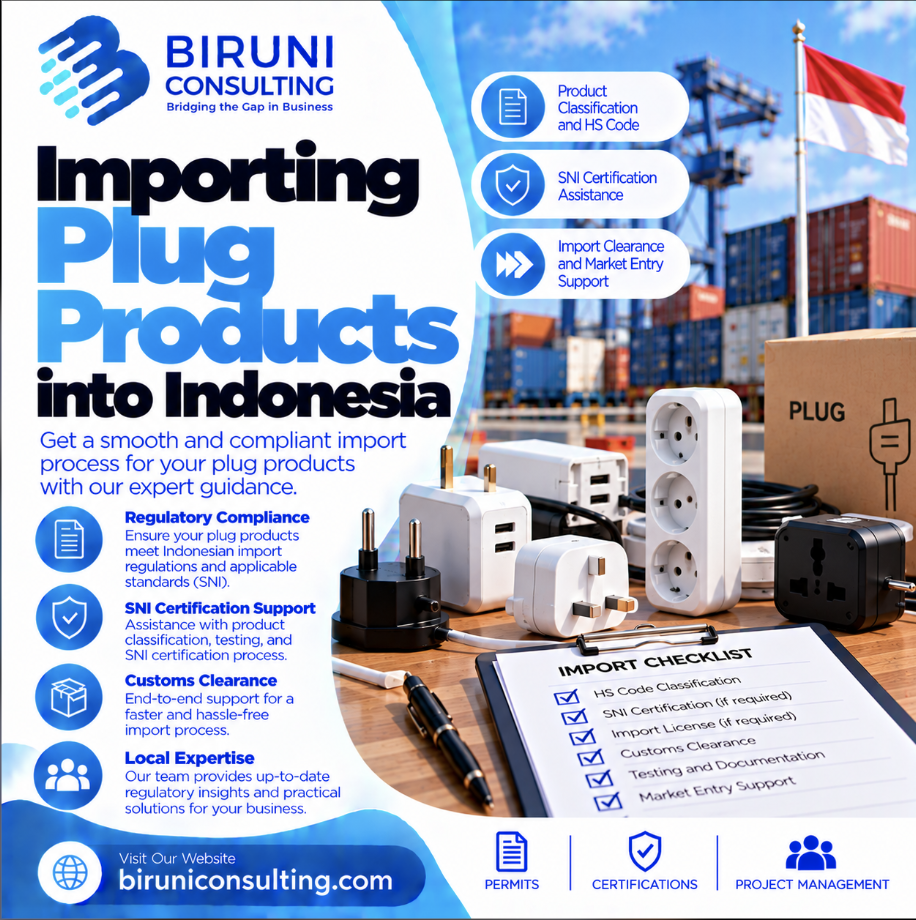
Guide to Import Requirements, SNI, NPB, Testing, and Plug Certification in Indonesia
Importing plug products into Indonesia requires an assessment of the product type, rated voltage and current, earthing system, terminal construction, cable connection method, pin configuration, HS Code, and applicable SNI standards. A plug is an electrical component used to connect equipment or a cable to a power supply through a socket outlet.
Plugs for household and similar purposes are included among the product groups specifically listed in Minister of Energy and Mineral Resources Regulation No. 7 of 2021. The regulation establishes mandatory standards in the electricity sector and states that SNI compliance requirements also cover imported products according to the applicable HS classification. JDIH ESDM
For plugs and socket outlets, Minister of Energy and Mineral Resources Regulation No. 7 of 2021 lists SNI IEC 60884-1:2014 and SNI 04-3892.1.1-2003. Its scope includes household and similar products, products with or without earthing contacts, rated voltage above 50 V up to 440 V, rated current not exceeding 32 A, and plugs incorporated into flexible cords. JDIH ESDM
Companies intending to import plugs should therefore conduct product identification and certification assessment before commercial-scale shipment.
What Is an Electrical Plug?
A plug is a device containing pins or electrical contacts designed to be inserted into a socket outlet so that equipment can receive an electrical supply.
In commercial terminology, these products may be described as:
- Electrical plug.
- Power plug.
- AC plug.
- Male plug.
- Plug top.
- Rewirable plug.
- Non-rewirable plug.
- Grounded plug.
- Ungrounded plug.
- Plug with cable.
- Cord plug.
- Fused plug.
Although these products generally perform the same basic function, their construction may differ. These differences can affect the applicable standards, product family, testing, and certification.
Are Imported Plugs Required to Have SNI?
For products falling within the scope of Minister of Energy and Mineral Resources Regulation No. 7 of 2021, SNI is implemented as a mandatory standard. The regulation explicitly includes plugs, socket outlets, or combinations of plugs and socket outlets for household electrical installations, fixed installations, low-voltage generating sets, or similar applications. JDIH ESDM
The listed product scope includes:
- Plugs for household and similar purposes.
- Products intended for connection to fixed electrical installations.
- Products with or without earthing contacts.
- Rated voltage above 50 V but not exceeding 440 V.
- Rated current not exceeding 32 A.
- Indoor and outdoor products.
- Plugs incorporated into flexible cords.
- Portable plugs and socket outlets incorporated into extension cords. JDIH ESDM
Imported plugs meeting these characteristics therefore need to comply with mandatory SNI requirements before distribution according to the applicable regulatory scope.
However, assessment still needs to be based on the actual product. Industrial plugs, products with ratings outside the scope, special connectors, appliance couplers, or products intended for specialized applications may fall under different standards.
SNI IEC 60884-1:2014
The main standard that needs to be considered is SNI IEC 60884-1:2014 – Plugs and socket-outlets for household and similar purposes – Part 1: General requirements.
BSN currently lists SNI IEC 60884-1:2014 as an active standard. It is an identical adoption of IEC 60884-1:2006. Pesta
The Ministry of Trade’s LAMANSITU also lists SNI IEC 60884-1:2014 as a quality-policy requirement for plugs and socket outlets together with the Goods Registration Number or NPB. Laman Situ
The testing laboratory listed in LAMANSITU also has a full-test scope for plugs and socket outlets based on SNI IEC 60884-1:2014. Laman Situ
SNI 04-3892.1.1-2003
In addition to the general requirements standard, Minister of Energy and Mineral Resources Regulation No. 7 of 2021 also lists SNI 04-3892.1.1-2003 – Plugs and socket-outlets for household and similar purposes – Part 1-1: General requirements – Form and dimensions. JDIH ESDM
BSN currently lists this standard as active. Pesta
Form and dimensional requirements are important because plug conformity is not determined only by material or electrical current capacity. Physical pin configuration and dimensions also need to be considered.
Importers should therefore request dimensional drawings from the manufacturer before beginning certification.
Plugs with Earthing Contacts
Plugs may include an earthing or grounding contact.
Grounded products provide an additional conductive path as part of the protection system in the event of an electrical fault.
During product assessment, companies should provide information such as:
- Number of pins.
- Pin configuration.
- Grounding system.
- Rated voltage.
- Rated current.
- Plug class.
- Pin material.
- Insulating material.
Minister of Energy and Mineral Resources Regulation No. 7 of 2021 explicitly includes plugs with or without earthing contacts within the listed scope. JDIH ESDM
Rewirable and Non-Rewirable Plugs
One important distinction between plug products is whether the plug can be rewired.
A rewirable plug allows a cable to be installed or replaced through terminals inside the plug.
A non-rewirable plug is generally permanently manufactured together with a cord, preventing the user from opening the product and replacing the connection in the ordinary manner.
The cable connection method is one of the product-family grouping criteria listed under Minister of Energy and Mineral Resources Regulation No. 7 of 2021. Other criteria include current and voltage ratings, earthing, terminal type, protection against electric shock, and installation method. JDIH ESDM
Rewirable and non-rewirable models should therefore not automatically be treated as one product family without assessment.
Plugs with Cables
Many plugs are not imported as separate components but are already attached to flexible cords.
Examples include:
- Power cords.
- AC cords.
- Cord sets.
- Household-appliance cables.
- Cable assemblies with plugs.
Minister of Energy and Mineral Resources Regulation No. 7 of 2021 specifically includes plugs incorporated into flexible cords within the scope for plugs and socket outlets. JDIH ESDM
For this type of product, companies need to provide information not only on the plug but also on the cable used.
Cable information should generally include cable type, number of cores, conductor cross-sectional area, rated voltage, insulation material, cable length, and cable manufacturer.
Plugs for Extension Cords
An extension cord normally consists of a plug, cable, and one or more socket outlets.
Such a product should not be assessed only as an individual plug because the construction of the complete system needs to be considered.
BSN currently lists SNI IEC 60884-2-7:2017 for particular requirements for cord extension sets as an active standard. Pesta
Minister of Energy and Mineral Resources Regulation No. 7 of 2021 also explicitly includes portable plugs and socket outlets incorporated into extension flexible cords within the plug and socket-outlet scope. JDIH ESDM
Importers should therefore clarify whether the imported goods are plugs only, plugs with cables, or complete extension sets.
Fused Plugs
Certain plug designs incorporate a fuse within the plug.
A particular standard within the IEC 60884 series applies to fused plugs. The BSN catalogue lists SNI IEC 60884-2-1:2014 for particular requirements for fused plugs as an active standard. Pesta
A fused plug should therefore not automatically be treated in the same way as a standard plug without assessing whether the relevant particular standard applies.
Fuse information such as rating, type, holder construction, and protection should also be included in the technical documentation.
Travel Plugs and Adapters
Travel plugs and travel adapters require separate assessment.
Some products simply convert one pin configuration into another without changing voltage. Others contain multiple plug and socket configurations in one housing. Certain adapters also include USB charging functions.
The BSN catalogue includes particular standards within the SNI IEC 60884 series for adapters. Pesta
A product commercially described as a “travel plug” should therefore not automatically be registered as an ordinary plug without assessing its actual construction.
Importers should provide photographs from all sides, datasheets, ratings, input-output configurations, and details of additional functions.
Plugs with USB Chargers
Some modern products combine an electrical plug with USB-A or USB-C charging ports.
Such products have more complex construction because they contain an AC/DC power supply, PCB, electronic components, and USB ports in addition to the electrical pins and insulating housing.
In this situation, the assessment needs to consider the principal function of the product and all integrated circuitry.
SNI IEC 60884-1 may remain relevant to the plug portion where the product falls within its scope, but the electronic charging function may require additional assessment according to the product construction and applicable standards.
Companies should therefore provide more than external photographs when requesting certification assessment.
Technical Specifications for Plugs
Technical information that should be prepared before certification includes:
- Product name.
- Brand.
- Model or type.
- Product photographs.
- Dimensional drawing.
- Rated voltage.
- Rated current.
- Frequency where relevant.
- Number of pins.
- Pin form and dimensions.
- Grounding configuration.
- Rewirable or non-rewirable construction.
- Terminal type.
- Pin material.
- Housing material.
- Insulating material.
- Cable specification where a cable is attached.
- Fuse specification where provided.
- Switch or additional features where provided.
- Manufacturer and factory address.
This information helps determine the applicable product family, standard scope, and test samples.
Plug Testing
Plug testing is conducted to ensure that the product meets the technical requirements of the applicable standard.
Laboratories listed in LAMANSITU have a Full Test SNI IEC 60884-1:2014 scope for plugs and socket outlets. Laman Situ
Depending on product construction and the applicable standard, evaluation may include marking, dimensions, protection against electric shock, terminal construction, insulation resistance, electric strength, mechanical strength, temperature rise, insulating materials, and resistance to heat and conditions of use.
The tested configuration should correspond to the product that will later be manufactured and distributed.
Changing materials, pins, terminals, cables, or critical components after testing may require further assessment.
Plug Product Family
Minister of Energy and Mineral Resources Regulation No. 7 of 2021 also provides grouping criteria for plugs and socket outlets.
The criteria include:
- Rated current and voltage.
- Degree of protection against access to hazardous parts.
- With or without earthing contacts.
- Cable connection method.
- Terminal type.
- Protection against electric shock.
- Presence of a cover.
- Mounting method.
- Installation method. JDIH ESDM
Where one manufacturer has many plug models, the models should therefore first be organized into a product list.
Product-family assessment can help determine representative models and avoid submitting product types without a structured grouping strategy.
Determining the HS Code for Plugs
HS Code classification is an important part of the import process because mandatory compliance for imported products under the energy-sector regulation is linked to trade classification or HS codes. JDIH ESDM
The annex to Minister of Energy and Mineral Resources Regulation No. 7 of 2021 lists ex 8536.69.92 and ex 8536.69.99 for the plug and socket-outlet group. However, the use of “ex” means that only specified goods within those tariff lines are covered, so classification should not be based solely on the HS number without examining the actual product characteristics. JDIH ESDM
Customs classification used in actual import transactions also needs to follow the tariff provisions in force at the time of import.
Datasheets, photographs, function, materials, electrical ratings, and product configuration should therefore be reviewed together when determining the HS Code.
NPB for Imported Plugs
In addition to SNI, importers need to consider the Goods Registration Number or NPB.
The Ministry of Trade’s LAMANSITU currently lists NPB together with SNI IEC 60884-1:2014 as quality-policy requirements for the Plugs and Socket Outlets category. Laman Situ
For products falling within the scope of that quality policy, companies should therefore not stop after completing the SNI certification process.
The applicable NPB registration requirement should also be reviewed and fulfilled before product distribution.
Importer Requirements for Plugs
Indonesia’s current import-policy framework is based on Minister of Trade Regulation No. 16 of 2025 concerning Import Policy and Regulation, subsequently amended and most recently subject to a second amendment through Minister of Trade Regulation No. 18 of 2026. Regulation No. 18 of 2026 was established on June 3, 2026, promulgated on June 4, 2026, and is currently in force. JDIH Kementerian Perdagangan
Under this framework, import activities use an NIB functioning as an API in accordance with the applicable requirements. Amendments to Regulation No. 16 of 2025 continue to regulate NIBs functioning as API-U or API-P. JDIH Kementerian Perdagangan
Importer legality, however, is only one part of the preparation.
For plug imports, companies should also review:
- Product classification.
- HS Code.
- Mandatory SNI.
- Standard scope.
- Product family.
- Testing.
- Certification.
- NPB.
- Product labeling.
- Manufacturer documentation.
Documents from Overseas Manufacturers
Before shipment, importers should request complete technical documentation from the manufacturer.
Documents may include:
- Product datasheet.
- Product catalogue.
- Product photographs.
- Model list.
- Dimensional drawing.
- Rated voltage.
- Rated current.
- Plug configuration.
- Material specification.
- Terminal information.
- Grounding information.
- Cable specification where applicable.
- Fuse specification where applicable.
- Label artwork.
- User or installation instructions.
- Existing IEC test reports where available.
- Manufacturer name.
- Factory address.
- Quality-management documents where required.
Complete documentation from the beginning helps reduce revisions once certification is underway.
Plug Labels and Markings
Labels and markings are important aspects of electrical products.
The information shown should remain consistent with the certificate, test report, and actual product specifications.
Importers should ensure that the brand, model, rated voltage, rated current, and other information are not changed without evaluation after the sample has been certified.
For small products, the position and method of marking also need to be considered so that the required information can be applied according to the relevant standard and certification requirements.
Stages of Importing and Certifying Plugs
Product Identification
The first stage is determining whether the product is a standalone plug, plug with cable, fused plug, adapter, or part of an extension cord.
HS Code Identification
The HS classification is reviewed according to product construction, function, and specifications.
SNI Scope Assessment
The product is compared against the scope of Minister of Energy and Mineral Resources Regulation No. 7 of 2021 and the relevant SNI standards.
Product Family Assessment
Where multiple models are involved, they are compared based on ratings, grounding, terminals, construction, and other technical parameters.
Document Preparation
Company, manufacturer, product-list, drawing, label, and technical documentation is prepared.
Certification Application
The process is submitted through a certification body with an appropriate scope.
Sampling and Testing
Representative samples are tested according to the determined standard.
Production Evaluation
Where the certification scheme requires an audit or production-facility evaluation, the manufacturer needs to prepare the factory and necessary documentation.
Result Evaluation
Documents, testing results, and evaluation results are reviewed to confirm that all requirements have been fulfilled.
Certificate Issuance
Once all requirements have been fulfilled, the process may proceed to certificate issuance and compliance with the relevant marking requirements.
NPB Registration
Where the product falls within a category requiring NPB, goods registration also needs to be completed before marketing. Laman Situ
Importance of Assessment Before Shipment
Plugs may appear to be simple products, but numerous construction variations can affect certification.
Two plugs with nearly identical external designs may differ in rated current, grounding, terminals, pin materials, cable systems, fuses, or dimensions.
Such differences become more difficult to correct after mass production has been completed.
Assessment should therefore ideally take place during supplier selection or before the purchase order for mass production is finalized.
Early assessment gives importers an opportunity to correct specifications, labels, dimensional drawings, model lists, and components before samples enter the testing process.
Why Is Plug Certification Important?
A plug is the direct connection point between electrical equipment and the power supply. Inappropriate dimensions, materials, mechanical strength, current-carrying capability, or insulation can increase risks during use.
Mandatory SNI implementation is intended to ensure that products within the regulatory scope meet the specified technical requirements.
For importers, certification is also part of compliance before the product is distributed.
The appropriate approach is therefore not simply to obtain a certificate number, but to ensure that the brand, models, construction, factory, and distributed products correspond to the certified scope.
Contact Us
Biruni Consulting assists companies with importing plug products into Indonesia, including SNI consultation, HS Code identification, standard assessment, product family assessment, testing, and certification assistance.
Our services include:
- Consultation on plug import requirements.
- Identification of applicable SNI standards and regulations.
- HS Code and product-scope assessment.
- Product specification and product-list review.
- Identification of plugs, fused plugs, plugs with cords, and other configurations.
- Review of form, dimensions, grounding, terminals, and major components.
- Product family assessment.
- Certification document preparation.
- Testing and factory-evaluation assistance where required.
- SNI certification and NPB process assistance.
Contact Biruni Consulting for information regarding plug SNI services, electrical plug certification, power plug certification, plug NPB registration, SNI IEC 60884-1 testing, and plug import requirements in Indonesia according to your product’s brand, model, construction, specifications, HS Code, and country of origin.