
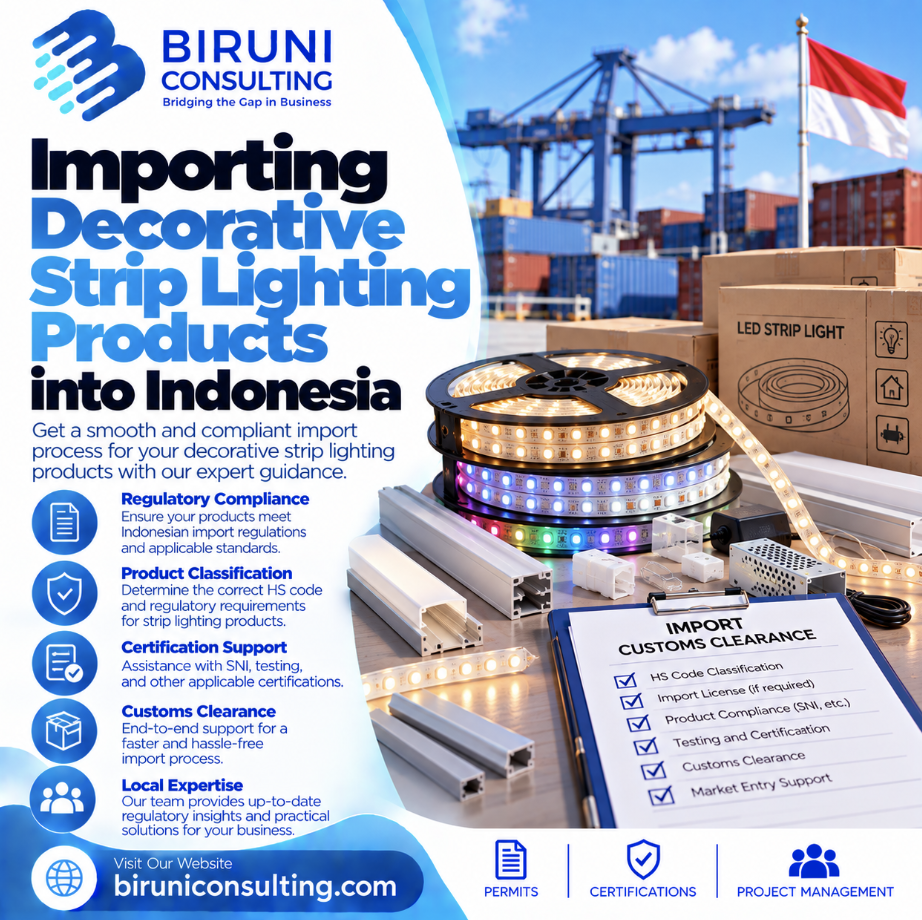
Guide to Import Requirements, SNI, NPB, Testing, and Decorative Strip Light Certification
Importing decorative strip lighting products into Indonesia requires an assessment of product construction, supply voltage, LED type, installation method, driver or adapter, HS Code, and final product function. The term decorative strip lighting may cover various products such as LED strips, flexible LED tape, rope lights, neon flex, RGB strips, COB LED strips, and decorative lighting chains.
These construction differences are important because not all strip lighting products are subject to the same standards or certification pathway. A 12 V DC LED strip without a driver, for example, has a different construction from a 220 V AC rope light connected directly to mains power. Likewise, an LED strip installed in an aluminium profile and sold as a complete luminaire may have a different classification from a flexible LED module sold in rolls.
Indonesia has several SNI standards relevant to these products. SNI IEC 60598-1:2016 for general luminaire requirements and testing remains active. SNI IEC 60598-2-21:2014 applies to rope lights, while standards within the SNI IEC 60598-2-20 series cover lighting chains or light strings. Pesta
Therefore, before mass production or shipment, importers should conduct a product assessment to determine whether the goods are classified as LED modules, rope lights, lighting chains, complete luminaires, or another product category.
What Is Decorative Strip Lighting?
Decorative strip lighting is an elongated and usually flexible lighting system used to provide direct or indirect illumination.
These products are widely used in:
- Residential interiors.
- Ceilings and drop ceilings.
- Kitchen cabinets.
- Furniture.
- Product showcases and displays.
- Hotels and restaurants.
- Signage.
- Building facades.
- Stairways and corridors.
- Landscape lighting.
- Event decoration.
- Gaming rooms and smart homes.
Strip lights are also available in many constructions, including:
- SMD LED strips.
- COB LED strips.
- RGB LED strips.
- RGBW LED strips.
- CCT adjustable strips.
- Neon flex.
- Rope lights.
- Addressable LED strips.
- Waterproof LED strips.
- LED strips with adapters.
- LED strips with controllers.
- Smart WiFi/Bluetooth LED strips.
These commercial descriptions are not sufficient to determine SNI obligations. The actual product specification and construction still need to be reviewed.
Are Decorative Strip Lights Required to Have SNI?
Not every product described as an LED strip is automatically subject to the same SNI certification requirement.
The first step is determining whether the product is an LED module, luminaire, rope light, lighting chain, or another lighting-system component.
The Ministry of Trade’s LAMANSITU lists a Luminaire category with SNI IEC 60598-1:2016 and NPB quality-policy requirements for several HS Codes under heading 9405. LAMANSITU
LAMANSITU also includes a Lighting Chain Luminaire category. This category currently lists SNI IEC 60598-2-20:2012 and a Goods Registration Number or NPB, covering several HS Codes under heading 9405. LAMANSITU
However, a flexible low-voltage LED tape or LED module that is not yet a complete luminaire may need to be classified differently.
The decision on whether a decorative strip light requires SNI certification should therefore be made after reviewing its construction, function, HS Code, voltage, driver, installation method, and the complete package being imported.
SNI IEC 60598-1 for Luminaire Products
One of the principal luminaire standards is SNI IEC 60598-1:2016 – Luminaires – Part 1: General requirements and tests.
BSN lists this standard as active, while LAMANSITU also lists it as a quality-policy requirement for several luminaire categories. Pesta
If a decorative LED strip is supplied as a complete luminaire consisting of LEDs, housing or profile, diffuser, driver, wiring, connectors, and a mounting system, luminaire standards may need to be considered during the assessment.
The applicable particular standard, however, still depends on the actual construction of the product.
SNI for Rope Lights
A product consisting of an elongated light source enclosed within a flexible protective enclosure may more closely resemble a rope light.
BSN lists SNI IEC 60598-2-21:2014 – Luminaires – Part 2-21: Particular requirements – Rope lights as an active standard. Pesta
This standard is therefore an important reference where a decorative strip product has a construction corresponding to a rope light.
However, the existence of this standard does not mean that all LED strips automatically qualify as rope lights. The physical form, insulation system, power supply, and construction need to be examined first.
SNI for Lighting Chains or Light Strings
Decorative lighting can also be constructed as a lighting chain or light string.
LAMANSITU lists a Lighting Chain Luminaire category with SNI IEC 60598-2-20:2012 and NPB. Listed HS Codes include several tariff lines under 940511, 940519, 940521, 940529, 940541, 940542, and 940549. LAMANSITU
Meanwhile, the current BSN catalogue also lists SNI IEC 60598-2-20:2022 – Luminaires – Part 2-20: Particular requirements – Lighting chains as an active standard. Pesta
This demonstrates the importance of distinguishing between the latest standard available in the BSN catalogue and the edition specifically cited by an applicable quality policy or certification scheme.
For certification purposes, the edition used should follow the regulation and certification scheme applicable to the product.
LED Strips as LED Modules
Not every LED strip is a complete luminaire.
A product consisting of a flexible PCB containing LEDs, supplied in a roll and requiring a separate driver or power supply, may be more appropriately assessed as an LED module.
BSN lists SNI IEC 62031:2013 – LED modules for general lighting – Safety specifications as an active standard. It also lists SNI IEC/PAS 62717:2015 covering LED-module performance requirements. Pesta
These standards are relevant during technical assessment, but their existence should not automatically be interpreted to mean that every LED strip requires mandatory certification under SNI IEC 62031.
Mandatory certification still needs to be checked against the applicable regulation, product category, and configuration of the goods placed on the market.
Strip Light Drivers and Power Supplies
Most low-voltage LED strips use a driver, adapter, or power supply.
Examples include:
- 5 V DC LED strips.
- 12 V DC LED strips.
- 24 V DC LED strips.
- Constant-current LED strips.
- Constant-voltage LED strips.
For LED controlgear, BSN lists SNI IEC 61347-2-13:2015 covering particular requirements for AC- or DC-supplied electronic controlgear for LED modules. SNI IEC 62384:2015 covering performance requirements for electronic LED controlgear is also listed as active. Pesta
Importers therefore need to clarify whether the driver is:
- Supplied with the LED strip.
- Integrated into the product.
- Sold separately.
- Manufactured by the same manufacturer.
- Supported by existing certificates or test reports.
This configuration may affect the regulatory assessment.
12 V and 24 V LED Strips
Many decorative strip lights operate at extra-low voltages such as 12 V or 24 V DC.
Although the strip itself does not connect directly to a 220–240 V AC power supply, the complete system still needs to be reviewed.
A product package may, for example, contain:
- 24 V LED strip.
- AC/DC driver.
- Controller.
- Remote control.
- Connector.
- Cable.
- Aluminium profile.
- Diffuser.
If the product is marketed as one set, the company should provide information on the complete system to the consultant, laboratory, or certification body.
Providing only the LED strip datasheet may not be sufficient when the marketed product is actually a complete lighting set.
220 V LED Strips
LED strips or rope lights operating directly at 220–240 V AC have different characteristics from 12 V or 24 V products.
These products may contain rectifier circuits, dedicated connectors, end caps, insulating enclosures, and construction designed to isolate live electrical parts.
Because they are directly connected to mains electricity, electrical safety becomes particularly important.
Such products need to be assessed to determine whether their construction corresponds to a rope light, luminaire, or another category covered by a particular standard.
Minimum information should include voltage, watts per metre, maximum length, connector type, IP rating, cutting method, cutting interval, and strip termination system.
Waterproof LED Strips
Decorative strip lights are commonly marketed with claims such as IP65, IP67, or IP68.
Such products may use silicone coatings, silicone tubes, polyurethane, or other encapsulating materials.
Where a product claims a particular protection level, its construction and testing need to support that claim.
For outdoor applications, companies should also ensure that protection is not limited to the strip itself. Connectors, end caps, drivers, controllers, and cable joints need to correspond to the actual installation configuration.
A “waterproof” claim in a supplier catalogue should not be the only basis for determining conformity.
RGB and RGBW Strip Lights
RGB strips combine red, green, and blue LEDs to produce multiple colors.
RGBW products add a white LED channel, allowing better white illumination in addition to color effects.
These products generally require a controller.
Controllers may use:
- RF remote control.
- Infrared remote control.
- Bluetooth.
- WiFi.
- Zigbee.
- Matter or other smart-home systems.
The controller needs to be included in the product assessment because a wired controller differs from a product incorporating active radio communications.
Smart WiFi/Bluetooth LED Strips
Where strip lighting incorporates WiFi, Bluetooth, Zigbee, or another radio technology, telecommunications-device requirements need to be assessed in addition to electrical requirements.
Information to prepare includes:
- Wireless technology.
- Frequency band.
- Module manufacturer.
- Module model.
- Chipset.
- Maximum transmit power.
- Antenna type.
- Antenna gain.
- RF test report.
- Module datasheet.
A smart decorative strip light may therefore require regulatory assessment from both the lighting-product and radio-communication perspectives.
Determining the HS Code for Decorative Strip Lights
HS Code classification is an important part of the import process.
Not every LED strip automatically falls under the same HS Code. Classification can be affected by whether the product is an LED module, complete luminaire, lighting set, or lighting component.
For luminaires, LAMANSITU lists several HS Codes under heading 9405 together with SNI IEC 60598-1:2016 and NPB requirements. LAMANSITU
For lighting chains, LAMANSITU also lists several tariff lines under heading 9405 together with SNI IEC 60598-2-20:2012 and NPB. LAMANSITU
HS Code assessment should therefore be based on complete information, including:
- Product photographs.
- Datasheets.
- Materials.
- Voltage.
- Function.
- Product form.
- Components included in the package.
- Installation method.
Incorrect HS Code classification may result in the wrong import requirements being applied.
NPB for Decorative Strip Lighting
The Goods Registration Number or NPB needs to be considered where the product falls within a category for which NPB is listed as a quality-policy requirement.
LAMANSITU lists NPB for both the general luminaire category and lighting-chain luminaires. LAMANSITU
Therefore, if a decorative strip light is assessed as falling within one of these categories, companies should not stop after obtaining an SNI certificate.
The applicable NPB registration requirement should also be confirmed before the product is marketed.
Importer Requirements
Indonesia’s current import-policy framework is based on Minister of Trade Regulation No. 16 of 2025 concerning Import Policy and Regulation, which has subsequently been amended, most recently by Minister of Trade Regulation No. 18 of 2026. Regulation No. 18 of 2026 is currently in force. JDIH Kemendag
Under Minister of Trade Regulation No. 16 of 2025, importers are required to hold an NIB that functions as an API for import activities. JDIH Kemendag
In addition to importer legality, companies should confirm the product’s technical requirements before shipment.
For decorative strip lights, the review should include:
- HS Code.
- SNI.
- NPB.
- Product category.
- Driver or adapter.
- Controller.
- Wireless module where applicable.
- Product family.
- Product label.
- Manufacturer documentation.
Do Decorative Strip Lights Require SKEM?
It is not appropriate to assume that every LED strip is automatically subject to SKEM requirements.
Minimum Energy Performance Standard requirements need to be assessed according to the product categories specifically included within the scope of energy-efficiency regulations.
An LED strip supplied as an LED module, complete luminaire, rope light, or decorative lighting set may have different construction and functionality.
SKEM assessment should therefore take place after the product category has been determined. The existence of an LED-module performance standard such as SNI IEC/PAS 62717:2015 also does not automatically mean that a product is required to obtain an Energy Saving Certificate. Pesta
Documents to Obtain from the Supplier
Before importing products, companies should request the following from the supplier or manufacturer:
- Product datasheet.
- Product photographs.
- Brand and model.
- Product list.
- Manufacturer name.
- Factory address.
- Country of origin.
- Rated voltage.
- Rated frequency.
- Rated power.
- Watts per metre.
- LED type.
- Number of LEDs per metre.
- PCB specification.
- Driver specification.
- Adapter specification.
- Controller specification.
- Connector specification.
- Cable specification.
- IP rating.
- Cutting interval.
- Maximum installation length.
- Installation instructions.
- Label artwork.
- User manual.
- Existing IEC/CB test reports.
- Existing component certificates.
This information will help the product classification and certification process from the beginning.
Decorative Strip Light Testing
The required testing depends on the product construction and applicable standard.
For products classified as luminaires, testing may include:
- Marking.
- Construction.
- Protection against electric shock.
- Terminals.
- Internal and external wiring.
- Insulation resistance.
- Electric strength.
- Creepage and clearance.
- Temperature rise.
- Resistance to heat.
- Mechanical strength.
- Protection against dust and water where relevant.
For products classified as LED modules, module safety characteristics and performance parameters may be assessed against the relevant LED-module standards.
Drivers also need to be reviewed according to the characteristics of the controlgear used.
Strip Light Product Family
One LED strip supplier may offer dozens or even hundreds of models.
Examples may include:
- 5 W/m.
- 8 W/m.
- 10 W/m.
- 12 W/m.
- 14 W/m.
- 18 W/m.
- 24 W/m.
Variations may also involve:
- LED chip.
- Number of LEDs per metre.
- PCB width.
- Voltage.
- CCT.
- RGB/RGBW.
- IP rating.
- Driver.
- Controller.
- Maximum length.
Before certification, all models should therefore be included in a product list so that potential product-family grouping can be assessed.
Models that appear almost identical externally may not necessarily belong to the same family where significant construction differences exist.
LED Strips in Aluminium Profiles
LED strips are frequently installed in aluminium profiles with diffusers, creating a linear lighting product.
Where the supplier markets the complete assembly as one product, the assessment needs to determine whether the product has become a complete luminaire rather than merely an LED strip.
Information regarding the profile material, diffuser, driver, mounting bracket, connectors, wiring, and overall construction becomes important.
This is particularly relevant for products sold as linear lights, cabinet lights, under-cabinet lights, cove lights, or architectural decorative luminaires.
Stages of Importing Decorative Strip Lights
Product Identification
Determine whether the product is an LED strip module, rope light, lighting chain, neon flex, or complete luminaire.
HS Code Identification
Review the HS Code based on the product’s form, function, construction, and included components.
SNI Assessment
The next step is assessing relevant standards such as SNI IEC 60598-1, SNI IEC 60598-2-20, SNI IEC 60598-2-21, SNI IEC 62031, or another standard appropriate to the product characteristics. Pesta
Product Family Review
Compare all types and models based on their technical parameters.
Document Preparation
Prepare importer, manufacturer, product, component, labeling, and test-report documentation.
Testing
Samples are tested against the standard specified by the certification scheme.
Factory Evaluation or Audit
Where required by the certification scheme, the production facility may undergo an evaluation or audit.
Certification
Once testing and evaluation demonstrate compliance, the process can proceed through certificate issuance.
NPB Registration
Where the product category requires NPB, goods registration should also be completed before marketing in accordance with the applicable requirements.
Why Is Assessment Before Shipment Important?
Decorative LED strip lighting can easily be misclassified because the products appear simple while their construction can vary considerably.
A product may look like a flexible LED tape but its sales package may include a driver, controller, wireless remote, connectors, and adapter.
Conversely, a supplier may describe a product as an “LED strip” even though its construction is closer to a rope light or a complete linear luminaire.
If assessment is only conducted after the goods arrive in Indonesia, the company may discover certification or documentation requirements that were not prepared in advance.
Product assessment should therefore be conducted using datasheets and product lists before mass production and shipment.
Contact Us
Biruni Consulting assists companies with importing decorative strip lighting products into Indonesia, including SNI consultation, HS Code identification, product-category review, testing, and certification assistance.
Our services include:
- Consultation on decorative strip light import requirements.
- Identification of applicable SNI standards and regulations.
- HS Code and product-scope assessment.
- Product specification and product-list review.
- Identification of LED strips, rope lights, lighting chains, or luminaires.
- Driver, adapter, controller, and major-component review.
- Product family assessment.
- Certification document preparation.
- Testing and factory-audit assistance where required.
- Certification and NPB process assistance.
Contact Biruni Consulting for information regarding decorative strip light SNI services, LED strip certification, rope light certification, decorative luminaire certification, lighting NPB, and LED strip import requirements in Indonesia according to your product’s brand, model, construction, specifications, HS Code, and country of origin.