
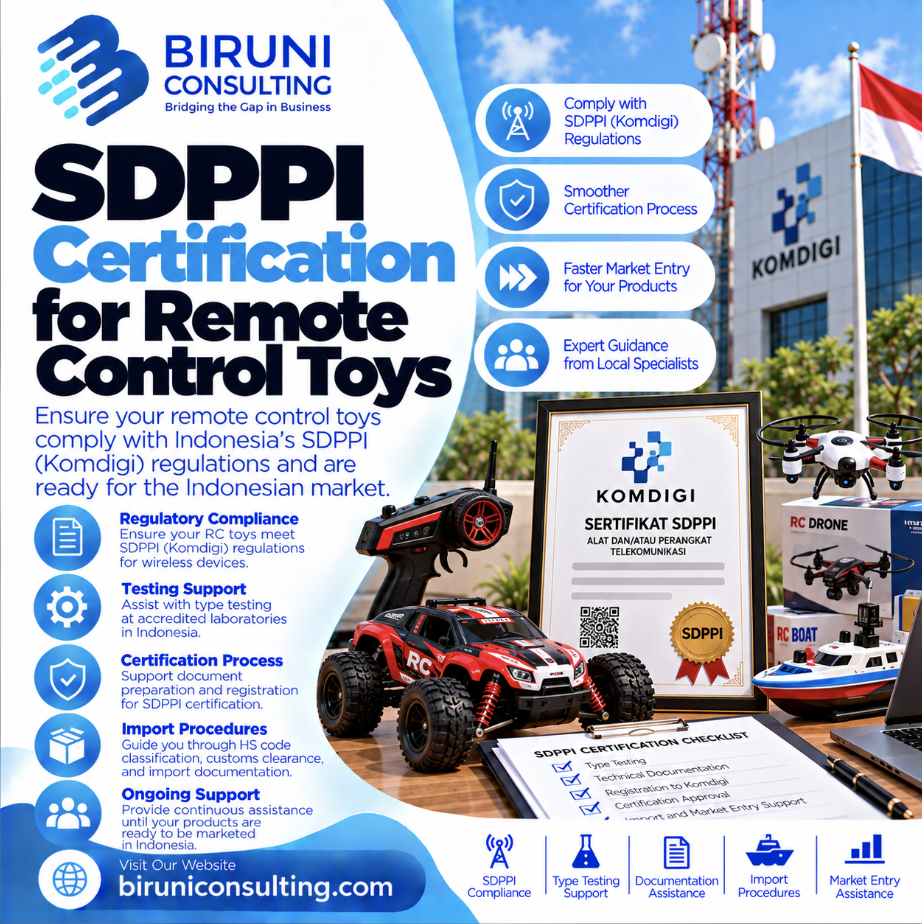
Guide to SDPPI/DJID Certification for remote control toys in Indonesia.
Remote control toys use wireless communication between a controller and the toy unit. Examples include RC cars, toy robots, remote control boats, toy aircraft, helicopters, tanks, and other remotely controlled toys.
The remote controller generally acts as a transmitter, while the receiver inside the toy receives and converts radio commands into movement or other functions.
Because these products use radio communication, SDPPI/DJID Certification requirements need to be assessed based on operating frequency, transmission power, transmitters, receivers, RF modules, antennas, and the final wireless configuration.
Indonesia’s current telecommunications equipment and device certification framework is governed by Minister of Communication and Informatics Regulation Number 3 of 2024, which remains in force and replaced Regulation Number 16 of 2018. JDIH Kemkomdigi
Do Remote Control Toys Require SDPPI Certification?
Certification requirements should not be determined solely from the product being classified as a remote control toy.
Two products with nearly identical designs may use different frequencies, RF modules, output power levels, or communication protocols.
A technical assessment should therefore identify the operating frequency, transmission power, RF module, transmitter and receiver, antenna configuration, bandwidth, modulation, brand, model, and country of manufacture.
The actual technical configuration is what helps determine the applicable Indonesian Technical Standards and certification process.
Wireless Systems in Remote Control Toys
In a conventional RC system, the remote controller transmits commands by radio to a receiver installed inside the toy.
The receiver then converts those radio signals into functions such as forward movement, reverse, steering, speed control, lighting, sound, or other actions.
The controller is therefore an important component of the assessment.
Where the toy supports two-way communication, the toy unit itself may also transmit data back to the controller.
Operating Frequency
Operating frequency is a key parameter in the SDPPI assessment.
Frequency information can normally be found in the product datasheet, RF module datasheet, controller specification, user manual, or laboratory report.
Indonesia’s class-license spectrum framework is based on Minister of Communication and Informatics Regulation Number 2 of 2023 as amended by Minister of Communication and Digital Regulation Number 2 of 2025. The 2025 amendment is currently in force. JDIH Kemkomdigi
The actual frequency range used by the RC toy should therefore be reviewed against the applicable Indonesian spectrum rules.
RC Toys and Short Range Devices
Many remote control toys use short-range radio communication and may fall within technical categories related to Short Range Devices.
Minister of Communication and Informatics Decision Number 260 of 2024 establishes the Technical Standards for Short Range Devices and remains listed in DJID’s official regulatory database. Postel Sertifikasi
However, short operating range does not automatically mean that the product is exempt from certification.
The actual frequency, transmission power, radio module, and communication function still need to be assessed.
Transmission Power
Transmission power indicates the radio power used by the transmitter.
Manufacturers may describe this parameter as RF output power, transmit power, conducted power, maximum output power, or radiated power.
Low output power does not automatically create a general certification exemption.
Regulation Number 3 of 2024 contains a specific provision under which one Certificate may cover more than one variant for certain other equipment incorporating a telecommunications feature below 10 mW and only one identical telecommunications feature, provided the specified conditions are met. JDIH Kemkomdigi
This is a variant-certification rule rather than a general exemption for all low-power RC toys.
Does the Remote Controller Need to Be Assessed?
Yes. In most RC toys, the remote controller contains the main transmitter.
Its operating frequency, output power, RF module, antenna, and technical documentation should therefore be reviewed.
When the controller and toy are sold as one set, they should generally be considered together when identifying the complete communication configuration.
RC Toys with Bluetooth
Some remote control toys also contain Bluetooth.
Bluetooth may allow users to control the toy through a smartphone or mobile application instead of, or in addition to, a conventional controller.
When Bluetooth is available, the assessment should review the Bluetooth version, operating frequency, output power, module, and antenna.
Bluetooth falls within Indonesia’s Short Range Device technical framework. Postel Sertifikasi
Where both proprietary RF and Bluetooth are present, both radio functions should be considered.
RC Toys with WiFi
WiFi may be used in toys equipped with cameras, applications, or video-streaming functions.
For example, an RC car may use proprietary RF for driving controls and WiFi to transmit live camera images to a smartphone.
In this case, the product contains more than one wireless function.
DJID’s current regulatory list includes Minister of Communication and Digital Decision Number 12 of 2025 for Radio Local Area Network spectrum and Technical Standards. Postel
The WiFi function should therefore be reviewed together with the RC radio system.
Toys with Multiple Wireless Technologies
Some products combine RF remote control, Bluetooth, and WiFi.
When several radio technologies are incorporated into one toy, the assessment needs to identify the purpose, operating frequency, output power, module, and antenna for each function.
Complete documentation from the manufacturer becomes particularly important for these products.
Assessing only one wireless feature may give an incomplete picture of the final product configuration.
Is a Certified RF Module Sufficient?
Not necessarily.
An existing RF module certificate may be useful supporting documentation, but it does not automatically mean that the complete remote control toy is covered.
Integration into the final product may involve changes to the antenna, output power, firmware, enclosure, or other RF parameters.
The module certificate and datasheet should therefore be compared with the final product specifications.
Documents Required for SDPPI Assessment
Before starting certification, companies should obtain sufficient technical documentation from the manufacturer.
Typical documents include product and controller photos, product datasheets, user manuals, RF module or controller datasheets, operating-frequency information, transmission power, antenna specifications, and RF test reports where available.
Manufacturer information and country of manufacture should also be confirmed.
For products containing Bluetooth or WiFi, documentation for those technologies should also be included.
RF Test Reports
RF test reports can provide important technical information regarding frequency, output power, bandwidth, emissions, and other radio parameters.
However, the report needs to correspond to the actual product or RF module used in the imported toy.
The model, module, antenna, firmware, and radio configuration should therefore be compared before the report is used as supporting documentation.
Can Several Models Use One Certificate?
Potential model grouping depends on technical similarity rather than appearance alone.
Different colors or body designs may use identical radio hardware, while visually identical products may sometimes contain different RF modules.
The assessment should compare the module, frequency, output power, antenna, wireless functions, brand, type, and transmitter/receiver configuration.
Regulation Number 3 of 2024 contains a specific mechanism allowing one Certificate to cover more than one variant in certain cases involving telecommunications features below 10 mW and one identical telecommunications feature, provided all regulatory conditions are satisfied. JDIH Kemkomdigi
Model grouping should therefore be determined before submitting the certification application.
SDPPI Certification Process for Remote Control Toys
The process normally begins with a technical assessment.
This may include reviewing product documentation, identifying the transmitter and receiver, checking frequency and transmission power, reviewing the RF module and antenna, determining the applicable Technical Standards, assessing testing requirements, and preparing the certification documents.
The application then proceeds under the applicable DJID/SDPPI certification procedure.
Regulation Number 3 of 2024 remains the primary certification regulation for telecommunications equipment and devices. JDIH Kemkomdigi
Certificate Validity
Under Regulation Number 3 of 2024, the Certificate itself does not have an expiration date.
However, the Certificate holder may manufacture, assemble, or import the relevant equipment for trade and/or use in Indonesia for up to three years from the Certificate issuance date.
If those activities continue after the three-year period, compliance with the Technical Standards must be demonstrated through testing and a new Certificate. JDIH Kemkomdigi
This distinction is important for companies planning to import and sell the same RC toy model over several years.
SDPPI Labeling for Remote Control Toys
Certified products are also subject to labeling requirements.
Regulation Number 3 of 2024 requires the label to include the Certificate number and PLG ID, QR Code, and warning sign. JDIH Kemkomdigi
The size and presentation may be adapted to the labeling medium as long as the required information remains readable. JDIH Kemkomdigi
Label planning should therefore be considered before mass production or commercial shipment, particularly for small toys and controllers.
Importance of Assessment Before Importation
Technical assessment should ideally be completed before remote control toys are shipped to Indonesia.
Two products that look almost identical may use different transmitters, RF modules, frequency ranges, antennas, or output power levels.
A pre-import assessment helps companies determine SDPPI/DJID Certification requirements, applicable Technical Standards, testing needs, documentation requirements, model-grouping possibilities, and labeling obligations.
It also helps reduce inconsistencies between the actual product, datasheet, RF test report, and Certificate.
SDPPI Certification and Toy Product Requirements
SDPPI Certification and toy-product compliance are separate regulatory matters.
SDPPI/DJID Certification concerns the telecommunications and wireless functions incorporated into the product.
Toy regulations address product safety, quality, and other requirements applicable to toys.
SDPPI Certification therefore does not automatically replace toy safety or other applicable product requirements.
Likewise, compliance with toy requirements does not automatically replace telecommunications certification requirements for RF, Bluetooth, or WiFi functions.
Conclusion
SDPPI Certification for remote control toys needs to be assessed based on the technical characteristics of the wireless communication system.
Operating frequency, transmission power, transmitters, receivers, RF modules, antennas, Bluetooth, WiFi, and the final product configuration are important elements of the assessment.
Conducting an assessment before importation helps companies determine SDPPI/DJID Certification, testing, technical documentation, model grouping, and labeling requirements more accurately.
Contact Us
Biruni Consulting assists with DJID/SDPPI assessment and certification for remote control toys and various wireless products that will be imported or marketed in Indonesia.
Our services include:
- Assessment of DJID/SDPPI certification requirements.
- Bluetooth module assessment.
- RF specification review.
- Frequency and transmission power analysis.
- Technical document review.
- Certification document preparation.
- Testing coordination where required.
- DJID/SDPPI Certification assistance.
If you have a remote control toy, you can prepare product photos, brand, model, datasheet, RF specifications, and wireless module datasheet for an initial assessment of the SDPPI/Postel Certification requirements.