
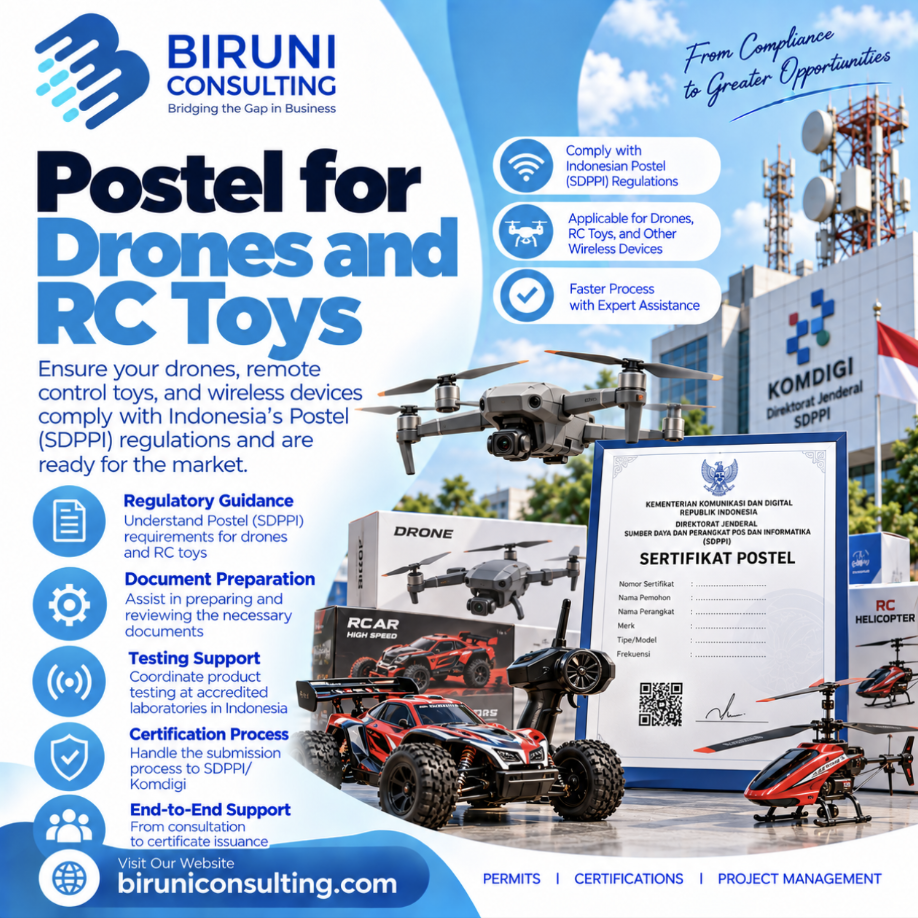
Guide to Postel/DJID requirements for drones and RC toys in Indonesia.
Drones and RC toys use wireless communication between a remote controller and the device. The communication system may use RF, Bluetooth, WiFi, or a combination of wireless technologies for control, data transmission, cameras, or video.
Because these products use radio communication, Postel/DJID Certification requirements need to be assessed based on frequency, transmission power, transmitters, receivers, wireless modules, antennas, and product configuration. Indonesia’s primary telecommunications equipment and device certification framework is currently Minister of Communication and Informatics Regulation Number 3 of 2024, which replaced Regulation Number 16 of 2018. JDIH Kemkomdigi
Do Drones and RC Toys Require Postel Certification?
The certification requirement cannot be determined solely from the product being called a drone or RC toy.
The wireless functions need to be assessed. Two products with similar designs may use different frequencies, transmission power levels, RF modules, or communication systems.
Information normally reviewed includes:
- Operating frequency.
- Frequency range.
- Transmission power.
- Transmitter and receiver.
- RF module.
- Bluetooth or WiFi module.
- Antenna.
- Bandwidth and modulation.
- Product brand and type.
A pre-import assessment helps determine the applicable DJID/SDPPI Certification requirements based on the actual product specifications.
Wireless Systems in Drones and RC Toys
The remote controller generally functions as the transmitter that sends commands to the receiver inside the drone or RC toy.
For RC toys, the wireless system may control movement, direction, or speed. For drones, wireless communication may also control flight direction, altitude, cameras, telemetry, and video transmission.
Because drones may contain several wireless functions, the assessment should review the complete communication system rather than only the remote controller.
Frequency of Drones and RC Toys
Frequency is one of the main parameters in a Postel assessment.
Frequency information may be available in product datasheets, controller specifications, wireless module datasheets, user manuals, or RF test reports.
Relevant information may include:
- Operating frequency.
- Frequency range.
- Channels.
- Bandwidth.
- Modulation.
Class-license spectrum use is regulated under Minister of Communication and Informatics Regulation Number 2 of 2023 as amended by Minister of Communication and Digital Regulation Number 2 of 2025. The amendment is currently in force and updates spectrum provisions for several device groups, including Short Range Devices. JDIH Kemkomdigi
The actual operating frequency therefore needs to be reviewed against the applicable spectrum provisions.
Transmission Power of Drones and RC Toys
Transmission power is another important parameter in determining the radio characteristics of the device.
Technical documentation may describe it as:
- Transmit power.
- RF output power.
- Maximum output power.
- Conducted power.
- Radiated power.
Low transmission power does not automatically exempt a product from Postel Certification.
Regulation Number 3 of 2024 contains specific provisions for certain devices with telecommunications features using transmission power below 10 mW and only one identical telecommunications feature. Under specified conditions, one Certificate may cover more than one variant. JDIH Kemkomdigi
The transmission power therefore needs to be assessed together with the complete product configuration.
Drones with Remote Control and Cameras
Drones generally use remote controllers for flight control. Some models also include cameras that transmit photos or video wirelessly to a smartphone or controller.
The camera itself does not determine Postel Certification, but the wireless communication used to transmit camera data needs to be assessed.
A drone may contain several communication systems, such as:
- RF flight control.
- WiFi video transmission.
- Bluetooth pairing or configuration.
- Wireless telemetry.
A drone assessment may therefore involve several radio technologies.
RC Toys with RF Remote Control
RC cars, robots, boats, airplanes, and other remote-controlled toys commonly use a transmitter in the remote controller and a receiver in the toy.
Information normally required for the controller includes:
- Remote controller photos.
- Brand and model.
- Operating frequency.
- Transmission power.
- RF module.
- Antenna.
- Channels.
- Datasheet.
The controller and toy unit should be reviewed together to determine the complete communication configuration.
Drones and RC Toys with Bluetooth or WiFi
Some products include Bluetooth or WiFi in addition to RF remote control.
Bluetooth may be used for pairing or smartphone control. Indonesia’s current SRD technical standard includes Bluetooth IEEE 802.15.1 operating in the 2400–2483.5 MHz frequency band. Sertifikasi Postel
WiFi may support applications, cameras, live video, or data communication.
When several wireless technologies are present, the assessment should cover:
- Frequency band.
- Transmission power.
- Wireless module.
- Antenna.
- Bandwidth.
- Function of each technology.
Drones, RC Toys, and Short Range Devices
Some remote control communication systems may relate to the Short Range Device or SRD category.
Minister of Communication and Informatics Decision Number 260 of 2024 establishes Technical Standards for Short Range Devices and includes Bluetooth and other short-range communication categories. Postel
However, classification as an SRD does not automatically exempt a device from Postel Certification.
Frequency, transmission power, technology, and product configuration still need to be assessed against the applicable technical requirements.
Documents Required for Postel Assessment
For an initial drone or RC toy assessment, companies should generally prepare:
- Product photos.
- Remote controller photos.
- Brand and model.
- Product datasheet.
- Remote controller datasheet.
- RF or wireless module datasheet.
- Operating frequency.
- Transmission power.
- Antenna specifications.
- User manual.
- Country of manufacture.
- RF test report, if available.
For drones with WiFi, Bluetooth, or wireless video transmission, documentation for all wireless modules should be prepared.
Is a Certified Wireless Module Sufficient?
Not necessarily.
An RF, Bluetooth, or WiFi module certificate may serve as supporting documentation, but it does not automatically mean that the complete drone or RC toy does not require assessment.
Module integration may affect the antenna, output power, firmware, enclosure, or RF configuration.
The module datasheet and certificate should therefore be reviewed together with the actual final product configuration.
Can Several Models Use One Certificate?
Whether several models or variants can be covered under one Certificate depends on their technical similarities.
Similar product appearance or color alone is not sufficient. Relevant parameters include:
- Brand and type.
- Wireless module.
- Frequency.
- Transmission power.
- Antenna.
- Wireless functions.
- Country of manufacture.
- Transmitter and receiver configuration.
Regulation Number 3 of 2024 contains specific provisions that may allow one Certificate to cover more than one variant when all specified conditions are fulfilled. JDIH Kemkomdigi
Model grouping should therefore be determined through a technical assessment.
Postel Certification Process for Drones and RC Toys
The process may generally include:
- Collecting product documentation.
- Identifying wireless technologies.
- Reviewing transmitters and receivers.
- Reviewing frequency and transmission power.
- Reviewing wireless modules and antennas.
- Identifying applicable Technical Standards.
- Determining testing requirements.
- Preparing certification documents.
- Conducting testing when required.
- Submitting the DJID/SDPPI Certification application.
- Certificate issuance after all requirements are fulfilled.
Regulation Number 3 of 2024 provides for compliance with Technical Standards through testing and certification. JDIH Kemkomdigi
Certification Validity and Postel Labeling
Under Regulation Number 3 of 2024, the Certificate itself does not expire. However, the Certificate holder may manufacture, assemble, or import the equipment or device for trade and/or use in Indonesia for up to three years from the Certificate issuance date. Continued activity after that period requires compliance based on testing and a new Certificate under the applicable provisions. JDIH Kemkomdigi
Certified products are also subject to labeling requirements, including the Certificate number and PLG ID, QR Code, and warning sign where applicable. JDIH Kemkomdigi
Importance of Assessment Before Importation
Pre-import assessment helps companies understand the requirements before drones or RC toys are shipped to Indonesia.
An initial assessment can identify:
- DJID/SDPPI Certification requirements.
- Wireless technologies used.
- Frequency and transmission power.
- Testing requirements.
- Required technical documents.
- Possibility of grouping several models.
- Labeling requirements.
Assessment is particularly important for drones containing several radio functions, such as flight control, WiFi video, and Bluetooth connectivity.
Difference Between Postel Certification and Other Product Requirements
Postel/DJID Certification concerns telecommunications and wireless functions incorporated into the product.
RC toys may also be subject to separate toy safety or product requirements. Depending on their type and use, drones may also be subject to other requirements outside Postel Certification.
Postel Certification therefore does not automatically replace other regulatory obligations that may apply to the product.
Conclusion
Postel requirements for drones and RC toys need to be assessed based on the communication technologies incorporated into the product.
Frequency, transmission power, transmitters, receivers, RF modules, Bluetooth, WiFi, antennas, wireless camera transmission, and product configuration are important elements of the assessment.
By conducting an assessment before importation, companies can determine certification, testing, technical documentation, model grouping, and labeling requirements more accurately.
Contact Us
Biruni Consulting assists with DJID/SDPPI assessment and certification for drones, RC toys, and various wireless products that will be imported or marketed in Indonesia.
Our services include:
- Assessment of DJID/SDPPI certification requirements.
- Bluetooth module assessment.
- RF specification review.
- Frequency and transmission power analysis.
- Technical document review.
- Certification document preparation.
- Testing coordination where required.
- DJID/SDPPI Certification assistance.
If you have a drone or RC toy, you can prepare product photos, brand, model, datasheet, RF specifications, and wireless module datasheet for an initial assessment of the Postel Certification requirements.