
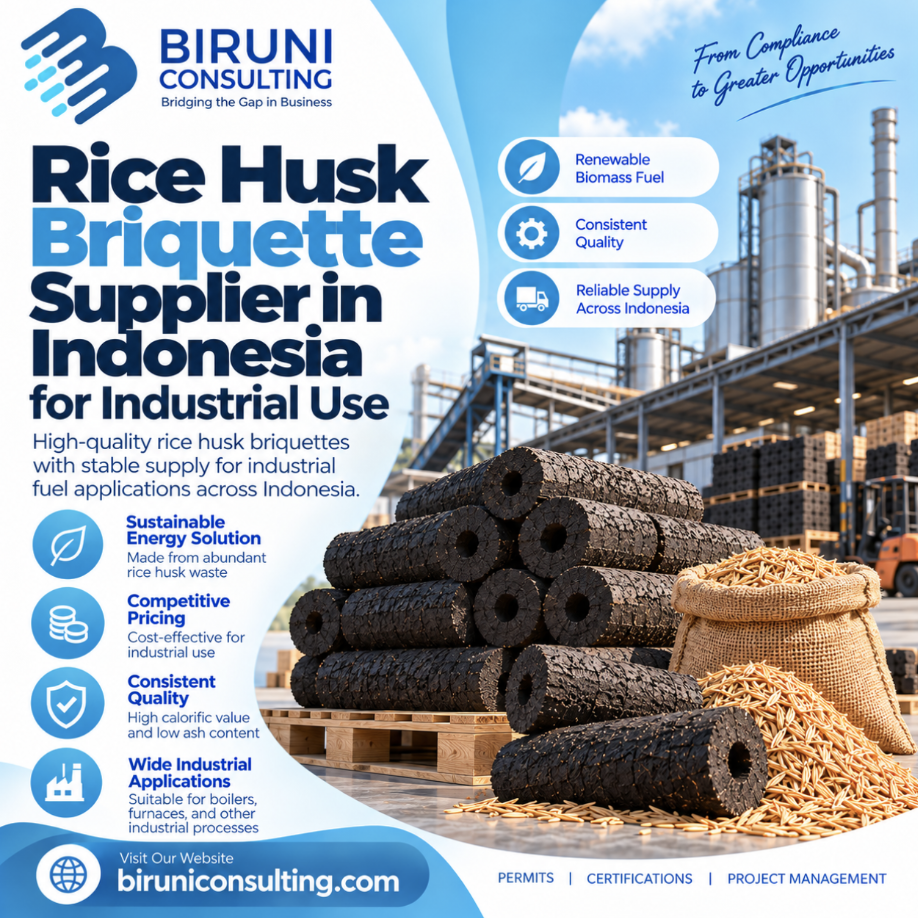
Rice Husk Briquette Supplier for Industrial Applications
Rice husk briquettes are a form of solid biomass fuel that can be considered for thermal-energy requirements in various industrial applications. Rice husks are processed and densified into a more compact and relatively uniform fuel product, making them easier to store, transport, and handle compared with loose rice husks.
Indonesia’s agricultural post-harvest agency describes rice biomass briquettes as products created through densification that improve the physical characteristics of rice residues. The agency also identifies easier storage, transportation, more uniform dimensions, and suitability for industrial energy applications among their characteristics. Pasca Panen
For companies operating boilers, furnaces, dryers, biomass burners, and other heating equipment, selecting a rice husk briquette supplier should involve more than simply comparing prices. Product specifications, consistency, production capacity, supply continuity, documentation, and logistics capability can all affect industrial operations.
Why Are Rice Husk Briquettes Used for Industrial Applications?
Industrial facilities generally require fuels that can be supplied consistently and are compatible with their existing combustion equipment.
Loose rice husk has a relatively low bulk density and can require significant storage space. Converting the material into briquettes produces a denser physical form that can simplify material handling, warehousing, transportation, and fuel feeding.
These characteristics can be useful for companies that need to manage regular biomass-fuel consumption.
Research indexed by Indonesia’s Garuda academic database has also examined rice husk- and straw-based briquettes for steam-boiler applications and found potential for their use under the conditions evaluated in the study. Garuda
Actual suitability should nevertheless be evaluated for each boiler because combustion-chamber design, feeding systems, operating load, steam requirements, and other technical conditions can differ substantially between facilities.
Industrial Applications of Rice Husk Briquettes
Rice husk briquettes can be considered for a range of processes requiring thermal energy.
Potential applications include:
- Industrial boilers.
- Steam boilers.
- Certain furnace systems.
- Biomass burners.
- Industrial dryers.
- Agricultural-product drying.
- Food-processing facilities.
- Agricultural-processing industries.
- Wood-processing facilities.
- Other manufacturing processes requiring thermal energy.
Before replacing or blending an existing fuel, companies should confirm that the briquettes are compatible with their equipment and operating requirements.
Rice Husk Briquette Specifications for Industrial Use
Technical specifications are among the most important considerations when selecting a rice husk briquette supplier.
A lower purchasing price does not necessarily result in lower operating costs if the fuel characteristics are unsuitable for the boiler.
Several parameters should be evaluated.
1. Calorific Value
Calorific value indicates the amount of heat energy that can be generated during combustion.
For industrial users, this parameter helps estimate how much fuel may be required to produce the desired amount of heat or steam.
Buyers should request specifications or available test results for the actual product being offered instead of relying on general values for rice husk biomass.
2. Moisture Content
Moisture content can influence combustion performance.
Water contained in the briquette needs to be evaporated during combustion, meaning part of the generated energy is used for moisture evaporation.
Suppliers should therefore maintain appropriate storage and transportation conditions to protect the product from rain and excessive humidity.
3. Ash Content
Rice husk produces ash during combustion.
For industrial boiler users, ash content can affect cleaning frequency, ash-removal equipment, maintenance requirements, and residue handling.
Industrial buyers should therefore request ash specifications before establishing a recurring supply arrangement.
4. Briquette Dimensions
Diameter, length, and shape should be compatible with the customer’s fuel-feeding system.
This becomes particularly important for boilers using hoppers, screw feeders, conveyors, or automatic feeding systems.
Oversized or inconsistent products may require modifications to the fuel-handling system.
5. Briquette Density
Densification creates a more compact fuel compared with loose rice husk.
Density can influence storage, transportation, handling, and combustion characteristics.
Industrial buyers should evaluate whether the supplier can maintain relatively consistent physical characteristics between production batches.
6. Mechanical Strength
Briquettes should have sufficient mechanical strength to withstand packaging, loading, transportation, unloading, and storage.
Excessive breakage can generate fines and smaller particles that may create additional challenges in feeding and material handling.
Carbonized and Non-Carbonized Rice Husk Briquettes
Rice husk briquettes can be manufactured using different production methods.
Some products are manufactured from material that has undergone carbonization before briquetting. Others may be produced by drying, processing, and densifying the biomass without complete carbonization.
These differences can affect calorific value, moisture, ash, density, appearance, combustion characteristics, and production costs.
Industrial buyers should therefore confirm whether a supplier is offering carbonized or non-carbonized rice husk briquettes before comparing quotations.
Rice Husk Briquette Supplier for Industrial Boilers
Industrial boiler customers have different purchasing requirements from retail customers.
Typical industrial requirements may include:
- larger purchasing volumes,
- consistent specifications,
- scheduled deliveries,
- technical documentation,
- trial quantities,
- and continuous supply.
Boiler characteristics can also vary significantly.
Grate design, burner configuration, fuel-feeding system, boiler capacity, steam pressure, and operating load may all affect fuel performance.
Companies should therefore provide information about their boiler and operating conditions when discussing requirements with a supplier.
Importance of Conducting a Fuel Trial
A trial can be useful before entering into a large-volume or long-term supply arrangement.
Testing the briquette under actual operating conditions allows a company to evaluate factors that cannot always be determined from laboratory specifications alone.
Parameters that may be observed during a trial include:
- Ease of ignition.
- Flame stability.
- Fuel consumption per hour.
- Furnace temperature.
- Steam production.
- Steam-pressure stability.
- Ash generation.
- Feeding performance.
- Deposit or clinker formation.
- Boiler condition after use.
- Operator adjustments.
- Consumption compared with the previous fuel.
Trial results can provide a better basis for supplier evaluation than unit price alone.
Supplier Production and Supply Capacity
Supply capacity becomes particularly important for industrial customers.
For example, if a facility consumes approximately 3 metric tons of briquettes per day and operates 25 days each month, its monthly requirement would be:
3 tons × 25 days = 75 tons per month.
If the company plans to source its entire requirement from one supplier, that supplier needs to be capable of consistently providing approximately 75 tons every month.
Industrial buyers may therefore need to confirm:
- Daily production capacity.
- Monthly production capacity.
- Actual available supply.
- Warehouse capacity.
- Raw-material availability.
- Production lead time.
- Transportation capacity.
- Ability to support long-term contracts.
Buyers should also distinguish between a supplier’s nominal production capacity and the amount that is actually available for new customers.
Rice Husk Raw-Material Continuity
Raw-material availability is an important part of the briquette supply chain.
A supplier that serves industrial customers needs access to sufficient rice husk to support continuous production.
For long-term procurement, customers may ask suppliers how they manage raw-material sourcing during seasonal changes, periods of high demand, or interruptions at individual rice mills.
A diversified sourcing network can be relevant when evaluating whether a supplier can maintain production and delivery schedules.
Quality Control for Rice Husk Briquettes
For industrial buyers, consistency between production batches can be as important as the nominal product specification.
Briquettes delivered in the first shipment and those supplied several months later should ideally remain within agreed specifications.
Quality-control parameters may include:
- Moisture content.
- Calorific value.
- Ash content.
- Dimensions.
- Density or weight.
- Physical condition.
- Fines or breakage.
- Packaging condition.
Depending on the procurement requirements, buyers may also request a Certificate of Analysis or available laboratory test documentation.
Industrial Delivery Capability
Rice husk briquettes can involve substantial shipment volumes, making logistics capability an important part of supplier evaluation.
Industrial deliveries need to account for the customer’s location, warehouse capacity, vehicle access, unloading arrangements, and consumption schedule.
Before establishing a delivery plan, the supplier and customer should confirm:
- Factory location.
- Fuel-storage capacity.
- Vehicle access.
- Receiving hours.
- Loading and unloading facilities.
- Quantity per shipment.
- Delivery frequency.
This information can help reduce both fuel shortages and unnecessary inventory accumulation.
Packaging for Industrial Rice Husk Briquettes
Packaging should be selected according to purchasing volume and the customer’s material-handling system.
Possible arrangements may include:
- sacks,
- industrial bags,
- jumbo bags,
- or other formats depending on supplier capability and customer requirements.
Packaging should protect the product from moisture while allowing practical loading, unloading, warehousing, and feeding.
For large-volume contracts, packaging arrangements can also affect the final delivered cost.
Ex-Factory and Delivered Quotations
When requesting a quotation from a rice husk briquette supplier in Indonesia, buyers should confirm the pricing basis.
Ex-Factory Price
An ex-factory quotation generally covers the product at the supplier’s production facility or warehouse.
Transportation to the customer’s facility is calculated separately.
This arrangement may be suitable for customers that operate their own fleet or already have a logistics contractor.
Delivered Price
A delivered quotation includes transportation to an agreed destination.
For customers comparing suppliers from different Indonesian regions, delivered pricing can provide a more useful view of total procurement cost.
Buyers should confirm whether the quotation includes loading, transportation, tolls, unloading, packaging, taxes where applicable, and any other logistics charges.
Rice Husk Briquette Supplier for Recurring Requirements
Industrial customers using biomass fuel every day require a different supply arrangement from one-time buyers.
For example, a requirement of 100 tons per month could potentially be divided into:
- approximately 25 tons per week,
- two deliveries of approximately 50 tons each,
- or another schedule based on warehouse capacity and consumption.
Scheduled deliveries can help customers maintain sufficient inventory without unnecessarily increasing on-site storage.
The customer and supplier can also discuss appropriate safety-stock levels to manage transportation delays or fluctuations in consumption.
Long-Term Supply Contracts
Companies with stable fuel consumption may consider medium- or long-term supply contracts.
A supply agreement can define:
- Monthly volume.
- Quantity tolerances.
- Product specifications.
- Testing methods.
- Delivery schedule.
- Packaging.
- Price.
- Price-adjustment mechanisms.
- Payment terms.
- Product acceptance procedures.
- Procedures for out-of-specification products.
- Contract duration.
Clear commercial and technical terms can help the supplier plan production while helping the customer maintain fuel continuity.
How to Choose a Rice Husk Briquette Supplier in Indonesia
Supplier selection should involve technical, commercial, and logistical considerations rather than price alone.
Industrial buyers can evaluate:
- Product specifications.
- Quality consistency.
- Product test results.
- Production capacity.
- Available monthly supply.
- Raw-material availability.
- Trial availability.
- Minimum order quantity.
- Packaging options.
- Production lead time.
- Delivery coverage.
- Logistics capacity.
- Ex-factory pricing.
- Delivered pricing.
- Ability to support long-term requirements.
This approach allows companies to evaluate the total supply arrangement rather than simply choosing the lowest quoted price.
Information to Provide When Requesting a Quotation
Providing detailed requirements allows suppliers to prepare more relevant quotations.
Industrial buyers can provide:
- Required monthly volume.
- Delivery location.
- Industry sector.
- Intended application.
- Boiler type.
- Boiler capacity.
- Fuel-feeding system.
- Target calorific value.
- Maximum moisture content.
- Maximum ash content.
- Required briquette dimensions.
- Packaging requirements.
- Delivery frequency.
- Target starting date.
- Sample or trial requirements.
The more complete the initial information, the easier it is for a supplier to evaluate product suitability, production capacity, logistics, and pricing.
Rice Husk Briquette Supply in Indonesia
Rice milling activities in Indonesia generate rice husk as an agricultural by-product. Through processing and densification, this material can be converted into solid biomass fuel products such as briquettes. Indonesia’s agricultural post-harvest agency also identifies rice-biomass briquettes as suitable for industrial energy applications. Pasca Panen
For industrial buyers, however, access to rice husk alone does not guarantee reliable supply.
A supplier also needs adequate production equipment, quality control, warehousing, raw-material management, and logistics capability to meet recurring industrial requirements.
These factors become particularly important when rice husk briquettes are intended to support daily production operations.
Contact Biruni Consulting
Biruni Consulting can assist companies looking for rice husk briquettes for various industrial requirements in Indonesia.
To obtain a quotation based on specific operating requirements, prospective buyers can provide:
- Required monthly volume.
- Delivery location.
- Industry sector.
- Intended application.
- Boiler type and capacity.
- Required briquette specifications.
- Fuel-feeding system.
- Packaging requirements.
- Delivery frequency.
- Target starting date.
- Sample or trial requirements.
This information allows the product requirements, specifications, purchasing volume, and logistics arrangement to be evaluated more accurately.
Contact Biruni Consulting for further information regarding rice husk briquette suppliers in Indonesia, product specifications, trial requirements, quotations, and large-volume supply for industrial applications.