
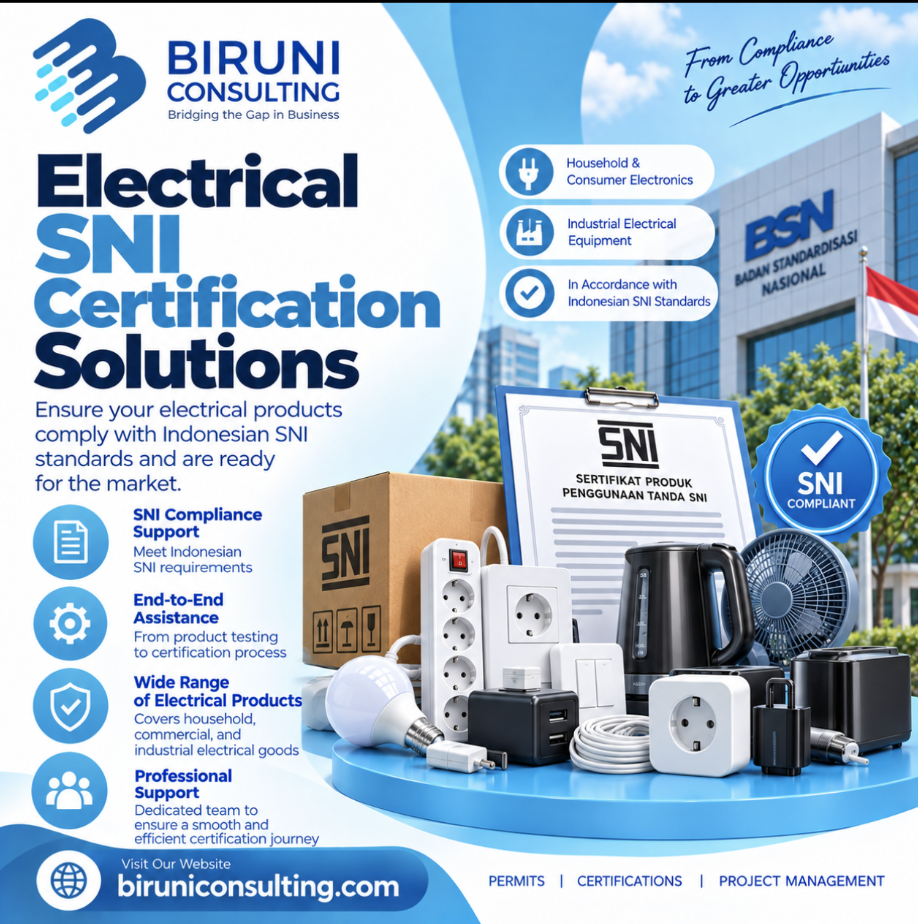
SNI Consultation, Testing, and Certification Services for Electrical Products in Indonesia
SNI certification is an important consideration for manufacturers, importers, distributors, and brand owners marketing electrical products in Indonesia. Products such as electrical cables, plugs, socket outlets, switches, luminaires, electrical protection devices, and various other electrical accessories may be subject to different standards and certification requirements.
Not every electrical product is automatically subject to the same SNI requirements. Certification obligations need to be determined based on product type, construction, function, electrical specifications, SNI scope, HS Code, and regulations that make a particular standard mandatory.
One important regulation in the electricity sector is Minister of Energy and Mineral Resources Regulation No. 7 of 2021 concerning Standardization in the Electricity Sector and the Affixing of the Indonesian National Standard and/or Safety Mark. The regulation provides for mandatory standards covering electrical power installations, electrical power equipment products, and electrical power utilization products.
Because electrical products cover many categories and different standards, an effective electrical SNI certification solution should begin with accurate product identification before laboratory testing and certification.
What Is Electrical SNI Certification?
Electrical SNI certification is a conformity assessment process used to determine whether an electrical product complies with the applicable Indonesian National Standard.
In practice, the process is not limited to laboratory sample testing. Depending on the product and certification scheme, it may include document review, product type or family identification, sampling, laboratory testing, production-process evaluation, factory audit, result evaluation, and certificate issuance.
The main objective is to ensure that products falling within the applicable standard scope comply with the specified technical requirements.
For products subject to mandatory SNI requirements, companies need to ensure that certification is processed through a body with an appropriate scope for the relevant product and standard.
Are All Electrical Products Required to Have SNI?
Not every electrical product can automatically be considered subject to mandatory SNI simply because it uses electricity.
The requirement needs to be assessed against mandatory implementation regulations and the applicable product scope.
Minister of Energy and Mineral Resources Regulation No. 7 of 2021 lists various SNI standards applied as mandatory standards in the electricity sector, together with the relevant product categories, implementation scopes, and classifications.
Therefore, the first stage in an electrical SNI certification solution is conducting a regulatory assessment.
Information that needs to be reviewed includes the product name, function, voltage, current, frequency, power, construction, installation method, HS Code, intended use, and additional product features.
This approach helps companies avoid mistakes such as using an inappropriate standard or beginning certification before confirming the applicable product scope.
Electrical Products Requiring SNI Assessment
Electrical products cover a broad range of categories. Product groups that frequently require SNI assessment include:
- Plugs.
- Socket outlets.
- Electrical cables.
- Switches.
- Luminaires.
- Certain lamps.
- MCBs and circuit breakers.
- RCCBs and RCBOs.
- Electrical protection equipment.
- Electrical household appliances.
- Electrical installation accessories.
- Electrical power utilization products.
Each category may have different standards. Even products that appear similar may be subject to different standards when their technical construction or function differs.
Therefore, SNI standards should not be determined solely from the product name shown in a supplier catalogue.
SNI Certification for Plugs and Socket Outlets
For plugs and socket outlets for household and similar purposes, one of the standards used is SNI IEC 60884-1:2014.
The Ministry of Trade’s LAMANSITU lists SNI IEC 60884-1:2014 as a quality-policy requirement for plugs and socket outlets, together with the Goods Registration Number or NPB requirement.
Laboratories listed in LAMANSITU also have testing scopes for plugs and socket outlets based on SNI IEC 60884-1:2014.
Products in this category may include conventional socket outlets, extension sockets, portable sockets, and products incorporating additional functions.
Where USB charging, WiFi, Bluetooth, switching, surge protection, or other electronic functions are included, the additional construction needs to be assessed because it may introduce requirements beyond the basic socket outlet function.
SNI Certification for Switches
Switches for fixed household and similar electrical installations are another product group requiring appropriate standard assessment.
LAMANSITU lists testing for switches for household and similar fixed electrical installations based on SNI IEC 60669-1:2013.
Switch products may include single switches, double switches, intermediate switches, push buttons, dimmers, and smart switches.
Where a switch includes WiFi, Bluetooth, or another radio technology, the company also needs to assess telecommunications requirements in addition to electrical requirements.
SNI Certification for Luminaires
Luminaires are one of the broadest categories of electrical products.
LAMANSITU lists SNI IEC 60598-1:2016 and NPB requirements for several luminaire product groups. Certain luminaire types are also subject to particular part standards depending on their construction and intended application.
For example, recessed luminaires are listed with SNI IEC 60598-1:2016 and SNI IEC 60598-2-2:2016, while floodlight luminaires are listed with SNI IEC 60598-1:2016 and SNI IEC 60598-2-5:2016.
Portable luminaires also have particular standards depending on the applicable product category.
Therefore, general commercial descriptions such as LED light, display light, spotlight, downlight, street light, or portable lamp first need to be translated into the appropriate technical classification.
SNI Certification for Electrical Cables
Electrical cables have numerous variations based on insulation material, number of cores, conductor size, construction, rated voltage, and intended application.
Laboratories listed in LAMANSITU have testing scopes for PVC-insulated cables with rated voltages up to 450/750 V based on the IEC 60227 series and related methods.
Companies seeking cable certification should therefore prepare detailed information on cable type, number of cores, conductor cross-sectional area, conductor material, insulation material, rated voltage, and construction.
Incorrect cable identification can result in the selection of an inappropriate standard and testing parameters.
SNI Certification for MCBs and Protection Equipment
Circuit breakers and electrical protection devices also have specific standards.
BSN currently lists SNI 8528-1:2022 for circuit breakers for overcurrent protection for household and similar installations as an active standard. It adopts IEC 60898-1:2019 with modifications.
BSN also lists other standards covering RCCBs, RCBOs, fuses, and other overcurrent protection equipment.
Commercial terms such as MCB, RCCB, RCBO, circuit breaker, or protection device should therefore be technically identified before determining the applicable standard.
Initial Solution: Product Identification
The first stage of an electrical SNI certification solution is product identification.
Companies should provide photographs, catalogues, datasheets, user manuals, product labels, model lists, and other available technical information.
Basic information that should be reviewed includes:
- Product name.
- Brand.
- Model or type.
- Manufacturer.
- Country of origin.
- Rated voltage.
- Rated current.
- Frequency.
- Power.
- Product function.
- Installation method.
- Main materials.
- Major components.
- HS Code where already available.
- Product and label photographs.
This information can be used for an initial review of the product category and potentially applicable standards.
Regulatory Assessment Solution
After product identification, the next step is to review the applicable regulations.
At this stage, it is important to distinguish between an available SNI standard and an SNI standard made mandatory by regulation.
The existence of an SNI in the BSN catalogue does not automatically mean that every product in that category must hold an SNI certificate. Mandatory application needs to be assessed against the relevant implementation regulation and product scope.
This is an important part of the certification process because it can prevent companies from conducting testing under a standard that does not actually correspond to their product.
Product Family Determination Solution
Electrical companies often have many models with similar designs.
For example, a socket outlet brand may have 20 models differing in outlet quantity, color, rated current, USB functions, switches, or grounding configuration.
Similarly, a luminaire manufacturer may have dozens of models differing in power, dimensions, drivers, LED modules, diffusers, and housings.
Before certification begins, these models should be compared to determine potential product-family grouping under the applicable certification scheme.
Parameters generally reviewed include construction, function, electrical rating, critical components, materials, design, and applicable standards.
Correct product-family determination can help companies manage certification for multiple models in a more structured manner.
Certification Document Preparation Solution
Documentation is an important part of electrical SNI certification.
For domestic and imported products, the required documents may vary according to the certification scheme and body handling the process.
Companies should generally prepare:
- Company legal documents.
- Applicant information.
- Manufacturer information.
- Production facility address.
- Product list.
- Datasheets.
- Product photographs.
- Product labels.
- User manuals.
- Technical drawings.
- Circuit diagrams where relevant.
- Bill of materials or component lists where requested.
- Critical component information.
- Quality-management documentation where required.
- Existing test reports.
Consistency between documents, samples, labels, and production units needs to be maintained throughout the certification process.
Laboratory Testing Solution
Products undergoing certification generally need to be tested according to the applicable standard.
Testing parameters depend on the product type. Electrical product testing may include protection against electric shock, insulation resistance, electric strength, temperature rise, mechanical strength, terminal construction, resistance to heat, and various other parameters.
For luminaires, for example, laboratories have different testing scopes for general-purpose luminaires, recessed luminaires, road-lighting luminaires, portable luminaires, and floodlights.
Laboratory selection therefore needs to correspond to the product and standard scope.
Solution When a Product Fails Testing
Not every sample immediately complies with every parameter during the first test.
Nonconformities may be related to product design, materials, components, markings, terminal construction, heat resistance, insulation performance, or other technical parameters.
Where a nonconformity is identified, the company needs to understand the cause before changing the product.
Changes should not be made randomly because modifying one component may affect another parameter or cause the final product configuration to differ from the documentation submitted for certification.
A better approach is to review the test result, identify the root cause, make appropriate technical corrections with the manufacturer, and then follow the applicable procedure for further testing.
Factory Audit Solution
Under certain certification schemes, the process may include an audit or evaluation of the production facility.
For imported products, this may involve an overseas factory. Importers therefore need to ensure that the manufacturer is prepared to provide documentation, access to production processes, quality controls, and product component information.
Factory readiness from the beginning helps prevent obstacles once the certification process is underway.
Companies also need to ensure that products manufactured after certification remain consistent with the samples and construction that were evaluated.
SNI Certification Solutions for Imported Products
Imported electrical products require additional attention because coordination with overseas manufacturers is an important part of the certification process.
Before beginning mass production or shipping products, importers should request that manufacturers provide product datasheets, technical drawings, model lists, product photographs, labels, circuit diagrams, major component information, and any existing test reports.
An assessment can then be conducted to determine the applicable standard, testing requirements, product family, and certification process.
This approach helps reduce the risk of products arriving in Indonesia before their technical and certification requirements have been completed.
Certification Solutions for Smart and IoT Products
The development of electrical products means that many devices now incorporate WiFi, Bluetooth, Zigbee, or other communication technologies.
Examples include smart sockets, smart switches, smart lighting, smart circuit breakers, and various IoT devices.
These products may involve more than one regulatory aspect. In addition to electrical requirements, their radio communication functions need to be assessed against telecommunications-device regulations.
Smart-product assessment should therefore examine the electrical portion and communication module separately.
Information such as radio module, chipset, operating frequency, transmit power, antenna type, and antenna gain should be available from the beginning.
Stages of Electrical SNI Certification Solutions
The process can generally be conducted through the following stages:
- Product assessmentIdentify the product’s function, construction, ratings, models, and specifications.
- Regulatory assessmentReview applicable SNI standards and regulations based on the product type.
- Scope determinationDetermine whether the product falls within the scope of the applicable standard.
- Product family assessmentCompare multiple models to determine appropriate grouping.
- Document preparationPrepare corporate, technical, and manufacturer documentation.
- Certification applicationSubmit the process to a certification body with an appropriate scope.
- Sampling and testingTest samples according to the determined standard.
- Factory audit or production evaluationConduct the activity where required by the certification scheme.
- Certification result evaluationReview documentation, test results, and evaluation results for conformity.
- Certificate issuance
The certificate is issued once all applicable scheme requirements have been fulfilled.
Why Use an Electrical SNI Consultant?
Electrical products cover numerous categories, each potentially subject to different standards. Errors during initial identification can result in companies choosing an inappropriate laboratory, standard, sample, or certification scheme.
A consultant can help structure the process from the beginning, especially for companies with multiple product types or products sourced from several manufacturers.
Assistance can also facilitate communication between the company, factory, laboratory, and certification body where technical information or document corrections are required.
The objective is not merely to obtain a certificate, but to ensure that the submitted product and documentation correspond to the required certification scope.
Solutions for Manufacturers, Importers, and Brand Owners
Each company may have different requirements.
Domestic manufacturers may require assistance with production-facility preparation, technical documentation, testing, and production consistency.
Importers typically require greater coordination with overseas manufacturers, particularly for obtaining technical documentation, preparing audits, selecting samples, and ensuring that marketed product configurations match the certification.
Brand owners working with multiple factories also need to manage relationships between brands, models, production locations, and certificate scopes.
Electrical SNI certification solutions should therefore be adapted to each company’s business model and supply-chain structure.
Importance of Assessment Before Mass Production
One particularly important step is conducting an assessment before mass production begins.
At this stage, companies can still modify designs, components, labels, models, or configurations where inconsistencies with Indonesian requirements are identified.
When assessment is performed only after products have been manufactured or shipped, the opportunity to make changes becomes more limited and correction costs may increase.
Companies planning to introduce new electrical products into Indonesia should therefore assess certification requirements during supplier selection and product-finalization stages.
Hubungi Kami dan Contact Us
Biruni Consulting assists companies with electrical SNI certification solutions, including regulatory consultation, standard identification, product assessment, testing, audits, and certification-process assistance.
Our services include:
- Consultation on electrical SNI certification requirements.
- Identification of applicable SNI standards and regulations.
- Product specification and product-list review.
- HS Code and product-scope identification where required.
- Product family assessment.
- Document and major-component review.
- Certification document preparation.
- Product testing assistance.
- Factory audit or evaluation assistance.
- Certification-process assistance through certificate issuance.
Contact Biruni Consulting for information regarding electrical SNI certification solutions, electrical product SNI services, electrical SNI consultation, electrical product testing, and electrical product certification in Indonesia according to your product’s brand, model, specifications, product category, and country of origin