
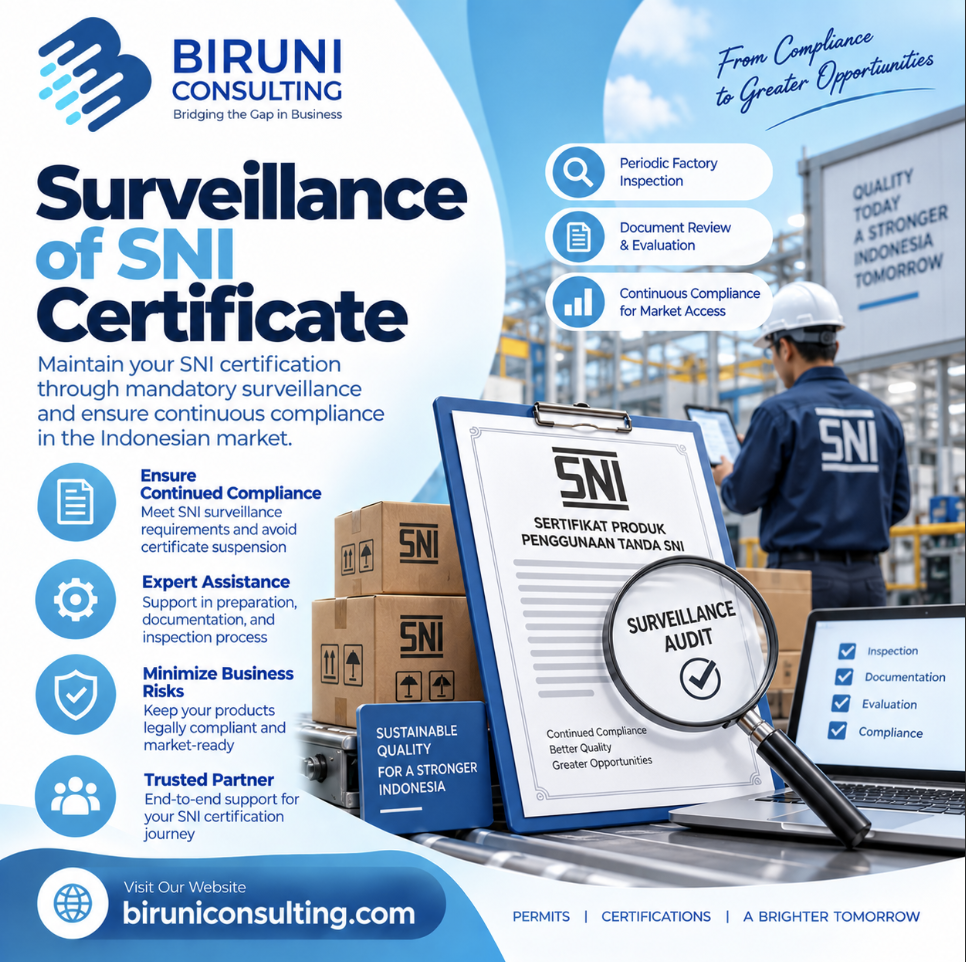
SNI Certificate Surveillance Process to Maintain Product Certification in Indonesia
SNI certificate surveillance is a periodic assessment conducted after an SNI Certificate has been issued to ensure that the company, production process, and products continue to meet applicable certification requirements. In Indonesian Ministry of Industry regulations, the official term commonly used is Surveilen, while “SNI surveillance” is commonly used by companies to refer to periodic monitoring activities associated with a certificate.
Surveillance is particularly important for products using a type 5 certification system. The issuance of a certificate does not mean that a company can disregard certification requirements during the certificate’s validity period. The Product Certification Body continues to conduct assessments to ensure production process consistency and product conformity with SNI.
The frequency and mechanism of surveillance must follow the regulations applicable to each product. For example, several 2025 Minister of Industry Regulations using type 5 certification require periodic surveillance once every year. Such provisions can be found, among others, in regulations concerning steel pipes, paper and paperboard, and other product categories using similar schemes. Database Peraturan | JDIH BPK
What Is SNI Certificate Surveillance?
SNI certificate surveillance is an assessment conducted during the validity period of a certificate to ensure that the certificate holder continues to meet the requirements that formed the basis for issuance of the SNI Certificate.
This process differs from initial certification. During initial certification, the company undergoes the complete process to obtain its first SNI Certificate. During surveillance, the assessment focuses on ensuring that the conditions evaluated during certification continue to be maintained.
The Product Certification Body may examine production processes, quality management systems, raw material controls, internal testing, product traceability, use of the SNI Mark, and may take product samples for laboratory testing according to the certification scheme.
Is SNI Certificate Surveillance Mandatory?
For SNI Certificates issued under schemes requiring surveillance, surveillance activities form part of the certification obligations.
Several recent mandatory SNI regulations clearly provide that a Product Certification Body that has issued an SNI Certificate under a type 5 certification system must conduct surveillance. Such surveillance consists of periodic surveillance and special surveillance. Database Peraturan | JDIH BPK
Therefore, companies need to understand that obtaining an SNI Certificate is not the end of the compliance process. While the certificate remains valid, companies must maintain product conformity and production facility readiness for surveillance activities.
How Often Is SNI Surveillance Conducted?
The frequency of surveillance must be determined according to the regulation and certification scheme applicable to the relevant product.
Under a number of Minister of Industry Regulations issued in 2025, periodic surveillance for SNI Certificates using a type 5 certification system is conducted once every year. The Product Certification Body is also required to inform the Industrial Company or Overseas Manufacturer of the periodic surveillance schedule. Database Peraturan | JDIH BPK
However, this provision should not automatically be applied to every product without reviewing its specific regulation. Certain products may have different assessment mechanisms, schedules, or provisions.
Therefore, before determining the surveillance schedule, companies need to review the SNI number, certification scheme, mandatory SNI regulation, certificate validity period, and requirements of the Product Certification Body that issued the SNI Certificate.
Periodic Surveillance and Special Surveillance
Under several recent mandatory SNI regulations, surveillance is divided into two types: periodic surveillance and special surveillance.
Periodic Surveillance
Periodic surveillance is conducted according to the period established under the regulation and certification scheme.
For various products using a type 5 scheme, periodic surveillance is conducted once a year. Its purpose is to ensure that production processes, quality systems, and products continue to comply with the requirements that formed the basis of certification. Database Peraturan | JDIH BPK
Special Surveillance
Special surveillance may be conducted outside the periodic surveillance schedule.
Under several 2025 Minister of Industry Regulations, special surveillance may be conducted at any time when there is a complaint from an individual, community, institution, or agency, or based on an instruction from the Minister. Database Peraturan | JDIH BPK
Therefore, companies need to maintain compliance throughout the entire SNI Certificate validity period rather than only preparing shortly before an annual audit.
What Is Checked During SNI Surveillance?
The assessment scope depends on the type of product and certification scheme. For type 5 certification, surveillance generally relates to production process consistency and product conformity.
Several aspects that may be examined include:
- Company legality and information.
- Production facility location.
- SNI Certificate scope.
- Product brands and types.
- Raw materials used.
- Production processes.
- Quality control systems.
- Quality management systems.
- Production equipment.
- Testing equipment and calibration.
- Internal inspection and testing records.
- Product traceability.
- Control of nonconforming products.
- Customer complaints.
- Use of the SNI Mark and electronic mark where required.
The Product Certification Body may adjust the assessment scope according to the certification scheme and the company’s circumstances.
Is Laboratory Testing Conducted During Surveillance?
Under many type 5 product certification schemes, surveillance may include product sampling and laboratory testing.
This can be seen in recent mandatory SNI regulations requiring Product Certification Bodies to report surveillance results through SIINas and include information such as the auditor’s name, sampling officer’s name, surveillance results, and the number and date of the test report. Database Peraturan | JDIH BPK
Samples may be taken according to the certification scheme and subsequently tested to ensure that products manufactured during the certification period continue to meet SNI requirements.
Therefore, companies need to ensure that regular production continues to have specifications and quality consistent with products previously confirmed as complying with the requirements.
SNI Certificate Surveillance Process
Surveillance Schedule Notification
The Product Certification Body conducts surveillance according to the schedule and certification scheme requirements. Under various type 5 regulations, the Product Certification Body is required to inform the Industrial Company or Overseas Manufacturer of the periodic surveillance schedule. Database Peraturan | JDIH BPK
The company then needs to prepare personnel, documents, production facilities, and products required for the assessment.
Document Preparation
Before the audit, the company should review documents related to the certification.
These documents may include the SNI Certificate, SPPT SNI where applicable, quality management system documents, production records, inspection records, internal test results, equipment calibration, customer complaints, corrective actions, and product change documents.
Production Facility Audit
The auditor examines the production facility and control systems forming part of the certification.
The company needs to demonstrate that the production processes operating during surveillance remain consistent with the processes assessed when the SNI Certificate was issued.
Product Sampling
Where the scheme requires product testing, a sampling officer may take samples from production or other sources specified in the scheme.
The samples must be capable of representing products covered by the SNI Certificate.
Laboratory Testing
The samples are then tested according to the SNI and specified parameters.
Testing results are used together with the audit results to determine whether the products continue to meet certification requirements.
Surveillance Result Evaluation
The Product Certification Body evaluates the audit and testing results.
Where nonconformities are identified, the company may be required to implement corrective actions within the period and mechanism established by the Product Certification Body or relevant regulation.
Surveillance Reporting
Under several recent mandatory SNI regulations, Product Certification Bodies are required to report surveillance results through SIINas to the relevant Ministry of Industry authority. Reported information may include the implementation date, auditor, sampling officer, surveillance results, and test report. Database Peraturan | JDIH BPK
Documents Required for SNI Surveillance
Document requirements may differ depending on the product, but companies should prepare updated certification documents and operational records.
Documents that may be required include:
- Valid SNI Certificate.
- SPPT SNI where required.
- Company legality documents.
- Product list covered by the certificate.
- Quality management system documents.
- Raw material receipt and inspection records.
- Production process records.
- Quality control records.
- Internal test results.
- Equipment calibration certificates.
- Production and testing equipment lists.
- Nonconforming product records.
- Corrective and preventive action records.
- Customer complaint records.
- Evidence of SNI Mark use according to applicable requirements.
Documents should reflect the company’s current condition. Changes occurring after initial certification should be properly controlled and reported according to applicable obligations.
SNI Surveillance for Imported Products
Surveillance also needs to be considered by Overseas Manufacturers holding SNI Certificates for products marketed in Indonesia.
Under product regulations using type 5 certification systems, Product Certification Bodies may conduct surveillance of Overseas Manufacturers in the same manner as domestic Industrial Companies. Annual surveillance provisions in several Minister of Industry Regulations explicitly refer to both Industrial Companies and Overseas Manufacturers. Database Peraturan | JDIH BPK
Because the production facility is located outside Indonesia, companies need to consider audit coordination, factory readiness, manufacturer documentation, product sample testing, and possible auditor travel and accommodation costs.
The Official Representative in Indonesia also needs to maintain coordination with the Overseas Manufacturer, Product Certification Body, importer, and other relevant parties throughout the surveillance process where the product regulation requires an Official Representative.
Cost of SNI Certificate Surveillance
There is no single SNI surveillance tariff that applies to every product.
Costs may be influenced by the Product Certification Body, product type, SNI standard, number of auditors, factory location, number of samples, laboratory testing, transportation, accommodation, and follow-up requirements where nonconformities are identified.
For Overseas Manufacturers, costs may be higher where the Product Certification Body needs to conduct an on-site audit at a production facility outside Indonesia.
Therefore, when calculating SNI certification costs, companies should not budget only for initial certification. Surveillance costs throughout the certificate validity period should also be included in the product compliance budget.
What Happens If Surveillance Results Do Not Meet the Requirements?
If nonconformities are found during surveillance, the company needs to address the findings according to the Product Certification Body’s procedures and applicable certification scheme.
Nonconformities may arise from documentation, production processes, quality management systems, raw materials, product testing, use of the SNI Mark, or other aspects within the certification scope.
The company may be required to perform root cause analysis, implement corrective actions, submit evidence of correction, or undergo additional verification.
Consequences for the SNI Certificate depend on the type and severity of the nonconformity and the applicable product regulation. Therefore, surveillance findings should be resolved within the specified period so that the certification status is not affected.
Difference Between SNI Surveillance and Recertification
Surveillance and recertification are two different processes.
Surveillance is conducted while the SNI Certificate remains valid to ensure that the company continues to meet certification requirements.
Recertification is conducted toward or at the end of the certificate period to obtain certification for the following period according to the applicable scheme.
For example, several type 5 SNI regulations establish a five-year validity period for SNI Certificates. During that period, surveillance is conducted according to the prescribed schedule, while recertification is required to continue certification after the validity period expires. One 2025 regulation, for example, specifies a five-year validity period for type 5 SNI Certificates. Database Peraturan | JDIH BPK
Difference Between Surveillance and the Initial SNI Audit
The initial audit is conducted as part of the process of obtaining an SNI Certificate for the first time.
At this stage, the Product Certification Body conducts an initial assessment of the system, production facility, processes, documents, and products to determine whether the company meets certification requirements.
Surveillance takes place after the certificate has been issued. Its purpose is not to restart certification from the beginning but to ensure that the conditions forming the basis of certification continue to be maintained.
Nevertheless, companies should prepare for surveillance with the same level of readiness as an initial audit because auditors may reassess various important aspects of the production and quality control systems.
Things to Consider Before SNI Certificate Surveillance
Companies should conduct an internal review before the surveillance schedule.
Several points that need to be considered include:
- Make sure the SNI Certificate remains valid.
- Review the product scope stated on the certificate.
- Make sure product brands and types have not changed without proper control.
- Make sure production processes remain consistent.
- Review changes to raw materials or suppliers.
- Make sure testing equipment has been calibrated.
- Review internal test results.
- Make sure production records are available.
- Review corrective actions from previous audits.
- Make sure customer complaints have been addressed.
- Make sure the SNI Mark is used according to applicable requirements.
- Prepare samples where required.
- Make sure relevant personnel are available during the audit.
- Review changes in address, facilities, trademarks, or company information.
- Coordinate the schedule with the Overseas Manufacturer where the product is imported.
Preparation before surveillance can help companies identify potential nonconformities before assessment by the Product Certification Body.
Why Is SNI Surveillance Important?
SNI certificate surveillance helps ensure that compliance with standards does not occur only when a company first obtains its certificate.
Products manufactured after certification must continue to demonstrate consistent quality and comply with applicable SNI requirements. Therefore, periodic audits, testing, and evaluation of the production system are important for maintaining certification.
For companies, surveillance also provides an opportunity to ensure that documents, facilities, production processes, quality control, and products remain compliant before problems arise that could affect the SNI Certificate.
Conclusion
SNI certificate surveillance is a periodic assessment activity conducted to ensure that the company, production process, and products continue to meet certification requirements while the SNI Certificate remains valid.
Under various mandatory SNI regulations using type 5 certification systems, Product Certification Bodies are required to conduct surveillance, with periodic surveillance conducted once every year. In addition to periodic surveillance, special surveillance may be conducted where there is a complaint or an instruction from the Minister. Database Peraturan | JDIH BPK
Because the requirements for each product may differ, companies need to review the certification scheme and Minister of Industry Regulation specifically applicable to their products. Document preparation, internal audits, production consistency, testing, and follow-up of findings are important parts of maintaining an SNI Certificate.
Contact Us
Biruni Consulting assists companies with SNI certificate surveillance professionally and in accordance with applicable regulations in Indonesia
Our services include
- Regulatory consultation.
- Identification of applicable standards.
- Preparation of certification documents.
- Assistance with laboratory testing.
- Assistance with SNI surveillance and audits.
- Certification processing until certificate issuance.
With experience in product certification in Indonesia, Biruni Consulting helps companies prepare the documents, production facilities, testing, and quality control systems required for SNI surveillance.
Contact Us for consultation, surveillance assistance, certification, and SNI Certificate processing services