
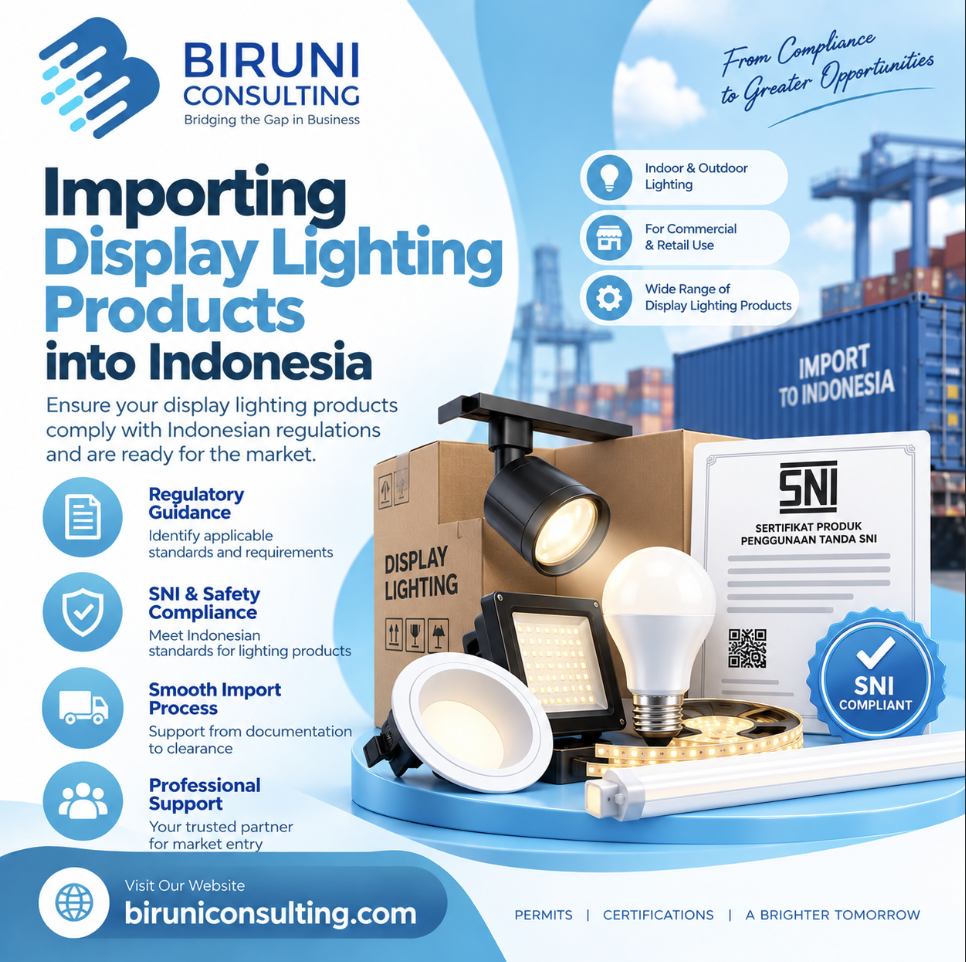
Guide to Import Requirements, SNI, and Display Lighting Certification
Importing display lighting products into Indonesia requires careful assessment because the term display lighting is a commercial description that can cover many different types of lighting products. Display lights may include lighting for showcases, retail shelves, display cabinets, exhibition booths, museums, stores, and decorative installations designed to highlight particular objects or products.
From a regulatory perspective, the term “display light” does not automatically correspond to one standard or a single HS Code. The product needs to be assessed based on its construction, light source, voltage, power rating, installation method, intended use, and whether it is a lamp, complete luminaire, or lighting system containing a driver and other supporting components.
If the product is classified as a luminaire, the Ministry of Trade’s LAMANSITU currently lists SNI IEC 60598-1:2016 and the Goods Registration Number (NPB) as quality-policy requirements for several luminaire tariff codes. Listed HS Codes include 94051191, 94051199, 94051991, 94051992, 94051999, 94054140, 94054220, 94054250, 94054920, and 94054950.
Therefore, before importing display lighting products in commercial quantities, companies should identify the product and review its HS Code to determine the applicable SNI, certification, NPB, and other requirements.
What Is Display Lighting?
Display lighting is a lighting product designed to provide focused illumination to a particular object. Its main purpose is usually to improve the visibility and presentation of products, collections, decorations, or other objects that need to be highlighted.
Display lighting is commonly used in retail stores, supermarkets, boutiques, jewelry stores, museums, galleries, hotels, vehicle showrooms, exhibitions, and other commercial facilities.
Products marketed as display lighting may include:
- Showcase lights.
- Cabinet display lights.
- Shelf lights.
- Display spotlights.
- Mini spotlights.
- LED bars for shelves or showcases.
- Track-mounted display lights.
- Recessed display lights.
- Surface-mounted display lights.
- Low-voltage display lighting.
- LED display cabinet lighting.
- Adjustable display spotlights.
Although all of these products may be marketed as “display lights,” their technical classification and certification requirements may not be identical.
Are Imported Display Lights Required to Have SNI?
SNI requirements should not be determined solely from the commercial term “display light.” The first consideration is whether the product is classified as a luminaire and whether its HS Code falls within the applicable regulatory scope.
The Ministry of Trade’s LAMANSITU lists several luminaire tariff classifications with SNI IEC 60598-1:2016 and NPB as quality-policy requirements. Therefore, display lighting products falling within these luminaire classifications need to be assessed against the applicable requirements before importation and marketing.
The BSN catalogue also lists SNI IEC 60598-1:2016 – Luminaires – Part 1: General requirements and tests as an active standard. BSN maintains various specific standards within the SNI IEC 60598 series according to luminaire type and application.
Therefore, two products both marketed as display lights may have different requirements when their construction and applications are different.
SNI Standards Related to Display Lighting
SNI IEC 60598-1
One of the main standards related to luminaires is SNI IEC 60598-1. This standard establishes general requirements and testing for luminaires.
SNI IEC 60598-1:2016 is currently listed as active in the BSN catalogue and is also the standard currently listed in LAMANSITU’s quality policy for several luminaire groups.
However, in addition to this general standard, companies need to determine whether a specific part standard applies based on the design and intended use of the light.
Portable Display Lighting
If the display light is constructed as a portable general-purpose luminaire, SNI IEC 60598-2-4:2017 provides particular requirements for general-purpose portable luminaires and is currently listed as active.
Recessed Display Lighting
For display lighting designed for recessed installation, specific standards in the SNI IEC 60598-2-2 series cover recessed luminaires.
Display Spotlights
If the product is a spotlight designed to provide focused illumination on an object, SNI IEC 60598-2-5:2016 – Luminaires – Part 2-5: Particular requirements – Floodlights is currently listed as an active standard.
Therefore, the applicable standard should be assessed based on the actual construction of the display light rather than only the product name appearing in the supplier’s catalogue.
Difference Between Display Lighting and Conventional LED Lamps
A conventional LED lamp may be a self-ballasted lamp installed in a specific lamp holder, whereas display lighting is often supplied as a complete luminaire.
A luminaire may include a light source, housing, reflector or diffuser, driver, wiring, connector, bracket, and other components necessary to distribute and direct light.
For example, an E27 LED bulb intended for general lighting has a different product structure from a showcase LED spotlight containing its own housing, driver, bracket, and optical lens.
These differences can affect the applicable standards, testing requirements, HS Code classification, and certification procedures.
Import Requirements for Display Lighting Products in Indonesia
For import activities generally, companies need to have the appropriate importer legality. Minister of Trade Regulation No. 16 of 2025 concerning Import Policy and Regulation provides that importers must hold a Business Identification Number (NIB) that functions as an API. The regulation has subsequently been amended by Minister of Trade Regulation No. 37 of 2025 and a second amendment, Minister of Trade Regulation No. 18 of 2026.
In addition to importer legality, companies need to consider product classification and technical requirements.
Information that should generally be prepared before importation includes:
- NIB and company legal documents.
- Importer API status.
- Manufacturer name and address.
- Country of origin.
- Product brand.
- Model or type.
- HS Code.
- Datasheet.
- Product photographs.
- User manual.
- Rated voltage.
- Rated frequency.
- Rated power.
- Light-source type.
- Driver type.
- Installation method.
- Product dimensions.
- Housing material.
- Electrical class information.
- IP rating where applicable.
This information forms the basis for determining the correct product classification and certification requirements.
Determining the HS Code for Display Lighting
HS Code classification is an important part of the import process because it is used to determine the product classification and related requirements.
For luminaires, LAMANSITU lists several tariff codes within heading 9405. However, an HS Code should not be determined only from the product’s appearance or commercial description.
For example, an LED display cabinet light may have a different construction from a track spotlight or portable showcase light. Therefore, classification should be based on product function, materials, construction, and technical characteristics.
Incorrect HS Code classification may result in inconsistencies in import documents, certification requirements, and product inspections when the goods enter Indonesia.
NPB for Luminaire Products
In addition to SNI, LAMANSITU lists the Goods Registration Number (NPB) as part of the quality policy for the luminaire category included in its system.
Therefore, when imported display lighting falls within a luminaire category and tariff classification subject to these requirements, importers need to ensure that the relevant certification and product registration processes are fulfilled.
NPB and product certification should be prepared before commercial-scale importation.
Do LED Display Lights Require SKEM?
Not every product using LED technology is automatically subject to the same SKEM requirements.
The application of Minimum Energy Performance Standards needs to be determined according to the relevant product category and the scope of applicable energy-efficiency requirements. Therefore, LED display lighting products should first be assessed to determine whether they fall within a lamp or luminaire category covered by a specific SKEM requirement.
Companies should not automatically assume that all showcase lights, shelf lights, display spotlights, or cabinet lights are subject to identical SKEM requirements.
The product’s HS Code, luminaire type, power, voltage, and intended function should be reviewed before determining whether an Energy Conservation Certificate or SKEM requirement applies.
Stages of Importing Display Lighting Products
Product Identification
The first stage is detailed product identification.
Companies need to clarify whether the product is a complete luminaire, LED lamp, spotlight, track light, recessed light, cabinet light, LED bar, or another type of display lighting product.
HS Code Identification
Once the product characteristics are known, the HS Code classification can be reviewed.
This stage is important because the HS Code is one of the bases for determining import requirements and applicable quality policies.
SNI Identification
The relevant SNI standards should then be reviewed.
For luminaires, one of the general standards to assess is SNI IEC 60598-1, followed by any specific luminaire standard where applicable.
Product List Review
When a company has multiple product types, it is advisable to prepare a product list.
The product list may contain:
- Brand.
- Model.
- Power.
- Voltage.
- Frequency.
- LED type.
- Driver.
- Luminaire shape.
- Installation method.
- IP rating.
- Dimensions.
- HS Code.
The product list helps determine which models may be grouped and which have significant technical differences.
Certification Document Preparation
Once the applicable standards and product grouping have been identified, the company and manufacturer can prepare the technical and administrative documents.
Information should remain consistent between datasheets, labels, product samples, photographs, test reports, and production units.
Product Testing
Samples then undergo testing according to the applicable standard.
For luminaires, testing may cover electrical safety, construction, protection against electric shock, insulation resistance, temperature rise, mechanical strength, internal wiring, terminals, and other parameters according to the standard and product characteristics.
Factory Audit or Production Evaluation
Where the certification scheme requires a factory audit, the manufacturing facility is also assessed to determine whether the manufacturer can consistently produce products equivalent to the tested samples.
For imported products, overseas factory readiness is important because the manufacturer needs to support the certification process and provide the required documentation.
Certification and Registration
After testing and evaluation have been completed and the product meets the applicable requirements, the process can proceed to certification and required registration.
For products falling within the luminaire quality policy listed in LAMANSITU, companies also need to consider NPB requirements according to the applicable provisions.
Documents Required from Overseas Manufacturers
Importers should request technical documentation from manufacturers before placing large-volume orders.
Documents that should generally be available include:
- Product datasheet.
- Product specification.
- Model list.
- Product photographs.
- Label artwork.
- User manual.
- Circuit diagram where required.
- LED module information.
- Driver specification.
- Electrical rating.
- IP rating where applicable.
- Construction drawing.
- Material information.
- Existing IEC/CB test reports where available.
- ISO 9001 or factory quality-system documents where available.
- Manufacturer information.
These documents greatly assist the regulatory and certification assessment process.
Display Lighting with External Drivers
Some display lighting products use drivers located outside the luminaire. For such products, the driver is an important component that needs to be assessed because it affects the electrical characteristics of the product.
Companies should provide information regarding driver input, output voltage, output current, rated power, manufacturer, model, and existing test reports where available.
Changing the driver model after certification also requires careful consideration because it may affect conformity with the configuration previously assessed.
Low-Voltage Display Lighting
Display lighting products are also commonly designed to operate at low voltages such as 12 V DC or 24 V DC.
Even where the luminaire operates at low voltage, companies still need to explain how the product receives electrical power. It may use an adapter, LED driver, power supply, or centralized power supply.
This configuration needs to be included in the product assessment because certification should be based on the actual system configuration.
For example, a 24 V LED cabinet light using an external driver has a different construction from a 220 V spotlight with an integrated driver.
Importance of Determining the Product Family
A display lighting supplier may have dozens or even hundreds of models. However, this does not necessarily mean that every model must be treated without grouping.
Product-family determination may consider luminaire design, construction, driver, power rating, voltage, installation method, light source, and other technical characteristics.
For example, five display spotlight models using the same housing design but different power ratings need to be assessed to determine whether they can remain within one family under the applicable certification scheme.
Conversely, a recessed light and portable display light may have different construction and particular standards and therefore may not always be included in the same group.
What Should Be Considered Before Importing Display Lighting?
Importers should avoid beginning mass production before confirming Indonesian requirements.
The recommended first step is to obtain complete datasheets and model lists from the supplier. This information can then be screened for HS Code, SNI, NPB, and other technical requirements.
Companies should also ensure that the brand and model shown on samples, products, packaging, test reports, and certification documents remain consistent.
Specification changes after testing begins can lead to additional evaluation. Therefore, the models intended for the Indonesian market should ideally be finalized before certification starts.
Why Is Pre-Import Assessment Important?
Pre-import assessment allows companies to determine from the beginning whether the product is a luminaire, which standards apply, which HS Code needs to be reviewed, and what certification or registration may be required.
It also helps prevent a situation where products have already been manufactured or shipped before the required certification documentation is available.
For display lighting, assessment is especially important because the commercial term “display light” can cover products with very different constructions.
Therefore, product photographs alone are not sufficient. Datasheets and technical specifications should also be reviewed to determine the correct requirements.
Hubungi Kami dan Contact Us
Biruni Consulting assists companies with the process of importing display lighting products into Indonesia, including SNI consultation, HS Code identification, standard review, product assessment, testing, and certification assistance.
Our services include:
- Consultation on display lighting import requirements.
- Identification of applicable SNI standards and regulations.
- HS Code and product-scope review.
- Product specification and product-list assessment.
- Identification of luminaire type and installation method.
- Driver and major component assessment.
- Certification document preparation.
- Product testing assistance.
- Factory audit assistance where required.
- Product certification and registration assistance.
Contact Biruni Consulting for information regarding display lighting SNI services, luminaire certification, lighting NPB, and display lighting import requirements in Indonesia according to your product’s brand, model, specifications, HS Code, and country of origin.