
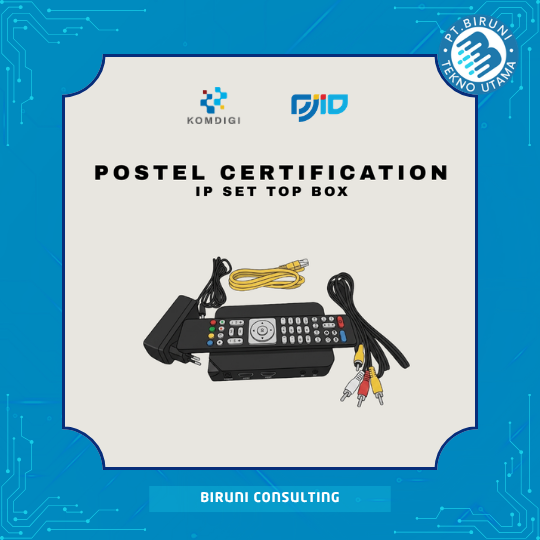
Guide to Postel IP Set Top Box Certification in Indonesia
An IP Set Top Box (IP-STB) is a device used to receive, process, and display multimedia content delivered through an Internet Protocol (IP)-based network. These devices are commonly used for IPTV services and other internet-based television services.
Unlike DVB-C or DVB-T2 Set Top Boxes, which receive broadcasts through specific television transmission systems, an IP Set Top Box uses IP-based connectivity as part of its content reception and processing system.
IP Set Top Boxes have been included as a category of equipment considered under Indonesia’s telecommunications certification regulations. Government documentation lists IP Set Top Box under HS Code 8528.71.11, together with Integrated Receiver Decoder.
The Directorate General of Digital Infrastructure also lists IP Set Top Box (IP-STB) as one of the telecommunications equipment types included in its equipment testing tariff classification.
What Is an IP Set Top Box?
An IP Set Top Box is a customer-premises device designed to receive communication and multimedia content through an IP network. In the IPTV environment, it can be used to receive television services through an operator-managed IP network.
Previous Indonesian technical requirements specifically categorized IP Set Top Boxes into Set Top Box – Internet Protocol Television (STB-IPTV) and Set Top Box – Over The Top (STB-OTT). Government documentation describes STB-IPTV as operating on a closed network with managed services and QoS, while STB-OTT operates on an open network with unmanaged services.
IP Set Top Boxes may include various interfaces such as RJ45, WiFi, USB, HDMI, composite, component, and digital optical, depending on the device design. The technical requirements for IP-STB also specify IPv4 support with the capability to implement IPv6.
Does an IP Set Top Box Require DJID (Postel) Certification?
IP Set Top Box is a telecommunications equipment category that needs to be assessed for certification requirements. Government documentation identifies IP Set Top Box as a specific type of telecommunications equipment for testing and technical compliance.
In the government classification document, IP Set Top Box is listed under HS Code 8528.71.11.
However, the applicable technical requirements for a specific model still need to be determined based on the actual configuration and functions of the device. This is particularly important when an IP Set Top Box includes WiFi, Bluetooth, Ethernet, USB, cellular, or other communication technologies.
IP Set Top Box Postel Certification Requirements
For the certification process, companies generally need to prepare administrative and technical documents describing the device comprehensively.
The required documents may include:
- Company legal documents.
- Business Identification Number (NIB).
- Product brand and model.
- Datasheet.
- User Manual.
- Product photographs.
- Product label and marking photographs.
- Block diagram.
- Network interface specifications.
- Ethernet or RJ45 specifications.
- WiFi specifications, where applicable.
- Bluetooth specifications, where applicable.
- Network protocol information.
- Audio and video specifications.
- Device input and output information.
- Test reports where required.
- Additional supporting documents according to applicable requirements.
Complete technical documentation is important to determine the device category and the parameters that need to be tested.
IP Set Top Box Technical Requirements
Technical requirements for IP Set Top Boxes may cover safety, EMC, interfaces, functions, device management, and content security.
The technical requirements document for IP-STB specifies that IPTV devices may have input interfaces such as RJ45, WiFi and/or USB, while output interfaces may include Composite, Component, HDMI, and/or Digital Optical. The document also specifies IPv4 and the capability to implement IPv6.
For certain functions, an IP Set Top Box may support decoding, specific video formats, closed captioning, device configuration, and content security mechanisms such as DRM.
Because technology and technical requirements may develop over time, the specifications used during certification should be aligned with the requirements applicable at the time of application.
IP Set Top Box Postel Certification Process
The certification process begins by identifying the model and functions of the IP Set Top Box. At this stage, the communication technologies and all device interfaces are reviewed to determine the certification scope.
Administrative and technical documentation is then assessed. Information such as network type, Ethernet, WiFi, Bluetooth, IP protocols, audio-video interfaces, and other communication functions may be required to determine the relevant parameters.
Where testing is required, the device may be tested at a laboratory that meets applicable requirements. Testing may include EMC, safety, interface characteristics, and communication parameters relevant to the device configuration.
Once the documentation and test results meet the applicable requirements, the certification process can proceed until the certificate is issued by the relevant authority.
IPTV and OTT IP Set Top Boxes
IP Set Top Boxes can be used for two major service models: IPTV and OTT.
IPTV Set Top Boxes are used for IPTV services delivered through an operator’s IP network. These devices generally operate within an operator-managed network and may use specific device management mechanisms.
Meanwhile, OTT Set Top Boxes are used to receive multimedia services through an open internet network. These devices can access various streaming services and multimedia content through an internet connection.
The differences between these service models need to be considered during product identification because they may affect the specifications and functions assessed for the device.
IP Set Top Boxes with WiFi
Modern IP Set Top Boxes often incorporate WiFi to provide flexible network connectivity. WiFi allows the device to connect to a router or internet network without using an Ethernet cable.
When an IP Set Top Box incorporates a WiFi module, the module specifications should be included in the technical documentation. Information such as operating frequency, WiFi standard, antenna configuration, and module characteristics may be required during the certification assessment.
If the device also includes Bluetooth, cellular connectivity, or other wireless technologies, each function needs to be assessed to determine the applicable requirements.
Benefits of IP Set Top Box Postel Certification
Meeting certification requirements provides benefits for manufacturers, importers, distributors, IPTV operators, and brand owners.
Key benefits include:
- Supporting compliance with Indonesian telecommunications regulations.
- Supporting equipment importation.
- Ensuring the device meets applicable technical requirements.
- Reducing potential issues during product commercialization.
- Increasing operator and distributor confidence.
- Supporting legal product distribution in Indonesia.
IP Set Top Boxes have also appeared in government testing certification records, demonstrating that this equipment category has been processed within the telecommunications equipment certification system.
Types of IP Set Top Boxes That Require Assessment
Examples of products that may fall within the IP Set Top Box category include:
- IPTV Set Top Boxes.
- IP Television Set Top Boxes.
- OTT Set Top Boxes.
- Android IP Set Top Boxes.
- Smart IP Set Top Boxes.
- IPTV Receivers.
- IP TV Decoders.
- IP Set Top Boxes with Ethernet.
- IP Set Top Boxes with WiFi.
- IP Set Top Boxes with Bluetooth.
- Hybrid IP Set Top Boxes.
Certification requirements and testing parameters may vary depending on communication technologies, network configuration, interfaces, and features incorporated into each device.
Contact Us
Biruni Consulting provides professional services to assist with DJID (Postel) Certification for various telecommunications equipment, including IP Set Top Boxes, IPTV Set Top Boxes, OTT Set Top Boxes, and other IP-based television receiver devices.
We assist with:
- DJID (Postel) certification requirement analysis.
- IP Set Top Box classification identification.
- Assessment of Ethernet, WiFi, Bluetooth, and other interfaces.
- Technical document review.
- Preparation of administrative and technical documentation.
- Laboratory testing coordination where required.
- Certification assistance until the certificate is issued.
Contact Biruni Consulting for consultation regarding Postel IP Set Top Box Certification, including IPTV, OTT, Android TV Box, and other IP-based devices.