
Guide to Managing PIRT Registration for Food and Beverage Products in Indonesia
For food and beverage businesses, especially home industries and small-scale enterprises, product legality plays an important role in building consumer trust and expanding market opportunities. One of the most common licenses required for processed food products in Indonesia is PIRT (Pangan Industri Rumah Tangga) or SPP-IRT (Home Industry Food Production Certificate).
PIRT is a food distribution permit issued for certain processed food products manufactured by home-based industries. This certification is generally granted by local government authorities through related institutions responsible for food safety supervision.
Through the PIRT registration process, authorities ensure that food products circulating in the market meet basic requirements regarding food safety, hygiene, labeling information, and proper production practices. Products such as chips, chili sauce, cookies, ground coffee, seasoning products, powdered drinks, packaged snacks, and several low-risk processed foods are commonly eligible for PIRT registration.
However, not all food products can be registered under PIRT. Certain categories such as milk and dairy products, infant food, canned food, and products with higher safety risks generally require registration through BPOM instead of PIRT. Therefore, understanding product classification from the beginning is an important first step before starting the licensing process.
Why Is PIRT Important?
Managing PIRT registration is not only about fulfilling administrative requirements but also about demonstrating a commitment to food safety and consumer protection. Products that already have PIRT certification are generally perceived as more trustworthy because they have passed basic food safety evaluations.
In addition to improving credibility, PIRT can help businesses expand marketing opportunities. Many supermarkets, modern retail stores, distributors, and online marketplaces now require food legality documents before accepting food and beverage products for sale.
Some key benefits of obtaining PIRT include:
- Increasing consumer confidence in product safety
- Supporting product entry into retail stores and marketplaces
- Strengthening food business legality
- Helping businesses expand into wider markets
Having a valid PIRT permit also helps businesses become more prepared for inspections or compliance evaluations conducted by authorities.
Requirements for PIRT Registration
Before starting the registration process, business owners should prepare several administrative documents and product-related information. While requirements may vary by region, authorities generally require business data and product information as part of the evaluation process.
Documents commonly required include:
- Business owner identification card
- Business Identification Number (NIB) through OSS
- Business location or production facility information
- Food product details
- Product label and packaging photographs
In addition to administrative documents, information regarding ingredient composition, shelf life, production methods, and product labeling is often reviewed during the assessment process. For this reason, businesses are encouraged to ensure product labels contain clear and complete information.
In some regions, food business owners may also be required to participate in Food Safety Training Programs as part of food hygiene and sanitation education.
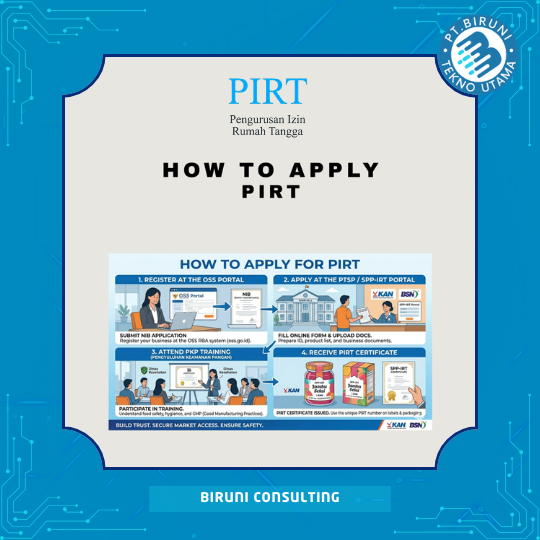
How to Apply for PIRT
In general, the PIRT registration process consists of several stages designed to ensure products meet basic food safety and regulatory requirements.
1. Obtain a Business Identification Number (NIB)
The process usually starts by obtaining a Business Identification Number (NIB) through Indonesia’s OSS (Online Single Submission) system. NIB serves as one of the core business legality documents required for many licensing applications, including PIRT.
During registration, businesses should ensure that their business classification, activities, and food production categories match the products being manufactured.
2. Prepare Product Documents and Information
After obtaining business legality documents, businesses should prepare all product-related information carefully. Details such as ingredients, net weight, expiration date, manufacturer information, and packaging design usually become part of the evaluation process.
Well-prepared documentation can help reduce administrative revisions and speed up the approval process.
3. Submit the PIRT Application
Once all documents are complete, businesses can submit the application through local government authorities or systems applicable in their region.
Authorities usually review several aspects, including:
a. Food product category
b. Product label information
c. Ingredient composition
d. Business legality compliance
If inconsistencies are found, applicants may be requested to revise certain information before the process continues.
4. Food Safety Training and Production Verification
In some regions, businesses are required to attend food safety counseling or training programs to better understand hygiene standards and proper food production practices.
Authorities may also inspect production facilities to ensure that food processing activities are conducted in a clean, safe, and hygienic environment.
5. Issuance of PIRT Number
Once all requirements have been fulfilled, the government will issue the PIRT/SPP-IRT number, which can then be displayed on product packaging.
With this certification number, products gain stronger legal standing and can be distributed more widely across Indonesia.
Regulations Related to PIRT
PIRT registration in Indonesia generally refers to food safety regulations for home industry products and processed food supervision.
Relevant regulations commonly include:
- BPOM provisions regarding Home Industry Food Production Certificates (SPP-IRT)
- National food safety regulations
- OSS business licensing systems
- Processed food labeling requirements
These regulations aim to ensure that food products distributed to consumers are safe, hygienically produced, and clearly labeled.
Contact Us
Managing PIRT registration requires understanding food safety standards, labeling requirements, business legality, and administrative procedures. Biruni Consulting is a professional consultant assisting food business owners with PIRT registration processes according to Indonesian regulations.
Our services include:
- PIRT registration consultation
- Food product document assistance
- Food and beverage label review
- Food business legality consultation
- Regulatory compliance support for food products
We are ready to help simplify the PIRT registration process so your products can be legally marketed and professionally prepared for business growth