
Understanding SDPPI, Its Functions, and Its Transition to DJID
SDPPI stands for the Directorate General of Resources and Equipment of Post and Information Technology, formerly operating under Indonesia’s Ministry of Communication and Informatics (Kominfo). The organization was responsible for managing radio frequency spectrum, satellite orbit resources, and the certification of telecommunications equipment before such products could be legally distributed in Indonesia.
For many years, the term SDPPI became widely recognized among manufacturers, importers, distributors, testing laboratories, and companies involved in the telecommunications industry. Any device utilizing radio frequency technology or connecting to public telecommunications networks was generally required to obtain SDPPI certification before entering the Indonesian market.
Following the government’s organizational restructuring, the Ministry of Communication and Informatics was renamed the Ministry of Communication and Digital Affairs (Komdigi). As part of this transformation, the responsibilities previously handled by SDPPI were transferred to the Directorate General of Digital Infrastructure (DJID). Although the official organization has changed, the terms “SDPPI certification” and “Postel certification” are still widely used by businesses and industry professionals because they have become familiar references within the telecommunications sector.
Understanding what SDPPI is, why it became DJID, and how telecommunications certification works is essential for companies planning to manufacture, import, or distribute telecommunications and wireless communication equipment in Indonesia.
History of SDPPI
SDPPI was established to manage Indonesia’s national telecommunications resources, particularly radio frequency spectrum and telecommunications equipment. Its responsibilities included regulating radio frequency usage, managing satellite orbit resources, supervising telecommunications devices, and administering certification programs to ensure technical compliance.
As communication technology evolved, SDPPI played a significant role in maintaining the quality, safety, and interoperability of telecommunications equipment. Every certified product was evaluated to ensure it complied with Indonesian technical standards and would not interfere with existing telecommunications infrastructure.
The rapid growth of WiFi, Bluetooth, cellular networks, Internet of Things (IoT), satellite communications, and digital connectivity further expanded the scope of telecommunications regulation, making equipment certification increasingly important for manufacturers and importers.
What Was SDPPI?
SDPPI was the government authority responsible for developing technical regulations for telecommunications equipment, managing radio frequency spectrum, supervising telecommunications devices, and issuing certifications for products entering the Indonesian market.
Today, these responsibilities have been transferred to DJID under the Ministry of Communication and Digital Affairs. Consequently, all new telecommunications equipment certifications now follow the regulations, technical requirements, and administrative procedures established by DJID.
Despite this organizational change, the term SDPPI continues to appear in business documents, technical discussions, online searches, and industry communications because it remains closely associated with Indonesian telecommunications certification.
Why Did SDPPI Become DJID?
The transition from SDPPI to DJID was part of Indonesia’s broader governmental transformation aimed at supporting digital infrastructure development and technological innovation.
As digital technologies continue to expand—including broadband networks, fiber optic infrastructure, cloud computing, data centers, 5G connectivity, artificial intelligence, and smart devices—the government restructured its organization to better support the country’s digital transformation strategy.
Although the organization has been renamed, the primary objective remains unchanged: ensuring that telecommunications equipment marketed in Indonesia complies with applicable technical standards, operates safely, supports network interoperability, and minimizes harmful interference with other communication systems.
The Difference Between SDPPI, Postel, and DJID
Many companies are uncertain about the relationship between the terms Postel, SDPPI, and DJID. In practice, these terms refer to different stages in the evolution of Indonesia’s telecommunications regulatory system.
Postel is the traditional term associated with Indonesia’s postal and telecommunications sector. SDPPI was the former Directorate General responsible for telecommunications equipment certification and spectrum management. Today, these responsibilities are carried out by DJID, the Directorate General of Digital Infrastructure.
For this reason, businesses still commonly refer to telecommunications approval as Postel certification, SDPPI certification, or DJID certification, even though the official authority is now DJID.
Functions of SDPPI (Now DJID)
The primary responsibilities previously performed by SDPPI and now managed by DJID include:
- Telecommunications equipment certification.
- Radio frequency spectrum management.
- Satellite orbit administration.
- Development of technical regulations for telecommunications equipment.
- Technical conformity assessment.
- Supervision of telecommunications equipment.
- Radio frequency utilization management.
- Protection and efficient use of radio spectrum resources.
These responsibilities help maintain reliable telecommunications services, improve equipment safety, support technological innovation, and ensure efficient utilization of Indonesia’s communication infrastructure.
Devices That Require DJID Certification
Numerous electronic and telecommunications products must obtain DJID certification before they can be legally marketed in Indonesia, particularly devices utilizing radio frequency technology or connecting to public telecommunications networks.
Examples include:
- Smartphones.
- Tablets.
- Routers.
- Wireless access points.
- Modems.
- Optical Network Terminals (ONT).
- Optical Network Units (ONU).
- WiFi-enabled laptops.
- Smart TVs.
- WiFi CCTV cameras.
- Wireless keyboards.
- Wireless mice.
- Bluetooth devices.
- Internet of Things (IoT) products.
- Two-way radios.
- VSAT equipment.
- Base stations.
- Other telecommunications equipment subject to Indonesian regulations.
Certification requirements may vary depending on product functionality and applicable technical standards.
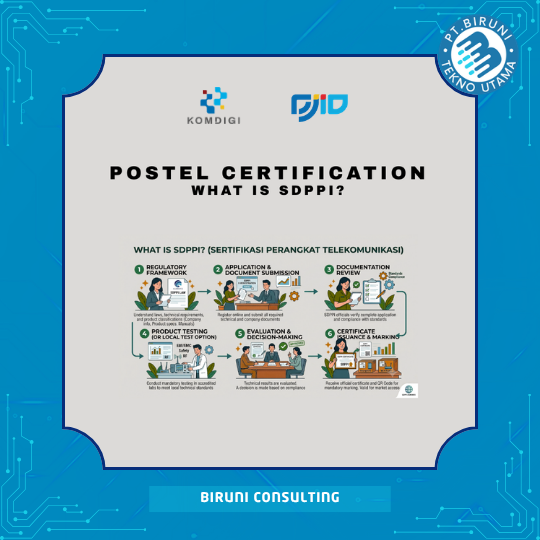
How the DJID Certification Process Works
The certification process begins by identifying the product category to determine the applicable regulations and testing requirements. Technical documentation, product specifications, user manuals, labeling information, and administrative documents are then reviewed.
The equipment subsequently undergoes laboratory testing based on its technical characteristics. Testing may include radio frequency (RF), electromagnetic compatibility (EMC), electrical safety, WiFi, Bluetooth, cellular communication, and other applicable performance evaluations.
Once the product successfully meets all technical and administrative requirements, DJID issues the certification authorizing the product for legal distribution within Indonesia.
Why DJID Certification Is Important
DJID certification serves not only as a regulatory requirement but also as evidence that telecommunications equipment complies with Indonesian technical standards.
The certification process verifies product safety, communication performance, network compatibility, spectrum efficiency, and overall technical compliance. This helps protect consumers while maintaining the quality and reliability of Indonesia’s telecommunications infrastructure.
For manufacturers, importers, and distributors, certification also provides legal certainty and facilitates smoother importation, commercialization, and product distribution.
Common Challenges During Certification
Many companies encounter obstacles during the certification process due to technical or administrative issues. Some of the most common challenges include:
- Incomplete technical documentation.
- Incorrect product classification.
- Product specification changes without updated documentation.
- Wireless modules that require additional evaluation.
- Laboratory test results that do not meet applicable requirements.
- Limited understanding of the latest Indonesian telecommunications regulations.
Proper preparation before submitting an application can significantly reduce certification delays and improve approval efficiency.
Contact Us
Biruni Consulting provides professional services for DJID certification of telecommunications equipment across various industries.
We assist companies with:
- Telecommunications regulatory analysis.
- Identification of applicable DJID certification requirements.
- Preparation of technical and administrative documentation.
- Coordination with accredited testing laboratories.
- End-to-end certification support until approval is issued.
With extensive experience in Indonesian telecommunications regulations, we help manufacturers, importers, and distributors complete the certification process efficiently while ensuring full regulatory compliance.
Contact us today for professional consultation regarding DJID certification and telecommunications equipment approval requirements in Indonesia.