
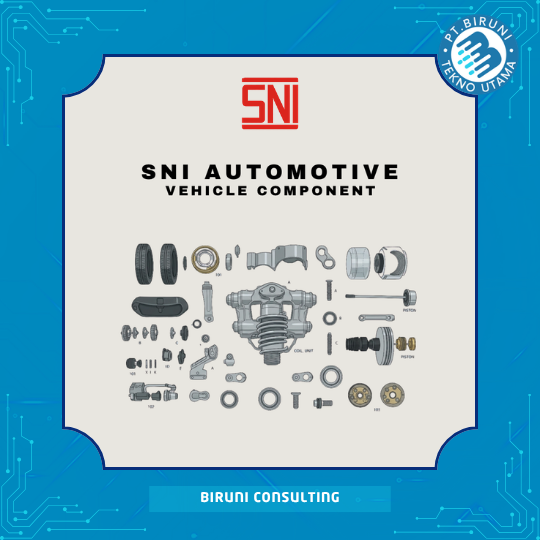
Guide to Vehicle Component Certification in Indonesia
Vehicle components play a crucial role in ensuring the safety, reliability, and performance of motor vehicles. Components manufactured locally or imported into Indonesia should comply with applicable quality and safety requirements before being distributed to consumers. Therefore, vehicle component certification is an important process that helps verify compliance with Indonesian standards and applicable regulations.
Through the certification process, manufacturers and importers can demonstrate that their products have successfully completed testing and conformity assessment based on the applicable technical requirements. Besides improving product quality, certification also provides confidence to customers that the components they purchase meet recognized safety and performance standards.
For many companies, certification requires a comprehensive understanding of regulations, product standards, documentation requirements, laboratory testing, and certification procedures. Professional certification assistance helps simplify these processes and improves certification efficiency.
What Is Vehicle Component Certification?
Vehicle component certification is a conformity assessment process conducted to verify that automotive products comply with applicable quality, safety, and technical requirements in Indonesia. Depending on the product category, certification may refer to the Indonesian National Standard (SNI) or other applicable technical regulations.
The certification process generally includes document evaluation, laboratory testing, and factory audits where required by the applicable certification scheme. After successfully completing all certification requirements, companies receive certification confirming compliance with the applicable standards.
Vehicle Components That May Be Certified
Various automotive products may require certification depending on applicable regulations and product categories.
Examples include:
- Motorcycle helmets.
- Vehicle tires.
- Vehicle wheels and rims.
- Automotive lighting products.
- Automotive safety glass.
- Brake linings.
- Seat belts.
- Vehicle batteries.
- Automotive wiring products.
- Vehicle reflectors.
- Automotive electrical components.
- Other vehicle safety equipment.
Certification requirements vary according to product type, intended application, and applicable standards.
Benefits of Vehicle Component Certification
Certification offers numerous advantages for manufacturers, importers, distributors, and consumers.
These benefits include:
- Compliance with Indonesian regulations.
- Increased customer confidence.
- Improved product quality and safety.
- Stronger market competitiveness.
- Better cooperation with distributors and business partners.
- Reduced risk of product rejection due to non-compliance.
Certification also demonstrates a company’s commitment to supplying safe, reliable, and high-quality vehicle components.
How to Obtain Vehicle Component Certification
Product Identification
The certification process begins by identifying the product category, technical specifications, intended application, and applicable standards.
Document Preparation
Typical certification documents include:
- Business registration documents.
- Product technical specifications.
- Product datasheets.
- Product labels and packaging information.
- Engineering drawings where applicable.
- Quality management documentation where required.
- Additional supporting documents according to the certification scheme.
Certification Application
Applications are submitted to a Product Certification Body (LSPro) accredited by the National Accreditation Committee (KAN) for the relevant certification scope.
Laboratory Testing
Products undergo laboratory testing according to the applicable standards.
Testing may include:
- Safety testing.
- Performance testing.
- Mechanical strength testing.
- Dimensional testing.
- Material testing.
- Durability testing.
- Electrical testing where applicable.
The testing program depends on the characteristics of each automotive component.
Factory Audit
For applicable certification schemes, factory audits verify that manufacturing processes consistently comply with certification requirements.
Certificate Issuance
After successfully completing all certification stages and demonstrating compliance with applicable standards, the certification body issues the relevant certificate confirming that the product satisfies the required certification requirements.
Contact Us
Biruni Consulting helps companies in the vehicle component certification process professionally and in accordance with applicable regulations in Indonesia
Our services include
- Consultation on vehicle component certification regulations.
- Identification of applicable standards.
- Certification document preparation.
- Laboratory testing assistance.
- Certification processing until certificate issuance.
With extensive experience in product certification in Indonesia, Biruni Consulting helps ensure vehicle components comply with applicable safety, quality, and performance requirements and are ready for legal distribution in Indonesia.
Contact Us for vehicle component certification services, certification consultation, and certification assistance