
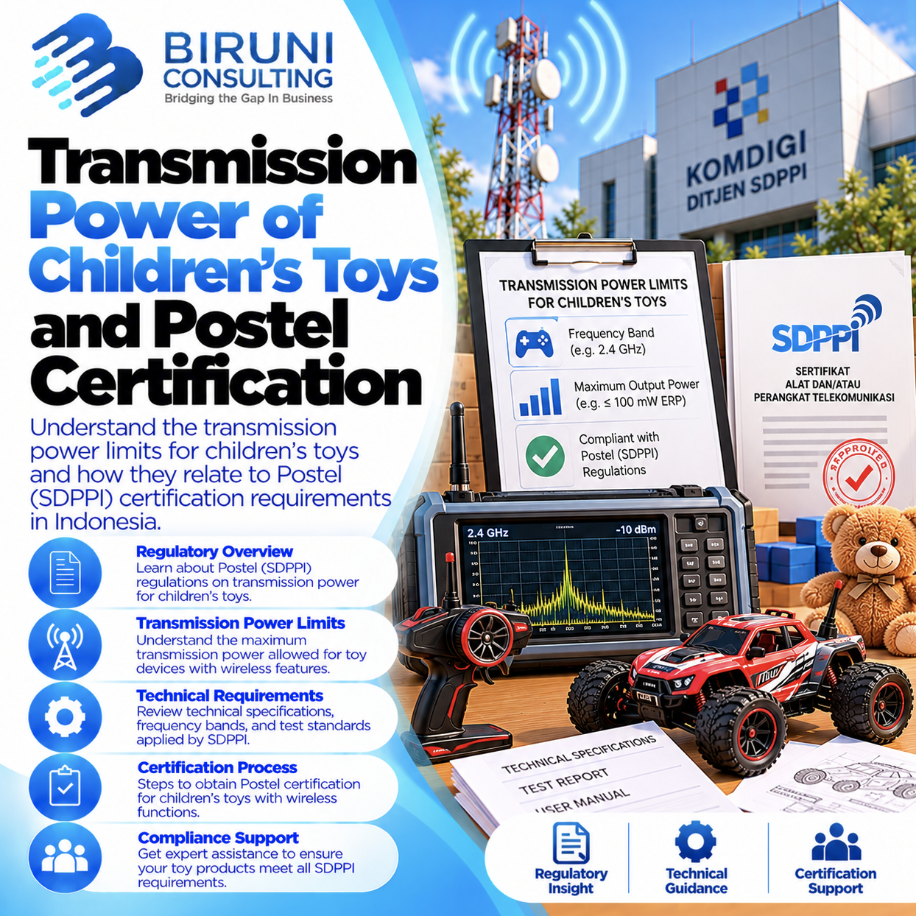
Guide to wireless-toy transmission power and its relationship with DJID/SDPPI Certification in Indonesia.
Transmission power is one of the important radio parameters when assessing children’s toys that incorporate RF remote controls, Bluetooth, WiFi, or other wireless technologies.
For a remote-controlled toy, the main transmitter is commonly located inside the controller. For Bluetooth or WiFi toys, the transmitter may be integrated into a wireless module inside the toy.
However, transmission power alone does not determine whether a product requires Postel/DJID Certification. Operating frequency, radio technology, bandwidth, modulation, antenna configuration, transmitter and receiver functions, and the applicable Indonesian Technical Standards also need to be assessed.
Indonesia’s principal telecommunications equipment certification framework remains Minister of Communication and Informatics Regulation Number 3 of 2024, which is currently in force and repealed Regulation Number 16 of 2018. JDIH Kemkomdigi
What Is Transmission Power?
Transmission power describes the amount of radio-frequency energy produced by a transmitter.
It is commonly expressed in mW (milliwatts) or dBm.
For reference, 1 mW corresponds to 0 dBm, 10 mW to 10 dBm, and 100 mW to 20 dBm.
However, technical documentation may refer to conducted power, ERP, EIRP, peak power, or average power.
These parameters are not necessarily interchangeable.
When reviewing a laboratory report, it is therefore important to identify exactly which power measurement is being reported.
Why Is Transmission Power Important?
Transmission power contributes to the characteristics of the radio link and can affect communication range.
However, actual operating range also depends on antenna performance, receiver sensitivity, interference, obstacles, modulation, and product design.
From a regulatory perspective, transmission power is assessed together with the operating frequency and radio technology to determine compliance with the applicable Technical Standard.
A description such as “2.4 GHz wireless toy” is therefore insufficient without additional RF specifications.
Transmission Power in Remote-Controlled Toys
In most RC toys, the transmitter is located inside the remote controller.
When the user operates the controls, radio commands are sent to a receiver inside the toy.
For RC cars, trucks, excavators, tanks, motorcycles, trains, dinosaur toys, and racing vehicles, the controller should therefore be included in the assessment.
This is important because the toy itself may be receive-only while the principal RF output power originates from the separate controller.
Bidirectional Wireless Toys
Some smart toys use two-way radio communication.
In this configuration, both the controller and the toy may act as transmitters.
The toy might send status, telemetry, sensor information, or other data back to the controller or smartphone.
Where bidirectional communication is present, the transmission characteristics of both sides of the radio link should be assessed.
Transmission Power and Short Range Devices
Many wireless toys use technologies associated with the Short Range Device or SRD framework.
DJID’s current regulatory list continues to include Minister of Communication and Informatics Decision Number 260 of 2024 on Short Range Device Technical Standards. The same current list includes Decision Number 12 of 2025 for RLAN/WiFi equipment. Postel
The term Short Range Device does not mean that every SRD uses the same power limit.
Applicable requirements depend on the frequency band, radio technology, intended function, and relevant Technical Standard.
Transmission power must therefore always be considered together with frequency and technology.
Are Toys Below 10 mW Exempt from Postel?
Not automatically.
This is an important distinction in Indonesian equipment certification.
Regulation Number 3 of 2024 contains a provision for other equipment incorporating a telecommunications feature with transmission power below 10 mW and only one identical telecommunications feature.
Where the regulatory conditions are satisfied, a single Certificate may cover more than one qualifying variant. JDIH Kemkomdigi
This means the below-10-mW provision relates to variant coverage under a Certificate.
It does not establish a general certification exemption for every wireless toy transmitting below 10 mW.
10 mW Is Not a Universal Radio Limit
The 10 mW figure should also not be interpreted as the universal permitted power level for all wireless technologies.
Different technologies are subject to different technical requirements.
For example, a currently valid 2026 DJID Certificate for a game controller lists Bluetooth with transmission power below 100 mW and NFC below 10 mW, while both functions remain covered by a DJID Certificate referencing the SRD Technical Standard. sertifikasi.postel.go.id
This illustrates why radio power must be evaluated in the context of the specific technology rather than against a single universal figure.
Bluetooth Transmission Power in Toys
Bluetooth is commonly found in smart toys, educational products, robots, and smartphone-controlled toys.
The assessment should identify the Bluetooth version, operating frequency, output power, module, antenna, and enabled radio functions.
DJID Certificates issued in 2026 continue to reference Decision Number 260 of 2024 for Bluetooth equipment. Current examples list Bluetooth operation in the 2.4 GHz range with transmission power below 100 mW. sertifikasi.postel.go.id
These values should not simply be copied to another product. The actual toy must still be assessed according to its own laboratory report and radio configuration.
WiFi Transmission Power in Toys
Some toys incorporate WiFi for cameras, applications, video streaming, or other data functions.
WiFi is subject to different technical requirements from a simple proprietary RF controller.
DJID’s current technical-reference database lists Minister of Communication and Digital Decision Number 12 of 2025 as an applicable Radio Local Area Network Technical Standard. sertifikasi.postel.go.id
Where a toy incorporates both proprietary RF and WiFi, each radio should therefore be evaluated independently against its applicable technical requirements.
Conducted Power and EIRP
RF documentation may state conducted transmitter power or radiated power such as EIRP.
Conducted power describes the power generated by the transmitter before antenna effects are considered.
EIRP incorporates transmitter power together with antenna gain relative to an isotropic reference.
Two products with the same conducted output power may therefore have different effective radiated performance if their antennas differ.
The reported measurement method should always be identified when reviewing a test report.
Antenna Configuration Matters
Antenna design forms part of the RF configuration.
A toy may use a PCB antenna, chip antenna, wire antenna, or another integrated design.
If a wireless module was tested with one antenna configuration but the final toy uses another, the relevance of the module test report may need to be reassessed.
Transmission power should therefore not be reviewed separately from antenna characteristics.
Module Power and Final-Product Power
Wireless-module datasheets often provide a maximum RF output-power specification.
However, a final toy may use firmware settings that operate the module at a different power level.
Changes to firmware, radio configuration, or antenna integration may also mean that the final product is no longer technically identical to the module configuration originally tested.
Module datasheets, laboratory reports, antenna information, firmware settings, and final-product specifications should therefore be compared.
Is the Datasheet Power Value Sufficient?
Not necessarily.
A commercial datasheet may provide an output-power specification, but formal DJID Certification requires supporting conformity documentation.
DJID’s current e-Sertifikasi NextGen requirements include a Laporan Hasil Uji/test report and technical-specification documentation among the general requirements for a new Certificate application. sertifikasi.postel.go.id
A datasheet is useful for initial assessment, but the laboratory report normally provides the more detailed evidence of the tested RF configuration.
RF Test Reports and Output Power
An RF test report normally records output-power measurements under defined radio conditions.
The report may identify the test channel, frequency, modulation, bandwidth, power level, and other RF parameters.
For wireless toys, the report should correspond to the exact controller, radio module, or transmitter used in the commercial product.
Where a toy contains proprietary RF and Bluetooth or WiFi, more than one radio function may need to be documented and assessed.
Toys with Multiple Wireless Technologies
One toy can contain several radio transmitters.
A racing car might use proprietary RF for steering while WiFi transmits camera video. A smart robot might use Bluetooth for its application while retaining a separate RF remote controller.
In such products, there is no single output-power value that describes the entire wireless system.
Each radio should be mapped by technology, frequency, transmission power, module, and antenna.
Power Differences Between Product Variants
Two visually identical toys may not use identical radio configurations.
A supplier may change controllers, RF chipsets, antennas, or firmware for different production batches or destination markets.
Potential model grouping should therefore not be based only on colour or enclosure design.
Operating frequency, transmission power, module, antenna, controller, wireless functions, brand, type, and country of manufacture should be compared.
Documents for Transmission-Power Assessment
Useful documentation normally includes:
- Product and controller photographs.
- Product datasheet.
- RF or wireless-module datasheet.
- RF test report.
- Operating-frequency and transmission-power specifications.
- Antenna information.
Where Bluetooth, WiFi, and proprietary RF are combined in one toy, documentation for each radio should be available.
Current DJID certification requirements also include a test report, technical specifications, Declaration of Conformity, and colour photographs for a new Certificate application. sertifikasi.postel.go.id
Lowering Power Does Not Automatically Avoid Certification
Simply reducing RF output power does not automatically place a wireless toy outside the scope of Postel/DJID Certification.
Compliance depends on the telecommunications function, operating frequency, product configuration, applicable Technical Standard, and certification rules.
The below-10-mW provision in Regulation Number 3 of 2024 should therefore not be used as a general basis for claiming an exemption. JDIH Kemkomdigi
A technical assessment remains the appropriate way to determine the certification approach.
Transmission Power and Remote-Control Range
RF output power affects link budget, but it is not the only factor determining operating range.
Antenna efficiency, receiver sensitivity, modulation, interference, obstacles, PCB design, and battery condition can all affect range.
Marketing claims such as “50-metre range” or “100-metre range” therefore do not substitute for RF specifications.
For Postel assessment, technical data and laboratory results are more relevant than advertised communication distance.
Why Pre-Import Assessment Matters
Transmission power should ideally be reviewed before a large purchase order or commercial shipment.
Where an importer only knows that a toy uses “2.4G” communication but does not have the RF power, module, antenna, or laboratory information, the certification scope may remain unclear.
Early assessment helps confirm the frequency, output power, controller, antenna, available test reports, and model-grouping approach before products are manufactured or shipped.
Conclusion
Transmission power is an important parameter in Postel/DJID Certification of children’s toys, but it is not the only factor.
The assessment should consider transmission power together with operating frequency, transmitters, receivers, modulation, wireless modules, antennas, radio technologies, and the applicable Technical Standards.
A wireless toy operating below 10 mW is not automatically exempt from Postel Certification. Regulation Number 3 of 2024 uses the below-10-mW condition in a specific rule concerning coverage of multiple variants under one Certificate, rather than as a general certification exemption. JDIH Kemkomdigi
Reviewing the RF datasheet and laboratory report before importation is therefore important when determining DJID/SDPPI requirements.
Contact Us
Biruni Consulting assists with DJID/SDPPI assessment and certification for wireless children’s toys and various wireless products that will be imported or marketed in Indonesia.
Our services include:
- Assessment of DJID/SDPPI certification requirements.
- Transmitter and receiver assessment.
- RF specification review.
- Frequency and transmission power analysis.
- Technical document review.
- Certification document preparation.
- Testing coordination where required.
- DJID/SDPPI Certification assistance.
If you have a wireless children’s toy, you can prepare product photos, brand, model, datasheet, RF specifications, and wireless module datasheet for an initial assessment of the Postel Certification requirements.