
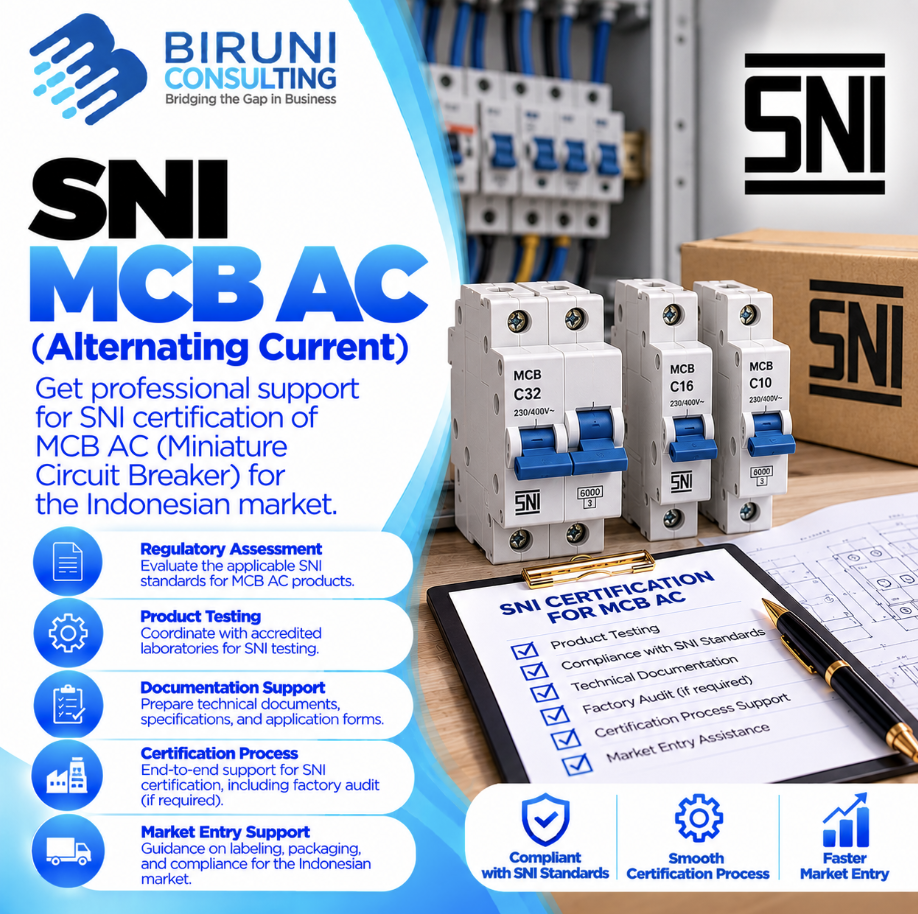
Guide to Standards, Certification, Testing, HS Code, NPB, and Requirements for AC Miniature Circuit Breakers
An AC MCB or Miniature Circuit Breaker for Alternating Current is an overcurrent protection device designed to automatically disconnect a circuit when an overload or short circuit occurs in an alternating-current electrical installation. These products are commonly used in houses, apartments, commercial buildings, distribution panels, light industrial installations, and low-voltage generating systems.
For AC MCBs used in household and similar installations, the currently active Indonesian standard is SNI 8528-1:2022 – Electrical accessories – Circuit-breakers for overcurrent protection for household and similar installations – Part 1: Circuit-breakers for AC operation, which adopts IEC 60898-1:2019 with modifications. BSN currently lists SNI 8528-1:2022 as active. Pesta
Minister of Energy and Mineral Resources Regulation No. 7 of 2021 includes MCBs among products subject to mandatory SNI. Its annex still lists SNI 8528-1:2018, but Article 2 paragraph (4) explicitly states that products must comply with the SNI listed in the annex or the latest edition. BSN has since established SNI 8528-1:2022 as the active edition and lists SNI 8528-1:2018 as no longer active. Database Peraturan | JDIH BPK
Manufacturers and importers should therefore confirm the standard edition, product ratings, HS classification, product family, representative test samples, and certification scheme before beginning certification or mass production.
What Is an AC MCB?
An AC MCB is a circuit breaker designed to provide overcurrent protection in alternating-current systems.
When current exceeds the permitted level for a specified period, the thermal trip mechanism can disconnect the circuit. During a short circuit with a rapid increase in current, the magnetic trip mechanism can operate much faster.
MCBs are commonly installed in distribution boards using DIN rails.
Typical AC MCB characteristics include:
- Rated currents such as 2 A, 6 A, 10 A, 16 A, 20 A, 25 A, 32 A, 40 A, 50 A, and 63 A, as well as other ratings within the standard scope.
- Configurations such as 1P, 1P+N, 2P, 3P, and 4P.
- B, C, or D tripping characteristics.
- Breaking capacities such as 4.5 kA, 6 kA, 10 kA, or other declared values.
- Voltage ratings for single-phase and three-phase systems.
These characteristics should be clearly identified in the datasheet and product marking.
Is SNI Mandatory for AC MCBs?
Yes. AC MCBs falling within the scope specified by Minister of Energy and Mineral Resources Regulation No. 7 of 2021 are subject to mandatory SNI requirements.
The regulation covers overcurrent protection circuit breakers or Miniature Circuit Breakers (MCBs) used in household and similar installations, with rated voltage not exceeding 440 V between phases, rated current not exceeding 125 A, and rated short-circuit capacity not exceeding 25,000 A. JDIH ESDM
The regulation lists HS ex 8536.20.91 and ex 8536.20.99. The “ex” designation means that only goods within those tariff lines that meet the relevant description and regulatory scope are covered. JDIH ESDM
The obligation applies to domestic products as well as imported products falling within the relevant HS scope. Database Peraturan | JDIH BPK
SNI 8528-1:2022 for AC MCBs
SNI 8528-1:2022 is the active Indonesian standard for AC circuit breakers intended for household and similar installations.
It adopts IEC 60898-1:2019 with modifications and was established by BSN on June 14, 2022. Pesta
The standard is the principal reference for AC MCBs falling within the household and similar installation scope.
Product evaluation is not limited to confirming whether the breaker can switch ON and OFF. Assessment also relates to construction, terminals, tripping characteristics, temperature rise, dielectric properties, mechanical operation, endurance, and short-circuit interruption capability.
Because an MCB is a safety protection device, consistency between the tested sample and mass-produced products is particularly important.
SNI 8528-1:2018 and SNI 8528-1:2022
Companies may still encounter SNI 8528-1:2018 in older regulations and databases.
Minister of Energy and Mineral Resources Regulation No. 7 of 2021 lists SNI 8528-1:2018 in its annex, and LAMANSITU currently also displays SNI 8528-1:2018 for the MCB category. JDIH ESDM
BSN, however, lists SNI 8528-1:2018 as no longer active, while SNI 8528-1:2022 is listed as active. Pesta
Importantly, Ministerial Regulation No. 7 of 2021 states that mandatory compliance applies to the SNI listed in the annex or its latest edition. Database Peraturan | JDIH BPK
Companies should therefore confirm the edition currently implemented by the relevant certification body and laboratory before product testing begins.
Mandatory AC MCB Scope
Under Minister of Energy and Mineral Resources Regulation No. 7 of 2021, the listed MCB scope includes:
- Circuit breakers used in household and similar electrical installations.
- Rated voltage not exceeding 440 V between phases.
- Rated current not exceeding 125 A.
- Rated short-circuit capacity not exceeding 25,000 A.
- MCBs having more than one rated-current setting where changing that rating cannot be done without tools or additional equipment. JDIH ESDM
Products outside these characteristics need further assessment to determine whether they remain household-type MCBs or are more appropriately classified as industrial circuit breakers.
Household AC MCBs and Industrial Circuit Breakers Are Not Always the Same
The term “MCB” is sometimes used broadly by suppliers, but the appropriate standard depends on construction and intended use.
Circuit breakers for household and similar installations are generally associated with the IEC 60898 family.
Circuit breakers for switchgear, industrial panels, or applications with characteristics outside the IEC 60898 scope may instead fall within the IEC 60947-2 family.
The BSN catalogue continues to list standards and amendments within the SNI 04-6282.2 low-voltage switchgear and controlgear circuit-breaker family as active. Pesta
A product should therefore not be placed into the household MCB certification scheme merely because it uses a DIN-rail housing or is marketed by the supplier as a “mini circuit breaker”.
AC MCB and AC/DC MCB
An AC-only MCB needs to be distinguished from a breaker with dual AC and DC ratings.
Indonesia also has SNI 04-6507.2-2002, which explicitly covers circuit breakers for AC and DC operation. BSN currently lists this standard as active. Pesta
The existence of this standard does not mean that every AC/DC MCB automatically follows the same mandatory certification route as an AC MCB under SNI 8528-1.
Where a product carries both AC and DC ratings, the manufacturer should provide test reports and standard references supporting both operating capabilities.
Number of Poles
AC MCBs are available in single-pole and multipole configurations.
For single-phase installations, 1P, 1P+N, or 2P products may be used depending on installation design and switching requirements.
For three-phase installations, 3P and 4P products are common.
The number of poles is not merely an external housing difference. Internal contact arrangements, neutral-pole construction where applicable, mechanical linkage, and breaking behavior can differ.
Product-family assessment should therefore compare 1P, 2P, 3P, and 4P constructions rather than treating them only as different module counts.
Rated Current
Rated current is one of the principal MCB characteristics.
Products may have ratings such as 6 A, 10 A, 16 A, 20 A, 25 A, 32 A, 40 A, 50 A, 63 A, 80 A, 100 A, or 125 A where within the applicable standard scope.
Rated current does not, however, indicate the short-circuit interruption capability.
Two 16 A breakers from different product series can have different breaking capacities.
Rated current, breaking capacity, voltage rating, and tripping curve therefore need to be reviewed separately.
B, C, and D Curves
AC MCBs are commonly marketed with B, C, or D tripping characteristics.
The main difference relates to the instantaneous or magnetic trip response at different multiples of rated current.
Curve B generally operates magnetically at a lower multiple than Curve C, while Curve D is associated with applications having higher inrush currents.
Selection should not be based only on broad labels such as “residential”, “commercial”, or “industrial”.
Load characteristics, starting current, conductor protection, prospective fault current, and protection coordination need to be considered.
MCB Breaking Capacity
Breaking capacity represents the circuit breaker’s ability to safely interrupt short-circuit current under specified test conditions.
Products may carry markings such as 4.5 kA, 6 kA, 10 kA, or another rating.
This value is different from rated current.
A 32 A MCB with a 6 kA breaking capacity is designed to carry its rated current under defined conditions while also having a tested short-circuit interruption capability according to its declared 6 kA rating and applicable standard.
Breaking capacity is therefore an important consideration when selecting representative models for certification.
AC MCB Rated Voltage
An MCB needs to be used within the manufacturer’s declared voltage rating.
Products for single-phase systems may carry a 230 V AC rating, while some designs have 230/400 V or 400 V ratings depending on construction and pole arrangement.
Minister of Energy and Mineral Resources Regulation No. 7 of 2021 defines the mandatory MCB scope up to 440 V between phases. JDIH ESDM
Using a breaker outside its declared voltage rating can affect insulation performance and short-circuit interruption capability.
MCB Is Not the Same as RCCB or RCBO
MCBs, RCCBs, and RCBOs perform different protection functions.
An MCB primarily provides overcurrent protection, covering overload and short-circuit conditions.
An RCCB provides residual-current protection but does not incorporate overcurrent protection in the same way as an MCB.
An RCBO combines residual-current protection with overcurrent protection.
BSN maintains separate SNI IEC 61008 standards for RCCBs and SNI IEC 61009 standards for RCBOs, which remain separate from the MCB standard. Pesta
An RCBO should therefore not be certified or classified as an ordinary MCB simply because its enclosure and toggle appear similar.
MCBs with Additional Functions
Modern protective devices may incorporate auxiliary contacts, alarm contacts, shunt trips, under-voltage releases, remote operation, or electronic modules.
Where the base product remains an MCB, these additional functions should be identified in the product list and technical documentation.
Such variations can affect dimensions, terminals, internal wiring, electrical insulation, and product-family grouping.
Where additional functions cause the product to fall outside the household circuit-breaker scope, standard mapping should be repeated before certification.
AC MCB Testing
AC MCB testing is intended to demonstrate safe operation under normal, overload, and short-circuit conditions according to the applicable standard.
Testing may include:
- Marking, dimensions, and terminals.
- Mechanical operation and tripping characteristics.
- Temperature rise and dielectric properties.
- Overcurrent performance and endurance.
- Short-circuit breaking performance.
The tested unit needs to represent the mass-production construction.
Changes to contact materials, arc chambers, thermal elements, magnetic trip units, terminals, housing materials, or internal mechanisms after testing should be controlled.
Temperature Rise
An MCB continuously carries current during normal operation, making terminal and internal-conductor temperature rise an important safety consideration.
Terminal construction, contact resistance, conductor dimensions, materials, and tightening arrangements can affect temperature.
Changing terminal or contact materials after testing can alter thermal performance even where the external housing remains unchanged.
Critical components should therefore be controlled during mass production.
Mechanical and Electrical Endurance
MCBs need to withstand mechanical and electrical operating cycles in accordance with the applicable standard.
The toggle mechanism, springs, latches, contact systems, and arc chambers work together during opening and closing operations.
The quality of these internal components is important because the breaker is expected to continue functioning after specified operating cycles and fault conditions.
Manufacturers should identify whether different models use identical or different internal mechanisms.
AC MCB Marking
MCB markings need to provide installers and users with sufficient information regarding permitted product use.
Relevant information commonly includes brand, model, rated current, rated voltage, tripping characteristic, breaking capacity, frequency, number of poles, and applicable standard reference.
For example, a marking such as C16 normally indicates a C characteristic and a 16 A rated current, but this marking alone is not sufficient. Rated voltage and breaking capacity still need to be identified from the product or technical documentation.
Products marketed in Indonesia also need to follow applicable certification marking and SNI/Safety Mark requirements.
AC MCB Product Family
A manufacturer may offer one MCB series with dozens of combinations.
The series may include ratings from 6 A to 63 A, B, C, and D characteristics, and 1P, 2P, 3P, and 4P configurations.
Product-family assessment needs to determine whether these variations use the same internal construction or whether particular current ranges use different designs.
Relevant characteristics can include contact systems, arc chambers, thermal elements, magnetic mechanisms, terminals, housings, rated voltage, breaking capacity, tripping curves, and number of poles.
Representative test models are then selected according to the certification scheme and the most appropriate or critical configurations.
One Housing Does Not Necessarily Mean One Product Family
A common mistake is assuming that all models using the same external housing can be included in one certificate.
Manufacturers may use identical cases for breakers from 6 A to 63 A while using different thermal elements or magnetic coils internally.
A 6 kA and 10 kA series may also use different arc chambers or contact systems.
Likewise, a 1P model and a 4P model can have different mechanical arrangements.
Product families therefore need to be based on technical construction rather than catalogue photographs alone.
HS Code for AC MCBs
LAMANSITU currently lists the Overcurrent Protection Circuit Breaker (Miniature Circuit Breaker/MCB) category under:
- 85362091
- 85362099
The same page currently lists SNI 8528-1:2018 and NPB as quality-policy requirements. Laman Situ
Minister of Energy and Mineral Resources Regulation No. 7 of 2021 uses ex 8536.20.91 and ex 8536.20.99 for the mandatory MCB scope. JDIH ESDM
Because the regulation uses the term “ex”, the HS classification needs to be read together with the technical description of the product. Not every circuit breaker within those tariff lines automatically falls under the SNI 8528-1 MCB scope.
NPB for AC MCBs
In addition to SNI certification, the Goods Registration Number or NPB needs to be considered for MCBs falling within the Ministry of Trade quality-policy scope.
LAMANSITU currently lists NPB for the MCB category under HS Codes 85362091 and 85362099. Laman Situ
Companies importing or marketing MCBs within this scope should therefore ensure that compliance does not end with SNI certification.
Product classification, HS Code, SNI certificate, brand, models, and company information should remain consistent for the applicable registration process.
Imported AC MCBs
Imported AC MCBs falling within Minister of Energy and Mineral Resources Regulation No. 7 of 2021 remain subject to mandatory SNI because the regulation applies to imported products under the relevant HS classifications. Database Peraturan | JDIH BPK
Importers should request technical documentation from manufacturers before shipment.
Documentation may include datasheets, model lists, internal-construction information, label artwork, product photographs, existing IEC 60898-1 or CB reports, factory information, and critical-component lists.
Existing IEC reports may assist with initial assessment, but their acceptance and use remain subject to the applicable Indonesian SNI certification scheme and conformity-assessment requirements.
Documents to Prepare
Before certification, companies should prepare documentation clearly describing the entire MCB series.
Documents may include product catalogues, datasheets, model lists, label artwork, technical drawings, product photographs, internal-component information, and available test reports.
Important technical information should include:
- Rated voltage, rated current, frequency, and number of poles.
- Tripping curve or characteristic.
- Breaking capacity.
- Applicable IEC/SNI standard.
- Model, brand, manufacturer, and factory.
Complete documentation helps determine product-family grouping and representative samples before testing.
AC MCB SNI Certification
The certification process should begin with product assessment and standard mapping.
Models and ratings are reviewed to confirm that they fall within the household and similar AC MCB scope.
Product-family grouping, representative-sample selection, manufacturer documentation, and laboratory testing can then be prepared.
Depending on the applicable certification scheme, production evaluation or factory audit may also be required.
After certification requirements are fulfilled and a certificate is issued, applicable conformity marking and NPB registration should also be completed where required.
Component Changes After Certification
MCB performance depends heavily on internal construction.
Changes to thermal bimetals, magnetic coils, contact materials, arc chambers, terminals, springs, or housing materials can affect tripping performance and breaking capacity.
Suppliers should therefore not substitute components solely because of cost or availability without conducting an appropriate change assessment.
Importers or certificate holders should maintain approved component lists and production change-control procedures.
PUIL and MCB Selection
Electrical installations also have requirements concerning overcurrent protection in addition to the product standard for the MCB itself.
BSN currently lists SNI 0225-4-43:2020 – PUIL 2020 Part 4-43: Protection for safety – Protection against overcurrent as active. Pesta
PUIL is an installation standard and does not replace the MCB product standard.
The MCB therefore needs to comply with its applicable product standard, while its selection and application within an installation need to match the characteristics and protection requirements of that installation.
Mistakes to Avoid
One mistake is assuming that every modular DIN-rail breaker automatically belongs to the SNI 8528-1 MCB category.
Another is continuing to use SNI 8528-1:2018 as the sole reference without recognizing that BSN has established SNI 8528-1:2022 as the active edition and Ministerial Regulation No. 7 of 2021 explicitly accommodates the latest edition. Database Peraturan | JDIH BPK
Another mistake is grouping all current ratings and breaking capacities within one family solely because the external housing is identical.
For imported products, HS Code and NPB requirements should also be reviewed before goods are produced and shipped rather than after arrival.
Why Is AC MCB Assessment Important?
An MCB is one of the main protective components in an electrical installation.
If a breaker fails to trip during overload or fails to interrupt a short circuit, the risk of overheating, installation damage, or fire can increase.
Assessment should therefore focus not only on obtaining certification but also on confirming that ratings, construction, breaking capacity, tripping characteristics, standards, and intended use are appropriate.
Pre-certification assessment also helps determine whether the product is a household MCB based on IEC 60898-1, an AC/DC breaker, RCCB, RCBO, or an industrial circuit breaker based on another standard family.
Contact Us
Biruni Consulting assists companies with AC MCB (Alternating Current) SNI assessment and certification, including standard identification, HS Code review, product family assessment, testing, and certification assistance.
Our services include:
- Consultation on AC MCB SNI requirements and mandatory-SNI scope.
- Review of SNI 8528-1:2022, IEC 60898-1, product specifications, and existing test reports.
- Review of HS Code, rated voltage, rated current, breaking capacity, tripping curve, and number of poles.
- Identification of household MCBs, AC/DC MCBs, RCCBs, RCBOs, and industrial circuit breakers.
- Product family assessment and representative-model selection for testing.
- Testing, factory-audit or production-evaluation assistance where required, SNI certification, and NPB assessment.
Contact Biruni Consulting for information regarding AC MCB SNI certification, SNI 8528-1:2022, Miniature Circuit Breaker certification, MCB testing, MCB NPB, and MCB requirements in Indonesia according to your product’s brand, model, rated voltage, rated current, breaking capacity, tripping curve, number of poles, HS Code, and country of origin.