
Understanding SDPPI Certification and Its Transition to DJID Certification
SDPPI Certification refers to the telecommunications equipment certification process that was previously administered by the Directorate General of Resources and Equipment of Post and Information Technology (SDPPI) under Indonesia’s Ministry of Communication and Informatics (Kominfo). The certification was established to ensure that telecommunications equipment complies with Indonesian technical regulations, operates safely, maintains compatibility with public telecommunications networks, and does not cause harmful interference to the country’s radio frequency spectrum.
Today, the responsibility for telecommunications equipment certification has been transferred to the Directorate General of Digital Infrastructure (DJID) under the Ministry of Communication and Digital Affairs (Komdigi). Although the official authority has changed, the term SDPPI Certification remains widely recognized throughout the telecommunications industry. Manufacturers, importers, distributors, testing laboratories, and regulatory consultants continue to use the term because it has long been associated with Indonesia’s telecommunications certification system.
Companies planning to import, manufacture, or distribute telecommunications equipment in Indonesia should understand the SDPPI certification process and its current implementation under DJID. Obtaining certification is not only a legal obligation but also demonstrates that a product has met Indonesian technical standards and is approved for commercial distribution.
What Is SDPPI Certification?
SDPPI Certification is a conformity assessment process designed to verify that telecommunications equipment complies with Indonesia’s applicable technical standards before entering the local market.
During the certification process, technical documentation is evaluated, product specifications are reviewed, and laboratory testing is conducted to confirm that the equipment performs according to regulatory requirements. Once all technical and administrative requirements have been successfully completed, an official certificate is issued.
Although the certification authority now operates under DJID, many businesses continue to refer to the process as SDPPI Certification because it remains a familiar and widely searched industry term.
Why Did SDPPI Certification Become DJID Certification?
The transition from SDPPI to DJID was part of the Indonesian government’s organizational restructuring to support the country’s digital transformation and rapidly expanding telecommunications infrastructure.
As technologies such as 5G, Internet of Things (IoT), cloud computing, artificial intelligence, fiber optic networks, and smart devices continue to develop, the government reorganized its regulatory framework to better support national digital infrastructure.
Despite this organizational change, the certification objectives remain the same. Every telecommunications device marketed in Indonesia must comply with applicable technical regulations before being legally imported, sold, or distributed.
For this reason, the terms SDPPI Certification, Postel Certification, and DJID Certification are often used interchangeably within the industry, although DJID is now the official certification authority.
Why Is SDPPI Certification Important?
SDPPI Certification plays an essential role in ensuring that telecommunications equipment marketed in Indonesia is safe, reliable, and technically compliant.
The certification process verifies that products operate correctly within Indonesia’s telecommunications infrastructure without causing radio interference or network disruption. This contributes to maintaining communication quality while protecting consumers and network operators.
For manufacturers, importers, and distributors, certification provides legal certainty and simplifies product importation, customs clearance, commercial distribution, and regulatory compliance.
Certified products also demonstrate a higher level of credibility, helping companies strengthen customer confidence and expand their business opportunities within the Indonesian market.
Telecommunications Equipment That Requires SDPPI Certification
Many telecommunications and wireless communication devices must obtain certification before they can be legally marketed in Indonesia, particularly products utilizing radio frequency technology or connecting to public telecommunications networks.
Examples include:
- Smartphones
- Tablets
- Routers
- Wireless Access Points
- Cellular Modems
- Optical Network Terminals (ONT)
- Optical Network Units (ONU)
- WiFi-enabled Laptops
- Smart TVs
- Wireless Keyboards
- Wireless Mice
- WiFi CCTV Cameras
- Bluetooth Devices
- Internet of Things (IoT) Devices
- Two-way Radios
- VSAT Equipment
- Base Stations
- Other Telecommunications Equipment
The certification scope may vary depending on the product’s communication technology and applicable Indonesian regulations.
SDPPI Certification Requirements
Before submitting a certification application, companies should prepare both technical and administrative documentation required during the evaluation process.
Typical documentation includes:
- Company legal documents
- Business Identification Number (NIB)
- Product technical specifications
- User Manual
- Product Datasheet
- Product Label
- Product Photographs
- Accredited Laboratory Test Reports
- Additional supporting documents required by applicable regulations
Well-prepared documentation significantly improves certification efficiency and minimizes unnecessary revisions during the application process.
SDPPI Certification Process
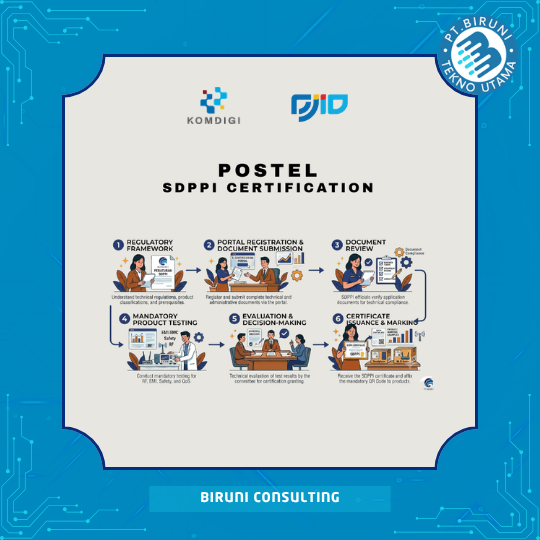
The certification process begins by identifying the equipment category and determining the applicable Indonesian technical regulations.
Following document verification, the product undergoes laboratory testing according to its communication technology and technical characteristics. Testing may include Radio Frequency (RF), Electromagnetic Compatibility (EMC), WiFi, Bluetooth, Cellular Communication, Electrical Safety, and other relevant technical evaluations.
After successfully completing both technical assessment and administrative review, DJID issues the official certification authorizing the product for legal distribution throughout Indonesia.
Common Challenges During Certification
Many companies experience delays because they are unfamiliar with Indonesian telecommunications regulations or submit incomplete documentation.
Common challenges include:
- Incomplete technical documentation.
- Incorrect equipment classification.
- Product specification changes during certification.
- Wireless communication modules requiring additional evaluation.
- Laboratory test reports that do not satisfy applicable requirements.
- Limited understanding of current DJID regulations.
Preparing documentation carefully and understanding applicable regulations before submission can significantly reduce certification time and improve approval success.
Contact Us
Biruni Consulting provides professional consulting services for DJID certification covering a wide range of telecommunications equipment in Indonesia.
We assist companies with:
- Telecommunications regulatory analysis.
- Identification of applicable DJID certification requirements.
- Preparation of technical and administrative documentation.
- Coordination with accredited testing laboratories.
- End-to-end certification assistance until the certificate is issued.
With extensive experience in Indonesian telecommunications regulations and product certification, our team helps manufacturers, importers, and distributors complete the certification process efficiently while ensuring full regulatory compliance.
Contact us today for professional consultation regarding DJID certification and telecommunications equipment approval requirements in Indonesia