
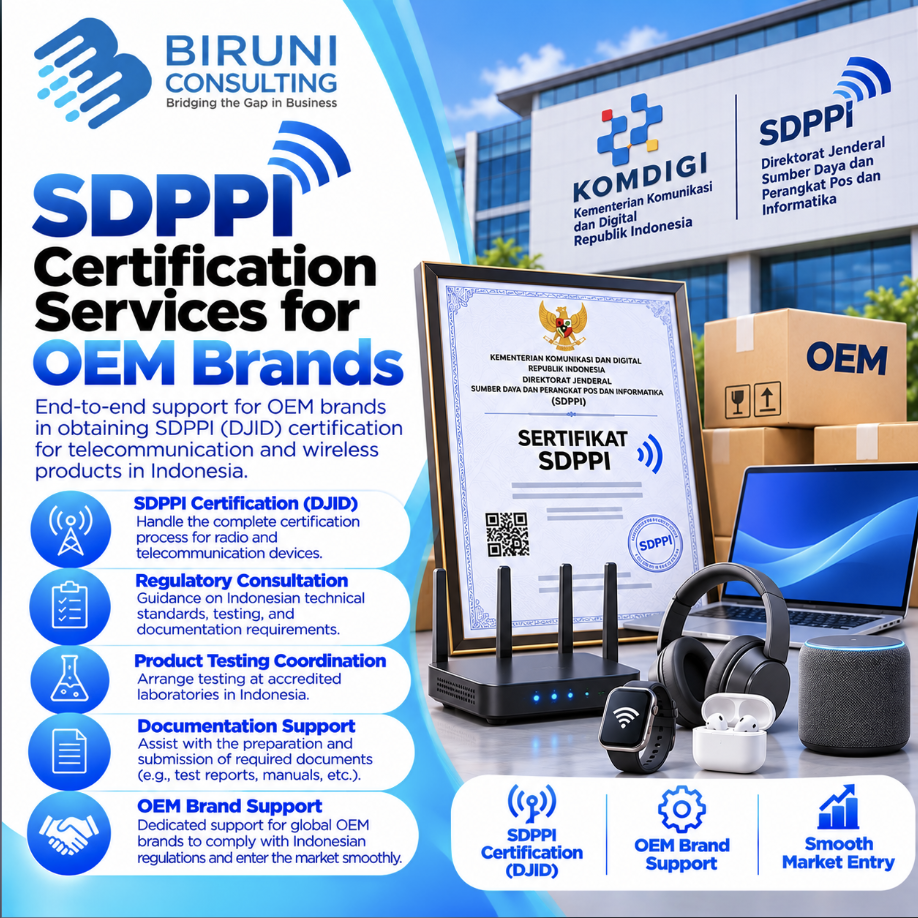
DJID/SDPPI certification services for OEM, private-label, and own-brand wireless products in Indonesia
The OEM (Original Equipment Manufacturer) model allows businesses to market wireless products under their own brands while manufacturing is carried out by another company. This arrangement is common for Bluetooth devices, routers, IoT products, smart devices, computer peripherals, printers, wireless toys, and many other electronic products.
For Indonesian DJID/SDPPI Certification, an OEM project involves more than RF specifications. The relationship between the brand owner, OEM manufacturer, Indonesian applicant, product model, manufacturing country, and laboratory reports should be established clearly.
Regulation Number 3 of 2024 allows several categories of business applicants, including Indonesian registered trademark holders, representatives or distributors of trademark holders, manufacturers or assemblers working for trademark holders, and manufacturers or assemblers themselves. JDIH Komdigi
Understanding the OEM Structure
One OEM factory may manufacture technically similar hardware for several customers.
For example, Factory A could manufacture the same basic Bluetooth device for Brand X, Brand Y, and Brand Z.
The PCB, radio module, antenna, enclosure, and firmware could be very similar.
However, technical similarity does not automatically mean that one brand’s DJID Certificate can be used for every other brand.
Indonesia’s certification framework connects conformity with the brand and equipment type, and also requires separate certification where the same brand and type originate from different manufacturing countries. JDIH Komdigi
OEM and Private-Label Products
Private-label projects often begin with an existing manufacturer product that is rebranded for a customer.
More extensive OEM projects may involve customised PCBs, wireless modules, antennas, firmware, features, or enclosures.
The greater the technical changes, the more important it becomes to verify that existing RF test reports remain representative of the final commercial product.
Certification planning should therefore begin before final production specifications are frozen.
Who Can Apply for Certification?
Current rules recognise several business-applicant categories, including:
- An Indonesian registered trademark holder.
- A representative or distributor appointed by the trademark holder.
- A manufacturer or assembler working for the trademark holder.
- A manufacturer or assembler.
- A business using equipment for its own purposes.
The current e-Sertifikasi portal lists these same categories. JDIH Komdigi
For an OEM project, the applicant structure should ideally be established before testing and submission.
Indonesian-Owned Private-Label Brands
Where an Indonesian company owns the brand under which the OEM product will be marketed, trademark documentation becomes relevant.
The current e-Sertifikasi requirements state that applications submitted by an Indonesian legal entity acting as the brand owner require documentation demonstrating compliance with applicable trademark-ownership requirements. e-Sertifikasi NextGen
The brand displayed on the final product should therefore be consistent with the application, product photographs, technical documentation, and relevant brand records.
Foreign Brand Owners
A different arrangement applies where the trademark owner is located outside Indonesia.
An Indonesian company can apply as an officially appointed representative or distributor of the overseas brand owner.
Current e-Sertifikasi requirements specify an appointment letter from the brand owner for this applicant structure. e-Sertifikasi NextGen
The commercial relationship should therefore be documented clearly before a Certificate application is submitted.
Manufacturer and Brand Owner Can Be Different
The OEM manufacturer and trademark owner do not need to be the same business.
A typical structure could be:
Brand: ABC
Brand Owner: PT ABC Indonesia
Manufacturer: XYZ Electronics Co., Ltd.
Country of Manufacture: China
The key issue is consistency throughout the certification documentation.
Manufacturer details in technical specifications, laboratory reports, product documentation, and factory information should not conflict without an appropriate explanation.
A DJID Certificate Is Not Trademark Ownership Evidence
Regulation Number 3 of 2024 expressly provides that the telecommunications Certificate is not evidence of trademark ownership and is not evidence of appointment as an equipment agent. JDIH Komdigi
The Certificate demonstrates conformity of the equipment with the applicable Technical Standards.
Trademark rights and commercial appointments between a manufacturer, brand owner, representative, and distributor remain separate matters.
Can the OEM Manufacturer’s Existing Certificate Be Used?
It should not automatically be assumed that it can.
Suppose the manufacturer holds a Certificate for:
Brand: FactoryBrand
Model: BT-100
The Indonesian customer then sells the same hardware as:
Brand: IndonesiaBrand
Model: IB-100
Even if the electronics are identical, the final commercial brand and model have changed.
Because Indonesian certification is tied to equipment brand and type, the private-label product needs to be assessed according to its own final identification. JDIH Komdigi
Using the OEM Factory’s RF Test Reports
OEM manufacturers frequently already hold CE, FCC, ETSI, Bluetooth, WiFi, cellular, or other RF laboratory documentation.
These reports can be valuable for an Indonesian certification project.
However, they should be checked against the actual hardware, module or chipset, operating frequencies, transmission power, antennas, firmware, tested model, and issuing laboratory.
Current e-Sertifikasi requirements require an LHU/test report from a designated Indonesian laboratory or a recognised overseas laboratory. e-Sertifikasi NextGen
An existing international RF report therefore needs to be assessed rather than assumed to be automatically acceptable.
Different Model Names on Reports
A common OEM issue is that the laboratory report uses the manufacturer’s internal model while the final private-label product uses another model number.
For example:
Tested model: OEM-2401
Final model: ABC-W01
The technical relationship between those products should be established before certification.
If the module, PCB, antenna, firmware, or RF settings have changed significantly, the original report may no longer represent the final commercial product adequately.
Model mapping is therefore an important part of an OEM certification project.
Module Test Reports for OEM Products
OEM devices often use wireless modules for which laboratory reports already exist.
Current e-Sertifikasi rules for equipment using a module LHU require a block diagram, a photograph showing the installed module, and a declaration identifying the module brand/type and the brand, type, and variant of the final equipment. e-Sertifikasi NextGen
Using a tested module therefore does not eliminate the need to connect that module clearly to the final OEM product.
Component Changes After Certification
One of the major risks in OEM manufacturing is component substitution.
A factory may replace a Bluetooth module, WiFi chipset, RF PCB, or antenna because of component availability without changing the commercial model number.
The product may look identical while its RF characteristics have changed.
Brand owners and importers should therefore establish change-control procedures with the OEM manufacturer.
RF-critical components should not be changed without prior technical and regulatory assessment.
Same Brand and Model from Different Countries
Manufacturing origin also matters.
Regulation Number 3 of 2024 provides that the same brand and type originating from a different country requires separate evidence of conformity through a different Certificate. JDIH Komdigi
For example:
Brand: ABC
Model: X100
Manufacturing country: China
and:
Brand: ABC
Model: X100
Manufacturing country: Vietnam
should not automatically be treated as one certification configuration.
This is particularly relevant where a brand owner uses several OEM factories internationally.
Basic Documents for an OEM Certification Project
An initial assessment should generally include:
- Final-product photographs showing the private-label brand.
- Exact brand and model/type.
- Product datasheet.
- User manual.
- Manufacturer and factory information.
- Country of manufacture.
- Wireless/RF specifications.
- Module datasheets.
- RF test reports.
- Antenna information.
- Trademark or appointment documentation according to the applicant structure.
Current e-Sertifikasi requirements also include NIB and OSS access, laboratory reports, technical specifications, a Declaration of Conformity, photographs displaying the brand and model/type, and a declaration concerning the accuracy and completeness of the application. e-Sertifikasi NextGen
Brand and Model Consistency
Consistency is particularly important for OEM products.
The brand and model may appear on the product label, packaging, datasheet, manual, Declaration of Conformity, application, photographs, and Certificate.
The current e-Sertifikasi process specifically requires colour photographs showing the brand and model/type. e-Sertifikasi NextGen
It is therefore preferable to finalise the commercial brand and model before mass-production labels are printed.
One OEM Factory Supplying Multiple Brands
One manufacturer may supply technically identical equipment to several customers.
However, this does not automatically mean that a Certificate belonging to Brand A can be used for Brand B.
The final commercial brand and type remain important certification identifiers.
A shared factory, PCB, or wireless module does not by itself make two private-label brands a single certification identity.
Multiple Models in an OEM Product Family
An OEM manufacturer may also offer multiple products based on one technical platform.
Potential model grouping should therefore compare the wireless module, frequencies, transmission power, antennas, PCBs, firmware, and telecommunications functions.
Regulation Number 3 of 2024 contains a specific mechanism for certain devices below 10 mW having only one identical telecommunications feature that can allow multiple qualifying variants under one Certificate.
This is a variant-coverage mechanism, not a general certification exemption. JDIH Komdigi
Our SDPPI Certification Process for OEM Brands
The process should ideally begin before a mass-production purchase order is placed.
The initial assessment identifies the applicant structure, trademark ownership, brand owner, OEM manufacturer, manufacturing country, exact model, and wireless technologies.
RF specifications, laboratory reports, modules, antennas, firmware, and applicable Technical Standards are then reviewed.
Where additional testing is required, it can be coordinated before the certification application is completed.
Current business applications for new Certificates are submitted online through OSS and e-Sertifikasi NextGen. e-Sertifikasi NextGen
Labeling After Certification
Certificate holders are also responsible for regulatory marking.
The current e-Sertifikasi portal requires implementation of the relevant Label, QR Code, and Warning Sign and requires reporting of their implementation within 30 working days after Certificate issuance. e-Sertifikasi NextGen
For OEM products, certification marking should therefore be incorporated into controlled label and packaging artwork before mass production.
Certificate Period and Long-Term OEM Production
Under Regulation Number 3 of 2024, the Certificate itself is not time-limited.
However, the Certificate holder may manufacture, assemble, or import the equipment for trade and/or use in Indonesia for a maximum of three years from the Certificate issuance date. Continued commercial activity after that period requires renewed Technical Standard conformity and a new Certificate under the applicable rules. JDIH Komdigi
This should be included in long-term regulatory planning for OEM product lines.
Why Pre-Production Assessment Matters
Certification issues become more difficult when discovered after thousands of private-label units have already been manufactured.
A product may already carry a model number that differs from the laboratory report, use a changed wireless module, or show a brand that does not match the applicant structure.
A pre-production assessment helps establish the chain:
final brand → final model → applicant → OEM manufacturer → country of manufacture → RF configuration → laboratory report → certification strategy.
Establishing this chain before production can significantly reduce rework and regulatory risk.
Conclusion
SDPPI/DJID Certification services for OEM brands require assessment of both the commercial brand structure and the technical product configuration.
An overseas OEM manufacturer may produce equipment that is sold under an Indonesian company’s own brand. Current regulations allow several applicant structures, including registered trademark holders, appointed representatives/distributors, and manufacturers or assemblers. JDIH Komdigi
An Indonesian trademark owner needs to consider the applicable trademark documentation, while an Indonesian company acting as an official representative or distributor of a foreign trademark owner needs the appropriate appointment documentation. e-Sertifikasi NextGen
The final brand, model, manufacturer, manufacturing country, wireless modules, antennas, RF configuration, and laboratory reports should all be reviewed before mass production.
Early technical and administrative assessment helps reduce the risk of changing product labels, models, reports, or commercial shipments after production has already started.
Contact Us
Biruni Consulting assists with DJID/SDPPI assessment and certification for OEM/private-label products and various wireless products that will be imported or marketed in Indonesia.
Our services include:
- Assessment of DJID/SDPPI certification requirements.
- Transmitter and receiver assessment.
- RF specification review.
- Frequency and transmission power analysis.
- Technical document review.
- Certification document preparation.
- Testing coordination where required.
- DJID/SDPPI Certification assistance.
If you have an OEM/private-label product, you can prepare product photos, brand, model, datasheet, RF specifications, and wireless module datasheet for an initial assessment of the Postel Certification requirements.