
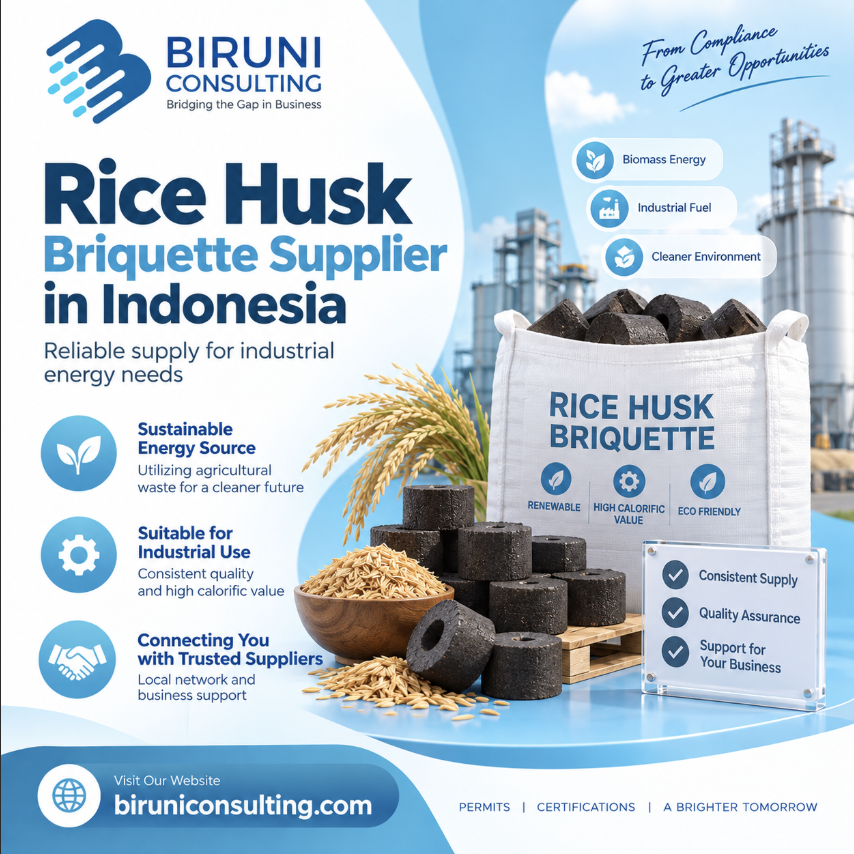
Rice Husk Briquettes as Industrial Biomass Fuel
Rice husk is an agricultural residue that can be utilized as solid fuel through processing and compaction. With proper processing, rice husk can be formed into briquettes that are easier to handle, store, and use as fuel for industrial applications.
The use of rice husk briquettes can be considered by companies that require biomass fuel for production processes, heating, drying, and other thermal applications. The compact form of briquettes also makes the material more practical for transportation and storage compared with loose rice husk.
For industries that consume large quantities of fuel, selecting the right supplier is an important factor. A supplier must not only be able to provide the required quantity but should also be capable of maintaining consistent quality, specifications, availability, and delivery arrangements according to the customer’s operational requirements.
Industrial Requirements for Rice Husk Briquettes
Biomass fuel requirements can differ from one industry to another. Differences in boilers, furnaces, dryers, burners, or heating systems can result in different fuel specifications being required.
Therefore, before purchasing in large quantities, companies should determine the briquette characteristics that are suitable for their combustion system. Several parameters that may need to be considered include moisture content, ash content, calorific value, briquette size and shape, density, and the ability of the briquettes to produce heat consistently.
Product consistency is also important for industrial applications. Briquettes with relatively consistent specifications can help companies manage the combustion process and reduce changes in fuel characteristics during production activities.
Rice Husk Briquette Specifications to Consider
When selecting a rice husk briquette supplier, companies can request complete technical product information. This information is required to determine whether the briquettes are compatible with the machinery and production processes being used.
1. Calorific Value
Calorific value indicates the amount of heat energy that can be generated from briquette combustion. This parameter is important for industries because it is related to energy requirements for heating or drying processes.
The supplier should ideally be able to provide information regarding the calorific value based on product testing or product specifications. The company can then compare this information with the requirements of its existing combustion system.
2. Moisture Content
Moisture content can affect the combustion characteristics of briquettes. Products with higher moisture content may require additional energy to evaporate the water during combustion.
Therefore, information regarding moisture content should be considered, particularly by industries that require stable and continuous combustion processes.
3. Ash Content
Briquettes made from rice husk can produce ash after combustion. The amount of ash should be considered because it can affect equipment cleaning frequency and the management of combustion residues.
Industries can request ash-content data as part of their technical evaluation before selecting the type of briquette to be used.
4. Briquette Size and Shape
The size and shape of briquettes should be compatible with the fuel feeding system used by industrial equipment. Manual combustion systems, conveyors, hoppers, and automatic feeding systems may have different material-size requirements.
An experienced supplier should be able to provide product size or specification options that correspond to the customer’s requirements.
5. Briquette Density and Strength
Briquettes should have a sufficiently strong structure so that they do not easily break during packaging, storage, transportation, and transfer into the combustion system.
Product density is also one of the characteristics that can be considered because it is related to the physical form and handling of the fuel during use.
Rice Husk Briquette Supplier for Production Requirements
For industrial requirements, purchasing rice husk briquettes usually involves more than considering the price per kilogram. Companies should also evaluate the supplier’s ability to provide products continuously.
Supply availability becomes important when briquettes are used as part of routine production activities. Supply disruptions may affect operations if the company does not have alternative fuel sources or sufficient inventory.
Therefore, companies can evaluate suppliers based on several aspects, including production capacity, specification consistency, delivery capacity, packaging quality, ability to fulfill order volumes, and delivery punctuality.
For long-term contracts, companies can also discuss monthly requirements, delivery schedules, product specifications, packaging methods, and quality inspection requirements before shipment.
Rice Husk Briquette Applications in Various Industries
Rice husk briquettes can be considered for various industrial activities that require solid biomass fuel. Their applications may differ depending on the characteristics of the machinery and production process.
Examples of sectors that may use biomass fuel include food-processing industries, agricultural-product drying, wood-processing industries, certain manufacturing activities, and production operations using boilers or heating systems.
Before use, companies should ensure that the briquette characteristics are compatible with the equipment design. Replacing one fuel type with rice husk briquettes without evaluating the combustion system may affect equipment performance and production processes.
Advantages of Choosing a Local Indonesian Supplier
Choosing a rice husk briquette supplier in Indonesia can provide supply-chain advantages, particularly for companies operating domestically.
Local suppliers can help companies obtain fuel through distribution channels that are more suitable for their operating locations. Communication regarding specifications, order volumes, delivery schedules, and technical requirements can also be handled more directly.
Indonesia also has rice husk resources from various rice-producing regions. The availability of these raw materials can support the development of biomass fuel supplies for industrial requirements.
However, companies should still evaluate the supplier’s quality and capacity before establishing large-scale cooperation. The availability of raw materials does not automatically mean that every supplier can provide briquettes with the same specifications and volume consistently.
Information to Request from a Rice Husk Briquette Supplier
Before placing an order, companies can request several basic pieces of information from the supplier to ensure that the product is suitable for their industrial requirements.
- Complete rice husk briquette specifications.
- Product calorific value.
- Moisture and ash content.
- Briquette size and shape.
- Supplier production capacity.
- Minimum order quantity or MOQ.
- Packaging type and size.
- Monthly supply capacity.
- Delivery areas and methods.
- Availability of samples for initial testing.
This information can be used by purchasing, engineering, production, and quality control teams to conduct an evaluation before the product is used routinely.
Procuring Rice Husk Briquettes for Industrial Use
Biomass fuel procurement should consider both technical and operational requirements. Briquettes with a competitive price but unsuitable combustion characteristics may create additional costs during use.
On the other hand, a product with suitable specifications but inconsistent supply may also create problems for production continuity. Therefore, supplier evaluation should be conducted comprehensively by considering quality, capacity, price, logistics, and the ability to fulfill long-term requirements.
For companies that are transitioning from another fuel source to rice husk briquettes, using samples during the initial stage can help evaluate combustion characteristics before determining the regular purchasing volume.
Contact Us
Biruni Consulting can assist companies that require information and support regarding product requirements, documentation, and compliance processes related to product importation, marketing, or use according to business requirements in Indonesia.
The services that can be supported include:
- Consultation on product requirements for industrial needs.
- Initial assessment of product specifications and applications.
- Technical document review.
- Review of product specifications and information.
- Consultation on applicable regulatory requirements according to the product type and business activities.
- Assistance in preparing required documents.
- Consultation on certification or licensing processes when required based on the product characteristics and intended use.
Contact Biruni Consulting for information regarding product requirements, documentation, certification, and compliance needs to support business activities and product marketing in Indonesia.