
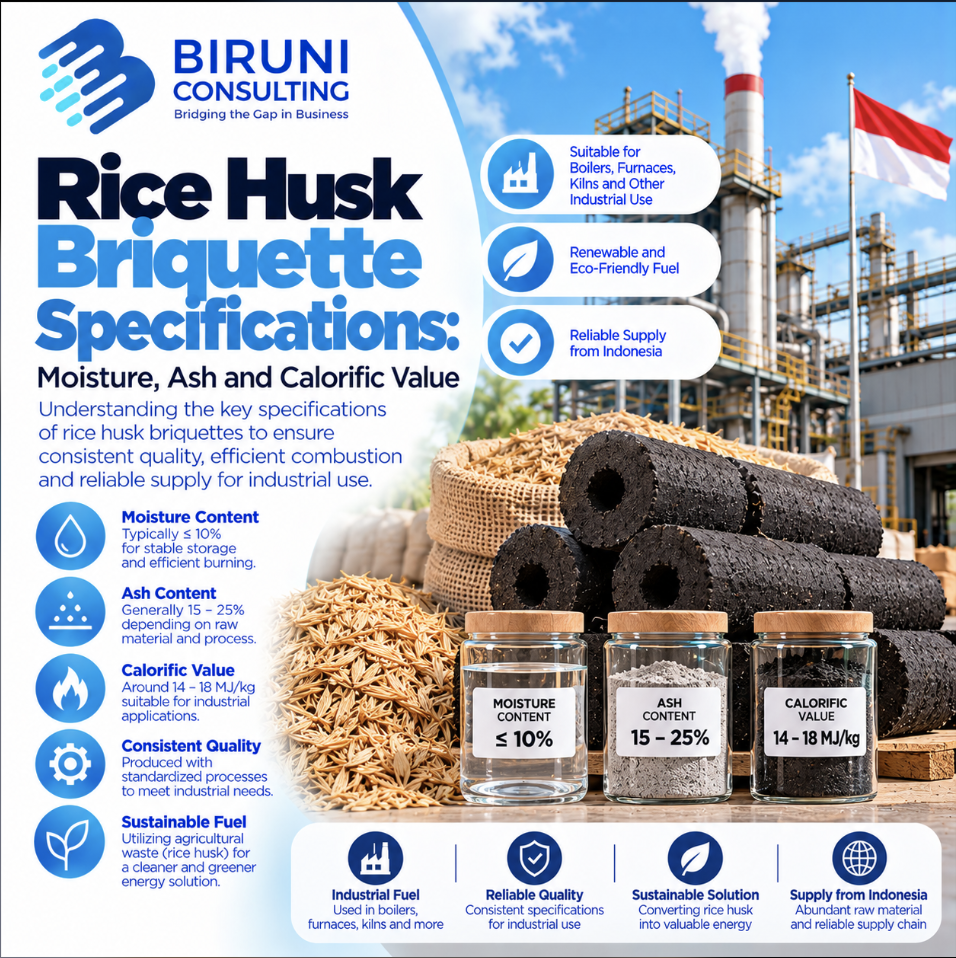
Why Are Rice Husk Briquette Specifications Important?
Rice husk briquette specifications are an important consideration before the fuel is used in boilers, furnaces, dryers, biomass burners, or other industrial thermal systems.
Two products described as rice husk briquettes do not necessarily have identical combustion characteristics.
Raw-material condition, carbonization process, binder type, binder percentage, compaction pressure, particle size, drying method, and storage conditions can all influence the final fuel properties.
Industrial buyers should therefore evaluate more than price per kilogram or metric ton.
Three of the most important parameters are moisture content, ash content, and calorific value.
Reference Specifications Used in Indonesia
SNI 01-6235-2000 for wood charcoal briquettes has been used in a number of Indonesian biomass-briquette studies as a reference for evaluating certain quality parameters.
It is important to note that this reference specifically concerns wood charcoal briquettes rather than being a dedicated standard for rice husk briquettes.
For industrial procurement, specifications should ultimately be based on product characteristics, boiler requirements, operating conditions, and agreements between the buyer and supplier.
Common reference values used in research include:
| Parameter | Common Reference |
|---|---|
| Moisture Content | Max. approximately 8% |
| Ash Content | Max. approximately 8% |
| Calorific Value | Min. approximately 5,000 cal/g |
| Volatile Matter | Max. approximately 15% under charcoal-briquette references |
| Other Parameters | According to user requirements |
These figures should be treated as reference points rather than universal specifications for every commercial rice husk briquette.
Moisture Content of Rice Husk Briquettes
Moisture content indicates how much water is contained in the briquette.
Water does not directly contribute useful thermal energy during combustion.
When fuel containing significant moisture enters the combustion chamber, part of the generated heat must first be used to heat and evaporate the water.
This can influence furnace temperature, flame stability, and the amount of heat available for the industrial process.
Research on rice husk charcoal briquettes shows that moisture levels can vary depending on formulation and processing conditions.
As an example, one study reported approximately 3.80% to 5.85% moisture content across the rice husk charcoal briquette treatments evaluated.
These values are not universal specifications. Industrial buyers should verify the actual product supplied.
Why Is Controlled Moisture Important?
Consistent moisture helps operators maintain more predictable combustion conditions.
Large variations between shipments may require changes to fuel-feeding rates and combustion-air settings.
Moisture can also change after manufacturing.
Briquettes that meet specification at the production facility can absorb additional moisture if packaging is damaged or the product is exposed to rain and high humidity.
Moisture management therefore extends beyond manufacturing and includes packaging, transportation, warehousing, and inventory management.
Ash Content of Rice Husk Briquettes
Ash content represents the mineral residue remaining after combustion.
This is particularly important for rice-husk-based biomass fuels.
Ash generation can affect ash-handling systems, furnace cleaning frequency, maintenance, and the amount of residue requiring management after combustion.
Different rice husk briquette formulations can produce different ash results.
For example, one study reported ash levels of approximately 4.55% to 6.38% for the rice husk charcoal briquettes evaluated.
Other formulations containing rice husk have produced significantly higher ash values.
This variation illustrates why ash content cannot be determined solely from the raw-material name.
Why Does Ash Matter for Industrial Boilers?
Purchasing price and calorific value are not the only factors that affect industrial fuel costs.
Ash can also contribute to operating costs.
Larger quantities of residue may require more frequent collection, cleaning, transportation, and management.
Depending on mineral composition and operating temperature, ash characteristics can also be relevant to deposit and clinker formation.
An operational boiler trial can therefore provide valuable information beyond the ash percentage shown in a laboratory report.
Calorific Value of Rice Husk Briquettes
Calorific value indicates how much thermal energy a fuel can release during combustion.
It may be expressed in:
- cal/g,
- kcal/kg,
- MJ/kg,
- or other energy units.
In simple unit conversion:
1,000 cal/g is numerically equivalent to 1,000 kcal/kg.
Therefore, a laboratory result of 5,000 cal/g can also be expressed as approximately 5,000 kcal/kg in that unit context.
Calorific value is particularly relevant for industrial applications because it can influence the amount of fuel required to generate a targeted quantity of heat or steam.
What Is the Calorific Value of Rice Husk Briquettes?
There is no single calorific value that applies to all rice husk briquettes.
Results may vary according to:
- Raw-material condition.
- Carbonization process.
- Binder type.
- Binder percentage.
- Moisture.
- Ash.
- Fixed carbon.
- Volatile matter.
- Compaction.
- Drying process.
One rice husk charcoal briquette study reported values ranging from approximately 5,045.6 to 5,519.9 cal/g, with an average of around 5,286.9 cal/g under the conditions tested.
Another study reported a value of approximately 5,242.76 cal/g for one 100% rice husk charcoal formulation.
These figures are examples from research and should not be treated as guaranteed commercial specifications.
Industrial purchasing decisions should rely on test results for the supplier’s actual product.
Relationship Between Moisture and Calorific Value
Moisture and usable thermal energy are closely related.
The more water contained in the fuel, the more energy is required to evaporate that water during combustion.
This can reduce the amount of heat effectively available for steam generation or other thermal processes.
Moisture, however, is not the only factor affecting calorific value.
Fixed carbon, volatile matter, mineral content, binder formulation, and carbonization conditions can also affect the final result.
Relationship Between Ash and Calorific Value
Ash consists of mineral material that does not generate thermal energy in the same way as combustible fuel components.
A larger mineral fraction may therefore reduce the percentage of fuel material available for energy generation.
However, the actual relationship depends on the complete composition of the briquette.
Industrial buyers should consequently request a complete analytical report rather than comparing products using calorific value alone.
Carbonized vs. Non-Carbonized Rice Husk Briquettes
The terms rice husk briquette and rice husk charcoal briquette should not automatically be considered interchangeable.
A non-carbonized briquette can be produced by drying, processing, and densifying rice husk biomass directly.
Rice husk charcoal briquettes use material that has undergone carbonization before briquetting.
Carbonization can change:
- Moisture content.
- Ash content.
- Volatile matter.
- Fixed carbon.
- Calorific value.
- Combustion characteristics.
Before comparing quotations, industrial buyers should therefore confirm whether the product is carbonized or non-carbonized.
Additional Parameters to Evaluate
Moisture, ash, and calorific value are important, but they do not provide a complete picture of industrial fuel quality.
| Parameter | Industrial Relevance |
|---|---|
| Volatile Matter | Represents components released during heating |
| Fixed Carbon | Provides information on the solid carbon fraction |
| Density | Influences storage, transportation, and feeding |
| Briquette Dimensions | Must be compatible with feeding equipment |
| Mechanical Strength | Determines resistance to breakage |
| Fines | Excessive fine material can affect feeding and handling |
| Burning Rate | Helps evaluate fuel-consumption behavior |
| Ash Behavior | Relevant to deposits, clinker, and cleaning |
Proximate Analysis
One analytical approach commonly used for solid fuels is proximate analysis.
It generally provides information about:
- Moisture content.
- Ash content.
- Volatile matter.
- Fixed carbon.
Calorific value can then be determined through appropriate calorimetric testing.
Together, these parameters provide a more complete description of a fuel than the raw-material name alone.
Two briquettes made from rice husk may produce substantially different proximate-analysis results due to differences in manufacturing.
Example Rice Husk Charcoal Briquette Test Results
As an illustration, one rice husk charcoal briquette optimization study reported the following range:
| Parameter | Research Result |
|---|---|
| Moisture Content | 3.80%–5.85% |
| Ash Content | 4.55%–6.38% |
| Calorific Value | 5,045.6–5,519.9 cal/g |
| Average Moisture | 4.97% |
| Average Ash | 5.51% |
| Average Calorific Value | 5,286.9 cal/g |
These results should be used only as an example of potential briquette characteristics.
Commercial procurement should use laboratory data from the supplier’s actual production.
Specifications for Industrial Boilers
Different boiler systems can require different fuel characteristics.
Fixed-grate, moving-grate, chain-grate, and other combustion systems may respond differently to fuel dimensions, moisture, density, ash, and combustion behavior.
Companies can establish purchasing specifications based on:
- Boiler manufacturer recommendations.
- Engineering assessment.
- Operational experience.
- Fuel trials.
- Steam requirements.
- Fuel-feeding system.
- Ash-handling system.
A company may, for example, define a maximum moisture content, maximum ash content, and minimum calorific value for supplier acceptance.
Certificate of Analysis
For industrial procurement, a Certificate of Analysis or CoA can be an important quality-control document.
A CoA may include:
- Moisture content.
- Ash content.
- Calorific value.
- Volatile matter.
- Fixed carbon.
- Density.
- Product dimensions.
- Additional agreed parameters.
Buyers should also verify the testing method and reporting basis.
This is particularly important because calorific value and other fuel parameters may be reported on an as-received, air-dried, or dry basis.
Why Does the Reporting Basis Matter?
Laboratory results can be expressed using different reporting bases.
An as-received basis represents the sample in the condition received, including moisture.
A dry basis removes moisture from the calculation.
As a result, two test values from similar materials can appear different simply because different reporting bases have been used.
When comparing suppliers, industrial buyers should ensure that technical parameters are being compared on an equivalent basis.
Conducting a Trial Before Bulk Procurement
Laboratory specifications are an important first step, but actual boiler performance depends on equipment and operating conditions.
A trial can help evaluate:
- Fuel consumption.
- Temperature stability.
- Steam production.
- Steam pressure.
- Feeding performance.
- Ash generation.
- Ash condition.
- Deposits.
- Clinker formation.
- Cleaning requirements.
- Operator adjustments.
The resulting data can help companies calculate actual fuel costs based on production output or useful thermal energy rather than simply price per kilogram.
Batch-to-Batch Consistency
Consistency is essential for recurring industrial fuel supply.
If an initial sample contains approximately 5% moisture but later deliveries contain substantially more, combustion performance may change.
The same principle applies to ash content and calorific value.
Long-term purchase arrangements can therefore establish:
- Minimum values.
- Maximum values.
- Specification tolerances.
- Sampling procedures.
- Testing methods.
- Procedures for out-of-specification products.
Quality control should continue throughout the supply period.
Storage and Its Effect on Specifications
Briquette quality can change after manufacturing if storage conditions are inappropriate.
Products should be protected from:
- rain,
- standing water,
- excessive humidity,
- damaged packaging,
- and direct contact with wet surfaces.
Moisture absorption can increase the fuel’s moisture content and potentially change combustion performance.
Quality management should therefore cover manufacturing, packaging, transportation, receiving, and storage.
Comparing Rice Husk Briquette Suppliers
Industrial procurement teams can compare suppliers using a technical table rather than price alone.
| Parameter | Supplier A | Supplier B | Supplier C |
|---|---|---|---|
| Moisture | CoA Data | CoA Data | CoA Data |
| Ash | CoA Data | CoA Data | CoA Data |
| Calorific Value | CoA Data | CoA Data | CoA Data |
| Volatile Matter | CoA Data | CoA Data | CoA Data |
| Fixed Carbon | CoA Data | CoA Data | CoA Data |
| Dimensions | Specification | Specification | Specification |
| Density | Test Result | Test Result | Test Result |
| Price/Ton | Quotation | Quotation | Quotation |
| Delivered Cost | Quotation | Quotation | Quotation |
This approach allows purchasing teams to evaluate price and quality together.
Information to Request from a Supplier
Before establishing recurring supply, industrial buyers should request:
- Confirmation of carbonized or non-carbonized product.
- Moisture content.
- Ash content.
- Calorific value.
- Reporting basis for calorific value.
- Volatile matter.
- Fixed carbon.
- Density.
- Briquette dimensions.
- Binder information where applicable.
- Certificate of Analysis.
- Monthly supply capacity.
- Packaging.
- Ex-factory quotation.
- Delivered quotation.
- Sample or trial availability.
This information helps purchasing, engineering, production, and quality-control teams evaluate whether the product is suitable for operational testing.
Contact Us
Biruni Consulting can assist companies that require information and support regarding product requirements, documentation, and compliance processes related to product importation, marketing, or use according to business requirements in Indonesia.
The services that can be supported include:
- Consultation on product requirements for industrial needs.
- Initial assessment of product specifications and applications.
- Technical document review.
- Review of product specifications and information.
- Consultation on applicable regulatory requirements according to the product type and business activities.
- Assistance in preparing required documents.
- Consultation on certification or licensing processes when required based on the product characteristics and intended use.
Contact Biruni Consulting for information regarding product requirements, documentation, certification, and compliance needs to support business activities and product marketing in Indonesia.