
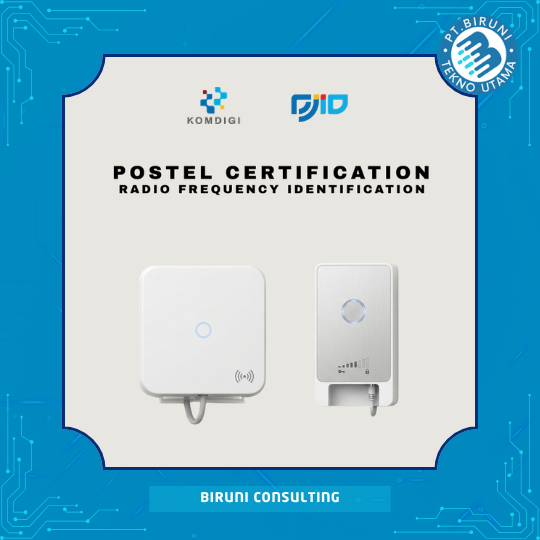
Complete Guide to RFID Postel Certification in Indonesia
Radio Frequency Identification (RFID) is an automatic identification technology that uses radio waves to transmit and receive information between RFID tags and RFID readers. RFID technology is widely implemented in logistics, manufacturing, warehousing, retail, healthcare, transportation, asset management, and access control systems because it improves operational efficiency, inventory accuracy, and business automation.
In Indonesia, RFID equipment utilizing radio frequency technology must comply with applicable telecommunications regulations before being imported, distributed, or commercially marketed. Manufacturers, importers, and distributors should therefore determine whether their RFID products require DJID (formerly Postel/SDPPI) certification based on the product’s technical specifications and operating frequency.
Obtaining the appropriate certification helps companies comply with Indonesian regulations while demonstrating that their products meet national technical standards for telecommunications equipment.
What Is RFID?
RFID (Radio Frequency Identification) is a wireless identification technology that uses electromagnetic radio waves to identify, track, and exchange data without requiring direct physical contact.
A typical RFID system consists of RFID tags, RFID readers, antennas, and software that manages communication between devices. RFID technology enables rapid and simultaneous reading of multiple tags, making it suitable for inventory management, asset tracking, electronic payment systems, warehouse automation, vehicle identification, and industrial process control.
RFID systems commonly operate within Low Frequency (LF), High Frequency (HF), or Ultra High Frequency (UHF) bands, each serving different industrial applications.
Does RFID Require DJID (Postel) Certification?
Whether RFID equipment requires DJID certification depends on its communication characteristics, operating frequency, transmission capability, and applicable Indonesian telecommunications regulations.
Products utilizing regulated radio frequency bands generally require certification before they can be legally marketed in Indonesia. Technical evaluations typically consider radio transmission parameters, antenna characteristics, operating frequency, communication functionality, and overall regulatory compliance.
Conducting regulatory analysis before product importation helps companies determine the appropriate certification pathway and avoid unnecessary delays.
RFID Certification Requirements
Companies preparing RFID certification applications typically need supporting technical and administrative documentation, including:
- Company legal documents.
- Business Identification Number (NIB).
- Technical specifications.
- User Manual.
- Product Datasheet.
- Product Label.
- Product Photographs.
- Block diagrams and circuit schematics.
- Accredited laboratory test reports where applicable.
- Additional supporting documentation required by DJID regulations.
Complete documentation contributes significantly to a faster and more efficient certification process.
RFID Certification Process
The certification process begins by identifying the product category and reviewing applicable Indonesian telecommunications regulations.
Technical documentation is evaluated before laboratory testing is conducted when required. Testing may include radio frequency performance and other applicable technical evaluations depending on the product design.
Following successful technical assessment and administrative review, DJID issues the certification authorizing legal distribution of the RFID equipment within Indonesia.
Benefits of RFID Certification
Obtaining certification provides numerous advantages for manufacturers, importers, and distributors.
Key benefits include:
- Compliance with Indonesian regulations.
- Support for import and product distribution.
- Increased customer confidence.
- Verification of technical compliance.
- Reduced regulatory risks.
- Improved market access in Indonesia.
Proper certification demonstrates a company’s commitment to quality, regulatory compliance, and product reliability.
Contact Us
Biruni Consulting provides professional consulting services for DJID (Postel) certification of RFID equipment and other telecommunications devices in Indonesia.
We assist companies with:
- RFID regulatory analysis.
- Identification of applicable DJID certification requirements.
- Preparation of technical and administrative documentation.
- Coordination with accredited testing laboratories.
- End-to-end certification assistance until approval is granted.
With extensive experience in Indonesian telecommunications certification, we help manufacturers, importers, and distributors obtain certification efficiently while ensuring full regulatory compliance.
Contact us today for professional consultation regarding RFID Postel certification and telecommunications equipment approval requirements in Indonesia