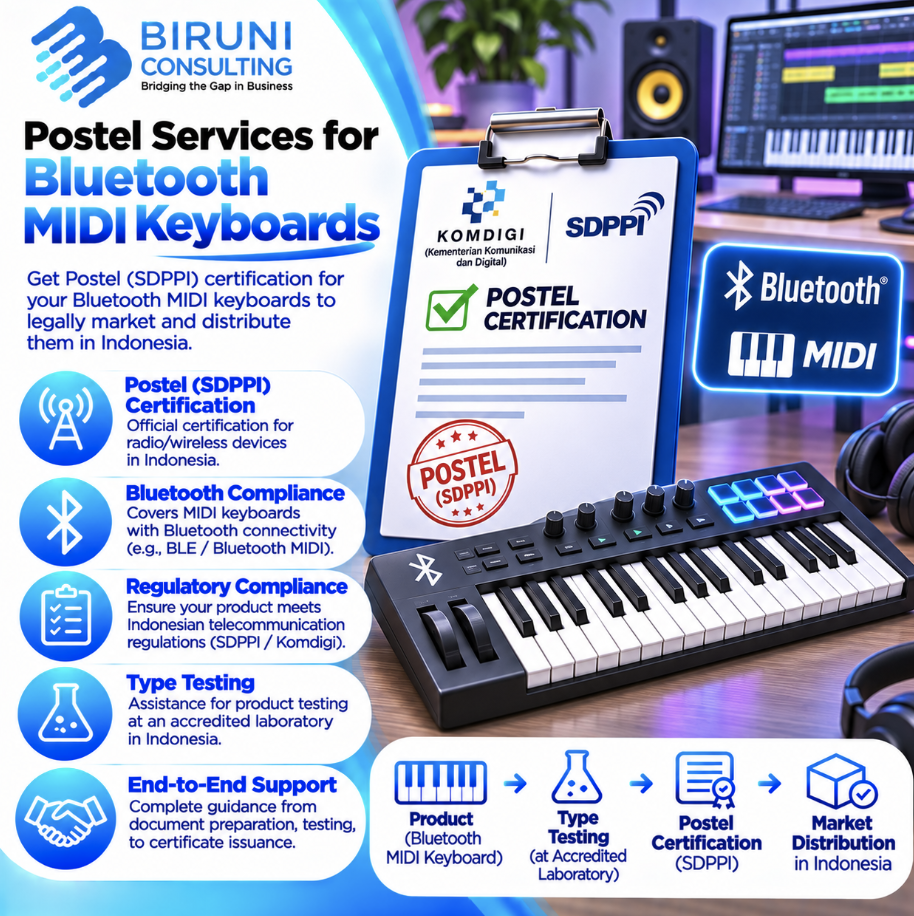
DJID/SDPPI Certification services for Bluetooth MIDI keyboards and wireless MIDI controllers in Indonesia
A Bluetooth MIDI keyboard allows musicians, producers, content creators, and studios to transmit MIDI data wirelessly to computers, tablets, smartphones, synthesizers, and Digital Audio Workstations.
Some MIDI keyboards operate only through USB or wired MIDI ports, while others include Bluetooth or several connectivity options simultaneously.
For Indonesian Postel/DJID Certification, the musical function or number of keys is not the main factor. The relevant issue is the Bluetooth radio incorporated into the equipment, including its operating frequency, transmission power, module or chipset, antenna, firmware, and RF test report.
Indonesia’s Short Range Device Technical Standard includes Bluetooth IEEE 802.15.1 and defines Bluetooth operation in the 2400–2483.5 MHz band. Conformity with the SRD Technical Standard is demonstrated through telecommunications-equipment certification. Sertifikasi Postel
USB MIDI and Bluetooth MIDI Keyboards
Not every MIDI keyboard has a wireless transmitter.
A conventional controller may use USB MIDI or wired MIDI ports only. Another version may add Bluetooth for wireless communication with a computer or mobile device.
Some models provide USB MIDI, Bluetooth MIDI, and conventional MIDI connections together.
The exact communications configuration should therefore be identified before the DJID certification scope is established.
Bluetooth MIDI
Bluetooth MIDI is widely used for mobile music production and compact MIDI controllers.
Modern implementations commonly use Bluetooth Low Energy MIDI, or BLE-MIDI, allowing MIDI controllers and keyboards to communicate wirelessly with compatible computing devices. MIDI.org
For Postel assessment, however, “Bluetooth MIDI” still needs to be translated into the actual RF configuration.
The Bluetooth version, frequencies, RF output power, antennas, wireless modules, and final firmware settings should be identified.
Bluetooth MIDI and Bluetooth Audio Are Different
MIDI data is different from audio streaming.
Bluetooth MIDI carries control information such as notes, velocity, modulation, pitch bend, and other MIDI messages rather than a conventional audio stream.
A MIDI keyboard can therefore use Bluetooth differently from a Bluetooth speaker or wireless headset.
Where a musical keyboard provides both Bluetooth MIDI and Bluetooth audio functionality, all enabled radio functions should be considered during the technical assessment.
Bluetooth and USB Connections
Many MIDI keyboards use USB for wired MIDI communication and Bluetooth for wireless operation.
The presence of USB does not remove the need to assess the Bluetooth radio where that wireless function remains enabled.
A USB-only model should therefore be distinguished from a Bluetooth version even where the enclosure, keys, pads, knobs, and controls are nearly identical.
Proprietary Wireless MIDI Connections
Some musical controllers can also use proprietary 2.4 GHz wireless adapters or USB receivers.
Where such a radio exists in addition to Bluetooth, it should be assessed separately.
Bluetooth and proprietary 2.4 GHz communication can use different modulation, bandwidth, radio modes, and transmitter configurations.
The complete wireless system therefore needs to be identified rather than reviewing only the Bluetooth interface.
Bluetooth Modules
Manufacturers may use integrated Bluetooth modules or wireless chipsets supported by existing laboratory reports.
A module report can support certification, but it does not automatically cover the final MIDI keyboard.
Current e-Sertifikasi requirements for products relying on a module LHU/test report include a block diagram, a photograph showing the module location, and a declaration connecting the module brand/type with the brand, type, and variant of the final equipment. e-Sertifikasi NextGen
The final product integration remains part of the certification assessment.
RF Test Reports
An RF test report provides technical evidence for the Bluetooth configuration actually tested.
The report can contain information about operating frequency, transmission power, modulation, bandwidth, antennas, hardware configuration, and test modes.
Current e-Sertifikasi requirements require an LHU/test report issued by a designated Indonesian laboratory or recognised overseas laboratory. New Certificate applications also require technical specifications, a Declaration of Conformity, product photographs showing brand and model/type, and other supporting documents. e-Sertifikasi NextGen
CE or FCC reports may therefore support the assessment, but their laboratory status and technical coverage still need to be reviewed.
Different Test and Commercial Models
OEM and private-label products can have a test-report model different from the commercial model.
For example:
Tested model: OEM-MK49
Commercial model: MUSIC-49BT
The technical relationship between these products should be established.
The Bluetooth module, PCB, antennas, firmware, transmission-power configuration, and manufacturing origin should be compared before the existing report is relied upon.
Antenna and Transmission Power
A Bluetooth MIDI keyboard normally uses an integrated PCB antenna, chip antenna, or similar internal antenna.
Antenna configuration should be compared with the tested equipment because it can influence the final radio characteristics.
Decision Number 260 of 2024 also contains specific requirements for SRD equipment using a dedicated antenna. Sertifikasi Postel
The Bluetooth module specification alone is therefore not sufficient to describe the complete commercial product.
Multiple Models in One MIDI Keyboard Series
One product family may include 25-key, 37-key, 49-key, 61-key, and 88-key versions.
Models may also have different pads, sliders, knobs, displays, colours, or software packages.
Potential certification grouping should not rely only on the musical features or external design.
The Bluetooth modules, RF configuration, antennas, firmware, PCB design, transmission power, model identification, and manufacturing country should be compared.
Certification Documents
For an initial assessment, businesses should prepare:
- MIDI keyboard and product-label photographs.
- Exact brand and model/type.
- Datasheet and user manual.
- Bluetooth/BLE specifications.
- Operating frequency and transmission power.
- Module or chipset datasheets.
- Antenna information.
- Block diagram.
- Available RF test reports.
Current e-Sertifikasi requirements for a new Certificate also include NIB and OSS access for business applicants, laboratory reports, technical specifications, a Declaration of Conformity, colour product photographs, and declarations concerning the accuracy and completeness of submitted information. e-Sertifikasi NextGen
Our Postel Certification Process
The process begins with a technical assessment of the exact MIDI keyboard model.
Bluetooth version, operating frequency, transmission power, wireless modules, antennas, firmware, and available RF reports are reviewed first.
Where a proprietary wireless receiver or other active radio interface is included, it is incorporated into the same wireless mapping.
Once the applicable Indonesian Technical Standards and report suitability have been established, certification documents can be prepared and additional testing coordinated where required. e-Sertifikasi NextGen
Regulatory Labeling
Certificate holders must also comply with regulatory-labeling requirements.
Regulation Number 3 of 2024 requires labeling that includes the Certificate number and PLG ID, QR Code, and Warning Sign. Labeling generally applies to the equipment and its packaging. JDIH Komdigi
MIDI keyboards normally provide sufficient space on the rear or underside of the enclosure for product and regulatory labels, so the artwork can ideally be prepared before mass production.
Certificate Period
Under Regulation Number 3 of 2024, the Certificate itself is not time-limited.
However, the Certificate holder may manufacture, assemble, or import the equipment for trade and/or use in Indonesia for up to three years from the Certificate issuance date. Continued activity after that period requires renewed conformity with the Technical Standards and a new Certificate. JDIH Komdigi
Distributors making recurring imports should therefore include the Certificate issuance date in their long-term compliance planning.
Why Pre-Import Assessment Matters
A supplier may offer USB-only and Bluetooth versions of the same MIDI keyboard under very similar product names.
Other versions can combine Bluetooth MIDI with additional proprietary wireless functions.
A pre-import assessment helps verify the exact SKU, Bluetooth configuration, module, antenna, transmission power, laboratory reports, and certification documentation before production or shipment.
This can reduce the risk of discovering that the RF documentation does not match the final commercial model after the goods have already been produced.
Conclusion
Postel services for Bluetooth MIDI keyboards help importers, distributors, and brand owners determine DJID/SDPPI Certification requirements based on the actual wireless configuration of the product.
Bluetooth MIDI should be distinguished from USB MIDI, conventional wired MIDI, Bluetooth audio, and proprietary 2.4 GHz wireless connections. Indonesia’s Short Range Device Technical Standard includes Bluetooth IEEE 802.15.1 operating in the 2400–2483.5 MHz band. Sertifikasi Postel
The technical assessment should review the exact model, Bluetooth/BLE functionality, operating frequency, transmission power, wireless modules, antennas, firmware, RF test reports, and any additional wireless accessories.
Reviewing these elements before production or importation can reduce certification risk and help ensure that the laboratory evidence corresponds to the final MIDI keyboard sold in Indonesia.
Contact Us
Biruni Consulting assists with DJID/SDPPI assessment and certification for Bluetooth MIDI keyboards and various wireless products that will be imported or marketed in Indonesia.
Our services include:
- Assessment of DJID/SDPPI certification requirements.
- Bluetooth module assessment.
- RF specification review.
- Frequency and transmission power analysis.
- Technical document review.
- Certification document preparation.
- Testing coordination where required.
- DJID/SDPPI Certification assistance.
If you have a Bluetooth MIDI keyboard, you can prepare product photos, brand, model, datasheet, RF specifications, and wireless module datasheet for an initial assessment of the Postel Certification requirements.