
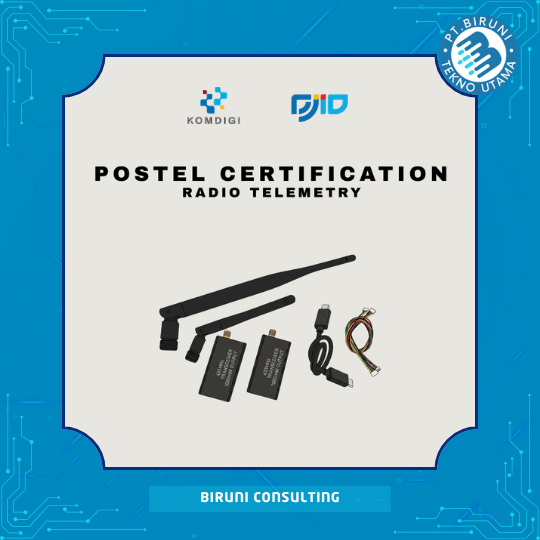
Guide to Postel Radio Telemetry Certification in Indonesia
Radio Telemetry is a communication device used to wirelessly transmit data from an object, sensor, or system to a receiving location. This technology enables information such as temperature, pressure, humidity, position, speed, machine conditions, and other operational parameters to be transmitted automatically over a certain distance.
Radio Telemetry is widely used in various sectors, including industry, agriculture, mining, energy, transportation, meteorology, water management, environmental monitoring, and Internet of Things (IoT) systems.
Because Radio Telemetry uses radio frequencies to transmit and receive data, devices intended to be imported, marketed, or distributed in Indonesia need to be assessed for DJID (formerly Postel/SDPPI) Certification based on their technology, frequency, transmission power, and technical specifications.
What Is Radio Telemetry?
Radio Telemetry is a radio communication device used to transmit data from a transmitting device to a receiving device without requiring a direct wired connection.
A Radio Telemetry system generally consists of a transmitter, receiver, antenna, sensor or data acquisition device, and data processing system. Certain systems may support two-way communication, allowing the system not only to receive field data but also to transmit commands back to field devices.
Radio Telemetry can use various radio communication technologies, ranging from basic RF systems to digital technologies designed for long-distance data communication.
Does Radio Telemetry Require DJID (Postel) Certification?
Radio Telemetry equipment that uses radio frequencies to transmit or receive data needs to be assessed for DJID (Postel) Certification before being marketed or distributed in Indonesia.
Certification requirements are not determined solely by the product name but also by the technical characteristics of the equipment. Important factors include operating frequency, bandwidth, transmission power, modulation type, communication technology, and transmitter and receiver functions.
In addition to equipment certification, the use of radio frequencies must comply with applicable spectrum utilization requirements in Indonesia.
Radio Telemetry Postel Certification Requirements
For Radio Telemetry equipment that falls within the scope of telecommunications equipment certification, companies generally need to prepare administrative and technical documentation.
The required documents may include:
- Company legal documents.
- Business Identification Number (NIB).
- Technical equipment specifications.
- Datasheet.
- User Manual.
- Equipment photographs.
- Product label and marking photographs.
- Block diagram.
- Operating frequency information.
- Bandwidth.
- Output power or transmission power.
- Modulation type.
- Antenna specifications.
- Communication technology information.
- Test reports where required.
- Additional supporting documents according to applicable DJID requirements.
Frequency and transmission power information is particularly important because Radio Telemetry uses the radio spectrum as its data communication medium.
Radio Telemetry Postel Certification Process
The certification process begins by identifying the type of Radio Telemetry and the communication technology used. The assessment covers operating frequency, bandwidth, transmission power, modulation type, transmitter and receiver configuration, and data communication characteristics.
Administrative and technical documentation is then reviewed to determine the applicable certification requirements. Where testing is required, the device may be tested at a laboratory that meets the applicable technical requirements.
Testing may include Radio Frequency (RF), operating frequency, transmission power, bandwidth, frequency stability, spurious emissions, occupied bandwidth, Electromagnetic Compatibility (EMC), and other parameters relevant to the equipment.
Once the documentation and test results meet the applicable requirements, the certification process can proceed until the certificate is issued by the relevant authority.
Benefits of Radio Telemetry Postel Certification
Meeting certification requirements provides benefits for manufacturers, importers, distributors, and brand owners of Radio Telemetry equipment.
Key benefits include:
- Supporting compliance with Indonesian telecommunications regulations.
- Supporting equipment importation.
- Ensuring the equipment meets applicable technical requirements.
- Reducing potential issues during product commercialization.
- Increasing user and distributor confidence.
- Supporting legal use and distribution in Indonesia.
Certification also helps ensure that Radio Telemetry equipment operates according to applicable technical requirements and radio spectrum regulations.
Types of Radio Telemetry Equipment That Require Certification Assessment
Examples of Radio Telemetry equipment that may require certification assessment include:
- Wireless Telemetry Radios.
- Digital Telemetry Radios.
- Analog Telemetry Radios.
- Telemetry Transmitters.
- Telemetry Receivers.
- Telemetry Transceivers.
- Industrial Telemetry Radios.
- Remote Telemetry Radios.
- IoT Telemetry Devices.
- Radio Telemetry for sensor monitoring.
Certification requirements may vary depending on communication technology, operating frequency, bandwidth, transmission power, modulation type, and device functions.
Contact Us
Biruni Consulting provides professional services to assist with DJID (Postel) Certification for various radio and telecommunications equipment, including Radio Telemetry devices.
We assist with:
- DJID (Postel) certification requirement analysis.
- Equipment classification and technology identification.
- Frequency and RF specification assessment.
- Preparation of administrative and technical documentation.
- Coordination of laboratory testing where required.
- Certification assistance until the certificate is issued.
Contact Biruni Consulting for consultation regarding Postel Radio Telemetry Certification, including telemetry transmitters, receivers, transceivers, and other wireless telemetry equipment.